2011 Seat Ibiza SC tailgate
[x] Cancel search: tailgatePage 5 of 278

Table of Contents
Manual structure . . . . . . . . . . . . . . . . . . . . 5
Content . . . . . . . . . . . . . . . . . . . . . . . . . . . . . . . . 6
Safety First . . . . . . . . . . . . . . . . . . . . . . . . . . . . 7
Safe driving . . . . . . . . . . . . . . . . . . . . . . . . . . . . . . . 7
Brief introduction . . . . . . . . . . . . . . . . . . . . . . . . . 7
Proper sitting position for occupants . . . . . . . . . 10
Pedal area . . . . . . . . . . . . . . . . . . . . . . . . . . . . . . . 16
Storing objects . . . . . . . . . . . . . . . . . . . . . . . . . . . 16
Seat belts . . . . . . . . . . . . . . . . . . . . . . . . . . . . . . . . . 18
Brief introduction . . . . . . . . . . . . . . . . . . . . . . . . . 18
Why wear seat belts? . . . . . . . . . . . . . . . . . . . . . . 20
Seat belts . . . . . . . . . . . . . . . . . . . . . . . . . . . . . . . 24
Belt tensioners* . . . . . . . . . . . . . . . . . . . . . . . . . . 27
Airbag system . . . . . . . . . . . . . . . . . . . . . . . . . . . . . 29
Brief introduction . . . . . . . . . . . . . . . . . . . . . . . . . 29
Front airbags . . . . . . . . . . . . . . . . . . . . . . . . . . . . . 33
Side airbags . . . . . . . . . . . . . . . . . . . . . . . . . . . . . 37
Deactivating airbags* . . . . . . . . . . . . . . . . . . . . . . 40
Child safety . . . . . . . . . . . . . . . . . . . . . . . . . . . . . . . 42
Brief introduction . . . . . . . . . . . . . . . . . . . . . . . . . 42
Child seats . . . . . . . . . . . . . . . . . . . . . . . . . . . . . . . 44
Securing child seats . . . . . . . . . . . . . . . . . . . . . . . 47
Operating Instructions . . . . . . . . . . . . . 51
Cockpit . . . . . . . . . . . . . . . . . . . . . . . . . . . . . . . . . . . 51
Overview . . . . . . . . . . . . . . . . . . . . . . . . . . . . . . . . 51
Instruments . . . . . . . . . . . . . . . . . . . . . . . . . . . . . . 53 LPG system* . . . . . . . . . . . . . . . . . . . . . . . . . . . . . 54
Digital instrument panel display . . . . . . . . . . . . . 55
Warning lamps . . . . . . . . . . . . . . . . . . . . . . . . . . . 61
Steering column controls* . . . . . . . . . . . . . . . . . 74
General information . . . . . . . . . . . . . . . . . . . . . . . 74
Audio Control . . . . . . . . . . . . . . . . . . . . . . . . . . . . . 75
Audio + Telephone Control . . . . . . . . . . . . . . . . . . 76
Unlocking and locking . . . . . . . . . . . . . . . . . . . . . 77
Central locking . . . . . . . . . . . . . . . . . . . . . . . . . . . 77
Keys . . . . . . . . . . . . . . . . . . . . . . . . . . . . . . . . . . . . 81
Radio frequency remote control* . . . . . . . . . . . . . 82
Anti-theft alarm system* . . . . . . . . . . . . . . . . . . . 84
Tailgate . . . . . . . . . . . . . . . . . . . . . . . . . . . . . . . . . 87
Windows . . . . . . . . . . . . . . . . . . . . . . . . . . . . . . . . 89
Panorama tilting sunroof* . . . . . . . . . . . . . . . . . . 91
Lights and visibility . . . . . . . . . . . . . . . . . . . . . . . . 94
Lights . . . . . . . . . . . . . . . . . . . . . . . . . . . . . . . . . . . 94
Interior lights . . . . . . . . . . . . . . . . . . . . . . . . . . . . . 101
Visibility . . . . . . . . . . . . . . . . . . . . . . . . . . . . . . . . . 102
Windscreen wipers . . . . . . . . . . . . . . . . . . . . . . . . 103
Rear view mirrors . . . . . . . . . . . . . . . . . . . . . . . . . . 106
Seats and storage compartments . . . . . . . . . . 110
The importance of correct seat adjustment . . . . . 110
Head restraints . . . . . . . . . . . . . . . . . . . . . . . . . . . 111
Front seats . . . . . . . . . . . . . . . . . . . . . . . . . . . . . . . 113
Rear seats . . . . . . . . . . . . . . . . . . . . . . . . . . . . . . . 115
Storage compartment . . . . . . . . . . . . . . . . . . . . . . 117
Ashtrays, cigarette lighter and power socket . . . 120
First-aid kit, warning triangle, fire extinguisher* 122
Luggage compartment . . . . . . . . . . . . . . . . . . . . . 123
Air conditioning . . . . . . . . . . . . . . . . . . . . . . . . . . . 125
Heating . . . . . . . . . . . . . . . . . . . . . . . . . . . . . . . . . 125
Air conditioning* . . . . . . . . . . . . . . . . . . . . . . . . . . 128 Climatronic . . . . . . . . . . . . . . . . . . . . . . . . . . . . . . 131
General notes . . . . . . . . . . . . . . . . . . . . . . . . . . . . 133
Driving . . . . . . . . . . . . . . . . . . . . . . . . . . . . . . . . . . . . 135
Steering . . . . . . . . . . . . . . . . . . . . . . . . . . . . . . . . . 135
Safety . . . . . . . . . . . . . . . . . . . . . . . . . . . . . . . . . . . 136
Ignition lock . . . . . . . . . . . . . . . . . . . . . . . . . . . . . . 136
Starting and stopping the engine . . . . . . . . . . . . 138
Start-Stop function* . . . . . . . . . . . . . . . . . . . . . . . 141
Manual gearbox . . . . . . . . . . . . . . . . . . . . . . . . . . 144
Automatic gearbox* . . . . . . . . . . . . . . . . . . . . . . . 145
Handbrake . . . . . . . . . . . . . . . . . . . . . . . . . . . . . . . 152
Acoustic parking aid system* . . . . . . . . . . . . . . . 154
Cruise speed* (Cruise control system) . . . . . . . . 157
Practical Tips . . . . . . . . . . . . . . . . . . . . . . . . . 161
Intelligent technology . . . . . . . . . . . . . . . . . . . . . 161
Brakes . . . . . . . . . . . . . . . . . . . . . . . . . . . . . . . . . . 161
Anti-lock brake system and traction control ABS 162
Electronic Stability Programme (ESP)* . . . . . . . . 163
Driving and the environment . . . . . . . . . . . . . . . 166
Running-in . . . . . . . . . . . . . . . . . . . . . . . . . . . . . . . 166
Exhaust gas purification system . . . . . . . . . . . . . 167
Economical and environmentally friendly driving 168
Driving abroad . . . . . . . . . . . . . . . . . . . . . . . . . . . . 171
Trailer towing . . . . . . . . . . . . . . . . . . . . . . . . . . . . . 171
Vehicle maintenance and cleaning . . . . . . . . . 174
General notes . . . . . . . . . . . . . . . . . . . . . . . . . . . . 174
Care of the vehicle exterior . . . . . . . . . . . . . . . . . . 175
Vehicle interior maintenance . . . . . . . . . . . . . . . . 180
3
Table of Contents
Page 19 of 278

17
Safe driving
– Distribute the load evenly in the luggage compartment.
– Place heavy objects as far forward as possible in the luggage
compartment.
– Place the heavy objects first.
WARNING
● Loose luggage and other objects in the luggage compartment could
cause serious injuries.
● Always put objects in the luggage compartment.
● During sudden manoeuvres or accidents, loose objects can be thrown
forward, injuring vehicle occupants or even third parties. This increased
risk of injury will be further increased if a loose object is struck by an in-
flating airbag. If this happens, objects can be transformed into “mis-
siles”. Risk of fatal injury.
● Please note that the centre of gravity may shift when transporting
heavy objects; this may affect the vehicle's handling and lead to an acci-
dent. Therefore, it is essential to adjust your speed and driving style ac-
cordingly, to avoid accidents.
● Never exceed the allowed axle weights or allowed maximum weight.
If the allowed axle load or the allowed total weight is exceeded, the driv-
ing characteristics of the vehicle may change, leading to accidents, inju-
ries and damage to the vehicle.
● Never leave your vehicle unattended, especially when the tailgate is
open. Children could climb into the luggage compartment, closing the
door behind them; they will be trapped and run the risk of death.
● Never allow children to play in or around the vehicle. Close and lock
all the doors and tailgate when you leave the vehicle. Before you lock the
vehicle, make sure that there are no adults or children in the vehicle.
● Never transport passengers in the luggage compartment. All passen-
gers must have their seat belt fastened ⇒ page 18.
Note
● Air circulation in the vehicle helps reduce fogging of the windows. Used
air escapes through ventilation slits in the side trim of the luggage compart-
ment. Ensure that the ventilation slits are never covered.
Safety FirstOperating InstructionsPractical TipsTechnical Specifications
Page 64 of 278
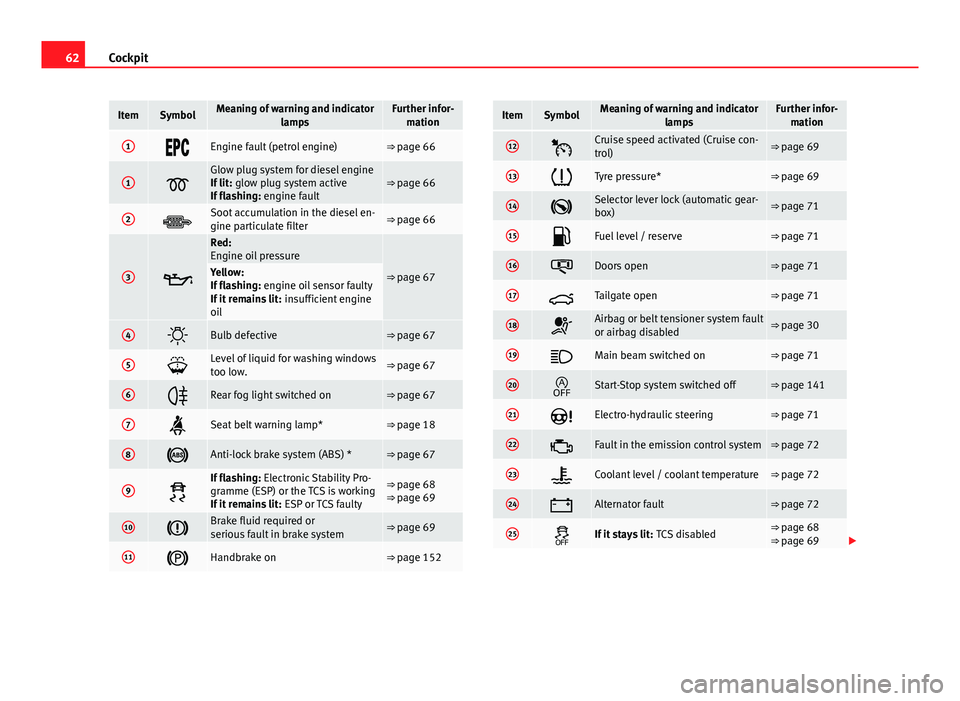
62Cockpit
ItemSymbolMeaning of warning and indicator
lampsFurther infor-mation
1Engine fault (petrol engine)⇒ page 66
1Glow plug system for diesel engine
If lit: glow plug system active
If flashing: engine fault⇒ page 66
2Soot accumulation in the diesel en-
gine particulate filter⇒ page 66
3
Red:
Engine oil pressure
⇒ page 67Yellow:
If flashing: engine oil sensor faulty
If it remains lit: insufficient engine
oil
4Bulb defective⇒ page 67
5Level of liquid for washing windows
too low.⇒ page 67
6Rear fog light switched on⇒ page 67
7Seat belt warning lamp*⇒ page 18
8Anti-lock brake system (ABS) *⇒ page 67
9
If flashing: Electronic Stability Pro-
gramme (ESP) or the TCS is working
If it remains lit: ESP or TCS faulty⇒ page 68
⇒ page 69
10Brake fluid required or
serious fault in brake system⇒ page 69
11Handbrake on⇒ page 152
ItemSymbolMeaning of warning and indicator
lampsFurther infor-mation
12Cruise speed activated (Cruise con-
trol)⇒ page 69
13Tyre pressure*⇒ page 69
14Selector lever lock (automatic gear-
box)⇒ page 71
15Fuel level / reserve⇒ page 71
16Doors open⇒ page 71
17Tailgate open⇒ page 71
18Airbag or belt tensioner system fault
or airbag disabled⇒ page 30
19Main beam switched on⇒ page 71
20Start-Stop system switched off⇒ page 141
21Electro-hydraulic steering⇒ page 71
22Fault in the emission control system⇒ page 72
23Coolant level / coolant temperature⇒ page 72
24Alternator fault⇒ page 72
25If it stays lit: TCS disabled⇒ page 68
⇒ page 69
Page 73 of 278

71
Cockpit
Speed selector lever lock*
The brake pedal must be depressed when this warning lamp lights up. This
is necessary when the automatic gearbox* selector lever is moved out of the
positions P or N.
Fuel level / reserve
This symbol lights up to indicate that the fuel tank is under
the reserve level.
It lights up when only 7 litres of fuel remain in the tank. Moreover, a warn-
ing buzzer* is heard. It reminds you to fuel up the fuel tank as soon as pos-
sible ⇒ page 187.
Indicates that the doors are open*
This warning lamp lights up if one of the doors or the tail-
gate is open.
The warning light should go off when all the doors are closed correctly.
Tailgate open*
The warning lamp should switch off when the tailgate is fully closed. Main beam headlights
This warning lamp lights up when the main beams are on.
The warning lamp is switched on once main beams are on or once the
headlight flasher is operating.
For further information see ⇒ page 100.
Electro-hydraulic steering*
The level of steering assistance depends on the vehicle speed and on the
steering wheel turning speed.
The warning lamp should light up for a few seconds when the ignition is
switched on. It should go out once the engine is started.
There is a fault in the electro-hydraulic steering system if the lamp does not
go out or lights up whilst the vehicle is in motion. Take the vehicle to the
Authorised Service Centre as soon as possible.
Note
When towing the vehicle with the engine stopped or due to a fault in the
power steering, this will not operate. The vehicle can still be steered, but it
will require greater force to turn the steering wheel.
Safety FirstOperating InstructionsPractical TipsTechnical Specifications
Page 80 of 278
78Unlocking and locking
Once this system is activated, opening doors from the outside and the in-
side is not possible. The tailgate can not be opened. The central locking
button does not work.
When the ignition is switched off, the instrument panel indicates that the
Safe system is on.
Deactivation
Rotate the key inserted in the lock cylinder twice towards the locking direc-
tion.
To activate the system using the remote control, press the lock button on
the remote twice
in less than five seconds.
On deactivating the “Safe” system, the alarm volumetric sensor is also de-
activated.
With the “Safe” switched off, doors can be opened from the interior but not
from the exterior.
See “Selective unlocking system*”
“Safe” status
On the driver door, there is a visible warning lamp which shows the “Safe”
system status.
We will know that “Safe” system is activated by the flashing warning lamp.
The indicator will flash on all vehicles, fitted and nor fitted with an alarm,
until they unlock.
Remember:
Safe activated with or without an alarm: Warning lamp flashes continuous-
ly.
Safe deactivated without an alarm: The indicator remains off.
Safe deactivated with an alarm: The indicator remains off.
WARNING
No one should remain inside the vehicle if the “Safe” mechanism is acti-
vated because opening the doors will not be possible in case of emergen-
cy neither from the inside nor the outside. Danger of death. Passengers
could become trapped inside in case of emergency.
Selective unlocking system*
This system allows to unlock either just the driver door or all
the vehicle.
Driver door unlock button
Unlock once. Use either the key or the remote control.
Once the key is inserted in the lock cylinder, rotate once in the unlock direc-
tion. The driver door will remain without “Safe” and unlocked. See Anti-theft
Alarm chapter for vehicles fitted with an alarm ⇒ page 84.
Using the remote control, press the unlock button on the remote
once.
The Safe system for all the vehicle is deactivated, only the driver door is un-
locked and both the alarm and the warning lamp are also turned off.
Unlocking all doors and the luggage compartment
The unlock button on the remote control must be pressed twice
so that
all doors and the luggage compartment can be opened.
Press twice within 5 seconds to deactivate the Safe system for all vehicle, to
unlock all doors and to use the luggage compartment. The warning lamp
and the alarm (only vehicles fitted with one) are turned off.
Unlocking the luggage compartment
See ⇒ page 87.
Page 81 of 278

79
Unlocking and locking
Activating the selective unlocking system*
With the door open, insert a key into the start cylinder and start the ignition.
Insert the other key into the driver door lock and turn in the opening direc-
tion for at least 3 seconds. The turn signals will flash twice.
Deactivating the selective unlocking system*
With the door open, insert a key into the start cylinder and start the ignition.
Insert the other key into the driver door lock and turn in the locking direc-
tion for at least 3 seconds. The turn signals will flash once.
Involuntary unlocking
It is an anti-theft system and prevents the unintentional un-
locking of the vehicle. If the vehicle is unlocked and any of the doors (including the tailgate) are
opened within 30 seconds, it gets re-locked automatically.
Automatic speed dependent locking and unlocking system*
This is a safety system which prevent the access to the vehi-
cle from the outside when it is running (for example, when
stopped at a traffic light).
Locking
The doors lock automatically after exceeding 15km/h. The tailgate locks au-
tomatically after exceeding 6 km/h.
If the vehicle is stopped and any of its doors open, when starting again and
exceeding the mentioned speed, all doors will lock again. Unlocking
On withdrawing the ignition key, the vehicle will returns to its status prior to
self-locking.
Each door can be unlocked and opened independently from the inside (for
example, when a passenger gets out of it). To do it, simply operate the lever
inside the door.
Activating the system*
With the ignition on, press the locking key on the central locking system
within 3 to 10 seconds.
Deactivating the system*
With the ignition on, press the unlocking key on the central locking system
within 3 to 10 seconds.
In both cases, if the operation has been carried out correctly, the locking
lamp will flash
⇒
fig. 43.
WARNING
The door handles must not be operated when the vehicle is running: the
door would open.
Note
If the airbags are triggered during an accident, the vehicle is unlocked, ex-
cept for the luggage compartment. It is possible to lock the vehicle from in-
side with the central locking, after turning the ignition off and back on
again.
Safety FirstOperating InstructionsPractical TipsTechnical Specifications
Page 82 of 278
80Unlocking and locking
Central lock button
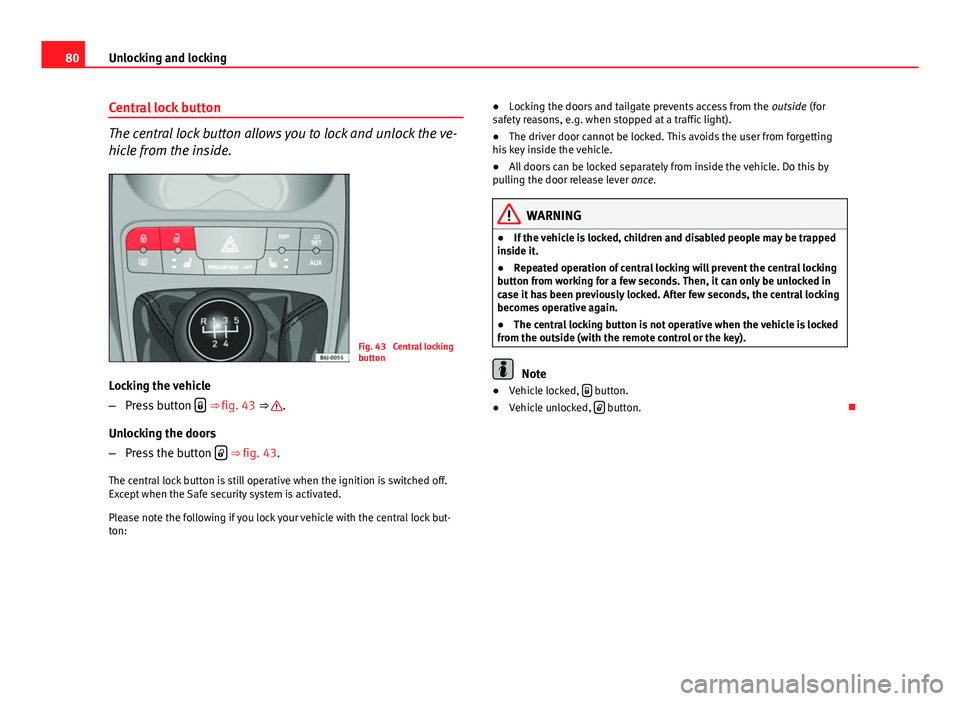
The central lock button allows you to lock and unlock the ve-
hicle from the inside.
Fig. 43 Central locking
button
Locking the vehicle
– Press button
⇒ fig. 43 ⇒ .
Unlocking the doors
– Press the button
⇒ fig. 43.
The central lock button is still operative when the ignition is switched off.
Except when the Safe security system is activated.
Please note the following if you lock your vehicle with the central lock but-
ton: ●
Locking the doors and tailgate prevents access from the outside (for
safety reasons, e.g. when stopped at a traffic light).
● The driver door cannot be locked. This avoids the user from forgetting
his key inside the vehicle.
● All doors can be locked separately from inside the vehicle. Do this by
pulling the door release lever once.
WARNING
● If the vehicle is locked, children and disabled people may be trapped
inside it.
● Repeated operation of central locking will prevent the central locking
button from working for a few seconds. Then, it can only be unlocked in
case it has been previously locked. After few seconds, the central locking
becomes operative again.
● The central locking button is not operative when the vehicle is locked
from the outside (with the remote control or the key).
Note
● Vehicle locked, button.
● Vehicle unlocked, button.
Page 84 of 278
82Unlocking and locking
Radio frequency remote control*
Locking and unlocking the vehicle
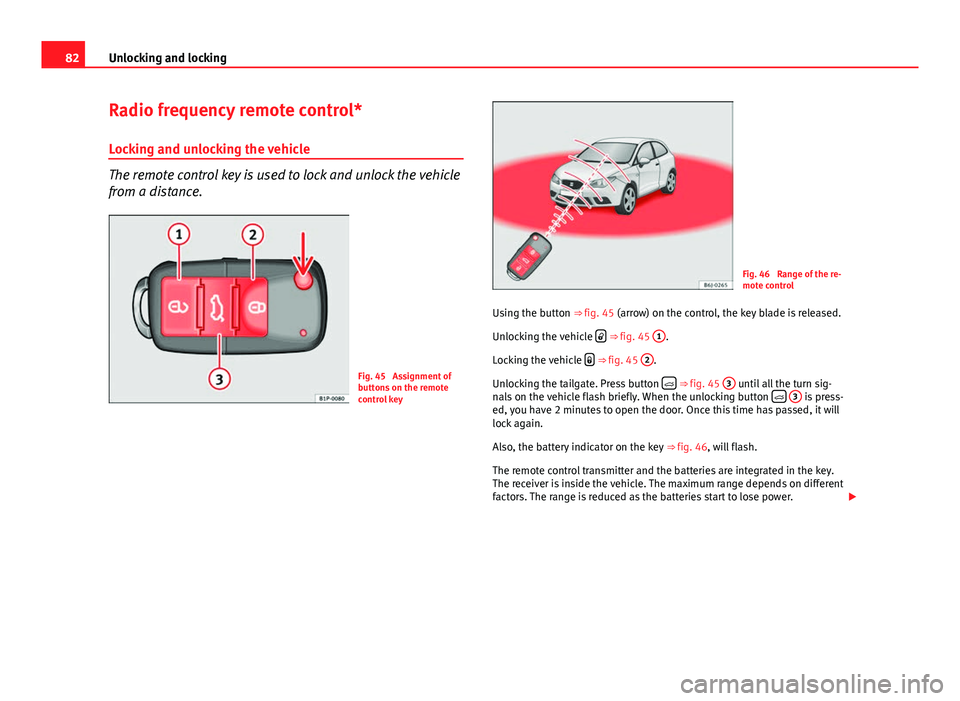
The remote control key is used to lock and unlock the vehicle
from a distance.
Fig. 45 Assignment of
buttons on the remote
control key
Fig. 46 Range of the re-
mote control
Using the button ⇒ fig. 45 (arrow) on the control, the key blade is released. Unlocking the vehicle
⇒ fig. 45
1.
Locking the vehicle
⇒ fig. 45
2.
Unlocking the tailgate. Press button
⇒ fig. 45
3 until all the turn sig-
nals on the vehicle flash briefly. When the unlocking button
3 is press-
ed, you have 2 minutes to open the door. Once this time has passed, it will
lock again.
Also, the battery indicator on the key ⇒ fig. 46, will flash.
The remote control transmitter and the batteries are integrated in the key.
The receiver is inside the vehicle. The maximum range depends on different
factors. The range is reduced as the batteries start to lose power.