2011 Seat Ibiza SC tailgate
[x] Cancel search: tailgatePage 126 of 278

124Seats and storage compartments
Rear shelf
Fig. 89 Rear shelf
Removing the shelf
– Disengage the loops ⇒ fig. 89 B
from the retaining pins A
–
Extract the cover from its slot, in its rest position and pull out-
wards.
WARNING
Do not place heavy or hard objects on the rear shelf, because they will
endanger the vehicle occupants in case of sudden braking.
CAUTION
● Before closing the tailgate, ensure that the rear shelf is correctly fitted.
● An overloaded luggage compartment could mean that the rear shelf is
not correctly seated and it may be bent or damaged.
● If the luggage compartment is overloaded, remove the tray.
Note
● Ensure that, when placing items of clothing on the luggage compart-
ment cover, rear visibility is not reduced.
Roof rack*
Please observe the following points if you intend to carry loads on the roof:
● For safety reasons, only luggage racks and accessories approved by
SEAT should be used.
● It is essential that you follow the assembly instructions included with
the bars exactly, being especially careful to position front and rear luggage
compartment cover bars on the special housings on the longitudinal bars.
You must also respect their position according to the direction of travel indi-
cated in the assembly manual. Not following these instructions may dam-
age the bodywork.
● Pay special attention to the tightening torque of the attachment bolts
and check them following a short journey. If necessary, retighten the bolts
and check them at regular intervals.
● Distribute the load evenly. A maximum load of 40 kg only is permitted
for each roof rack system support bar, the load must be distributed evenly
along the entire length. However, the maximum load permitted for the en-
tire roof (including the support system) of 75 kg must not be exceeded nor
should the total weight of the vehicle be exceeded. See the Technical Data
section.
● When transporting heavy or large objects on the roof, any change in the
normal vehicle behaviour due to a change in the centre of gravity or an in-
creased wind resistance must be taken into account. For this reason, a suit-
able speed and driving style must be used.
● For those vehicles fitted with a sliding/tilting sunroof*, ensure that it
does not interfere with the load on the roof rack system when opened.
Page 178 of 278
176Vehicle maintenance and cleaning
WARNING
● Wash your vehicle with the ignition switched off.
● Protect your hands and arms from cuts on sharp metal edges when
cleaning the underbody, the inside of the wheel housings etc. Risk of in-
jury.
● Water, ice and salt on the brakes can reduce braking efficiency. Risk
of accident.
CAUTION
● Never remove dirt, mud or dust if the vehicle surface is dry. Never use a
dry cloth or sponge for cleaning purposes. This could scratch the paintwork
or glass on your vehicle.
● Washing the vehicle in low temperatures: when washing the vehicle
with a hose, do not direct water into the lock cylinders or the gaps around
the doors, tailgate, or sunroof. Risk of freezing.
For the sake of the environment
To protect environment, the vehicle should be washed only in specially pro-
vided wash bays. This prevents toxic, oil-laden waste water entering the
sewerage system. In some places, washing vehicles outside wash bays is
prohibited.
Note
Do not wash the vehicle in direct sunlight. Washing the vehicle with a high pressure cleaner
Be particularly careful when using a high pressure cleaner!
– Always observe the instructions for the high-pressure cleaner,
particularly those concerning the pressure and the spraying
distance.
– Increase the spraying distance for soft materials and painted
bumpers.
– Do not use a high pressure cleaner to remove ice or snow from
windows ⇒ page 177.
– Never use concentrated jet nozzles (“rotating jets”) ⇒
.
– After washing, avoid sudden and sharp braking. “Dry” the
brakes by braking several times ⇒ page 166.
WARNING
● Never wash tyres with a concentrated jet (“rotating nozzle”). Even at
large spraying distances and short cleaning times, visible and invisible
damage can occur to the tyres. This may cause an accident.
● Water, ice and salt on the brakes can reduce braking efficiency. Risk
of accident.
CAUTION
● Do not use water hotter than 60 °C. This could damage the car.
● To avoid damage to the vehicle, keep a sufficient distance from sensitive
materials such as flexible hoses, plastic, soundproofing material, etc. This
is also important for bumpers painted in the colour of the bodywork. The
closer the nozzle is to the surface, the greater the wear on the material.
Page 180 of 278
178Vehicle maintenance and cleaning
If possible, use a de-icing spray to remove ice. If you use an ice scraper,
push it in one direction only without swinging it.
Use window cleaner or a silicone remover to clean rubber, oil, grease and
silicone deposits off.
Wax deposits can be removed with a special cleaner available in your Au-
thorised Service Centre. Wax deposits on the windscreen could cause the
wiper blades to judder. Adding a window cleaner that dissolves wax to the
windscreen washer fluid prevents wiper blades from juddering, but wax de-
posits are not removed.
CAUTION
● Never use warm or hot water to remove snow and ice from windows and
mirrors. This could cause the glass to crack!
● The heating element for the rear window is located on the inner side of
the window. To prevent damage, do not put stickers over the heating ele-
ments on the inside of the window.
Cleaning windscreen wiper blades
Clean wiper blades improve visibility.
1. Use a soft cloth to remove dust and dirt from the windscreen wiper blades.
2. Use window cleaner to clean the windscreen wiper blades. Use a sponge or a cloth to remove stubborn dirt. Rubber seals maintenance
If rubber seals are well looked after, they will not freeze so
quickly.
1. Use a soft cloth to remove dust and dirt from the rubber seals.
2. Apply a specialist care product to the rubber seals.
The rubber strips on the doors, windows, bonnet and tailgate will remain
pliable and last longer if they are treated with a suitable care product (for
example silicone spray).
Caring for rubber seals will also prevent premature ageing and leaks. The
doors will be easier to open. If rubber seals are well looked after, they will
not freeze so quickly in winter.
Door lock cylinders
The door lock cylinders can freeze up in winter.
To de-ice the lock cylinders you should only use spray with lubricating and
anti-corrosive properties.
Cleaning chrome parts
1. Clean chrome parts with a damp cloth.
2. Polish chrome parts with a soft, dry cloth. If this does not provide satisfying results, use a specialist chrome cleaning
product. Chrome cleaning products will remove stains from the surface.
Page 210 of 278
208Checking and refilling levels
CAUTION
● Never disconnect the battery if the ignition is switched on or if the en-
gine is running. This could damage the electrical system or electronic com-
ponents.
● Do not expose the battery to direct sunlight over a long period of time,
as the intense ultraviolet radiation can damage the battery housing.
● If the vehicle is left standing in cold conditions for a long period, protect
the battery from freezing. If it freezes it will be damaged.
Checking the electrolyte level
The electrolyte level should be checked regularly in high-
mileage vehicles, in hot countries and in older batteries. – Open the engine bonnet and the battery cover ⇒
in Safety in-
structions on working in the engine compartment on page 194
⇒
in Warnings on handling the battery on page 207. For vehi-
cles with the battery under the spare wheel, open the tailgate
and lift the floor covering. The battery is located next to the
spare wheel.
– Check the colour display in the "magic eye" on the top of the
battery.
– If there are air bubbles in the window, tap the window gently
until they disperse.
The position of the battery is shown in the corresponding engine compart-
ment diagram ⇒ page 250. The location of the battery in the luggage com-
partment can be seen in ⇒ fig. 175.
The “magic eye” indicator, located on the top of the battery changes colour,
depending on the charge state and electrolyte level of the battery. There are two different colours:
●
Black: correct charge status.
● Transparent/clear yellow: the battery must be replaced. Contact a spe-
cialist workshop.
Charging and changing the vehicle battery
The battery is maintenance-free and is checked during the
inspection service. All work on the vehicle battery requires
specialist knowledge.
If you often drive short distances or if the vehicle is not driven for long peri-
ods, the battery should be checked by a specialised workshop between the
scheduled services.
If the battery has discharged and you have problems starting the vehicle,
the battery might be damaged. If this happens, we recommend you have
the vehicle battery checked by an Authorised Service Centre where it will be
re-charged or replaced.
Charging the battery
The vehicle battery should be charged by a specialised workshop only, as
batteries using special technology have been installed and they must be
charged in a controlled environment.
Replacing a vehicle battery
The battery has been developed to suit the conditions of its location and
has special safety features.
Genuine SEAT batteries fulfil the maintenance, performance and safety
specifications of your vehicle.
Page 239 of 278
237
If and when
Changing the rear, side and interior light
bulbs
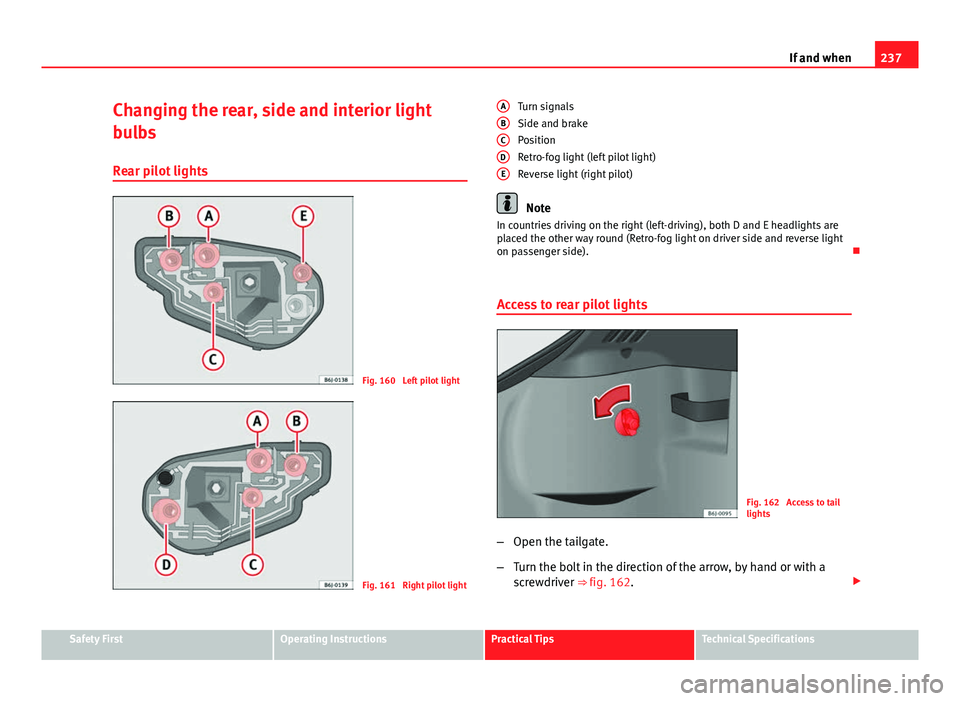
Rear pilot lights
Fig. 160 Left pilot light
Fig. 161 Right pilot light Turn signals
Side and brake
Position
Retro-fog light (left pilot light)
Reverse light (right pilot)
Note
In countries driving on the right (left-driving), both D and E headlights are
placed the other way round (Retro-fog light on driver side and reverse light
on passenger side).
Access to rear pilot lights
Fig. 162 Access to tail
lights
– Open the tailgate.
– Turn the bolt in the direction of the arrow, by hand or with a
screwdriver ⇒ fig. 162.
A
BCDE
Safety FirstOperating InstructionsPractical TipsTechnical Specifications
Page 275 of 278

Soot accumulation in the diesel particulate fil-ter
Warning lamp . . . . . . . . . . . . . . . . . . . . . . . . 66
Spanner symbol . . . . . . . . . . . . . . . . . . . . . . . . . 60
Spare parts . . . . . . . . . . . . . . . . . . . . . . . . . . . . 183
Spare wheel . . . . . . . . . . . . . . . . . . . . . . . . . . . 215
Speedometer . . . . . . . . . . . . . . . . . . . . . . . . . . . 54
Speed selector lever lock warning lamp . . . . . . . . . . . . . . . . . . . . . . . . 71
Start-Stop Activating and deactivating . . . . . . . . . . . . 143
Function . . . . . . . . . . . . . . . . . . . . . . . . . . . 141
Starting petrol engines . . . . . . . . . . . . . . . . . . 138
Starting Petrol engines . . . . . . . . . . . . . . . . . . 139
Starting the engine . . . . . . . . . . . . . . . . . 138, 139 After the fuel tank has been run dry . . . . . 139
Steam jets . . . . . . . . . . . . . . . . . . . . . . . . . . . . . 176
Steering . . . . . . . . . . . . . . . . . . . . . . . . . . . . . . 135 Steering lock . . . . . . . . . . . . . . . . . . . . . . . . 136
Steering column controls Audio Control . . . . . . . . . . . . . . . . . . . . . . . . 74
Steering wheel height adjustment . . . . . . . . . 135
Storage compartment Front passenger side . . . . . . . . . . . . . . . . . 117
Front right seat . . . . . . . . . . . . . . . . . . . . . . 118
Sun visor Sliding/tilting sunroof . . . . . . . . . . . . . . . . . 92
Sun visors . . . . . . . . . . . . . . . . . . . . . . . . . . . . . 102
Switch Hazard warning lights . . . . . . . . . . . . . . . . . 99
Light switch . . . . . . . . . . . . . . . . . . . . . . . . . 94
Rear window heating . . . . . . . . . . . . . . . . . . 98 Switches
Electric windows . . . . . . . . . . . . . . . . . . . . . . 89
Sliding/tilting sunroof . . . . . . . . . . . . . . . . . 91
Switching off the engine . . . . . . . . . . . . . . . . . 139
T Tailgate . . . . . . . . . . . . . . . . . . . . . . . . . . . . . . . . 87 Emergency opening . . . . . . . . . . . . . . . . . . . 88
Warning lamp . . . . . . . . . . . . . . . . . . . . . . . . 71
Tank Fuel level . . . . . . . . . . . . . . . . . . . . . . . . . . . . 55
Reserve indicator . . . . . . . . . . . . . . . . . . . . . 55
Tank capacity . . . . . . . . . . . . . . . . . . . . . . . . 55
TCS . . . . . . . . . . . . . . . . . . . . . . . . . . . . . . . . . . 162
TCS (Traction control system) Warning lamp . . . . . . . . . . . . . . . . . . . . . . . . 68
Technical modifications . . . . . . . . . . . . . . . . . . 183
The danger of not using the seat belt . . . . . . . . 21
Tightening torque of wheel bolts . . . . . . . . . . 249
Tilting sunroof . . . . . . . . . . . . . . . . . . . . . . . . . . 91
Tools . . . . . . . . . . . . . . . . . . . . . . . . . . . . . . . . . 215
Top Tether system . . . . . . . . . . . . . . . . . . . . . . . 48
Tow-starting . . . . . . . . . . . . . . . . . . . . . . . . . . . 243
Towing . . . . . . . . . . . . . . . . . . . . . . . . . . . . . . . . 243
Towing a trailer . . . . . . . . . . . . . . . . . . . . . 171, 248
Towing bracket . . . . . . . . . . . . . . . . . . . . . . . . . 172
Towing bracket, fitting . . . . . . . . . . . . . . . . . . . 185
Towing eye . . . . . . . . . . . . . . . . . . . . . . . . . . . . 243
Towing eyes . . . . . . . . . . . . . . . . . . . . . . . . . . . 244
Tow starting Comments . . . . . . . . . . . . . . . . . . . . . . . . . . 243 Traction control system
Warning lamp . . . . . . . . . . . . . . . . . . . . . . . . 68
Trailer turn signals Warning lamp . . . . . . . . . . . . . . . . . . . . . . . 101
Trailer weights . . . . . . . . . . . . . . . . . . . . . . . . . 248
Turn signals . . . . . . . . . . . . . . . . . . . . . . . . . . . 100 Indicator lamp . . . . . . . . . . . . . . . . . . . . . . . 73
Warning lamp . . . . . . . . . . . . . . . . . . . . . . . 101
Two-way radio . . . . . . . . . . . . . . . . . . . . . . . . . . 184
Tyre-Mobility-System (Tyre repair kit) . . . . . . . 221
Tyre Mobility-System (Tyre repair kit) . . . . . . . 216
Tyre pressure . . . . . . . . . . . . . . . . . . . . . . . . . . 210
Tyre pressures . . . . . . . . . . . . . . . . . . . . . . . . . . 249
Tyre pressure warning lamp . . . . . . . . . . . . . . . . 70
Tyre repair kit . . . . . . . . . . . . . . . . . . . . . . 216, 221
Tyres and wheels Dimensions . . . . . . . . . . . . . . . . . . . . . . . . . 211
Tyres service life . . . . . . . . . . . . . . . . . . . . . . . . 210
Tyres tread depth . . . . . . . . . . . . . . . . . . . . . . . 211
Tyres with directional tread pattern . . . . . . . . 209
U Underbody protection . . . . . . . . . . . . . . . . . . . 179
V
Vehicle battery . . . . . . . . . . . . . . . . . . . . . . . . . 207
Vehicle data . . . . . . . . . . . . . . . . . . . . . . . . . . . 247
Vehicle identification data . . . . . . . . . . . . . . . . 247
Vehicle identification number . . . . . . . . . . . . . 247
273
Index