Page 110 of 170
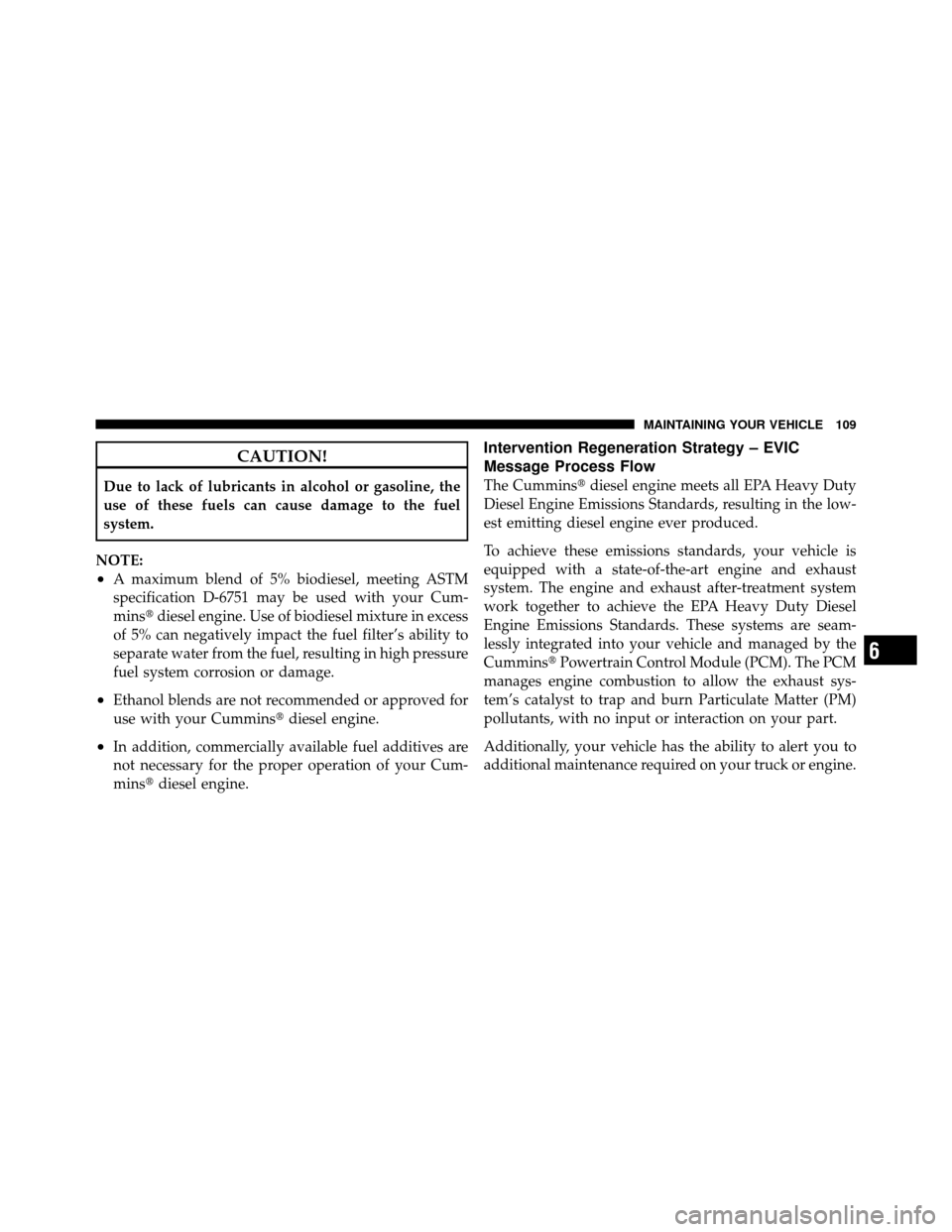
CAUTION!
Due to lack of lubricants in alcohol or gasoline, the
use of these fuels can cause damage to the fuel
system.
NOTE:
•A maximum blend of 5% biodiesel, meeting ASTM
specification D-6751 may be used with your Cum-
mins� diesel engine. Use of biodiesel mixture in excess
of 5% can negatively impact the fuel filter’s ability to
separate water from the fuel, resulting in high pressure
fuel system corrosion or damage.
•Ethanol blends are not recommended or approved for
use with your Cummins� diesel engine.
•In addition, commercially available fuel additives are
not necessary for the proper operation of your Cum-
mins�diesel engine.
Intervention Regeneration Strategy – EVIC
Message Process Flow
The Cummins� diesel engine meets all EPA Heavy Duty
Diesel Engine Emissions Standards, resulting in the low-
est emitting diesel engine ever produced.
To achieve these emissions standards, your vehicle is
equipped with a state-of-the-art engine and exhaust
system. The engine and exhaust after-treatment system
work together to achieve the EPA Heavy Duty Diesel
Engine Emissions Standards. These systems are seam-
lessly integrated into your vehicle and managed by the
Cummins� Powertrain Control Module (PCM). The PCM
manages engine combustion to allow the exhaust sys-
tem’s catalyst to trap and burn Particulate Matter (PM)
pollutants, with no input or interaction on your part.
Additionally, your vehicle has the ability to alert you to
additional maintenance required on your truck or engine.
6
MAINTAINING YOUR VEHICLE 109
Page 120 of 170

•Keep the front of the radiator clean. If your vehicle is
equipped with air conditioning, keep the front of the
condenser clean.
•Do not change the thermostat for Summer or Winter
operation. If replacement is ever necessary, install
ONLY the correct type thermostat. Other designs may
result in unsatisfactory cooling performance, poor gas
mileage, and increased emissions.
Charge Air Cooler – Inter-Cooler
The charge air cooler is positioned between the radiator
and the air conditioner condenser. Air enters the engine
through the air cleaner and passes through the turbo-
charger, where it is pressurized. This pressurized air
rapidly reaches high temperature. The air is then directed
through a hose to the charge air cooler and through
another hose to the intake manifold of the engine. The air
entering the engine has been cooled by about 50° to 100°F
(10° to 38°C). This cooling process enables more efficient
burning of fuel resulting in fewer emissions.To guarantee optimum performance of the system, keep
the surfaces of the charge air cooler, condenser and
radiator clean and free of debris. Periodically check the
hoses leading to and from the charge air cooler for cracks
or loose clamps resulting in loss of pressure and reduced
engine performance.
Brake System
Brake Master Cylinder – Brake Fluid Level Check
The fluid level of the master cylinder should be checked
when performing under the hood service, or immedi-
ately if the “Brake System Warning Light” indicates
system failure.
The brake master cylinder has a translucent plastic
reservoir. On the outboard side of the reservoir, there is a
“MAX” mark and an “MIN” mark. The fluid level must
be kept within these two marks. Do not add fluid above
the full mark because leakage may occur at the cap.
6
MAINTAINING YOUR VEHICLE 119
Page 131 of 170
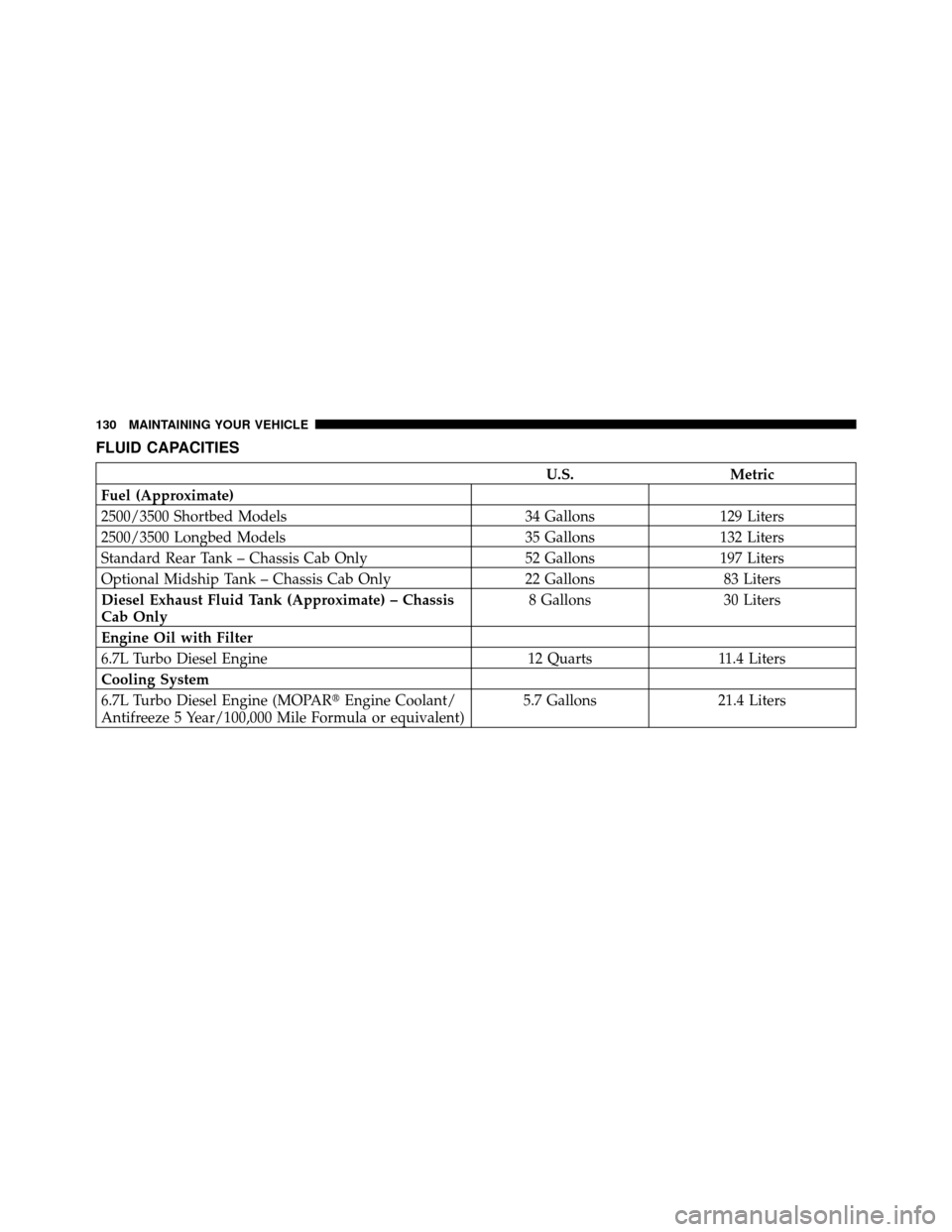
FLUID CAPACITIES
U.S.Metric
Fuel (Approximate)
2500/3500 Shortbed Models 34 Gallons129 Liters
2500/3500 Longbed Models 35 Gallons132 Liters
Standard Rear Tank – Chassis Cab Only 52 Gallons197 Liters
Optional Midship Tank – Chassis Cab Only 22 Gallons83 Liters
Diesel Exhaust Fluid Tank (Approximate) – Chassis
Cab Only 8 Gallons
30 Liters
Engine Oil with Filter
6.7L Turbo Diesel Engine 12 Quarts11.4 Liters
Cooling System
6.7L Turbo Diesel Engine (MOPAR� Engine Coolant/
Antifreeze 5 Year/100,000 Mile Formula or equivalent) 5.7 Gallons
21.4 Liters
130 MAINTAINING YOUR VEHICLE
Page 132 of 170
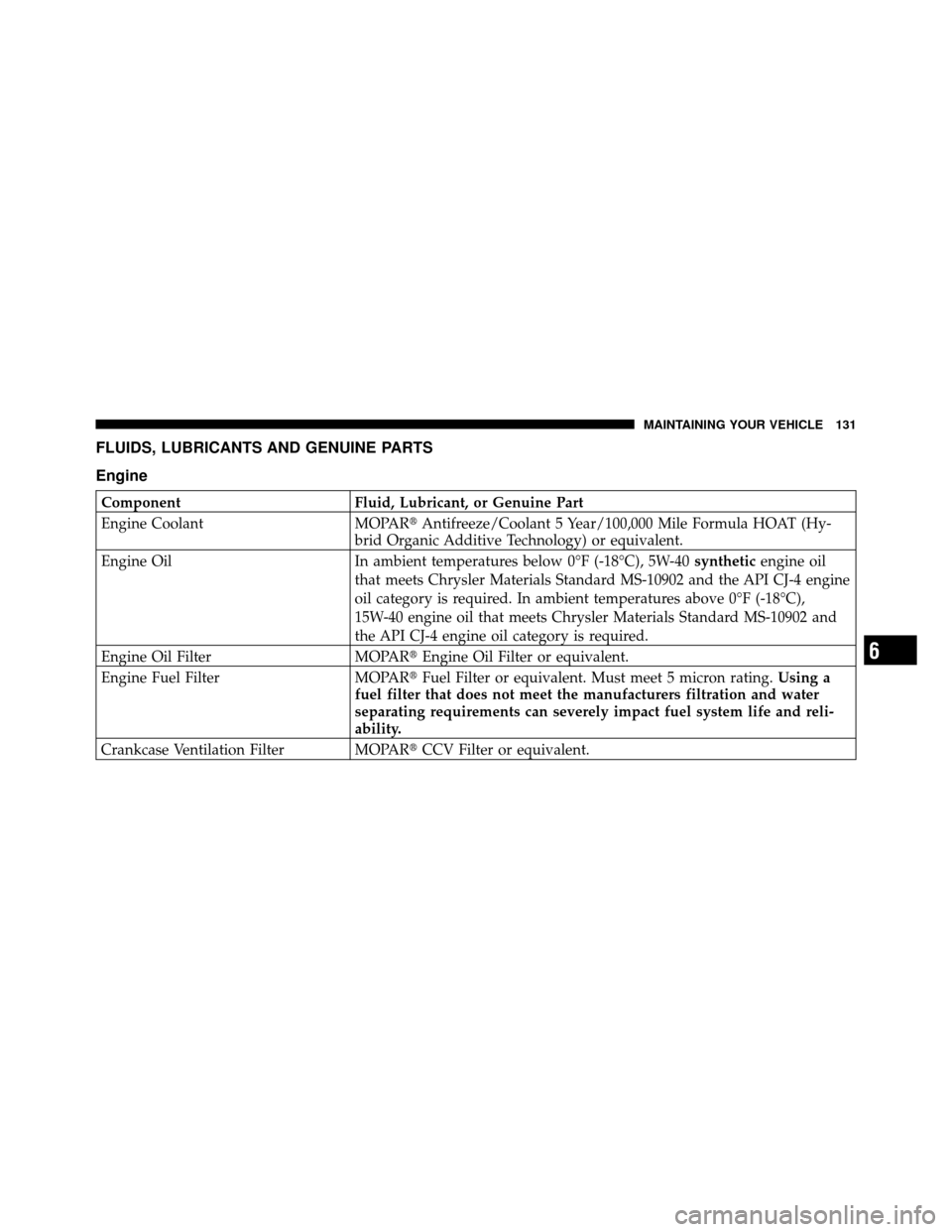
FLUIDS, LUBRICANTS AND GENUINE PARTS
Engine
ComponentFluid, Lubricant, or Genuine Part
Engine Coolant MOPAR�Antifreeze/Coolant 5 Year/100,000 Mile Formula HOAT (Hy-
brid Organic Additive Technology) or equivalent.
Engine Oil In ambient temperatures below 0°F (-18°C), 5W-40 syntheticengine oil
that meets Chrysler Materials Standard MS-10902 and the API CJ-4 engine
oil category is required. In ambient temperatures above 0°F (-18°C),
15W-40 engine oil that meets Chrysler Materials Standard MS-10902 and
the API CJ-4 engine oil category is required.
Engine Oil Filter MOPAR�Engine Oil Filter or equivalent.
Engine Fuel Filter MOPAR�Fuel Filter or equivalent. Must meet 5 micron rating. Using a
fuel filter that does not meet the manufacturers filtration and water
separating requirements can severely impact fuel system life and reli-
ability.
Crankcase Ventilation Filter MOPAR� CCV Filter or equivalent.
6
MAINTAINING YOUR VEHICLE 131
Page 133 of 170
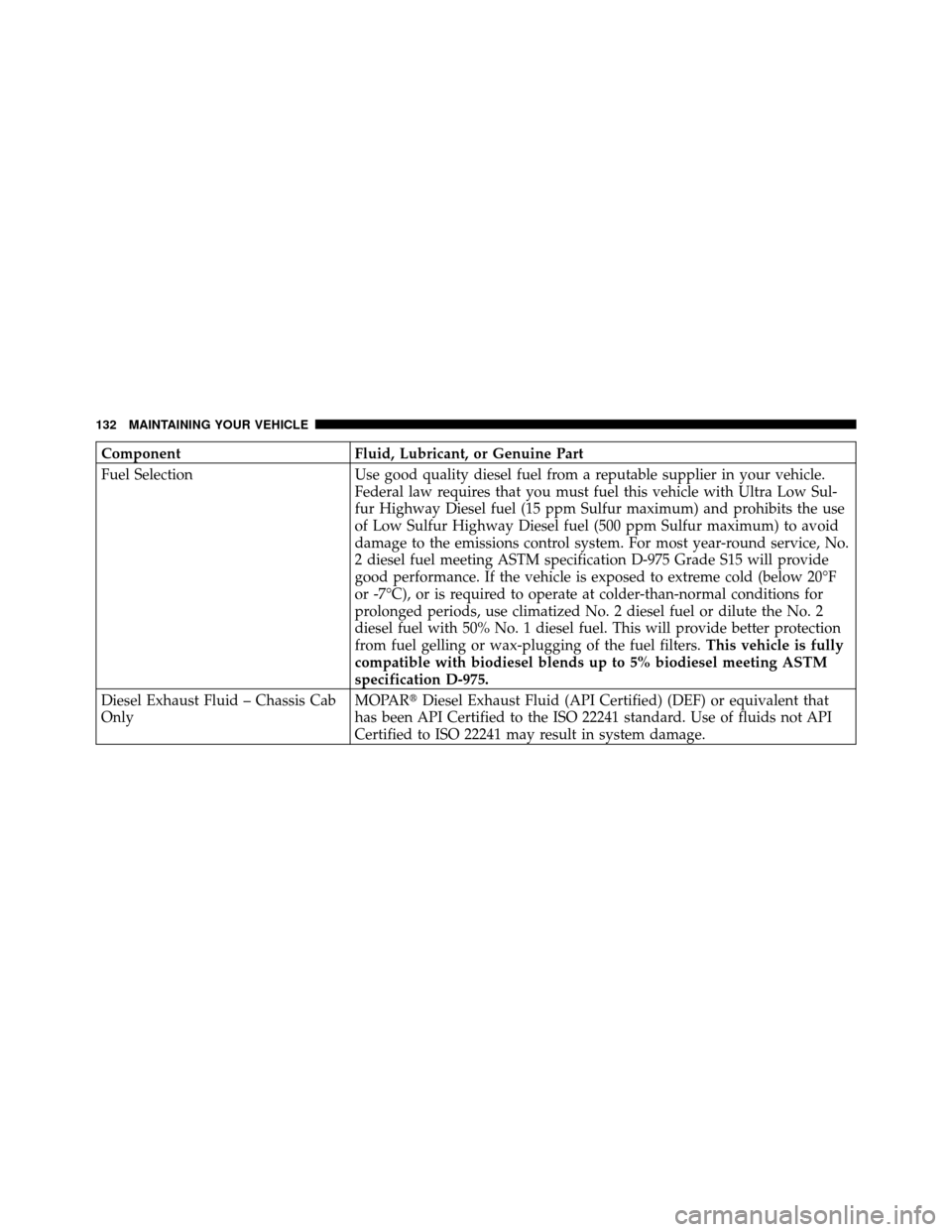
ComponentFluid, Lubricant, or Genuine Part
Fuel Selection Use good quality diesel fuel from a reputable supplier in your vehicle.
Federal law requires that you must fuel this vehicle with Ultra Low Sul-
fur Highway Diesel fuel (15 ppm Sulfur maximum) and prohibits the use
of Low Sulfur Highway Diesel fuel (500 ppm Sulfur maximum) to avoid
damage to the emissions control system. For most year-round service, No.
2 diesel fuel meeting ASTM specification D-975 Grade S15 will provide
good performance. If the vehicle is exposed to extreme cold (below 20°F
or -7°C), or is required to operate at colder-than-normal conditions for
prolonged periods, use climatized No. 2 diesel fuel or dilute the No. 2
diesel fuel with 50% No. 1 diesel fuel. This will provide better protection
from fuel gelling or wax-plugging of the fuel filters. This vehicle is fully
compatible with biodiesel blends up to 5% biodiesel meeting ASTM
specification D-975.
Diesel Exhaust Fluid – Chassis Cab
Only MOPAR�
Diesel Exhaust Fluid (API Certified) (DEF) or equivalent that
has been API Certified to the ISO 22241 standard. Use of fluids not API
Certified to ISO 22241 may result in system damage.
132 MAINTAINING YOUR VEHICLE
Page 137 of 170

MAINTENANCE SCHEDULE
CAUTION!
Failure to perform the required maintenance items
may result in damage to the vehicle.
At Each Stop for Fuel
•Check the engine oil level at least 30 minutes after a
fully warmed engine is shut off. Checking the oil level
while the vehicle is on level ground will improve the
accuracy of the oil level reading. Add oil only when
the level is at or below the ADD or MIN mark.
Once a Month
•Inspect the batteries, and clean and tighten the termi-
nals as required.
•Check the fluid levels of the coolant reservoir, brake
master cylinder, and transmission and transfer case (if
equipped), add as needed.
At Each Oil Change
•Change the engine oil filter.
•Inspect the exhaust system.
•Check the automatic transmission fluid level (if
equipped).
•Check the manual transmission fluid level (if
equipped).
•Check the coolant level, hoses, and clamps.
•Lubricate outer tie rod ends.
Inspection and service should also be performed anytime
a malfunction is observed or suspected. Retain all re-
ceipts.
136 MAINTENANCE SCHEDULES
Page 141 of 170
15,000 Miles (24,000 km) or 12 Months Maintenance Service
Schedule
❏When prompted by the Engine Oil Indicator System, the engine oil and filter must be
changed. If not prompted by the Engine Oil Indicator System within 7,500 miles
(12 000 km) or six months since the last oil and filter change, change the engine oil and
engine oil filter.
❏ Check the Diesel Exhaust Fluid (DEF) tank, refill if necessary (Chassis Cab Only).
❏ Rotate tires.
❏ Replace fuel filter element.
❏ Lubricate front drive shaft fitting (4x4).
❏ Lubricate outer tie rod ends.
❏ Inspect the front suspension, tie rod ends and boot seals for cracks or leaks and all parts for
damage, wear, improper looseness or end play; replace if necessary.
❏ Inspect the front (4x4) and rear axle fluid, change if using your vehicle for police, taxi, fleet,
off-road or frequent trailer towing.
Odometer Reading Date
Repair Order #Dealer Code
Signature Authorized Chrysler Dealer
140 MAINTENANCE SCHEDULES
Page 143 of 170

30,000 Miles (48,000 km) or 24 Months Maintenance Service Schedule
❏When prompted by the Engine Oil Indicator System, the engine oil and filter must be changed. If not prompted by the Engine Oil Indicator
System within 7,500 miles (12 000 km) or six months since the last oil and filter change, change the engine oil and engine oil filter.
❏ Check the Diesel Exhaust Fluid (DEF) tank, refill if necessary (Chassis Cab Only).
❏ Rotate tires.
❏ Replace fuel filter element.
❏ Lubricate front drive shaft fitting (4x4).
❏ Lubricate outer tie rod ends.
❏ Inspect the wheel bearings.
❏ Inspect the front suspension, tie rod ends and boot seals for cracks or leaks and all parts for damage, wear, improper looseness or end play;
replace if necessary.
❏ Inspect the front (4x4) and rear axle fluid, change if using your vehicle for police, taxi, fleet, off-road or frequent trailer towing.
❏ Check the transfer case fluid (4x4).
❏ Change automatic transmission fluid (Chassis Cab Only).
Odometer Reading Date
Repair Order #Dealer Code
Signature Authorized Chrysler Dealer
142 MAINTENANCE SCHEDULES