Page 60 of 232
58
Steering mounted controls
Exceeding the programmed
speed
Pressing the accelerator pedal in order
to exceed the programmed speed
will have no effect unless you press
the pedal fi rmly beyond the point of
resistance .
The limiter is deactivated temporarily
and the programmed speed fl ashes.
To return to the limiter function, reduce
your speed to below the programmed
speed.
Switching the function off
- Place the dial in position 0 or switch
off the ignition to switch the system
off.
The last programmed speed remains in
the memory.
Operating fault
The programmed speed is cleared
then replaced by three dashes.
Contact a PEUGEOT dealer to have
the system checked.
Good practice
Flashing of the speed
The speed fl ashes:
- following forcing of the accelerator
point of resistance,
- when the limiter cannot prevent an
increase in the vehicle speed due
to the profi le of the road or on a
steep descent,
- in the event of sharp acceleration.
In any event, the speed limiter cannot
replace the need to observe speed
limits, nor can it replace the need for
vigilance and responsibility on the part
of the driver.
Always pay attention to the profi le
of the road and sharp acceleration
and stay in complete control of your
vehicle.
To avoid any jamming under the
pedals:
- ensure that the mat and its fi xings
on the fl oor are positioned correctly,
- never place one mat on top of
another.
Page 84 of 232
82
Practical information
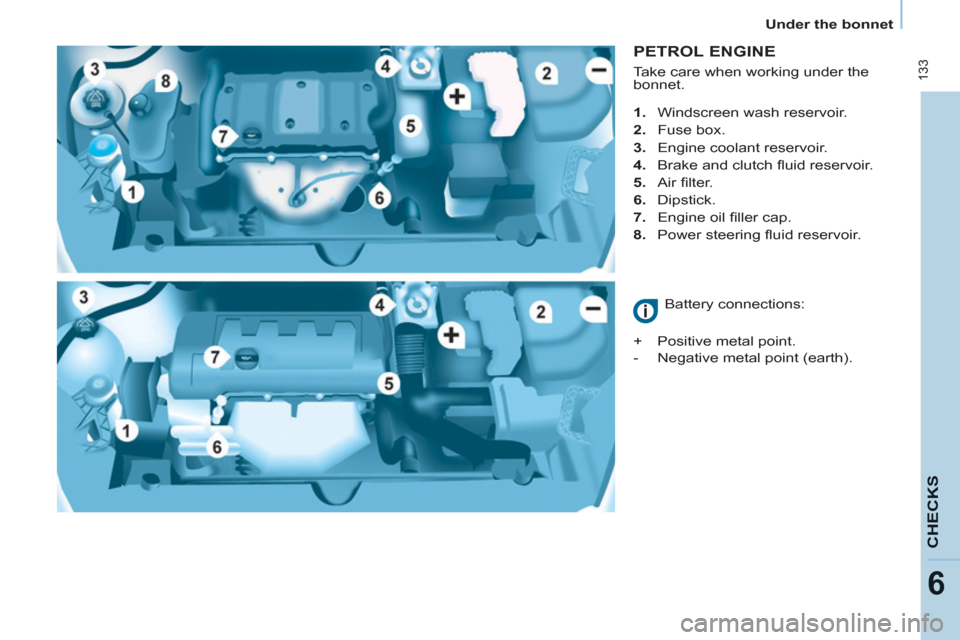
FRONT LAYOUT
1. Lower glove box
This may or may not be fi tted with a lid.
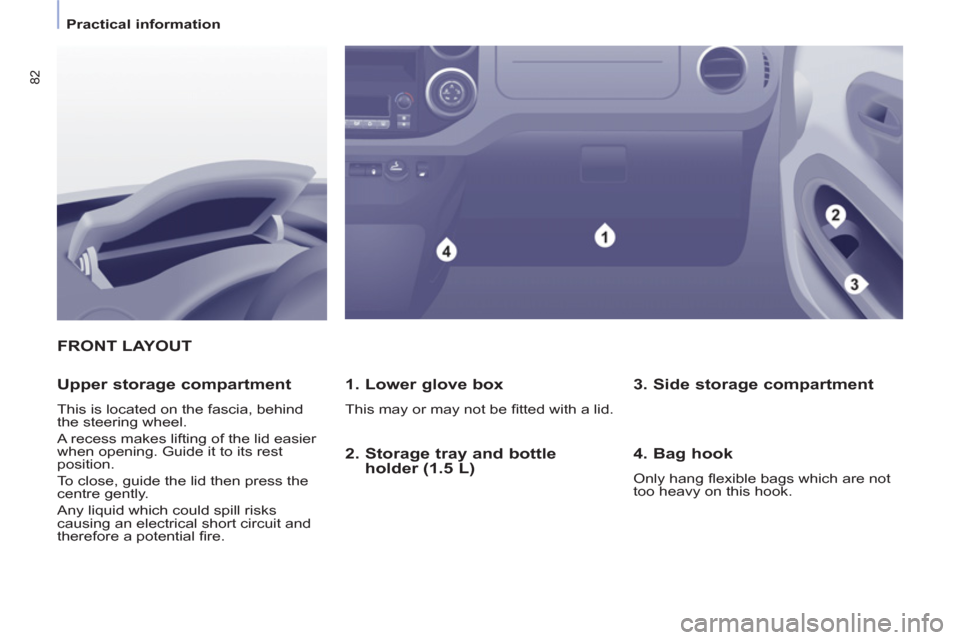
Upper storage compartment
This is located on the fascia, behind
the steering wheel.
A recess makes lifting of the lid easier
when opening. Guide it to its rest
position.
To close, guide the lid then press the
centre gently.
Any liquid which could spill risks
causing an electrical short circuit and
therefore a potential fi re.
3. Side storage compartment
4. Bag hook
Only hang fl exible bags which are not
too heavy on this hook.
2. Storage tray and bottle
holder (1.5 L)
Page 107 of 232

105
Driving safely
SAFETY
4
DRIVING SAFELY
HORN
Press the centre of the steering wheel.
PARKING BRAKE
Applying
Pull the parking brake lever up to
immobilise your vehicle.
Check that the parking brake is applied
fi rmly before leaving the vehicle.
Releasing
Pull the lever and press the button to
lower the parking brake lever.
HAZARD WARNING LAMPS
Press this button, the direction
indicators fl ash.
They can operate with the ignition off.
The hazard warning lamps should only
be used in dangerous situations, when
stopping in an emergency or when
driving in unusual conditions.
When parking on a slope, direct your
wheels towards the pavement and pull
the parking brake lever up.
There is no advantage in engaging
a gear after parking the vehicle,
particularly if the vehicle is loaded.
If the parking brake is still on or has
not been released properly, this is
indicated by this warning lamp which
comes on on the instrument panel.
Automatic lighting of hazard
warning lights
When braking in an emergency,
depending on the force of deceleration,
the hazard warning lights come
on automatically. They switch off
automatically the fi rst time you
accelerate.
It is also possible to switch them off by
pressing the button on the fascia.
Page 119 of 232
11 7
SAFETY
4
11 7
Airbags
Good practice
Sit in a normal upright position.
Wear a correctly adjusted seat belt.
Do not leave anything between the
occupants and the airbags (a child,
pet, object...). This could hamper the
operation of the airbags or injure the
occupants.
After an accident or if the vehicle has
been stolen or broken into, have the
airbag systems checked.
All work on the airbag system is strictly
forbidden unless it is carried out by
qualifi ed personnel of the PEUGEOT
network.
Even if all of the precautions
mentioned are observed, a risk of
injury or of minor burns to the head,
chest or arms when an airbag is
triggered cannot be ruled out. In fact,
the bag infl ates almost instantly (within
a few milliseconds) then defl ates within
the same time discharging the hot gas
via openings provided for this purpose.
Side airbags
Only put recommended covers on the
seats. These will not hinder infl ation of
the side airbags. Consult a PEUGEOT
dealer.
Do not fi x or glue anything to the seat
backs. This could cause injury to the
chest or arms when the side airbag
infl ates.
Do not sit with the upper part of the
body any nearer to the door than
necessary.
Front airbags
Do not drive holding the steering wheel
by its spokes or resting your hands on
the centre part of the wheel.
Do not allow passengers to place their
feet on the fascia, they risk serious
injury if the airbag is triggered.
Smoke as little as possible as
deployment of the airbags can cause
burns or the risk of injury from a
cigarette or pipe.
Never remove or pierce the steering
wheel or hit it violently.
Airbags only operate when the
ignition is switched on.
This equipment only operates once.
If a second impact occurs (during the
same or a subsequent accident), the
airbag will not operate.
The triggering of an airbag or airbags
is accompanied by a slight discharge
of harmless smoke and a noise, due
to the activation of the pyrotechnic
cartridge incorporated in the system.
This smoke is not harmful, but
sensitive individuals may experience
some irritation.
The noise of the detonation may result
in a slight loss of hearing for a short
time.
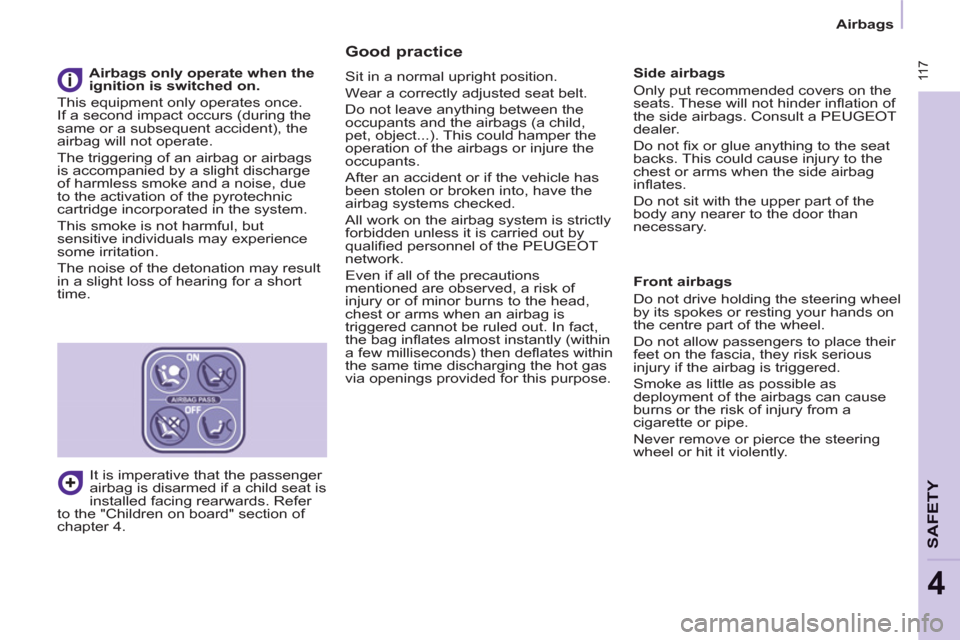
It is imperative that the passenger
airbag is disarmed if a child seat is
installed facing rearwards. Refer
to the "Children on board" section of
chapter 4.
Page 121 of 232

11 9
SAFETY
4
11 9
Airbags
Front airbags
The front airbags are incorporated in
the centre of the steering wheel for the
driver and in the fascia for the front
passenger.
Activation
They are deployed simultaneously,
unless the passenger's front airbag
has been disarmed, in the event of a
serious front impact applied to all or
part of the front impact zone A in the
longitudinal centreline of the vehicle
on a horizontal plane directed from the
front towards the rear of the vehicle.
The front airbag infl ates between
the front occupant of the vehicle and
the fascia to cushion his forward
movement.
Disarming
The passenger's front airbag alone can
be disarmed:
- With the ignition switched off
,
insert the key into the passenger
airbag disarming switch,
- turn it to the "OFF" position,
- then remove the key keeping the
slot in this position.
The airbag warning light on the
instrument panel is lit throughout
the period of disarming.
If the two airbag warning lights
are lit continuously, do not install
a rear-facing child seat. Consult a
PEUGEOT dealer.
Front airbag fault
To ensure the safety of your
child, it is essential to disarm the
passenger airbag when you install
a rear-facing child seat on the front
passenger seat. Otherwise, the child
would risk being killed or seriously
injured if the airbag were to infl ate.
Reactivation
In the "OFF" position, the passenger
airbag will not be triggered in the event
of an impact.
As soon as the child seat is removed,
turn the airbag slot to the "ON"
position to re-activate the airbag
and thus ensure the safety of your
passenger in the event of an impact.
If this warning light comes on,
accompanied by an audible
signal and a message on the
display, consult a PEUGEOT
dealer to have the system
checked.
Page 132 of 232
Equipment
130
The fi tting of electrical equipment
or accessories which are not
recommended by PEUGEOT
may result in a failure of your vehicle's
electronic system. Please note this
specifi c warning. You are advised
to contact a dealer to be shown the
range of recommended equipment or
accessories.
Depending on the country in which
the vehicle is sold, it is compulsory to
have a high visibility jacket, warning
triangle and spare bulbs available in
the vehicle.
"Active Fleet Data" telematic unit
Connected directly to the heart of the
vehicle (multiplexed network: "Full
CAN"), the telematic unit, by means of
a "ready to use" service, permits the
sending in real time of information such
as:
- distance travelled,
- distance remaining before the next
service,
- warnings and faults (oil level,
coolant level, oil temperature,
coolant temperature, etc ...).
This enables "Fleet" managers
to optimise the monitoring and
management of their professional
vehicles.
Depending on country, contact a
PEUGEOT dealer for more information.
Front mud fl aps, rear mud
fl aps, 15/17 inch alloy wheels,
wheelarch trim, leather steering
wheel, ...
Screenwash, interior and
exterior cleaning and
maintenance products, spare
bulbs, ...
Page 135 of 232
133
CHECK
S
6
Under the bonnet
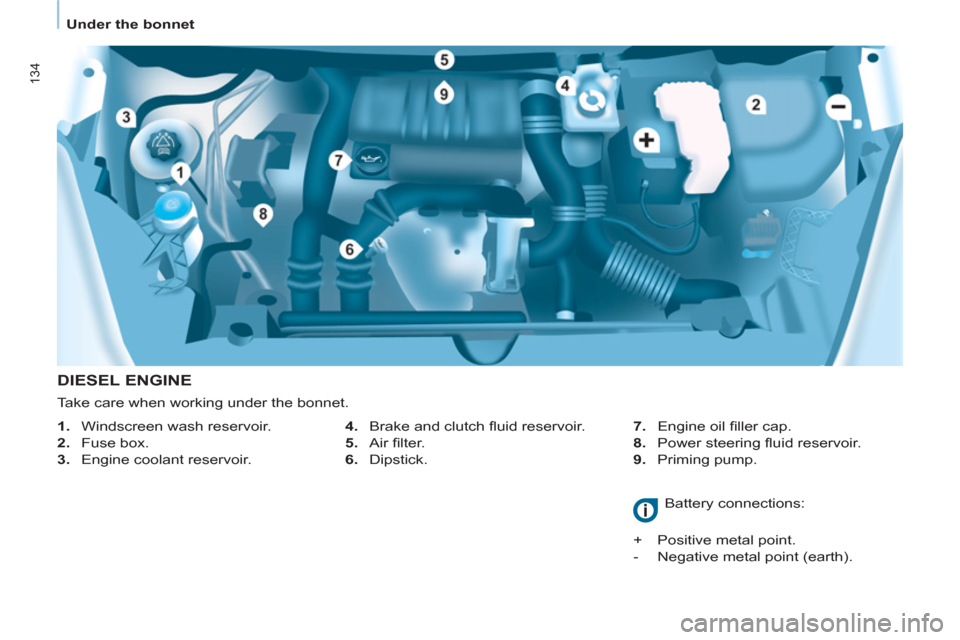
PETROL ENGINE
1. Windscreen wash reservoir.
2. Fuse box.
3. Engine coolant reservoir.
4. Brake and clutch fl uid reservoir.
5. Air fi lter.
6. Dipstick.
7. Engine oil fi ller cap.
8. Power steering fl uid reservoir.
Battery connections:
+ Positive metal point.
- Negative metal point (earth). Take care when working under the
bonnet.
Page 136 of 232
134
Under the bonnet
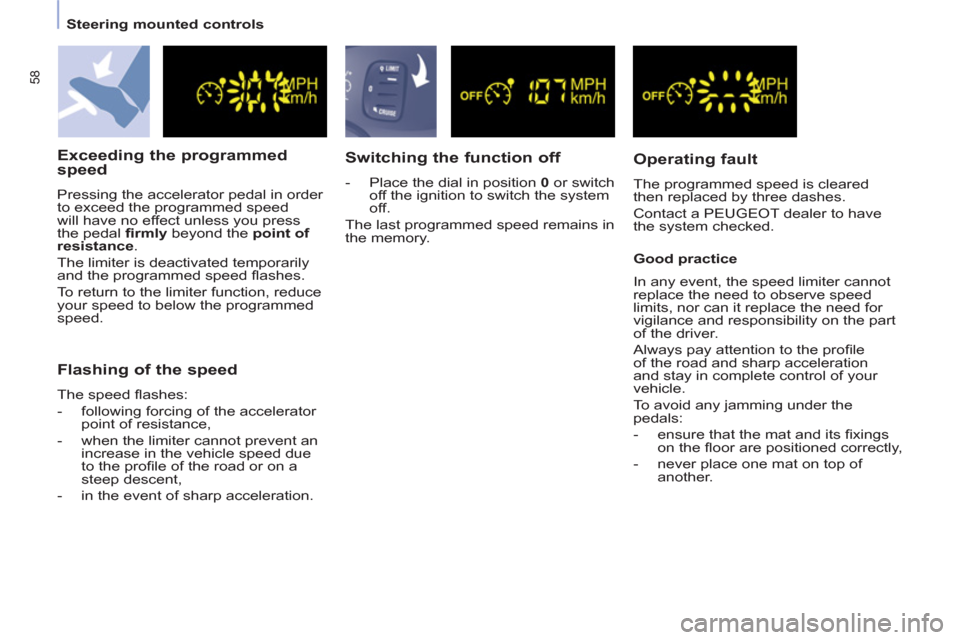
DIESEL ENGINE
4. Brake and clutch fl uid reservoir.
5. Air fi lter.
6. Dipstick.
7. Engine oil fi ller cap.
8. Power steering fl uid reservoir.
9. Priming pump.
1. Windscreen wash reservoir.
2. Fuse box.
3. Engine coolant reservoir.
Battery connections:
+ Positive metal point.
- Negative metal point (earth). Take care when working under the bonnet.