2011 MITSUBISHI PAJERO IV check engine
[x] Cancel search: check enginePage 269 of 377

Cigarette lighter*
E00711501042
The cigarette lighter
can be used while the ignition
switch is in the “ON” or “ACC” position. 1- Open the lid
2- Push all the way in.
The cigarette
lighter will automatically return to its
original position with a “click” when ready. Pull it
out for use.
After use, insert the cigarette lighter to its original
position in the socket.
NOTE
l Do not leave the cigarette lighter removed
from its socket, because the socket might be-
come clogged by foreign material and be
short-circuited. CAUTION
l
Do not touch
the heating element or the
cigarette lighter housing, hold the knob
only to prevent burns.
l Do not allow children to operate or play
with the cigarette lighter as burns may oc-
cur.
l Something is wrong with the cigarette
lighter if it does not pop back out within
approximately 30 seconds of being push-
ed in. We recommend you to have it
checked.
l Do not use any electric appliance that is
not approved by MITSUBISHI
MOTORS. Doing so could damage the
socket. If you used the cigarette lighter af-
ter damaging the socket, the cigarette
lighter might pop out or fail to come out
after being pushed in.
l When the cigarette lighter socket is used
as a power source for an electric appli-
ance, be sure that the electric appliance
operates at 12 V and has an electric ca-
pacity of 120 W or less. In addition, long
use of the electric appliance without run-
ning the engine may run down the battery. Accessory socket
E00711600987
The accessory socket
can be used while the igni-
tion switch is in the “ON” or “ACC” position. CAUTION
l
Be aware
that
using electronic equipment
with the engine off may run the battery
down.
l When you connect an electrical device,
make sure it is rated at 12 V and its elec-
trical capacity does not exceed 120 W.
When using some sockets at the same
time, make sure the total power consump-
tion of the electrical accessories does not
exceed 120 W at 12 V.
l When the accessory socket is not in use,
be sure to close the cap or plug, because
the socket might become clogged by for-
eign material and be short-circuited.
NOTE l The
two or
more accessory sockets can be
used simultaneously. For pleasant driving
5-86
5
OBKE12E1
Page 283 of 377

If the vehicle breaks down
E00800101179
If the vehicle
breaks down on the road, move it to
the shoulder and use the hazard warning flashers and/
or the warning triangle etc. Refer to “Hazard warn-
ing flasher switch” on page 3-35.
If the engine stops/fails
Vehicle operation and control are affected if the en-
gine stops. Before moving the vehicle to a safe
area, be aware of the following:
l The brake booster becomes inoperative and
the pedal effort will increase. Press down the
brake pedal harder than usual.
l Since the power steering pump is no longer
operative, the steering wheel feels heavy
when turning it. Emergency starting
E00800502587
If the engine
cannot be started because the battery
is weak or dead, the battery from another vehicle
can be used with jumper cables to start the engine. WARNING
l To start
the
engine using jumper cables
connected to another vehicle, perform the
correct procedures according to the in-
struction below. Incorrect procedures
could result in a fire or explosion or dam-
age to the vehicles. CAUTION
l
Do not attempt
to start the engine by pull-
ing or pushing the vehicle. It could dam-
age your vehicle.
l Always wear protective eye goggles when
working near the battery.
l Keep the battery out of the reach of chil-
dren.
1. Get the vehicles close enough so the jumper
cables can
reach, but be sure the vehicles
aren’t touching each other. CAUTION
l
Check the
other
vehicle. It must have a 12-
volt battery.
If the other system isn’t 12-volt, shorting
can damage both vehicles. 2. Set the parking brake firmly on each vehicle.
Put an
A/T in “P” (PARK) or a M/T in “N”
(Neutral). Turn off the ignition switch. WARNING
l Turn off
the
ignition on both vehicles be-
forehand. Make sure that the cables or
your clothes cannot be caught by the fan
or drive belt. Personal injury could result.
3. Turn off all lamps, heater and other electrical
loads.
4. Make
sure battery electrolyte is at the proper
level. Refer to “Battery” on page 8-10. WARNING
l If electrolyte
fluid
is not visible, or ap-
pears to be frozen, Do Not Attempt Jump
Starting!
A battery might rupture or explode if the
temperature is below the freezing point
or if it is not filled to the proper level.
5. Connect one end of one jumper cable to the
positive (+)
terminal of the discharged bat-
tery (A or B), and the other end to the posi-
tive (+) terminal of the booster battery (C). For emergencies
6-02
6
OBKE12E1
Page 285 of 377

CAUTION
l
Take care not to get the jumper cable
caught in the cooling fan or other rotat-
ing part in the engine compartment.
l Use the proper cables suitable for the bat-
tery size to prevent overheating of the ca-
bles.
l Check the jumper cables for damage and
corrosion before use.
7. Start the engine in the vehicle which has the
booster battery,
let the engine idle a few mi-
nutes, then start the engine in the vehicle
with the discharged battery. CAUTION
l
Keep the engine
of the vehicle giving assis-
tance running.
8. After the engine is started, disconnect the ca-
bles in
the reverse order and keep the engine
running for several minutes. WARNING
l If the
battery
has to be charged while fit-
ted in the vehicle, disconnect the vehicle
side negative (-) terminal connected to the
battery.
l Keep sparks, cigarettes and flames away
from the battery because the battery may
produce an explosion.
l Use adequate ventilation when charging
or using the battery in an enclosed space. WARNING
l Remove all the
caps before charging the
battery.
l Electrolyte is corrosive diluted sulphuric
acid. If electrolyte (battery acid) comes in-
to contact with your hands, eyes, clothes
and the painted surface of your vehicle, it
should be thoroughly flushed with water.
If electrolyte gets in your eyes, flush them
with water immediately and thoroughly,
and get prompt medical attention.
NOTE l If
the vehicle
is put in motion without fully
charging the battery, it might cause the loss
of smooth engine operation and the anti-lock
brake warning lamp to illuminate. Refer to
“Anti-lock brake system (ABS)” on page
4-39. Engine overheating
E00800600991
If the water
temperature gauge indication remains
in the overheating zone for a long time, the engine
may be overheating. If this occurs, take the follow-
ing corrective measures: 1. Stop the vehicle in a safe place.
2. Check whether steam is coming from the en-gine compartment.
[If steam does not come from the engine com-
partment]
With the engine still running, raise the bon-
net to ventilate the engine compartment.
[If steam is coming from the engine compart-
ment]
Stop the engine, and when the steam stops,
raise the bonnet to ventilate the engine com-
partment. Restart the engine. WARNING
l Do not
open
the bonnet while steam is com-
ing from the engine compartment. It
could cause steam or hot water to spurt
out, causing burns. Hot water could spurt
out even when there is no steam coming
out, and some parts will be very hot. Be
very careful when opening the bonnet.
l Be careful of hot steam, which could be
blowing off the reserve tank cap.
l Do not attempt to remove the radiator
cap while the engine is hot. For emergencies
6-04
6
OBKE12E1
Page 286 of 377

3. Confirm that the cooling fan is turning. If the
fan is not turning, stop the engine immediate-
ly and have it checked.Front A- Radiator cap
B- Cooling fan
C- Reserve tank
* : If so equipped WARNING
l Be careful
not
to get your hands or
clothes caught in the cooling fan. 4. After the engine coolant temperature has drop-
ped to
the normal temperature, stop the engine. 5. Check the coolant level in the reserve tank (A).
WARNING
l If there
is
none, make sure that the en-
gine has cooled down before removing
the radiator cap (B), because hot steam
or boiling water otherwise will gush from
the filler port and may scald you. 6. Add coolant to the radiator and/or reserve
tank if
necessary. (Refer to the “Mainte-
nance” section.) CAUTION
l
Do not
add
coolant while the engine is
hot. Suddenly adding cold coolant could
damage the engine. Wait for the engine to
cool down, then add coolant a little at a
time.
7. Examine the radiator hoses for coolant leak-
age and
the drive belt for looseness or damage.
If there is anything wrong with the cooling
system or drive belt, we recommend you to
have it checked and repaired. For emergencies
6-05 6
OBKE12E1
Page 287 of 377
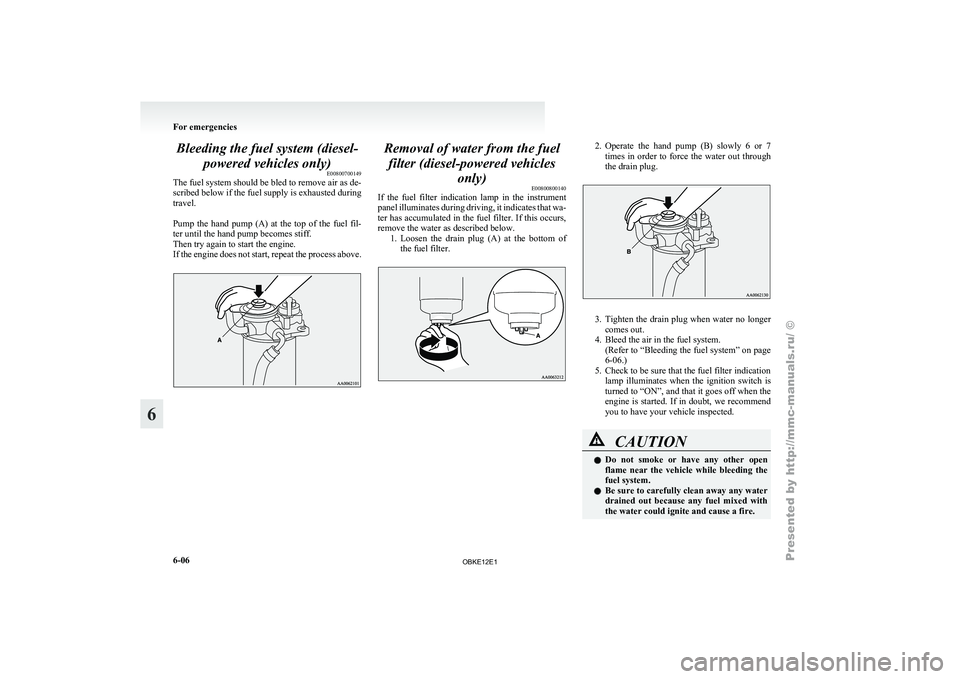
Bleeding the fuel system (diesel-
powered vehicles only) E00800700149
The fuel system should be bled to remove air as de-
scribed below if the fuel supply is exhausted during
travel.
Pump the hand
pump (A) at the top of the fuel fil-
ter until the hand pump becomes stiff.
Then try again to start the engine.
If the engine does not start, repeat the process above. Removal of water from the fuel
filter (diesel-powered vehicles only) E00800800140
If the fuel
filter indication lamp in the instrument
panel illuminates during driving, it indicates that wa-
ter has accumulated in the fuel filter. If this occurs,
remove the water as described below. 1. Loosen the drain plug (A) at the bottom ofthe fuel filter. 2. Operate the hand pump (B) slowly 6 or 7
times in order to force the water out through
the drain plug. 3. Tighten the drain plug when water no longer
comes out.
4. Bleed the air in the fuel system.
(Refer
to “Bleeding the fuel system” on page
6-06.)
5. Check to be sure that the fuel filter indication lamp illuminates when the ignition switch is
turned to “ON”, and that it goes off when the
engine is started. If in doubt, we recommend
you to have your vehicle inspected. CAUTION
l
Do not
smoke
or have any other open
flame near the vehicle while bleeding the
fuel system.
l Be sure to carefully clean away any water
drained out because any fuel mixed with
the water could ignite and cause a fire. For emergencies
6-06
6
OBKE12E1
Page 296 of 377

CAUTION
l
After
changing
the tyre and driving the ve-
hicle about 1,000 km (620 miles), retight-
en the wheel nuts to make sure that they
have not come loose.
l If the steering wheel vibrates when driv-
ing after changing the tyre, we recom-
mend you to have the tyres checked for
balance.
l Do not mix one type of tyre with another
or use a different size from the one listed.
This would cause early wear and poor han-
dling.
To store the flat tyre or spare tyre E00803400192
1. Attach the wheel to the spare wheel hanger
(A) while
aligning the holes in the wheel
with the bolts on the spare wheel hanger.
Using the wheel nut wrench, tighten the
spare wheel bolts firmly.
Tightening torque
37 to 54 Nm (Achieved by applying a force of 140 to
200 N
at the end of the wheel nut wrench sup-
plied with the vehicle.) 2. Reverse the opening procedure when closing
the spare wheel garnish.
Tightening torque
for spare wheel garnish
mounting bolt
11 to 25 Nm
(Achieved by applying a force of 40 to 92 N
at the end of the wheel nut wrench supplied
with the vehicle.) CAUTION
l
The spare
wheel
should always be se-
cured during vehicle operation. If a flat
tyre is changed, put the flat tyre in the
spare wheel mounting position, and use
the wheel nut wrench to secure it firmly.
NOTE l Have
your damaged
tyre repaired as soon as
possible. Towing
E00801503552
If your vehicle needs to be towed
If towing
is
necessary, we recommend you to have
it done by your MITSUBISHI MOTORS Author-
ized Service Point or a commercial tow truck service.
In the following cases, transport the vehicle using a
tow truck.
l The engine runs but the vehicle does not
move or abnormal noise is produced.
l Inspection of the vehicle’s underside reveals
that oil or some other fluid is leaking.
If a wheel gets stuck in a ditch, do not try to tow
the vehicle. Please contact your authorized
MITSUBISHI MOTORS dealer or a commercial
tow truck service for assistance.
Only when you cannot receive a towing service
from a MITSUBISHI MOTORS Authorized Serv-
ice Point or commercial tow truck service, tow
your vehicle carefully in accordance with the in-
structions given in “Emergency towing” in this part.
For emergencies
6-15 6
OBKE12E1
Page 309 of 377

Service precautions
E01000100764
Adequate care of
your vehicle at regular intervals
serves to preserve the value and appearance as long
as possible.
Maintenance items as described in this owner’s man-
ual can be performed by the owner.
We recommend you to have the periodic inspection
and maintenance performed by a MITSUBISHI
MOTORS Authorized Service Point or another spe-
cialist. In the event a malfunction or other problem
is discovered, we recommend you to have it
checked and repaired. This section contains infor-
mation on inspection maintenance procedures that
you can do yourself.
Follow the instructions and cautions for each of the
various procedures. WARNING
l When checking
or
servicing the inside of
the engine compartment, make sure the
engine is switched off and has had a
chance to cool down.
l If it is necessary to do work in the engine
compartment with the engine running, be
especially careful that your clothing, hair,
etc., does not become caught by the fans,
drive belts, or other moving parts.
l Do not smoke, cause sparks or allow open
flames around fuel or battery. The fumes
are flammable.
l Be extremely cautious when working
around the battery. It contains poisonous
and corrosive sulphuric acid. WARNING
l Do not get
under your vehicle with just
the body jack supporting it. Always use
automotive jack stands.
l Improper handling of components and
materials used in the vehicle can endan-
ger your personal safety. We recommend
you to consult a specialist for necessary in-
formation. Catalytic converter
E01000201355
For ordinary use,
there are no particular precau-
tions except that of using unleaded petrol.
The exhaust gas scavenging devices used with the
catalytic converter are extremely efficient for the re-
duction of noxious gases. The catalytic converter is
installed in the exhaust system.
It is important to keep the engine properly tuned to
ensure proper catalyst operation and prevent possi-
ble catalyst damage. WARNING
l As with
any
vehicle, do not park or oper-
ate this vehicle in areas where combusti-
ble materials such as dry grass or leaves
can come in contact with a hot exhaust
since a fire could occur.
l Paint should not be applied to the catalyt-
ic converter.
NOTE l In
case of
the petrol-powered vehicles, use
UNLEADED PETROL ONLY of the type
recommended in “Fuel selection” on page 02. Maintenance
8-02
8
OBKE12E1
Page 311 of 377
CAUTION
l
Be careful that hands or fingers are not
trapped when closing the bonnet. Engine oil
E01000402787
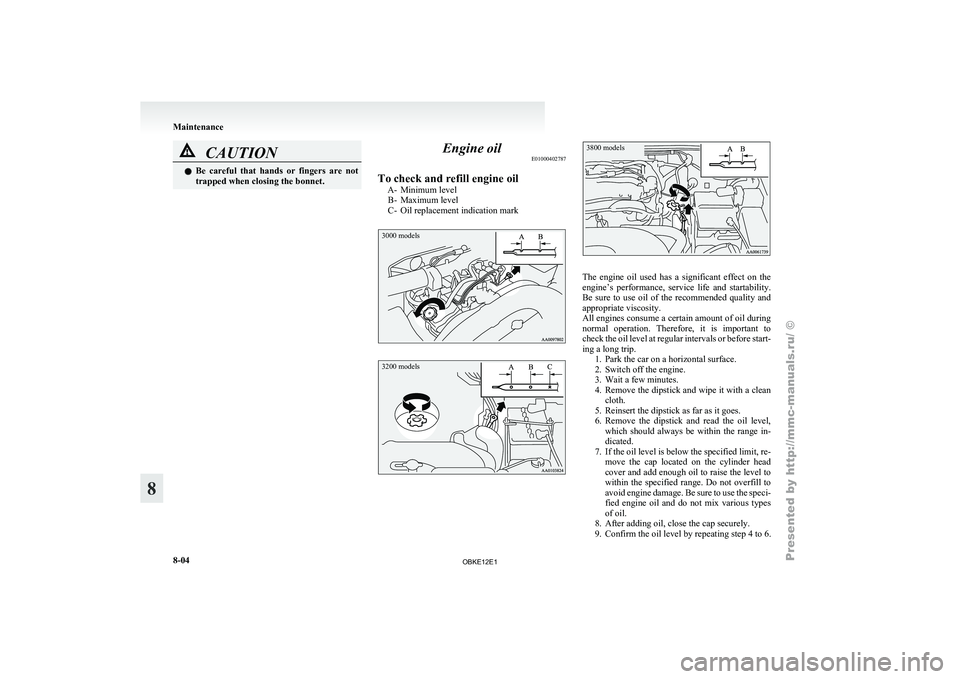
To check and refill engine oil A- Minimum level
B- Maximum level
C-
Oil replacement indication mark
3000 models
3200 models
3800 models The engine oil used has a significant effect on the
engine’s performance,
service
life and startability.
Be sure to use oil of the recommended quality and
appropriate viscosity.
All engines consume a certain amount of oil during
normal operation. Therefore, it is important to
check the oil level at regular intervals or before start-
ing a long trip. 1. Park the car on a horizontal surface.
2. Switch off the engine.
3. Wait a few minutes.
4. Remove the dipstick and wipe it with a cleancloth.
5. Reinsert the dipstick as far as it goes.
6. Remove the dipstick and read the oil level, which should always be within the range in-
dicated.
7. If the oil level is below the specified limit, re- move the cap located on the cylinder head
cover and add enough oil to raise the level to
within the specified range. Do not overfill to
avoid engine damage. Be sure to use the speci-
fied engine oil and do not mix various types
of oil.
8. After adding oil, close the cap securely.
9. Confirm the oil level by repeating step 4 to 6. Maintenance
8-04
8
OBKE12E1