Page 357 of 602
4-4 Driving safety
4
DefrostersCheck these by selecting the defroster mode, and set the blower
switch on high. You should be able to feel the air blowing
against the windshield.
Refer to “Defrosting or defogging (windshield, door win-
dows)” on page 5-14, 5-23, 5-33, 5-43.TiresCheck all the tires for heavy tread wear or uneven wear pat-
terns. Look for stones, nails, glass, or other objects stuck in the
tread. Look for any tread cuts or sidewall cracks. Check the
wheel nuts for tightness, and the tires (including spare tire) for
proper pressure. Replace your tires before they are heavily
worn out.
As your vehicle is equipped with a tire pressure monitoring
system, there is a risk of damage to the tire inflation pressure
sensors when the tire is replaced on the rim. Tire replacement
should, therefore, be performed only by an authorized Mitsub-
ishi Motors dealer.LightsHave someone watch while you turn all the exterior lights on
and off. Also check the turn signal indicators and high-beam
indicators on the instrument panel.Fluid leaksCheck the ground under the vehicle after parking overnight, for
fuel, water, oil, or other leaks. Make sure all the fluid levels are
correct. Also, if you can smell fuel, you need to find out why
immediately and have it fixed.
WA R N I N G
!�Always properly position floor mat and assure it
does not interfere with operation of the pedals.�Always use retaining clip on the driver’s floorboard
to secure the Mitsubishi genuine floor mat.�Always install the mat with the correct side facing
down.�Never install a second mat over an existing floor
mat.
BK0120400US.book 4 ページ 2010年5月12日 水曜日 午前10時50分
Page 394 of 602
Comfort controls
5-25
5 Automatic air conditioning-Type1
(if so
equipped)N00731500268
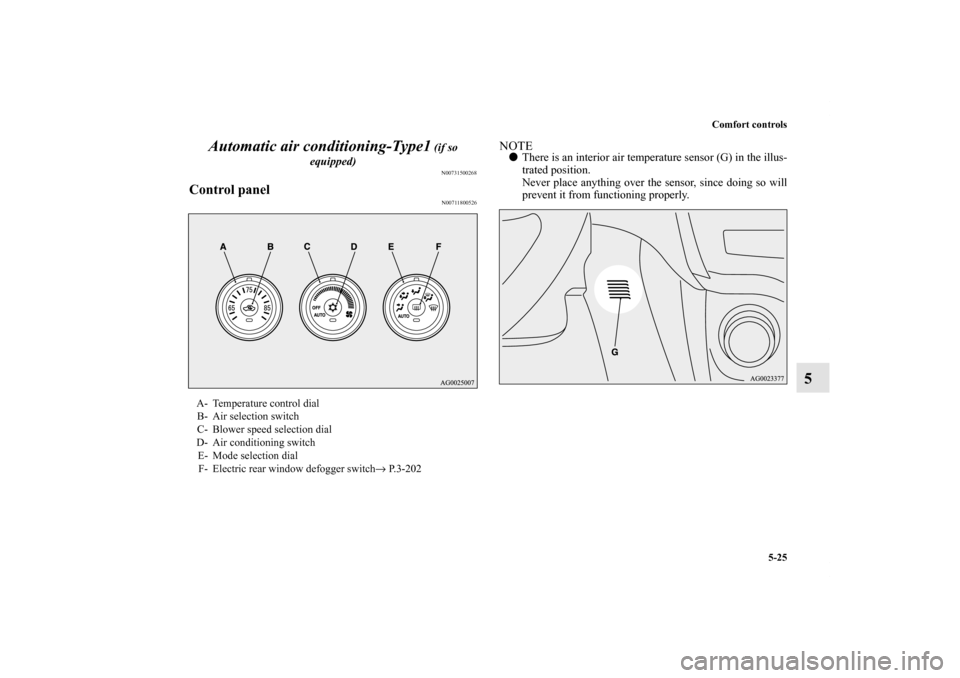
Control panel
N00711800526
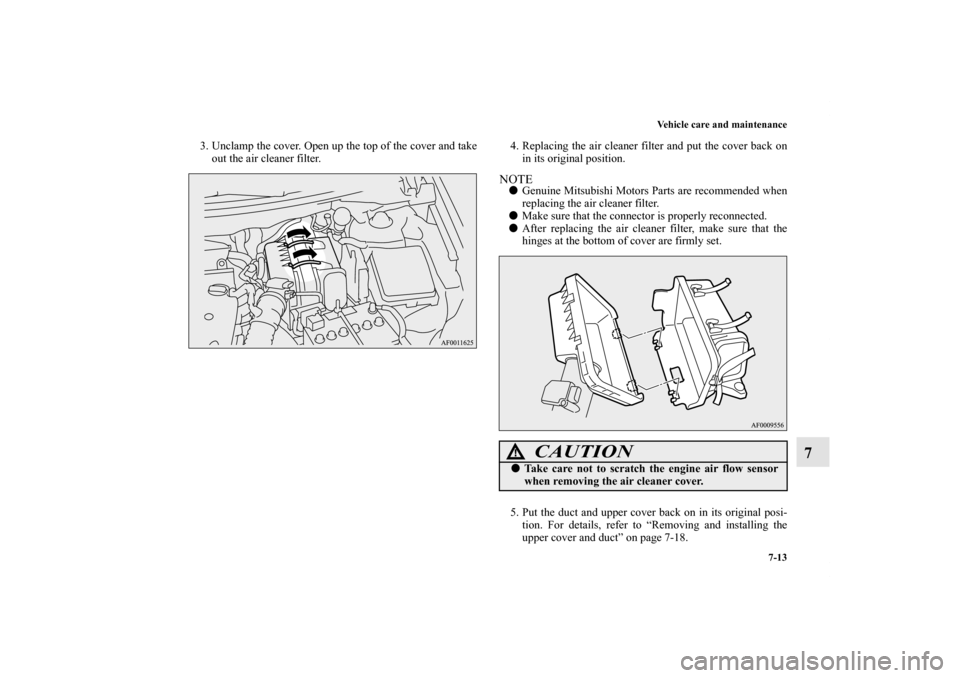
NOTE�There is an interior air temperature sensor (G) in the illus-
trated position.
Never place anything over the sensor, since doing so will
prevent it from functioning properly.
A- Temperature control dial
B- Air selection switch
C- Blower speed selection dial
D- Air conditioning switch
E- Mode selection dial
F- Electric rear window defogger switch→ P.3-202
BK0120400US.book 25 ページ 2010年5月12日 水曜日 午前10時50分
Page 404 of 602
Comfort controls
5-35
5 Automatic air conditioning-Type2
(if so
equipped)N00731500271
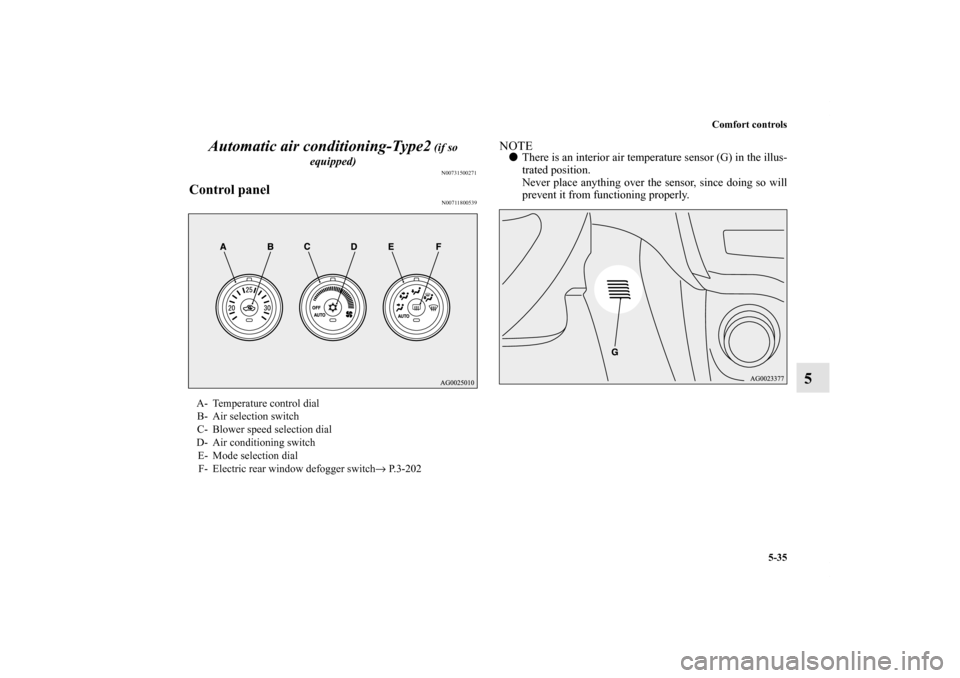
Control panel
N00711800539
NOTE�There is an interior air temperature sensor (G) in the illus-
trated position.
Never place anything over the sensor, since doing so will
prevent it from functioning properly.
A- Temperature control dial
B- Air selection switch
C- Blower speed selection dial
D- Air conditioning switch
E- Mode selection dial
F- Electric rear window defogger switch→ P.3-202
BK0120400US.book 35 ページ 2010年5月12日 水曜日 午前10時50分
Page 514 of 602
Vehicle care and maintenance
7-13
7
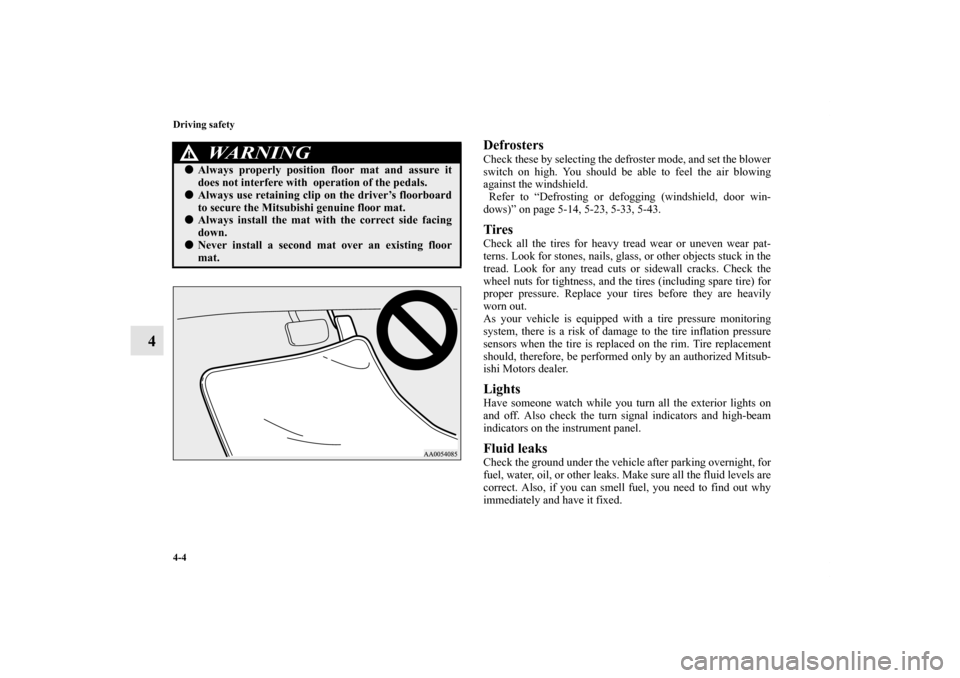
3. Unclamp the cover. Open up the top of the cover and take
out the air cleaner filter.4. Replacing the air cleaner filter and put the cover back on
in its original position.
NOTE�Genuine Mitsubishi Motors Parts are recommended when
replacing the air cleaner filter.
�Make sure that the connector is properly reconnected.
�After replacing the air cleaner filter, make sure that the
hinges at the bottom of cover are firmly set.
5. Put the duct and upper cover back on in its original posi-
tion. For details, refer to “Removing and installing the
upper cover and duct” on page 7-18.
CAUTION
!�Take care not to scratch the engine air flow sensor
when removing the air cleaner cover.
BK0120400US.book 13 ページ 2010年5月12日 水曜日 午前10時50分
Page 530 of 602
Vehicle care and maintenance
7-29
7
Replacing tires and wheels
N00939600241
Tire maintenance
N00939700141
The following maintenance steps are recommended:
�Check tire pressures regularly.
�Have regular maintenance done on the wheel balance and
front and rear suspension alignment.
�Rotate your tires regularly as described in the “Tire rota-
tion” section on page 7-30.
CAUTION
!�Avoid using different size tires from the one listed
and the combined use of different types of tires, as
this can affect driving safety.
Refer to “Tires and wheels” on page 9-8.�On all-wheel drive vehicles, always use tires of the
same size, same type, and same brand, and which
have no wear differences. Using tires that differ in
size, type, brand or the degree of wear, will increase
the differential oil temperature, resulting in possible
damage to the driving system. Further, the drive
train will be subjected to excessive loading, possibly
leading to oil leakage, component seizure, or other
serious problems.�Only Mitsubishi Motors Authorized wheels should
be used, because your vehicle is equipped with a tire
pressure monitoring system.
Use of another type of wheel risks air leaks and sen-
sor damage, as it will not be possible to install the
tire pressure sensor properly.
BK0120400US.book 29 ページ 2010年5月12日 水曜日 午前10時50分
Page 533 of 602
7-32 Vehicle care and maintenance
7
Snow tires
N00940000320
In some areas of the country, snow tires are required for winter
driving. If snow tires are required in your area, you must
choose snow tires of the same size and type as the original tires
provided with your vehicle. Snow tires should also be installed
on all four wheels. Otherwise your safety and vehicle handling
can be reduced.
Even where laws may permit it, snow tires should not be oper-
ated at sustained speeds over 75 mph (120 km/h).Tire chains
N00940100116
CAUTION
!�Avoid the combined use of different types of tires.
Using different types of tires can affect vehicle per-
formance and safety.
CAUTION
!�Only Mitsubishi Motors Authorized wheels should
be used, because your vehicle is equipped with a tire
pressure monitoring system.
Use of another type of wheel risks air leaks and sen-
sor damage, as it will not be possible to install the
tire pressure sensor properly.
CAUTION
!�Tire chains cannot be used on your vehicle. The
clearance between the chains and the body is not
sufficient to allow proper clearance, and the vehicle
body might be damaged.
BK0120400US.book 32 ページ 2010年5月12日 水曜日 午前10時50分
Page 574 of 602
Vehicle care and maintenance
7-73
7
During cold weatherSalt and other chemicals spread on winter roads in some geo-
graphical areas can have a detrimental effect on the vehicle
underbody. You should flush the underbody with a high pres-
sure hose every time you wash the outside of your vehicle.
Take special care to remove mud or other debris which could
trap and hold salt and moisture.
After washing your vehicle, wipe off all waterdrops from the
rubber parts around the doors to prevent the doors from freez-
ing.
CAUTION
!�When washing the underside of your vehicle or the
wheels, wear a pair of gloves to protect your hands.�If your vehicle has rain sensor wipers, place the
wiper switch lever in the “OFF” position to deacti-
vate the rain sensor before washing the vehicle. Oth-
erwise, the wipers will operate in the presence of
water spray on the windshield and may get damaged
as a result.�Never spray or splash water on the electrical parts
in the engine compartment. This may damage them.
Be careful also when washing the underbody to
ensure that water does not enter the engine com-
partment.�Avoid automatic car washers that use rotating
brushes. These brushes may scratch the paint sur-
face and make it dull.
Scratches are more noticeable on darker colored
vehicles.�Some hot water washing equipment uses high pres-
sure and heat to clean your vehicle. Because hot
water can damage plastics parts and seep inside
your vehicle, make sure you do the following when
using such equipment:
• Keep the washing nozzle at least 28 inches (70 cm)
away from the vehicle body.
• When washing around the door glass, hold the
nozzle at a distance of more than 28 inches (70 cm)
and at a right angle to the glass surface.
�Make sure to do the following when using an auto-
matic car wash, with help from either this manual or
the car wash operator, to avoid damaging your vehi-
cle:
• Fold the outside rearview mirrors.
• Remove the antenna.
• Tape the wiper arm assembly.
• If your vehicle is equipped with a rear spoiler or
roof rails, check with the car wash operator before
using the car wash.
• If your vehicle is equipped with the rain sensor
wipers, place the wiper switch lever in the “OFF”
position to deactivate the rain sensor.CAUTION
!
BK0120400US.book 73 ページ 2010年5月12日 水曜日 午前10時50分