2011 MITSUBISHI L200 oil type
[x] Cancel search: oil typePage 267 of 330

If the oil level is below the specified limit, remove
the cap located on the cylinder head cover and add
enough oil to raise the level to within the specified
range.
Be sure to use the specified engine oil and do not
mix various types of oil. Also, avoid mixing differ-
ent makes of oil together if possible.
After adding oil, close the cap securely.
Use only the recommended oils with an ACEA or
API classification as specified in this manual.
NOTE l The engine oil will deteriorate rapidly if the
vehicle is subjected to severe conditions (for
example, repeated operation on rough roads,
in mountainous regions, on roads with many
uphill and downhill gradients, or over short
distances). Consequently, the oil will require
earlier replacement.
l For handling of used engine oils, refer to
page 05.
Selection of engine oill Select engine oil of the proper SAE viscosity
number according to the atmospheric temper-
ature.
l Use engine oil conforming to the following
classification: • ACEA classification:“For service A1/ B1, A3/B3, A3/B4,
A5/B5”
• API classification: “For service CF-4”
NOTE l Use of additives is not recommended since
they may reduce the effectiveness of addi-
tives already included in the engine oil. It
may result in failure of the mechanical assem-
bly.Engine coolant E01000501202
To check the coolant level
A translucent coolant reserve tank is located in the
engine compartment.
The coolant level in this tank should be kept be-
tween the “LOW” and “FULL” marks when meas-
ured while the engine is cold.
To add coolant
The cooling system is a closed system and normal-
ly the loss of coolant should be very slight. A no-
ticeable drop in the coolant level could indicate leak-
age. If this occurs, we recommend you to have the
system checked as soon as possible.
If the level should drop below the “LOW” level on
the reserve tank, open the lid and add coolant.
Also, if the reserve tank is completely empty, re-
move the radiator cap and add coolant until the lev-
el reaches the filler neck.
Maintenance
8-05
8
Page 275 of 330
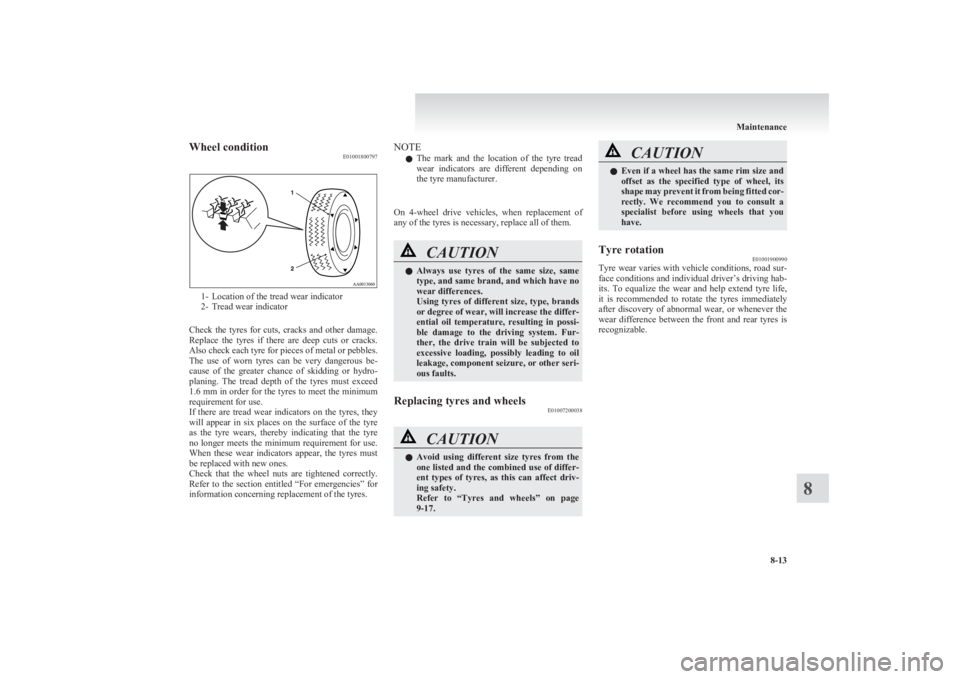
Wheel conditionE01001800797
1- Location of the tread wear indicator
2- Tread wear indicator
Check the tyres for cuts, cracks and other damage.
Replace the tyres if there are deep cuts or cracks.
Also check each tyre for pieces of metal or pebbles.
The use of worn tyres can be very dangerous be-
cause of the greater chance of skidding or hydro-
planing. The tread depth of the tyres must exceed
1.6 mm in order for the tyres to meet the minimum
requirement for use.
If there are tread wear indicators on the tyres, they
will appear in six places on the surface of the tyre
as the tyre wears, thereby indicating that the tyre
no longer meets the minimum requirement for use.
When these wear indicators appear, the tyres must
be replaced with new ones.
Check that the wheel nuts are tightened correctly.
Refer to the section entitled “For emergencies” for
information concerning replacement of the tyres.
NOTE
l The mark and the location of the tyre tread
wear indicators are different depending on
the tyre manufacturer.
On 4-wheel drive vehicles, when replacement of
any of the tyres is necessary, replace all of them.CAUTIONl Always use tyres of the same size, same
type, and same brand, and which have no
wear differences.
Using tyres of different size, type, brands
or degree of wear, will increase the differ-
ential oil temperature, resulting in possi-
ble damage to the driving system. Fur-
ther, the drive train will be subjected to
excessive loading, possibly leading to oil
leakage, component seizure, or other seri-
ous faults.Replacing tyres and wheels E01007200038CAUTIONlAvoid using different size tyres from the
one listed and the combined use of differ-
ent types of tyres, as this can affect driv-
ing safety.
Refer to “Tyres and wheels” on page
9-17.CAUTIONl Even if a wheel has the same rim size and
offset as the specified type of wheel, its
shape may prevent it from being fitted cor-
rectly. We recommend you to consult a
specialist before using wheels that you
have.Tyre rotation E01001900990
Tyre wear varies with vehicle conditions, road sur-
face conditions and individual driver’s driving hab-
its. To equalize the wear and help extend tyre life,
it is recommended to rotate the tyres immediately
after discovery of abnormal wear, or whenever the
wear difference between the front and rear tyres is
recognizable.
Maintenance
8-13
8
Page 287 of 330

Club cab
1- Door courtesy lamps*: 3.4 W
2- Front room lamp and personal lamps*:
7.5 W
3- Rear room lamp: 8 W
4- Glove box lamp: 1.4 W
5- Centre console downlight: 1.4 W
Double cab
1- Door courtesy lamps*: 3.4 W
2- Front room lamp and personal lamps: 7.5 W
3- Rear room lamp*: 8 W
4- Glove box lamp: 1.4 W
5- Centre console downlight: 1.4 W
Headlamps E01003501375
Type 1 1.Remove the bulb and connector assembly
(A) by turning it anticlockwise.High beamLow beam2. Depress the tab (B) on the harness connector
and pull the harness connector (C) to remove
it.High beamLow beam
3. To install the bulb, perform the removal
steps in reverse.
CAUTIONl Handle halogen lamp bulbs with care.
The gas inside halogen lamp bulbs is high-
ly pressurized, so dropping, knocking, or
scratching a halogen lamp bulb can cause
it to shatter.
l Never hold the halogen lamp bulb with a
bare hand, dirty glove, etc.
The oil from your hand could cause the
bulb to break the next time the head-
lamps are operated.
If the glass surface is dirty, it must be
cleaned with alcohol, paint thinner, etc.,
and refit it after drying it thoroughly.
Maintenance
8-25
8
Page 288 of 330

Type 21. Disconnect the connector (A).
2. Remove the sealing cover (B).
3.Unhook the spring (C) which secures the
bulb, and then remove the headlamp bulb.
4. To install the bulb, perform the removal
steps in reverse.
CAUTIONl Handle halogen lamp bulbs with care.
The gas inside halogen lamp bulbs is high-
ly pressurized, so dropping, knocking, or
scratching a halogen lamp bulb can cause
it to shatter.
l Never hold the halogen lamp bulb with a
bare hand, dirty glove, etc.
The oil from your hand could cause the
bulb to break the next time the head-
lamps are operated.
If the glass surface is dirty, it must be
cleaned with alcohol, paint thinner, etc.,
and refit it after drying it thoroughly.
Maintenance
8-26
8
Page 291 of 330
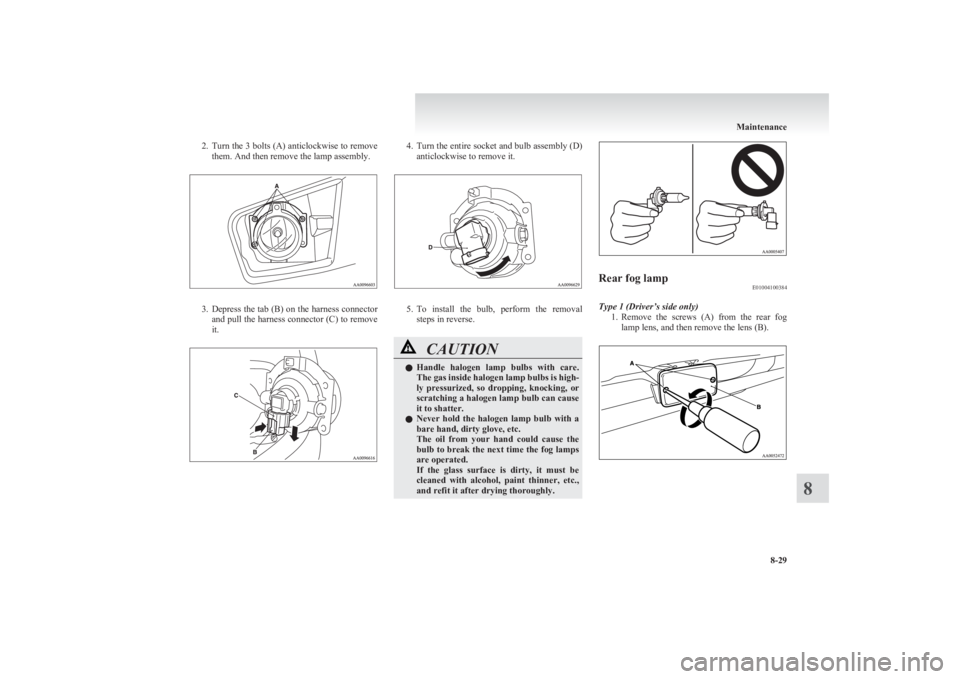
2.Turn the 3 bolts (A) anticlockwise to remove
them. And then remove the lamp assembly.
3. Depress the tab (B) on the harness connector
and pull the harness connector (C) to remove
it.
4. Turn the entire socket and bulb assembly (D)
anticlockwise to remove it.
5. To install the bulb, perform the removal
steps in reverse.
CAUTIONl Handle halogen lamp bulbs with care.
The gas inside halogen lamp bulbs is high-
ly pressurized, so dropping, knocking, or
scratching a halogen lamp bulb can cause
it to shatter.
l Never hold the halogen lamp bulb with a
bare hand, dirty glove, etc.
The oil from your hand could cause the
bulb to break the next time the fog lamps
are operated.
If the glass surface is dirty, it must be
cleaned with alcohol, paint thinner, etc.,
and refit it after drying thoroughly.Rear fog lamp E01004100384
Type 1 (Driver’s side only)
1.Remove the screws (A) from the rear fog
lamp lens, and then remove the lens (B).
Maintenance
8-29
8
Page 314 of 330
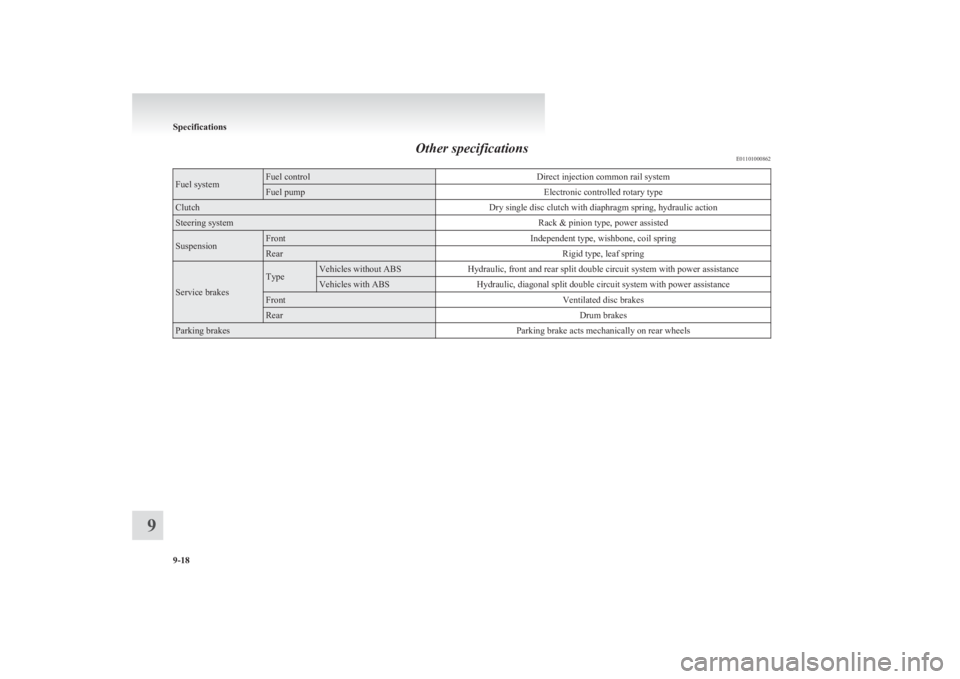
Other specificationsE01101000862Fuel systemFuel controlDirect injection common rail systemFuel pumpElectronic controlled rotary typeClutchDry single disc clutch with diaphragm spring, hydraulic actionSteering systemRack & pinion type, power assistedSuspensionFrontIndependent type, wishbone, coil springRearRigid type, leaf spring
Service brakes
TypeVehicles without ABSHydraulic, front and rear split double circuit system with power assistanceVehicles with ABSHydraulic, diagonal split double circuit system with power assistanceFrontVentilated disc brakesRearDrum brakesParking brakesParking brake acts mechanically on rear wheels
Specifications
9-18
9
Page 318 of 330
![MITSUBISHI L200 2011 Owners Manual (in English) No.ItemQuantityLubricants1Engine coolant8.2 litres
[includes 0.65 litre in the reserve tank]DIA QUEEN SUPER LONG LIFECOOLANT or equivalent2Automatic transmission fluid9.7 litresDIA QUEEN ATF SP III3Br](/manual-img/19/34873/w960_34873-317.png "MITSUBISHI L200 2011 Owners Manual (in English) No.ItemQuantityLubricants1Engine coolant8.2 litres
[includes 0.65 litre in the reserve tank]DIA QUEEN SUPER LONG LIFECOOLANT or equivalent2Automatic transmission fluid9.7 litresDIA QUEEN ATF SP III3Br")
No.ItemQuantityLubricants1Engine coolant8.2 litres
[includes 0.65 litre in the reserve tank]DIA QUEEN SUPER LONG LIFECOOLANT or equivalent2Automatic transmission fluid9.7 litresDIA QUEEN ATF SP III3Brake fluidAs requiredBrake fluid DOT3 or DOT44Clutch fluidAs requiredBrake fluid DOT3 or DOT45Power steering fluidAs requiredATF DEXRON III or DEXRON II
6Engine oil
Oil pan2WD with 15 inch tyres6.5 litres
Refer to page 8-04.
2WD with 16 inch tyres, 4WD5.5 litresOil filter0.8 litreOil cooler0.1 litre7Washer fluid4.8 litres,
4.5 litres* 1—8Manual transmis-
sion oil2WD2.3 litresGear oil API classification GL-3 SAE 75W-854WD3.4 litres9Transfer oil2.5 litresGear oil API classification GL-3 SAE
75W-85 or Gear oil API classification GL-4 SAE 75W-85
10Differential oil
Front*21.2 litres
Gear oil API classification GL-5 or
higher SAE 80WRear
Standard power en-
gine2WD with 15 inch tyres1.5 litres2WD with 16 inch tyres, 4WD2.6 litresHigh power engineA/TM/T3.2 litres11Refrigerant (air conditioning)480-520 g,
535-575 g* 3HFC-134a
*
1
: Vehicles with “front (Type 1)” (Refer to “Outside” on page 8-24)
* 2
: 4WD vehicles only
Specifications
9-22
9