2011 MERCEDES-BENZ GLK-Class Esc
[x] Cancel search: EscPage 283 of 304

Tire size designation, load-bearing
capacity and speed index:Tire width;Aspect ratio in percent=Tire code?Rim diameterALoad bearing indexBSpeed index
i Tire data is vehicle-specific and may
deviate from the data in the example.
General: depending on the manufacturer's
standards, the size imprinted in the tire wall
may not contain any letters or may contain
one letter that precedes the size description.
If there is no letter preceding the size
description (as shown above): passenger
vehicle tires according to European
manufacturing standards.
If "P" precedes the size description:
passenger vehicle tires according to U.S.
manufacturing standards.
If "LT" precedes the size description: light
truck tires according to U.S. manufacturing
standards.
If "T" precedes the size description: compact
emergency spare wheels at high tire
pressure, only for temporary use in an
emergency.
Tire width: tire width : shows the nominal
tire width in millimeters.
Aspect ratio: aspect ratio ; is relationship
between tire height and tire width and is
specified in percent. The aspect ratio is
calculated by dividing the tire width by the tire
height.
Tire code: tire code = specifies the tire type.
"R" represents radial tires. "D" represents
diagonal tires, "B" represents diagonal radial
tires.
Optionally, tires with a maximum speed of
over 149 mph (240 km/h) may have "ZR" in
the size description depending on the
manufacturer (e.g. 245/40 ZR 18).
Rim diameter: rim diameter ? is the
diameter of the bead seat, not the diameter
of the rim flange. The rim diameter is
specified in inches (in).
Load bearing index: load bearing index A
is a numerical code that specifies the
maximum load-bearing capacity of a tire.GWarning
The tire load rating must always be at least
half of the GAWR of your vehicle. Otherwise,
sudden tire failure may be the result which
could cause an accident and/or serious injury
to you or others.
Always replace rims and tires with rims and
tires having the same specifications
(designation, manufacturer and type) as
shown on the original part.
GWarning
Do not overload the tires by exceeding the
specified load limit as indicated on the Tire
and Loading Information placard on the
driver's door B-pillar. Overloading the tires
can overheat them, possibly causing a
blowout. Overloading the tires can also result
in handling or steering problems, or brake
failure.
Example:
The load bearing index 91 is equivalent to a
maximum load of 1356 lbs (615 kg) that the
tire can carry. For further information on the
maximum tire load in kilograms and pounds,
see ( Y page 278).
Tire labeling281Tires and wheelsBA 204.9 USA, CA Edition A 2011; 1; 6, en-USd2mwentsVersion: 3.0.3.62010-06-15T08:58:39+02:00 - Seite 281Z
Page 284 of 304

For further information on the load bearing
index, see load index ( Y page 283).
Speed index: speed index B specifies the
approved maximum speed of the tire.GWarning
Even when permitted by law, never operate a
vehicle at speeds greater than the maximum
speed rating of the tires.
Exceeding the maximum speed for which tires
are rated can lead to sudden tire failure,
causing loss of vehicle control and possibly
resulting in an accident and/or serious
personal injury and possible death, for you
and for others.
Regardless of the speed index always observe
the speed limits. Drive carefully and adapt
your driving style to the traffic conditions.
Summer tiresIndexSpeed ratingQup to 100 mph (160 km/h)Rup to 106 mph (170 km/h)Sup to 112 mph (180 km/h)Tup to 118 mph (190 km/h)Hup to 130 mph (210 km/h)Vup to 149 mph (240 km/h)Wup to 168 mph (270 km/h)Yup to 186 mph (300 km/h)ZR...Yup to 186 mph (300 km/h)ZR...(..Y)above 186 mph (300 km/h)ZRabove 149 mph (240 km/h)
R Optionally, tires with a maximum speed of
over 149 mph (240 km/h) may have "ZR"
in the size description depending on the
manufacturer (e.g. 245/40 ZR 18).
The service specifications consists of load
bearing index A and speed index B.
R If the size description of your tire includes
"ZR" and there are no service
specifications, ask the tire manufacturer in
order to find out the maximum speed.
If a service specification is available, the
maximum speed is limited according to the
speed index in the service specification.
Example: 245/40 ZR18 97 Y. In this
example, "97Y" is the service specification.
The letter "Y" represents the speed index
and the maximum speed of the tire is
limited to 186 mph (300 km/h).
R Every tire that has a maximum speed above
186 mph (300 km/h) must have "ZR" in the
size description and the service
specification must be given in brackets.
Example: 275/40 ZR 18 (99 Y). The speed
index "(Y)" shows that the maximum speed
of the tire is above 186 mph (300 km/h).
Ask the tire manufacturer to find out the
maximum speed.All-weather tires and winter tiresIndexSpeed ratingQ M+S 33up to 100 mph (160 km/h)T M+S33up to 118 mph (190 km/h)H M+S 33up to 130 mph (210 km/h)V M+S33up to 149 mph (240 km/h)
i
Not all tires that have the M+S
identification offer the driving
characteristics of winter tires. Winter tires
have, in addition to the M+S identification,
the i snow flake symbol on the tire
sidewall. Tires with this identification fulfill
the requirements of the Rubber
Manufacturers Association (RMA) and the
Rubber Association of Canada (RAC)
regarding the tire traction on snow and
33 or M+S i for winter tires.282Tire labelingTires and wheels
BA 204.9 USA, CA Edition A 2011; 1; 6, en-USd2mwentsVersion: 3.0.3.62010-06-15T08:58:39+02:00 - Seite 282
Page 285 of 304

have been especially developed for driving
on snow.
An electronic speed limiter prevents your
vehicle from exceeding a speed of
130 mph (210 km/h).
The speed index of tires installed at the
factory may be higher than the maximum
speed that the electronic speed limiter
permits.
Make sure that your tires have the required
speed index as specified in the "Tires" section
( Y page 287) for your vehicle, e.g. when
buying new tires.
More information on reading the tire data can
be obtained at any qualified specialist
workshop, e.g. at an authorized Mercedes-
Benz Center.
Load index
i Tire data is vehicle-specific and may
deviate from the data in the example.
In addition to the load bearing index, load
index : may be imprinted after the letters
that identify speed index B (Y page 281) on
the sidewall of the tire.
R If no specification is given: no text (as in the
example above), represents a standard
load (SL) tire
R XL or Extra Load: represents a reinforced
tire
R Light load: represents a light load tire
R C, D, E: represents a load range that
depends on the maximum load that the tire
can carry at a certain pressure
DOT, Tire Identification Number (TIN)
U.S. tire regulations prescribe that every new
tire manufacturer or retreader has to imprint
a TIN in or on the sidewall of each tire
produced.
The TIN is a unique identification number. The
TIN enables the tire manufacturers to inform
purchasers of recalls and other safety-
relevant matters. It makes it possible for the
purchaser to easily identify the affected tires.
The TIN is made up of manufacturer
identification code ;, tire size =, tire type
code ? and date of manufacture A.
i Tire data is vehicle-specific and may
deviate from the data in the example.
DOT (Department of Transportation): tire
symbol : marks that the tire complies with
the requirements of the U.S. Department of
Transportation.
Manufacturer identification code:
manufacturer identification code ; provides
details on the tire manufacturer. New tires
have a code with two symbols. Retreaded
tires have a code with four symbols.
Further information about retreaded tires
( Y page 264).
Tire size: identifier = describes the tire size.
Tire labeling283Tires and wheelsBA 204.9 USA, CA Edition A 2011; 1; 6, en-USd2mwentsVersion: 3.0.3.62010-06-15T08:58:39+02:00 - Seite 283Z
Page 286 of 304
Tire type code: tire type code ? can be
used by the manufacturer as a code to
describe specific characteristics of the tire.
Date of manufacture: date of manufacture
A provides information about the age of a
tire. The first and second positions represent
the week of manufacture, starting with "01"
for the first calendar week. Positions three
and four represent the year of manufacture.
For example, a tire that is marked with
"3208", was manufactured in week 32 in
2008.
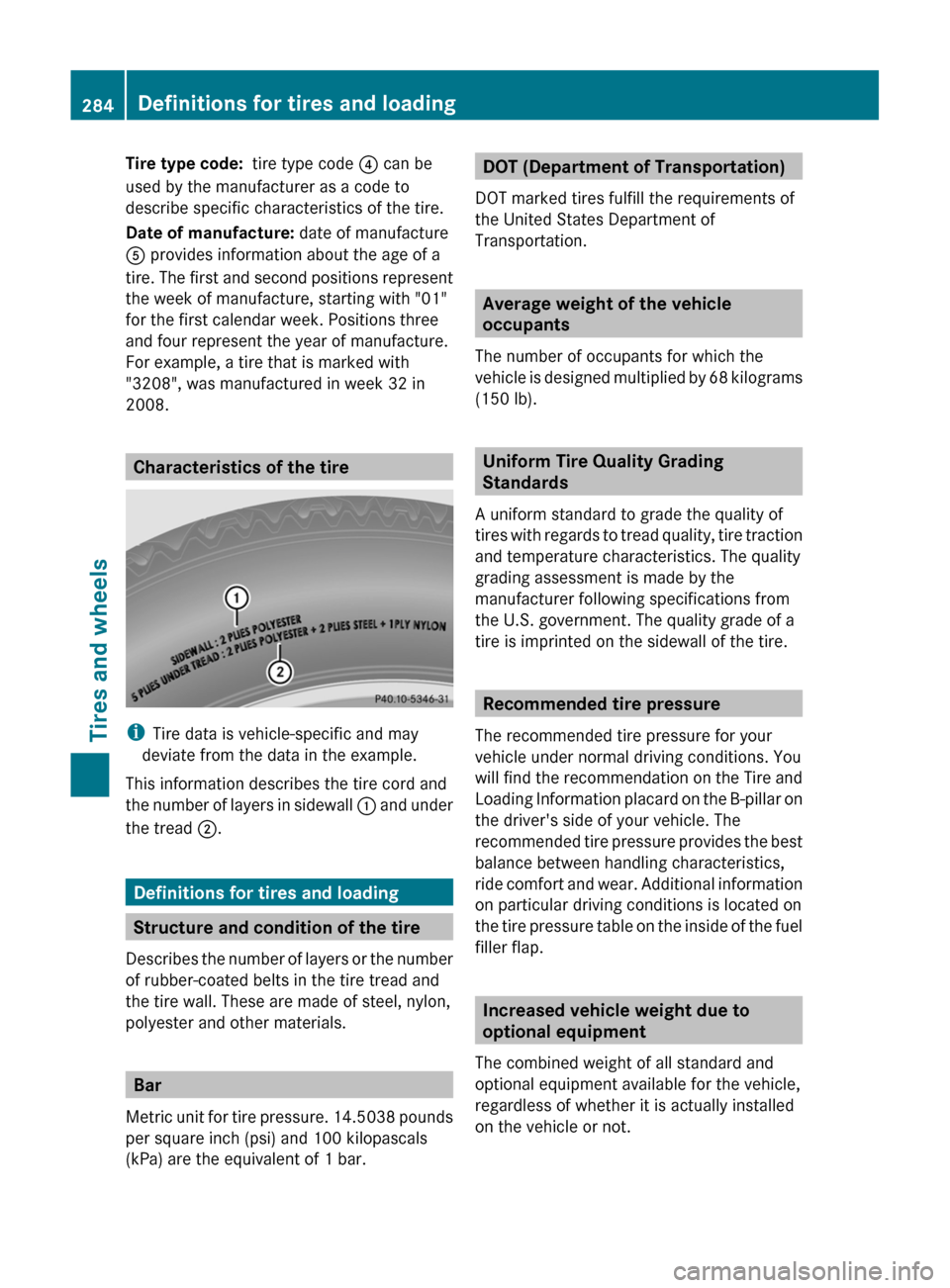
Characteristics of the tire
i Tire data is vehicle-specific and may
deviate from the data in the example.
This information describes the tire cord and
the number of layers in sidewall : and under
the tread ;.
Definitions for tires and loading
Structure and condition of the tire
Describes the number of layers or the number
of rubber-coated belts in the tire tread and
the tire wall. These are made of steel, nylon,
polyester and other materials.
Bar
Metric unit for tire pressure. 14.5038 pounds
per square inch (psi) and 100 kilopascals
(kPa) are the equivalent of 1 bar.
DOT (Department of Transportation)
DOT marked tires fulfill the requirements of
the United States Department of
Transportation.
Average weight of the vehicle
occupants
The number of occupants for which the
vehicle is designed multiplied by 68 kilograms
(150 lb).
Uniform Tire Quality Grading
Standards
A uniform standard to grade the quality of
tires with regards to tread quality, tire traction
and temperature characteristics. The quality
grading assessment is made by the
manufacturer following specifications from
the U.S. government. The quality grade of a
tire is imprinted on the sidewall of the tire.
Recommended tire pressure
The recommended tire pressure for your
vehicle under normal driving conditions. You
will find the recommendation on the Tire and
Loading Information placard on the B-pillar on
the driver's side of your vehicle. The
recommended tire pressure provides the best
balance between handling characteristics,
ride comfort and wear. Additional information
on particular driving conditions is located on
the tire pressure table on the inside of the fuel
filler flap.
Increased vehicle weight due to
optional equipment
The combined weight of all standard and
optional equipment available for the vehicle,
regardless of whether it is actually installed
on the vehicle or not.
284Definitions for tires and loadingTires and wheels
BA 204.9 USA, CA Edition A 2011; 1; 6, en-USd2mwentsVersion: 3.0.3.62010-06-15T08:58:39+02:00 - Seite 284
Page 294 of 304

Vehicle equipment
i This manual describes all the standard
and optional equipment of your vehicle
which was available at the time of
purchase. Country-specific differences are
possible. Bear in mind that your vehicle
may not feature all functions described
here. This also refers to safety-related
systems and functions.
Genuine Mercedes-Benz parts
All Mercedes-Benz Centers maintain a supply
of genuine Mercedes-Benz parts for
necessary service and repair work. In
addition, strategically located parts delivery
centers provide for quick and reliable parts
service.
More than 300,000 different genuine
Mercedes-Benz parts are available for
Mercedes-Benz models.
Genuine Mercedes-Benz parts are subjected
to stringent quality inspections. Every part
has been specifically developed,
manufactured or selected for and adapted to
Mercedes-Benz vehicles.
Only genuine Mercedes-Benz parts should
therefore be used.
! The use of non-approved parts could
impair the vehicle's safety. For this reason,
Mercedes-Benz recommends genuine
Mercedes-Benz parts and approved
conversion parts and accessories for your
vehicle model.
HEnvironmental note
Daimler AG also supplies reconditioned major
assemblies and parts which are of the same
quality as new parts. They are covered by the
same Limited Warranty entitlements as new
parts.
Always specify the vehicle identification
number and engine number when ordering
genuine Mercedes-Benz parts. You will find
these numbers on your vehicle's
identification plates, for example
( Y page 293).
Warranty
Your vehicle is covered under the terms of the
warranties printed in the Service and
Warranty Information booklet.
Your authorized Mercedes-Benz Center will
exchange or repair any defective parts
originally installed in the vehicle in
accordance with the terms of the following
warranties:
R New Vehicle Limited Warranty
R Emission System Warranty
R Emission Performance Warranty
R California, Connecticut, Maine,
Massachusetts, New York, Pennsylvania,
Rhode Island and Vermont Emission
Control Systems Warranty
R State Warranty Enforcement Laws (Lemon
Laws)
Replacement parts and accessories are
subject to the Mercedes-Benz Replacement
Part and Accessory Warranties. You can
obtain these at any Mercedes-Benz Center.
i Should you lose your Service and
Warranty Information booklet, have an
authorized Mercedes-Benz Center arrange
for a replacement. It will be mailed to you.
292WarrantyTechnical data
BA 204.9 USA, CA Edition A 2011; 1; 6, en-USd2mwentsVersion: 3.0.3.62010-06-15T08:58:39+02:00 - Seite 292
Page 299 of 304

Rmisfire
R power loss
In areas where carbon deposits may be
encountered due to lack of availability of
gasoline which contains these additives,
Mercedes-Benz recommends the use of
additives approved for use in Mercedes-Benz
vehicles.
Consult an authorized Mercedes-Benz Center
or visit http://www.mbusa.com (USA only)
to view a list of approved products. Observe
the instructions for use on the product label.
Do not mix other fuel additives with fuel. This
causes unnecessary costs and could damage
the engine.
! Do not refuel with low-grade fuel and do
not use fuel additives that are not tested
and approved for Mercedes-Benz vehicles.
Damage or malfunctions can result that are
not covered:
R by the Mercedes-Benz Limited Warranty
R by an existing Limited Warranty
R by an extended Limited Warranty
Engine oil
Points to remember
The engine oils are matched to the
performance of Mercedes-Benz engines and
service intervals. For this reason, only use
engine oils and oil filters that are approved for
vehicles with a service system.
Contact an authorized Mercedes-Benz Center
or visit http://www.mbusa.com (USA only)
for a list of approved engine oils and oil filters.
! Never use engine oil or an oil filter of a
specification other than is necessary to
fulfill the prescribed service intervals. Do
not change the engine oil or oil filter in
order to achieve longer replacement
intervals than those prescribed. Otherwise,
you may cause damage to the engine or
exhaust gas aftertreatment; this is not
covered by the Mercedes-Benz Limited
Warranty.
Follow the instructions in the service
interval display regarding the oil change.
Otherwise, you may damage the engine and
the exhaust gas aftertreatment.
Mercedes-Benz recommends MOBIL OIL.
The table shows which engines oil have been
approved for your vehicle.ModelEngine
modelMB
ApprovalGLK 350 38272229.5GLK 350 4MATIC272229.5
i
MB Approval is stated on the containers.
Lubricant additives
! Do not mix any lubricant additives with
the engine oil. This could damage the
engine. Damage resulting from the use of
such lubricant additives in the engine oil is
not covered by the Mercedes-Benz Limited
Warranty.
Engine oil viscosity
Viscosity describes the flow characteristics
of a fluid. If an engine oil has a high viscosity,
this means that it is thick; a low viscosity
means that it is thin.
Using the table below, make sure that the SAE
classification (viscosity) is sufficient for the
temperatures at which the vehicle is
operated. The low temperature
characteristics of engine oils can deteriorate
significantly, e.g. by aging, soot and fuel
deposits. It is therefore recommended that
you carry out oil changes regularly using an
approved engine oil with the appropriate SAE
classification.
38 USA only.Service products and capacities297Technical dataBA 204.9 USA, CA Edition A 2011; 1; 6, en-USd2mwentsVersion: 3.0.3.62010-06-15T08:58:39+02:00 - Seite 297Z