2011 HYUNDAI VELOSTER steering
[x] Cancel search: steeringPage 12 of 386
Introduction
6 1
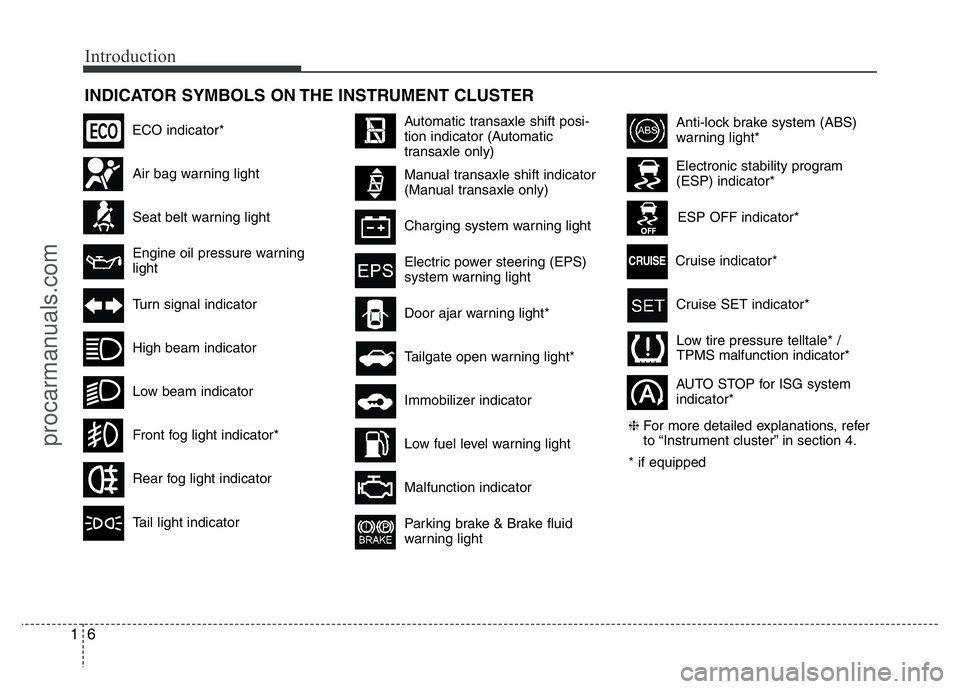
INDICATOR SYMBOLS ON THE INSTRUMENT CLUSTER
Seat belt warning light
High beam indicator
Turn signal indicator
Anti-lock brake system (ABS)
warning light*
Parking brake & Brake fluid
warning light
Malfunction indicator
Immobilizer indicator Tailgate open warning light*
Charging system warning light
Door ajar warning light*
Electronic stability program
(ESP) indicator*
ESP OFF indicator*
Front fog light indicator*
Engine oil pressure warning
lightElectric power steering (EPS)
system warning light
Air bag warning light
Low tire pressure telltale* /
TPMS malfunction indicator*
Rear fog light indicator
Cruise SET indicator*
AUTO STOP for ISG system
indicator* Cruise indicator*
Tail light indicator
Automatic transaxle shift posi-
tion indicator (Automatic
transaxle only)
Manual transaxle shift indicator
(Manual transaxle only)
Low fuel level warning light
Low beam indicator
❈For more detailed explanations, refer
to “Instrument cluster” in section 4.
* if equipped
ECO indicator*
CRUISE
procarmanuals.com
Page 14 of 386
Your vehicle at a glance
2 2
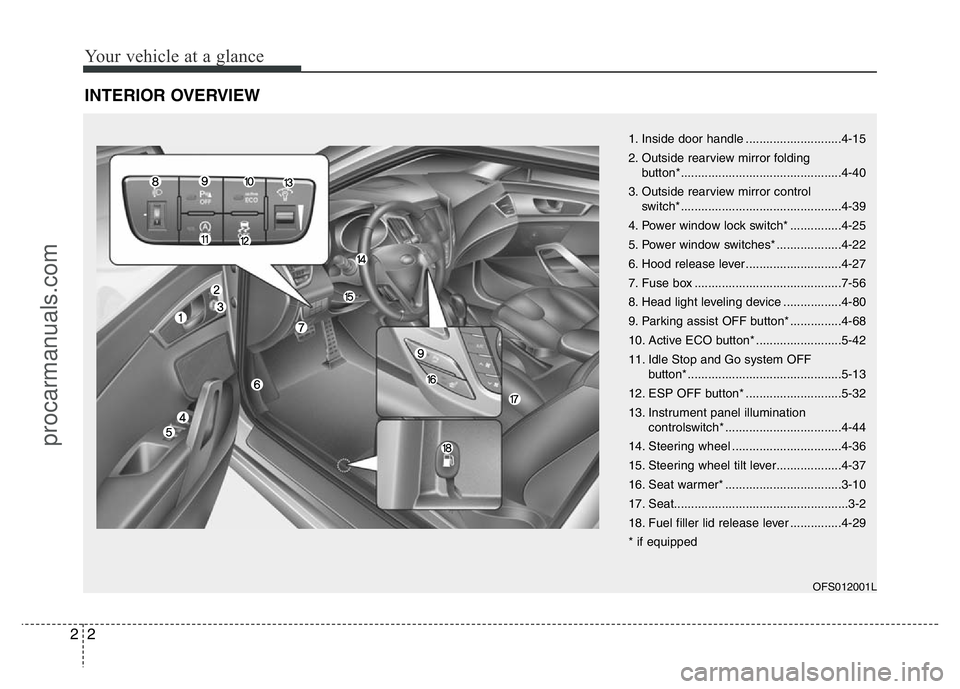
INTERIOR OVERVIEW
1. Inside door handle ............................4-15
2. Outside rearview mirror folding
button*...............................................4-40
3. Outside rearview mirror control
switch*...............................................4-39
4. Power window lock switch* ...............4-25
5. Power window switches* ...................4-22
6. Hood release lever ............................4-27
7. Fuse box ...........................................7-56
8. Head light leveling device .................4-80
9. Parking assist OFF button* ...............4-68
10. Active ECO button* .........................5-42
11.
Idle Stop and Go system OFF
button*.............................................5-13
12. ESP OFF button* ............................5-32
13. Instrument panel illumination
controlswitch* ..................................4-44
14. Steering wheel ................................4-36
15. Steering wheel tilt lever...................4-37
16. Seat warmer* ..................................3-10
17. Seat...................................................3-2
18. Fuel filler lid release lever ...............4-29
* if equipped
OFS012001L
procarmanuals.com
Page 15 of 386
23
Your vehicle at a glance
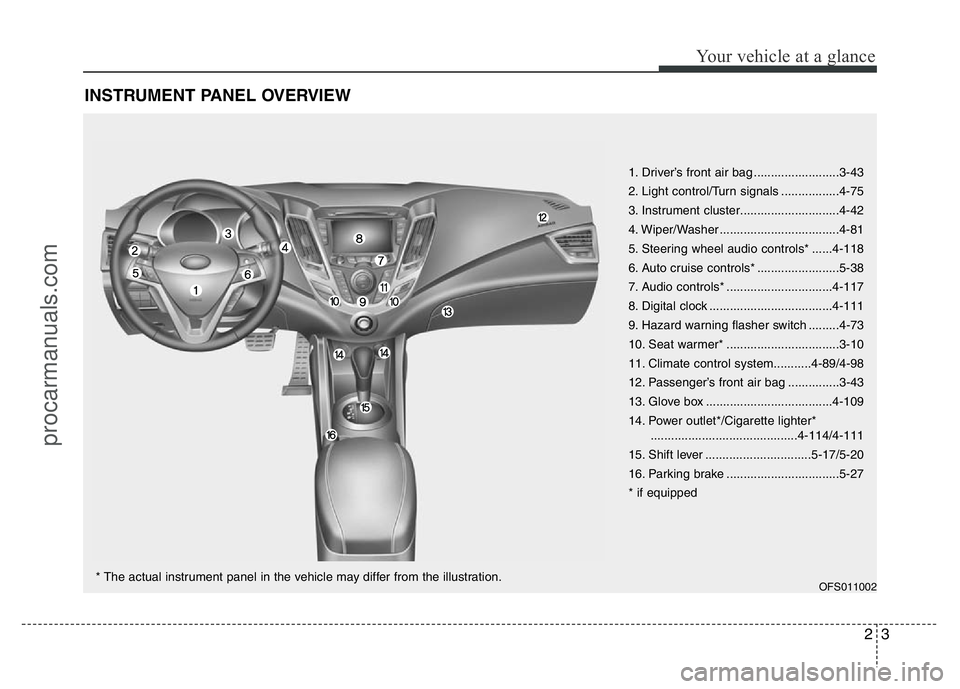
INSTRUMENT PANEL OVERVIEW
1. Driver’s front air bag .........................3-43
2. Light control/Turn signals .................4-75
3. Instrument cluster.............................4-42
4. Wiper/Washer ...................................4-81
5. Steering wheel audio controls* ......4-118
6. Auto cruise controls* ........................5-38
7. Audio controls* ...............................4-117
8. Digital clock ....................................4-111
9. Hazard warning flasher switch .........4-73
10. Seat warmer* .................................3-10
11. Climate control system...........4-89/4-98
12. Passenger’s front air bag ...............3-43
13. Glove box .....................................4-109
14. Power outlet*/Cigarette lighter*
...........................................4-114/4-111
15. Shift lever ...............................5-17/5-20
16. Parking brake .................................5-27
* if equipped
OFS011002* The actual instrument panel in the vehicle may differ from the illustration.
procarmanuals.com
Page 19 of 386
33
Safety features of your vehicle
WARNING- Driver’s seat
• Never attempt to adjust seat
while the vehicle is moving. This
could result in loss of control,
and an accident causing death,
serious injury, or property dam-
age.
• Do not allow anything to interfere
with the normal position of the
seatback. Storing items against a
seatback or in any other way
interfering with proper locking of
a seatback could result in serious
or fatal injury in a sudden stop or
collision.
• Always drive and ride with your
seatback upright and the lap por-
tion of the seat belt snug and low
across the hips. This is the best
position to protect you in case of
an accident.
• In order to avoid unnecessary
and perhaps severe air bag
injuries, always sit as far back as
possible from the steering wheel
while maintaining comfortable
control of the vehicle. We recom-
mend that your chest be at least
250 mm (10 inches) away from
the steering wheel.
WARNING - Uprighting
seat
When you return the seatback to its
upright position, hold the seatback
and return it slowly and be sure
there are no other occupants
around the seat. If the seatback is
returned without being held and
controlled, the back of the seat
could move forward or backward
resulting in accidental injury to a
person struck by the seatback.
WARNING- Driver respon-
sibility for passengers
Riding in a vehicle with seatback
reclined could lead to serious or
fatal injury in an accident. If a seat
is reclined during an accident, the
occupant’s hips may slide under
the lap portion of the seat belt
applying great force to the unpro-
tected abdomen. The protection of
your retraint system (seat belt and
air bags) is greatly reduced by
reclining your seat. Serious or fatal
internal injuries could result. The
driver must advise the passenger
to keep the seatback in an upright
position whenever the vehicle is in
motion.
WARNING- Loose objects
Loose objects in the driver’s foot
area could interfere with the opera-
tion of the foot pedals, possibly
causing an accident. Do not place
anything under the front seats.
WARNING
Do not use a sitting cushion that
reduces friction between the seat
and passenger. The passenger's
hips may slide under the lap por-
tion of the seat belt during an acci-
dent or a sudden stop. Serious or
fatal internal injuries could result
because the seat belt can't operate
normally.
procarmanuals.com
Page 23 of 386
37
Safety features of your vehicle
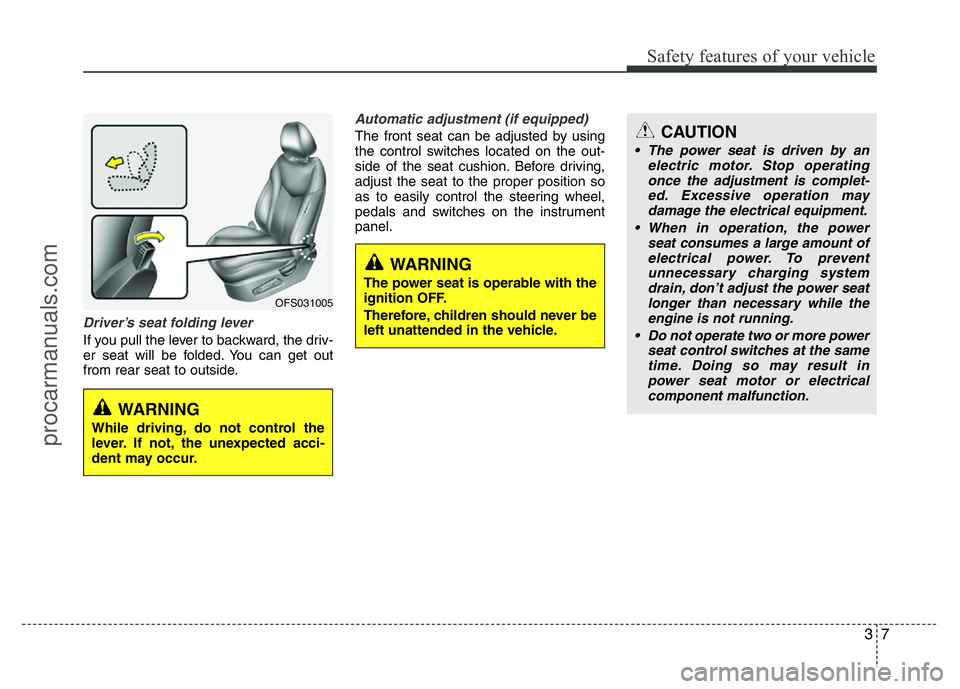
Driver’s seat folding lever
If you pull the lever to backward, the driv-
er seat will be folded. You can get out
from rear seat to outside.
Automatic adjustment (if equipped)
The front seat can be adjusted by using
the control switches located on the out-
side of the seat cushion. Before driving,
adjust the seat to the proper position so
as to easily control the steering wheel,
pedals and switches on the instrument
panel.
OFS031005
WARNING
While driving, do not control the
lever. If not, the unexpected acci-
dent may occur.
CAUTION
• The power seat is driven by an
electric motor. Stop operating
once the adjustment is complet-
ed. Excessive operation may
damage the electrical equipment.
• When in operation, the power
seat consumes a large amount of
electrical power. To prevent
unnecessary charging system
drain, don’t adjust the power seat
longer than necessary while the
engine is not running.
• Do not operate two or more power
seat control switches at the same
time. Doing so may result in
power seat motor or electrical
component malfunction.
WARNING
The power seat is operable with the
ignition OFF.
Therefore, children should never be
left unattended in the vehicle.
procarmanuals.com
Page 53 of 386
337
Safety features of your vehicle
How does the air bag system
operate
• Air bags are activated (able to inflate if
necessary) only when the ignition
switch is turned to the ON or START
position.
• Air bags inflate instantly in the event of
serious frontal or side collision in order
to help protect the occupants from seri-
ous physical injury.
• There is no single speed at which the
air bags will inflate.
Generally, air bags are designed to
inflate based upon the severity of a col-
lision and its direction. These two fac-
tors determine whether the sensors
produce an electronic deployment/
inflation signal.
• Air bag deployment depends on a
number of factors including vehicle
speed, angles of impact and the densi-
ty and stiffness of the vehicles or
objects which your vehicle hits in the
collision. The determining, factors are
not limited to those mentioned above.
• The front air bags will completely
inflate and deflate in an instant.
It is virtually impossible for you to see
the air bags inflate during an accident.It is much more likely that you will sim-
ply see the deflated air bags hanging
out of their storage compartments after
the collision.
• In order to help provide protection in a
severe collision, the air bags must
inflate rapidly. The speed of air bag
inflation is a consequence of extreme-
ly short time in which a collision occurs
and the need to get the air bag
between the occupant and the vehicle
structures before the occupant impacts
those structures. This speed of inflation
reduces the risk of serious or life-
threatening injuries in a severe colli-
sion and is thus a necessary part of air
bag design.
However, air bag inflation can also
cause injuries which can include facial
abrasions, bruises and broken bones
because the inflation speed also caus-
es the air bags to expand with a great
deal of force.
• There are even circumstances
under which contact with the steer-
ing wheel air bag can cause fatal
injuries, especially if the occupant
is positioned excessively close to
the steering wheel.
WARNING
• To avoid severe personal injury
or death caused by deploying air
bags in a collision, the driver
should sit as far back from the
steering wheel air bag as possible
(at least 250 mm (10 inches)
away). The front passenger should
always move their seat as far
back as possible and sit back in
their seat.
• Air bag inflates instantly in an
event of a collision, passengers
may be injured by the air bag
expansion force if they are not in
a proper position.
• Air bag inflation may cause
injuries including facial or bodily
abrasions, injuries from broken
glasses or burns.
procarmanuals.com
Page 54 of 386
Safety features of your vehicle
38 3
Noise and smoke
When the air bags inflate, they make a
loud noise and they leave smoke and
powder in the air inside of the vehicle.
This is normal and is a result of the igni-
tion of the air bag inflator. After the air
bag inflates, you may feel substantial dis-
comfort in breathing due to the contact of
your chest with both the seat belt and the
air bag, as well as from breathing the
smoke and powder.Open your doors
and/or windows as soon as possible
after impact in order to reduce dis-
comfort and prevent prolonged expo-
sure to the smoke and powder.
Though smoke and powder are non-
toxic, it may cause irritation to the skin
(eyes, nose and throat, etc.). If this is the
case, wash and rinse with cold water
immediately and consult with the doctor if
the symptom persists.
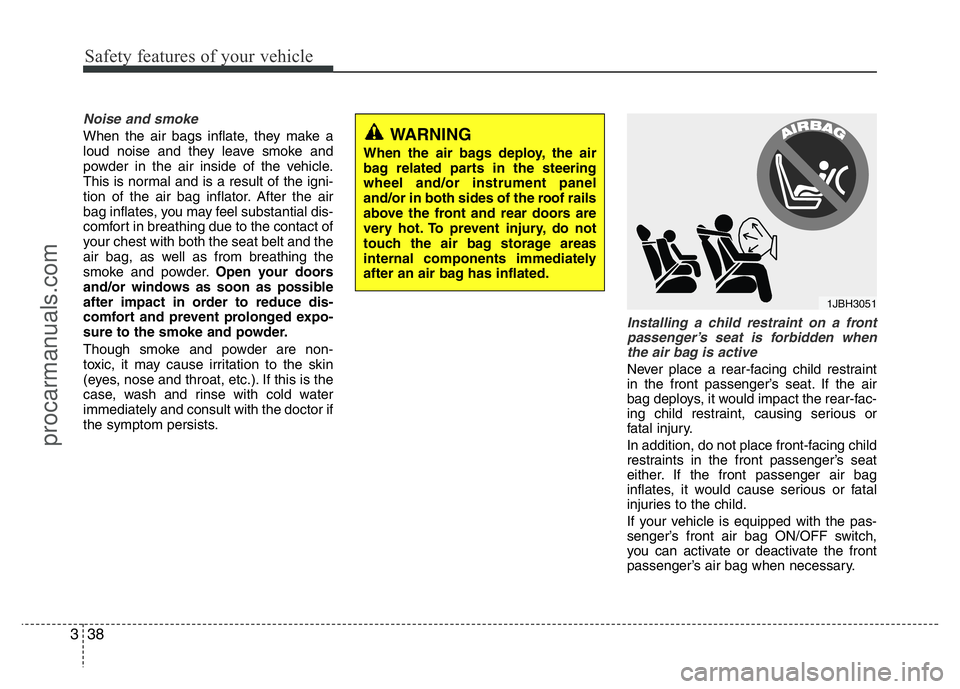
Installing a child restraint on a front
passenger’s seat is forbidden when
the air bag is active
Never place a rear-facing child restraint
in the front passenger’s seat. If the air
bag deploys, it would impact the rear-fac-
ing child restraint, causing serious or
fatal injury.
In addition, do not place front-facing child
restraints in the front passenger’s seat
either. If the front passenger air bag
inflates, it would cause serious or fatal
injuries to the child.
If your vehicle is equipped with the pas-
senger’s front air bag ON/OFF switch,
you can activate or deactivate the front
passenger’s air bag when necessary.
1JBH3051
WARNING
When the air bags deploy, the air
bag related parts in the steering
wheel and/or instrument panel
and/or in both sides of the roof rails
above the front and rear doors are
very hot. To prevent injury, do not
touch the air bag storage areas
internal components immediately
after an air bag has inflated.
procarmanuals.com
Page 58 of 386
Safety features of your vehicle
42 3
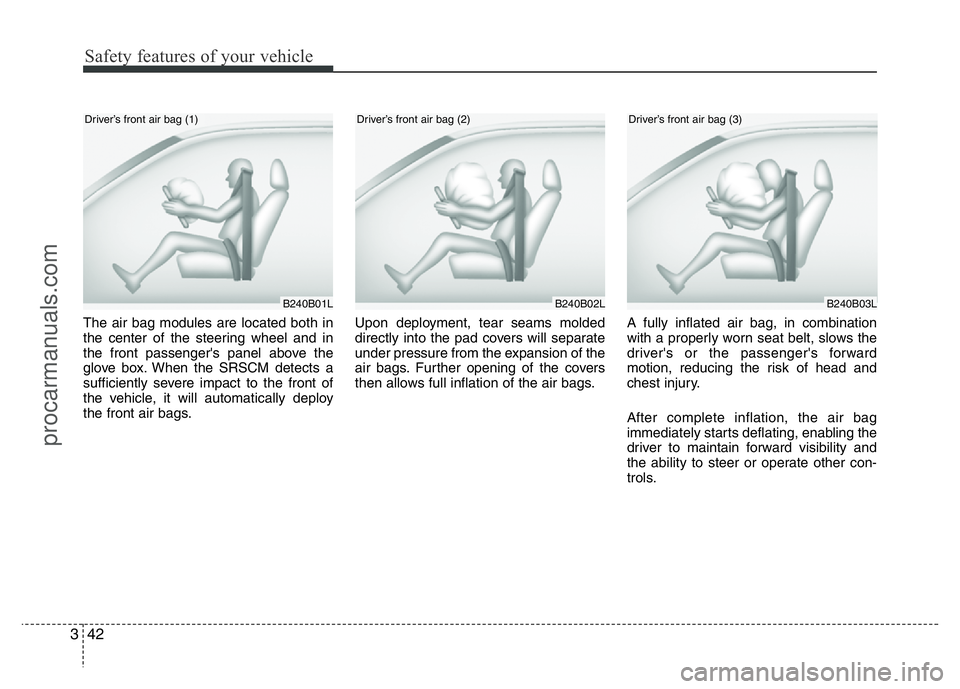
The air bag modules are located both in
the center of the steering wheel and in
the front passenger's panel above the
glove box. When the SRSCM detects a
sufficiently severe impact to the front of
the vehicle, it will automatically deploy
the front air bags.Upon deployment, tear seams molded
directly into the pad covers will separate
under pressure from the expansion of the
air bags. Further opening of the covers
then allows full inflation of the air bags.A fully inflated air bag, in combination
with a properly worn seat belt, slows the
driver's or the passenger's forward
motion, reducing the risk of head and
chest injury.
After complete inflation, the air bag
immediately starts deflating, enabling the
driver to maintain forward visibility and
the ability to steer or operate other con-
trols.
B240B02LB240B03L
Driver’s front air bag (2)Driver’s front air bag (3)
B240B01L
Driver’s front air bag (1)
procarmanuals.com