Page 348 of 386
Maintenance
56 7
FUSES
A vehicle’s electrical system is protected
from electrical overload damage by
fuses.
This vehicle has 2 (or 3) fuse panels, one
located in the driver’s side panel bolster,
the other in the engine compartment
near the battery.
If any of your vehicle’s lights, acces-
sories, or controls do not work, check the
appropriate circuit fuse. If a fuse has
blown, the element inside the fuse will be
melted.
If the electrical system does not work,
first check the driver’s side fuse panel.
Always replace a blown fuse with one of
the same rating.
If the replacement fuse blows, this indi-
cates an electrical problem. Avoid using
the system involved and immediately
consult an authorized HYUNDAI dealer.
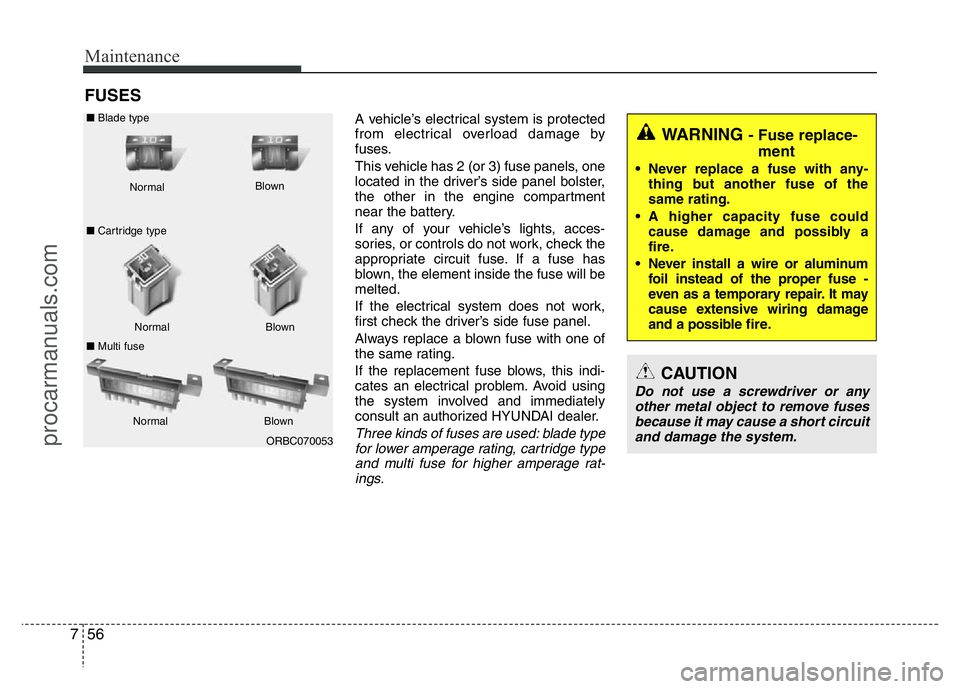
Three kinds of fuses are used: blade type
for lower amperage rating, cartridge type
and multi fuse for higher amperage rat-
ings.
WARNING - Fuse replace-
ment
• Never replace a fuse with any-
thing but another fuse of the
same rating.
• A higher capacity fuse could
cause damage and possibly a
fire.
• Never install a wire or aluminum
foil instead of the proper fuse -
even as a temporary repair. It may
cause extensive wiring damage
and a possible fire.
CAUTION
Do not use a screwdriver or any
other metal object to remove fuses
because it may cause a short circuit
and damage the system.
ORBC070053 Normal Normal ■Blade type
■Cartridge type
■Multi fuseBlown
Blown
Normal Blown
procarmanuals.com
Page 355 of 386
763
Maintenance
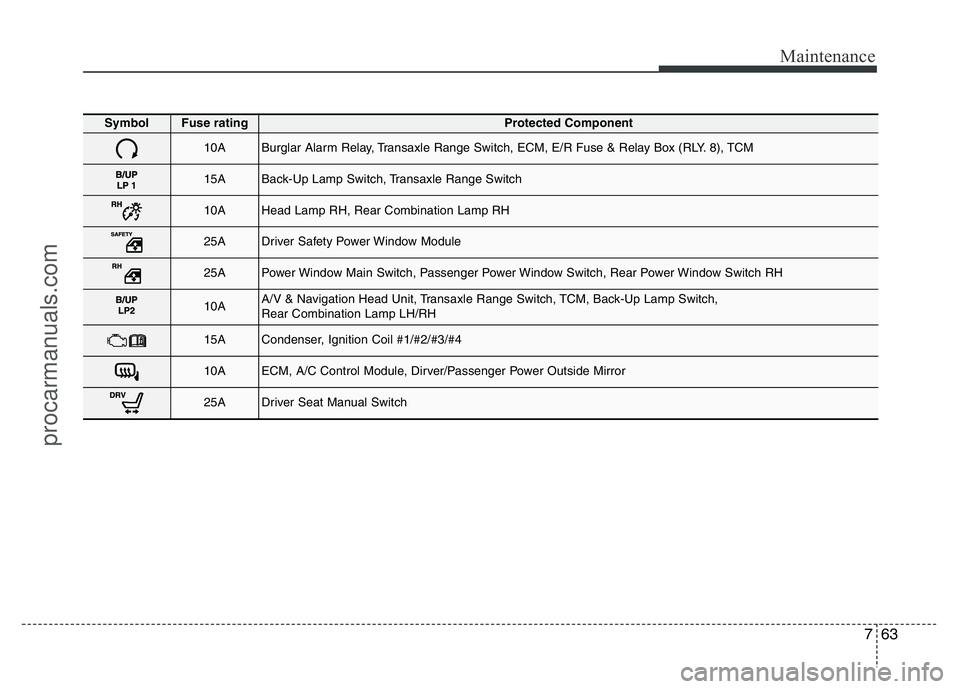
Symbol Fuse ratingProtected Component
10ABurglar Alarm Relay, Transaxle Range Switch, ECM, E/R Fuse & Relay Box (RLY. 8), TCM
15ABack-Up Lamp Switch, Transaxle Range Switch
10AHead Lamp RH, Rear Combination Lamp RH
25ADriver Safety Power Window Module
25APower Window Main Switch, Passenger Power Window Switch, Rear Power Window Switch RH
10AA/V & Navigation Head Unit, Transaxle Range Switch, TCM, Back-Up Lamp Switch,
Rear Combination Lamp LH/RH
15ACondenser, Ignition Coil #1/#2/#3/#4
10AECM, A/C Control Module, Dirver/Passenger Power Outside Mirror
25ADriver Seat Manual Switch
procarmanuals.com
Page 357 of 386
765
Maintenance
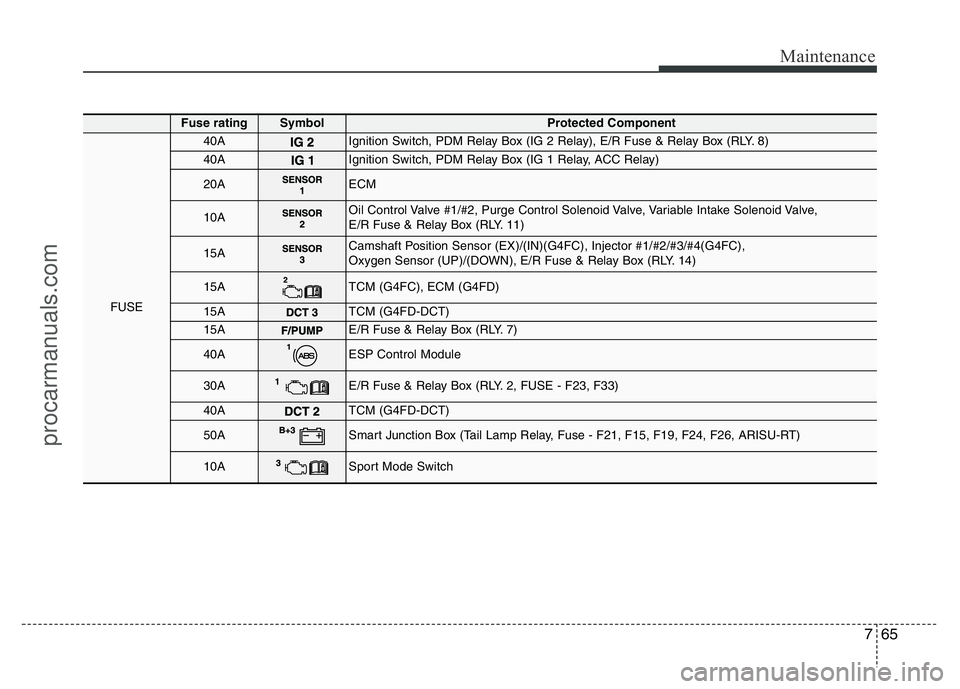
Fuse ratingSymbol Protected Component
FUSE
40AIgnition Switch, PDM Relay Box (IG 2 Relay), E/R Fuse & Relay Box (RLY. 8)
40AIgnition Switch, PDM Relay Box (IG 1 Relay, ACC Relay)
20AECM
10AOil Control Valve #1/#2, Purge Control Solenoid Valve, Variable Intake Solenoid Valve,
E/R Fuse & Relay Box (RLY. 11)
15ACamshaft Position Sensor (EX)/(IN)(G4FC), Injector #1/#2/#3/#4(G4FC),
Oxygen Sensor (UP)/(DOWN), E/R Fuse & Relay Box (RLY. 14)
15ATCM (G4FC), ECM (G4FD)
15ATCM (G4FD-DCT)
15AE/R Fuse & Relay Box (RLY. 7)
40AESP Control Module
30AE/R Fuse & Relay Box (RLY. 2, FUSE - F23, F33)
40ATCM (G4FD-DCT)
50ASmart Junction Box (Tail Lamp Relay, Fuse - F21, F15, F19, F24, F26, ARISU-RT)
10ASport Mode Switch
procarmanuals.com
Page 359 of 386

767
Maintenance
Headlight bulb
✽NOTICE
If the headlight aiming adjustment is
necessary after the headlight assembly is
reinstalled, consult an authorized
HYUNDAI dealer.
❈Traffic Change (For Europe)
The low beam light distribution is asym-
metric. If you go abroad to a country with
opposite traffic direction, this asymmetric
part will dazzle oncoming car driver. To
prevent dazzle, ECE regulation demand
several technical solutions (ex. automatic
change system, adhesive tape, down
aiming). This headlamps are designed to
be achieved by rotating 2~3 revolutions
the leveling device gear counterclock-
wise with a screw driver (OVM tool).1. Open the hood.
2. Remove the headlight bulb cover by
turning it counterclockwise.
3. Remove the headlight bulb cover by
turning it counter clockwise.
4. Remove the bulb from the headlight
assembly.
5. Install a new headlight bulb.
6. Connect the headlight bulb socket
connector.
7. Install the headlight bulb cover by turn-
ing it clockwise.
(Continued)
• If a bulb becomes damaged or
cracked, replace it immediately
and carefully dispose of it.
• Wear eye protection when chang-
ing a bulb. Allow the bulb to cool
down before handling it.
G270A03O
WARNING- Halogen bulbs
• Halogen bulbs contain pressur-
ized gas that will produce flying
pieces of glass if broken.
• Always handle them carefully,
and avoid scratches and abra-
sions. If the bulbs are lit, avoid
contact with liquids. Never touch
the glass with bare hands.
Residual oil may cause the bulb
to overheat and burst when lit. A
bulb should be operated only
when installed in a headlight.
(Continued)
OFS072026
procarmanuals.com
Page 371 of 386
779
Maintenance
Waxing
Wax the vehicle when water will no
longer bead on the paint.
Always wash and dry the vehicle before
waxing. Use a good quality liquid or
paste wax, and follow the manufacturer’s
instructions. Wax all metal trim to protect
it and to maintain its luster.
Removing oil, tar, and similar materials
with a spot remover will usually strip the
wax from the finish. Be sure to re-wax
these areas even if the rest of the vehicle
does not yet need waxing.Finish damage repair
Deep scratches or stone chips in the
painted surface must be repaired
promptly. Exposed metal will quickly rust
and may develop into a major repair
expense.
✽NOTICE
If your vehicle is damaged and requires
any metal repair or replacement, be sure
the body shop applies anti-corrosion
materials to the parts repaired or
replaced.
CAUTION
• Wiping dust or dirt off the body
with a dry cloth will scratch the
finish.
• Do not use steel wool, abrasive
cleaners, or strong detergents
containing highly alkaline or
caustic agents on chrome-plated
or anodized aluminum parts. This
may result in damage to the pro-
tective coating and cause discol-
oration or paint deterioration.
CAUTION
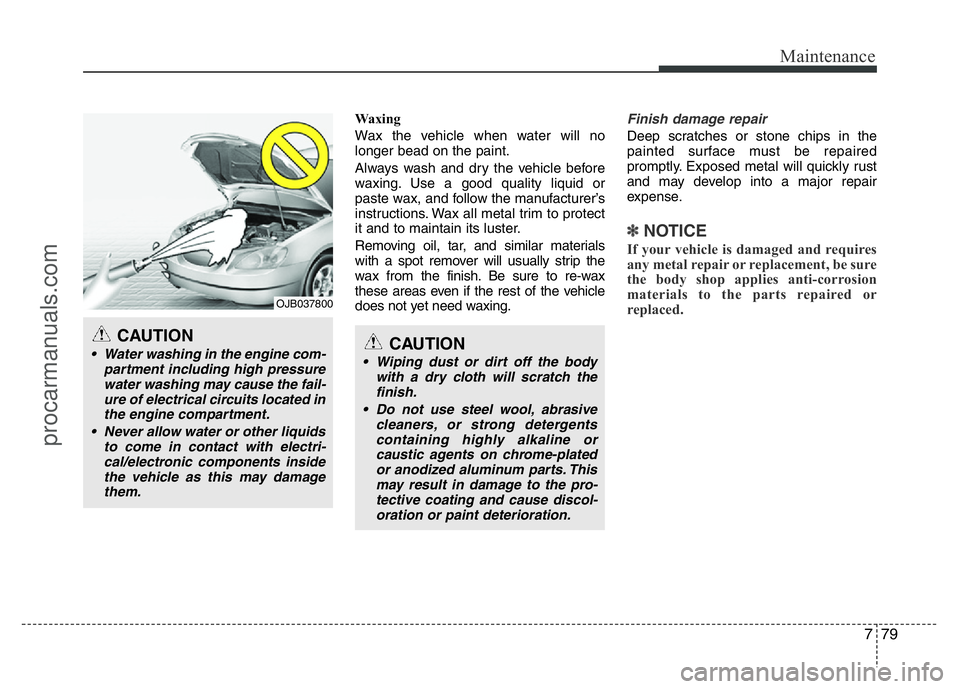
• Water washing in the engine com-
partment including high pressure
water washing may cause the fail-
ure of electrical circuits located in
the engine compartment.
• Never allow water or other liquids
to come in contact with electri-
cal/electronic components inside
the vehicle as this may damage
them.
OJB037800
procarmanuals.com
Page 375 of 386
783
Maintenance
Interior care
Interior general precautions
Prevent caustic solutions such as per-
fume and cosmetic oil from contacting
the dashboard because they may cause
damage or discoloration. If they do con-
tact the dashboard, wipe them off imme-
diately. See the instructions for the prop-
er way to clean vinyl.
Cleaning the upholstery and interior
trim
Vinyl
Remove dust and loose dirt from vinyl
with a whisk broom or vacuum cleaner.
Clean vinyl surfaces with a vinyl cleaner.
Fabric
Remove dust and loose dirt from fabric
with a whisk broom or vacuum cleaner.
Clean with a mild soap solution recom-
mended for upholstery or carpets.
Remove fresh spots immediately with a
fabric spot cleaner. If fresh spots do not
receive immediate attention, the fabric
can be stained and its color can be
affected. Also, its fire-resistant properties
can be reduced if the material is not
properly maintained.
Cleaning the lap/shoulder belt web-
bing
Clean the belt webbing with any mild
soap solution recommended for cleaning
upholstery or carpet. Follow the instruc-
tions provided with the soap. Do not
bleach or re-dye the webbing because
this may weaken it.
Cleaning the interior window glass
If the interior glass surfaces of the vehi-
cle become fogged (that is, covered with
an oily, greasy or waxy film), they should
be cleaned with glass cleaner. Follow the
directions on the glass cleaner container.CAUTION
Never allow water or other liquids
to come in contact with electrical/
electronic components inside the
vehicle as this may damage them.
CAUTION
Using anything but recommended
cleaners and procedures may affect
the fabric’s appearance and fire-
resistant properties.
CAUTION
Do not scrape or scratch the inside
of the rear window. This may result
in damage to the rear window
defroster grid.CAUTION
When cleaning leather products
(steering wheel, seats etc.), use
neutral detergents or low alcohol
content solutions. If you use high
alcohol content solutions or
acid/alkaline detergents, the color
of the leather may fade or the sur-
face may get stripped off.
procarmanuals.com
Page 382 of 386
Specifications & Consumer information
4 8
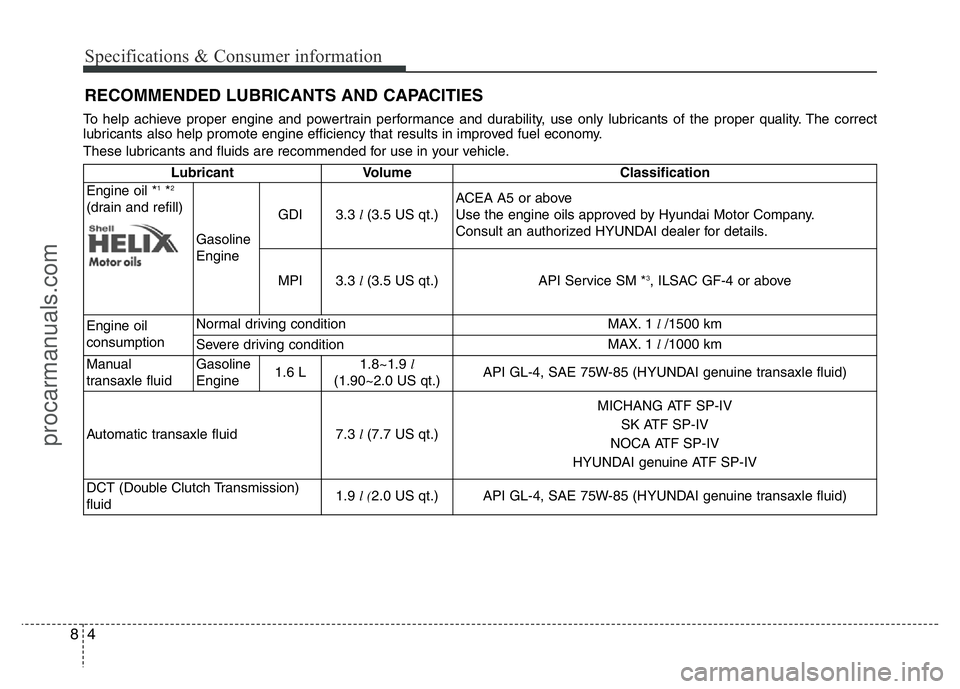
RECOMMENDED LUBRICANTS AND CAPACITIES
To help achieve proper engine and powertrain performance and durability, use only lubricants of the proper quality. The correct
lubricants also help promote engine efficiency that results in improved fuel economy.
These lubricants and fluids are recommended for use in your vehicle.
Lubricant Volume Classification
Engine oil *
1*2
(drain and refill)
Gasoline
EngineGDI3.3l (3.5 US qt.)ACEA A5 or above
Use the engine oils approved by Hyundai Motor Company.
Consult an authorized HYUNDAI dealer for details.
MPI3.3l (3.5 US qt.)API Service SM *3, ILSAC GF-4 or above
Engine oil
consumptionNormal driving conditionMAX. 1l /1500 km
Severe driving conditionMAX. 1l /1000 km
Manual
transaxle fluidGasoline
Engine1.6 L1.8~1.9l
(1.90~2.0 US qt.)API GL-4, SAE 75W-85 (HYUNDAI genuine transaxle fluid)
Automatic transaxle fluid7.3l (7.7 US qt.)
MICHANG ATF SP-IV
SK ATF SP-IV
NOCA ATF SP-IV
HYUNDAI genuine ATF SP-IV
DCT (Double Clutch Transmission)
fluid1.9l (2.0 US qt.)
API GL-4, SAE 75W-85 (HYUNDAI genuine transaxle fluid)
procarmanuals.com
Page 383 of 386
85
Specifications & Consumer information
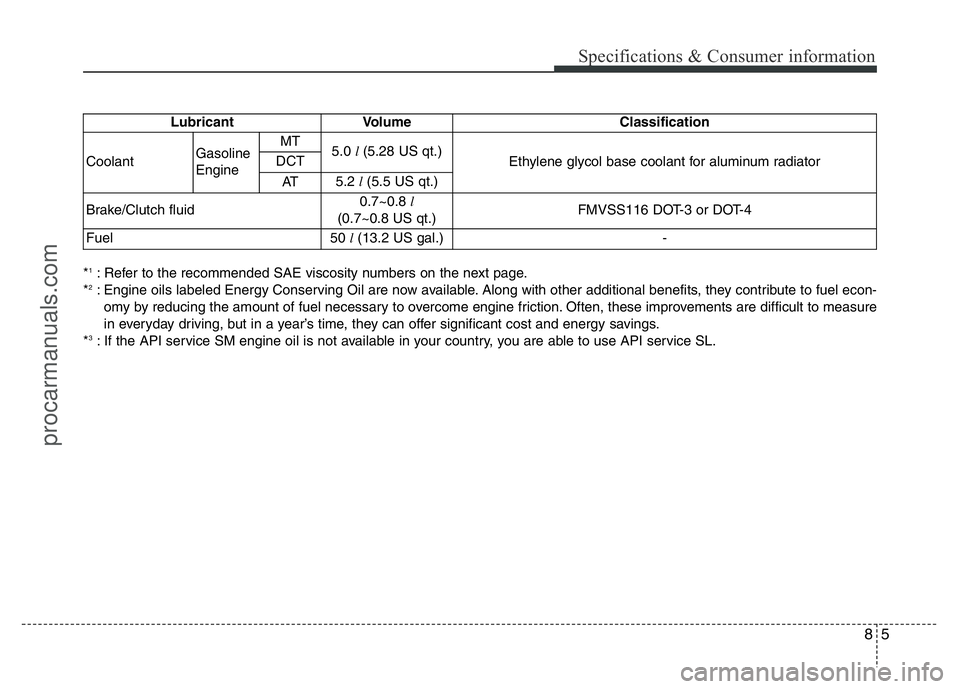
*1: Refer to the recommended SAE viscosity numbers on the next page.
*2: Engine oils labeled Energy Conserving Oil are now available. Along with other additional benefits, they contribute to fuel econ-
omy by reducing the amount of fuel necessary to overcome engine friction. Often, these improvements are difficult to measure
in everyday driving, but in a year’s time, they can offer significant cost and energy savings.
*
3: If the API service SM engine oil is not available in your country, you are able to use API service SL.Lubricant Volume Classification
CoolantGasoline
EngineMT5.0 l (5.28 US qt.)Ethylene glycol base coolant for aluminum radiatorDCT
AT5.2 l (5.5 US qt.)
Brake/Clutch fluid0.7~0.8l
(0.7~0.8 US qt.)FMVSS116 DOT-3 or DOT-4
Fuel50l (13.2 US gal.)-
procarmanuals.com