2011 HYUNDAI IX35 Driver
[x] Cancel search: DriverPage 4 of 560
Introduction
4
1
Do not use methanol
Fuels containing methanol (wood alco-
hol) should not be used in your vehicle.
This type of fuel can reduce vehicle per-
formance and damage components ofthe fuel system.
Fuels for cleaner air
To help contribute to cleaner air,
HYUNDAI recommends use of fuels
treated with detergent additives, which
help to prevent deposit formation in the
engine. These fuels will help the engines
run cleaner and increase the Emission
Control System performance.
Operation in foreign countries
Drivers of vehicles which are to be oper-
ated in foreign countries must satisfy
themselves that:
The vehicle meets all local regulations
with respect to insurance, specifica- tions etc..
The correct types and grades of fuel are available for satisfactory operation
of the vehicle. Diesel engine
Diesel fuel
Diesel engine must be operated only on
commercially available diesel fuel that
complies with EN 590 or comparable
standard (EN stands for "European
Norm"). Do not use marine diesel fuel,
heating oils, or non-approved fuel addi-
tives, as this will increase wear andcause damage to the engine and fuel
system. The use of non-approved fuels
and / or fuel additives will result in a limi-
tation of your warranty rights.
Diesel fuel of above cetane 52 is used in
your vehicle. If two types of diesel fuel
are available, use summer or winter fuel
properly according to the following tem-
perature conditions.
Above -5°C(23°F) ... Summer type
diesel fuel.
Below -5°C(23°F) ... Winter type diesel fuel.
Watch the fuel level in the tank very care-
fully : If the engine stops through fuel fail-
ure, the circuits must be completely
purged to permit restarting.
CAUTION
Do not allow petrol or water to enter the fuel tank. If this happens, the
tank should be completely drainedand the fuel lines must all becleaned out to prevent the fuel pump from becoming contaminat-
ed.
CAUTION - Diesel Fuel
It is recommended to use the regu-
lated automotive diesel fuel for
diesel vehicle equipped with theDPF system.
If you use diesel fuel including highsulfur (more than 50 ppm sulfur)
and unspecified additives, it can cause the DPF system to be dam-aged and white smoke can be emit- ted.
EL UK 1.QXP 1/12/2010 2:51 PM Page 4
Page 10 of 560
23
Your vehicle at a glance
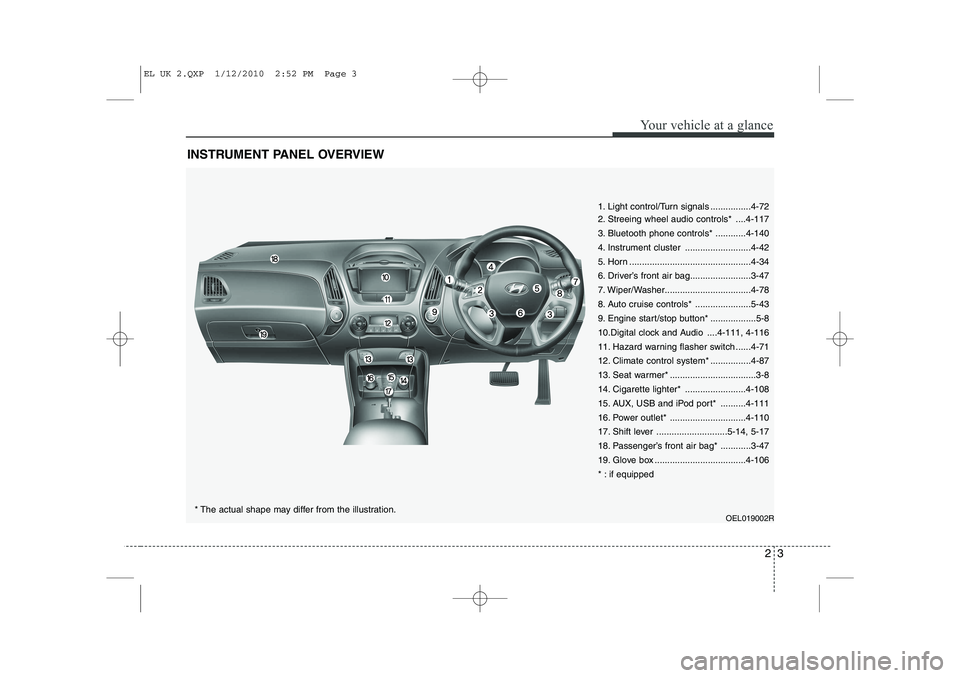
INSTRUMENT PANEL OVERVIEW
1. Light control/Turn signals ................4-72
2. Streeing wheel audio controls* ....4-117
3. Bluetooth phone controls* ............4-140
4. Instrument cluster ..........................4-42
5. Horn ................................................4-34
6. Driver’s front air bag........................3-47
7. Wiper/Washer..................................4-78
8. Auto cruise controls* ......................5-43
9. Engine start/stop button* ..................5-8
10.Digital clock and Audio ....4-111, 4-116
11. Hazard warning flasher switch ......4-71
12. Climate control system* ................4-87
13. Seat warmer* ..................................3-8
14. Cigarette lighter* ........................4-108
15. AUX, USB and iPod port* ..........4-111
16. Power outlet* ..............................4-110
17. Shift lever ............................5-14, 5-17
18. Passenger’s front air bag* ............3-47
19. Glove box ....................................4-106
* : if equippedOEL019002R
* The actual shape may differ from the illustration.
EL UK 2.QXP 1/12/2010 2:52 PM Page 3
Page 14 of 560
Safety system of your vehicle
2
3
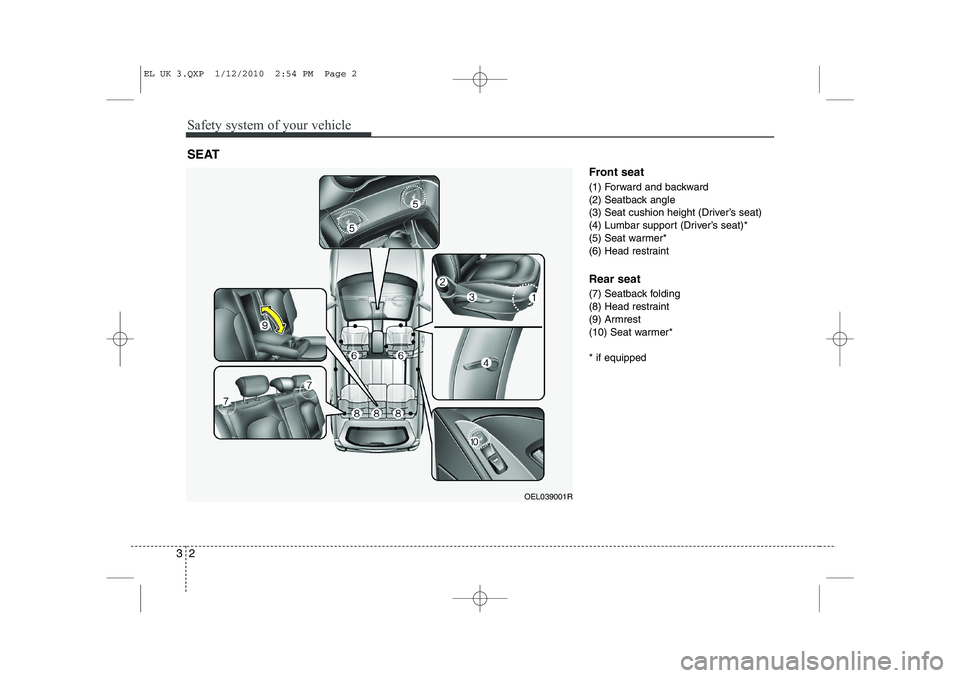
Front seat
(1) Forward and backward
(2) Seatback angle
(3) Seat cushion height (Driver’s seat)
(4) Lumbar support (Driver’s seat)*
(5) Seat warmer*
(6) Head restraint Rear seat
(7) Seatback folding
(8) Head restraint
(9) Armrest
(10) Seat warmer* * if equipped
SEAT
OEL039001R
EL UK 3.QXP 1/12/2010 2:54 PM Page 2
Page 15 of 560
33
Safety system of your vehicle
WARNING- Driver’s seat
Never attempt to adjust seat whilst the vehicle is moving. This
could result in loss of control,and an accident causing death,
serious injury, or property dam-
age.
Do not allow anything to interfere with the normal position of the
seatback. Storing items against a
seatback or in any other way
interfering with proper locking of
a seatback could result in serious
or fatal injury in a sudden stop orcollision.
Always drive and ride with your seatback upright and the lap por-
tion of the seat belt snug and low
across the hips. This is the best
position to protect you in case ofan accident.
In order to avoid unnecessary and perhaps severe air bag
injuries, always sit as far back as
possible from the steering wheel
whilst maintaining comfortable
control of the vehicle. It is recom-
mended that your chest is at least
10 inches (250 mm) away fromthe steering wheel.
WARNING - Uprighting seat
When you return the seatback to its
upright position, hold the seatback
and return it slowly and be surethere are no other occupants
around the seat. If the seatback isreturned without being held and
controlled, the back of the seat
could spring forward resulting in
accidental injury to a person struck
by the seatback.
WARNING - Loose objects
Loose objects in the driver’s foot
area could interfere with the opera-
tion of the foot pedals, possibly
causing an accident. Do not place
anything under the front seats.WARNING - Driver respon-
sibility for front seat pas-
senger
Riding in a vehicle with a front seat-
back reclined could lead to serious
or fatal injury in an accident. If a
front seat is reclined during an
accident, the occupant’s hips may
slide under the lap portion of the
seat belt applying great force to the
unprotected abdomen. Serious orfatal internal injuries could result.
The driver must advise the front
passenger to keep the seatback in
an upright position whenever the
vehicle is in motion.
EL UK 3.QXP 1/12/2010 2:54 PM Page 3
Page 16 of 560
Safety system of your vehicle
4
3
(Continued)
When resetting the seatback to
the upright position, make sure it
is securely latched by pushing it
forward and reverse.WARNING - Rear seatbacks
The rear seatback must be securely latched. If not, passen-
gers and objects could be thrown
forward resulting in serious
injury or death in the event of a
sudden stop or collision.
Luggage and other cargo should be laid flat in the cargo area. If
objects are large, heavy, or must
be piled, they must be secured.
Under no circumstances should
cargo be piled higher than the
seatbacks. Failure to follow thesewarnings could result in serious
injury or death in the event of a
sudden stop, collision or rollover.
No passenger should ride in the cargo area or sit or lie on folded
seatbacks whilst the vehicle is
moving. All passengers must be
properly seated in seats and
restrained properly whilst riding.
(Continued)WARNING
After adjusting the seat, always
check that it is securely locked into
place by attempting to move the
seat forward or reverse without
using the lock release lever.
Sudden or unexpected movement
of the driver's seat could cause you
to lose control of the vehicle result-ing in an accident.
EL UK 3.QXP 1/12/2010 2:54 PM Page 4
Page 17 of 560
35
Safety system of your vehicle
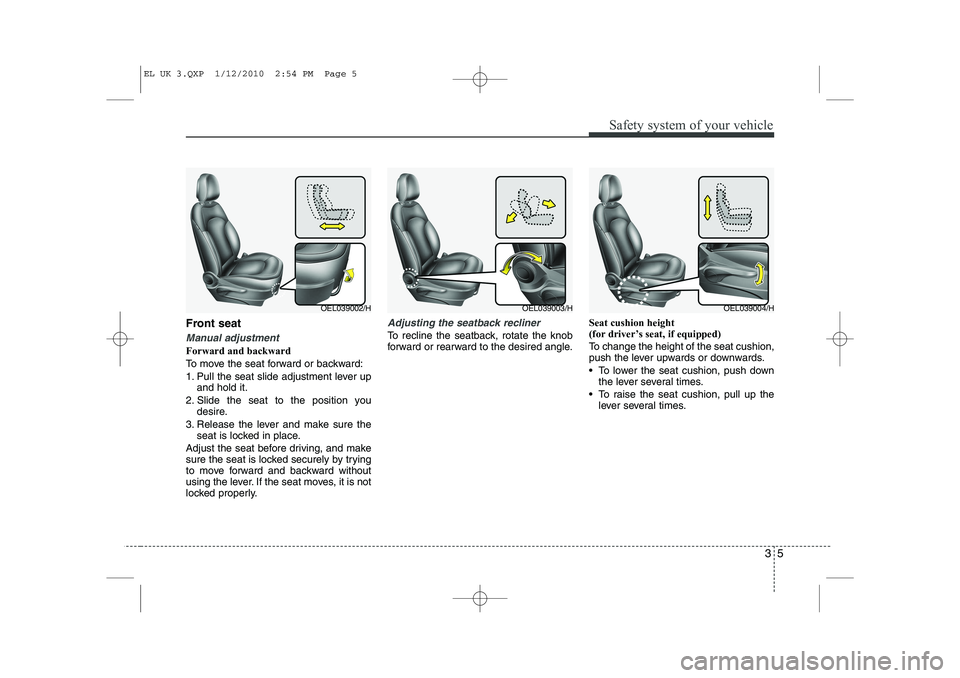
Front seat
Manual adjustment
Forward and backward
To move the seat forward or backward:
1. Pull the seat slide adjustment lever upand hold it.
2. Slide the seat to the position you desire.
3. Release the lever and make sure the seat is locked in place.
Adjust the seat before driving, and make
sure the seat is locked securely by trying
to move forward and backward without
using the lever. If the seat moves, it is not
locked properly.
Adjusting the seatback recliner
To recline the seatback, rotate the knob
forward or rearward to the desired angle. Seat cushion height
(for driver’s seat, if equipped)
To change the height of the seat cushion,
push the lever upwards or downwards.
To lower the seat cushion, push down
the lever several times.
To raise the seat cushion, pull up the lever several times.
OEL039002/HOEL039003/HOEL039004/H
EL UK 3.QXP 1/12/2010 2:54 PM Page 5
Page 18 of 560
Safety system of your vehicle
6
3
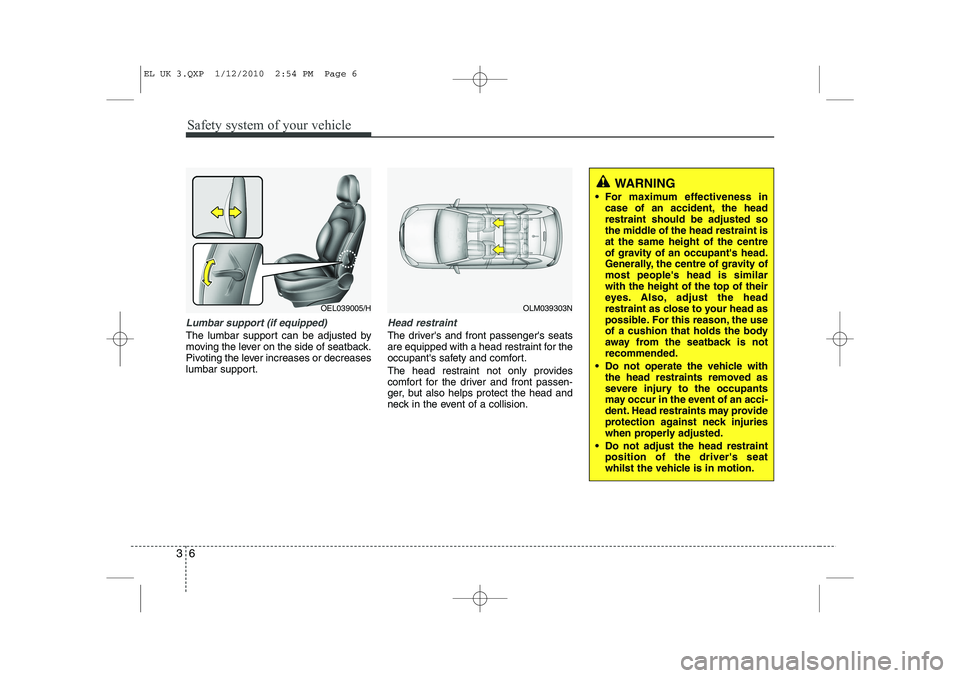
Lumbar support (if equipped)
The lumbar support can be adjusted by
moving the lever on the side of seatback.
Pivoting the lever increases or decreases
lumbar support.
Head restraint
The driver's and front passenger's seats
are equipped with a head restraint for the
occupant's safety and comfort.
The head restraint not only provides
comfort for the driver and front passen-
ger, but also helps protect the head and
neck in the event of a collision.
OLM039303N
WARNING
For maximum effectiveness in case of an accident, the head restraint should be adjusted so
the middle of the head restraint isat the same height of the centre
of gravity of an occupant's head.
Generally, the centre of gravity ofmost people's head is similarwith the height of the top of their
eyes. Also, adjust the head
restraint as close to your head as
possible. For this reason, the use
of a cushion that holds the body
away from the seatback is notrecommended.
Do not operate the vehicle with the head restraints removed as
severe injury to the occupants
may occur in the event of an acci-
dent. Head restraints may provide
protection against neck injuries
when properly adjusted.
Do not adjust the head restraint position of the driver's seat
whilst the vehicle is in motion.
OEL039005/H
EL UK 3.QXP 1/12/2010 2:54 PM Page 6
Page 19 of 560
37
Safety system of your vehicle
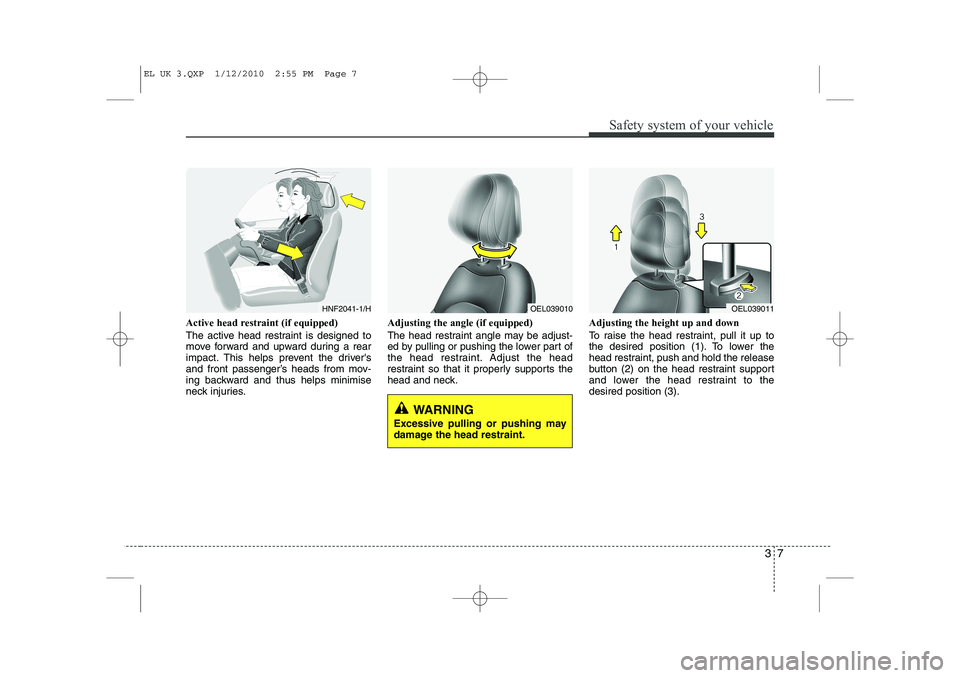
Active head restraint (if equipped)
The active head restraint is designed to
move forward and upward during a rear
impact. This helps prevent the driver's
and front passenger’s heads from mov-
ing backward and thus helps minimise
neck injuries.Adjusting the angle (if equipped)
The head restraint angle may be adjust-
ed by pulling or pushing the lower part of
the head restraint. Adjust the head
restraint so that it properly supports the
head and neck.
Adjusting the height up and down
To raise the head restraint, pull it up to
the desired position (1). To lower the
head restraint, push and hold the release
button (2) on the head restraint support
and lower the head restraint to thedesired position (3).
HNF2041-1/HOEL039010OEL039011
WARNING
Excessive pulling or pushing may
damage the head restraint.
EL UK 3.QXP 1/12/2010 2:55 PM Page 7