2011 HONDA ODYSSEY repair
[x] Cancel search: repairPage 663 of 722
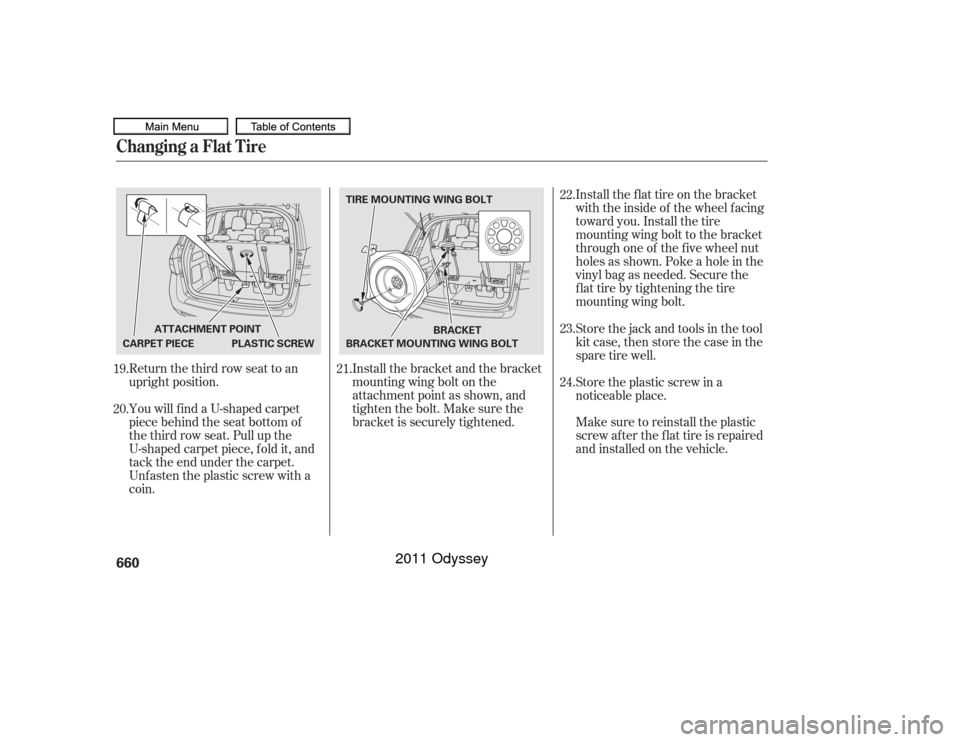
Install the flat tire on the bracket
with the inside of the wheel facing
toward you. Install the tire
mounting wing bolt to the bracket
through one of the f ive wheel nut
holes as shown. Poke a hole in the
vinyl bag as needed. Secure the
f lat tire by tightening the tire
mounting wing bolt.
Return the third row seat to an
upright position.
YouwillfindaU-shapedcarpet
piece behind the seat bottom of
the third row seat. Pull up the
U-shaped carpet piece, f old it, and
tack the end under the carpet.
Unf asten the plastic screw with a
coin. Install the bracket and the bracket
mountingwingboltonthe
attachment point as shown, and
tighten the bolt. Make sure the
bracket is securely tightened.
Store the jack and tools in the tool
kit case, then store the case in the
spare tire well.
Store the plastic screw in a
noticeable place.
Make sure to reinstall the plastic
screw af ter the f lat tire is repaired
andinstalledonthevehicle.
23.
19.
20. 21.22.
24.
Changing a Flat Tire660
BRACKET
CARPET PIECE PLASTIC SCREW TIRE MOUNTING WING BOLT
BRACKET MOUNTING WING BOLT
ATTACHMENT POINT
10/07/17 11:02:38 31TK8600_665
2011 Odyssey
Page 670 of 722
The pointer of the vehicle’s
temperature gauge should stay in
the midrange. If it climbs to the red
mark, you should determine the
reason (hot day, driving up a steep
hill, etc.).
If your vehicle overheats, you should
take immediate action. The only
indication may be the temperature
gauge climbing to or above the red
mark. Or you may see steam or
spray coming f rom under the hood.If you see steam and/or spray
coming f rom under the hood, turn
of f the engine. Wait until you see
no more signs of steam or spray,
then open the hood.If the temperature gauge stays at
the red mark, turn off the engine.
Saf ely pull to the side of the road.
Put the transmission in Park, and
set the parking brake. Turn of f all
the accessories, and turn on the
hazard warning lights. If you do not see steam or spray,
leave the engine running and
watch the temperature gauge. If
the high heat is due to overloading,
the engine should start to cool
down almost immediately. If it
does, wait until the temperature
gauge comes down to the midpoint,
then continue driving.
Look f or any obvious coolant leaks,
such as a split radiator hose.
Everything is still extremely hot,
so use caution. If you f ind a leak, it
must be repaired bef ore you
continue driving (see
on page ).
1.
2. 3.
4.
5.
683
CONT INUED
If theEngineOverheats
Emergency
Towing
Taking Care of the Unexpected
667
Steam and spray from an
overheated engine can
seriously scald you.
Do not open the hood if steam
is coming out.
Driving with the temperature gauge
pointer at the red mark can cause
serious damage to the engine.
10/07/17 11:03:30 31TK8600_672
2011 Odyssey
Page 671 of 722
If you do not f ind an obvious leak,
check the coolant level in the
radiator reserve tank. Add coolant
if the level is below the MIN mark.
If there was no coolant in the
reserve tank, you may need to add
coolant to the radiator. Let the
engine cool down until the pointer
reaches the middle of the tempera-
ture gauge, or lower, bef ore check-
ing the radiator.Using gloves or a large heavy
cloth, turn the radiator cap
counterclockwise, without pushing
down, to the f irst stop. Af ter the
pressure releases, push down on
the cap, and turn it until it comes
off.
Start the engine, and set the
temperature control dial to
maximum heat (climate control to
AUTO at ‘‘ ’’). Add coolant
to the radiator up to the base of
the f iller neck. If you do not have
the proper coolant mixture
available, you can add plain water.
Remember to have the cooling
system drained and ref illed with
the proper mixture as soon as you
can.Put the radiator cap back on
tightly. Run the engine, and check
the temperature gauge. If it goes
back to the red mark, the engine
needs repair (see
on page ).
If the temperature stays normal,
check the coolant level in the
radiator reserve tank. If it has
gone down, add coolant to the
MAX mark. Put the cap back on
tightly.
6.
7.
8.
9.10.
11.
683
If theEngineOverheats
Emergency
Towing
668
Removing the radiator cap
while the engine is hot can
cause the coolant to spray out,
seriously scalding you.
Always let the engine and
radiator cool down before
removing the radiator cap.
10/07/17 11:03:37 31TK8600_673
2011 Odyssey
Page 672 of 722
Let the vehicle sit f or a minute.
Open the hood, and check the oil
level (see page ). An engine
very low on oil can lose pressure
during cornering and other driving
maneuvers. Saf ely pull of f the road and shut
of f the engine. Turn on the hazard
warning lights.If necessary, add oil to bring the
level back to the full mark on the
dipstick (see page ).
Start the engine, and watch the oil
pressure indicator. If it does not go
outwithin10seconds,turnoff the
engine. There is a mechanical
problem that needs to be repaired
bef ore you can continue driving
(see
on page
).
This indicator should never
come on when the engine is
running. If it starts f lashing or stays
on, the oil pressure has dropped very
low or lost pressure. Serious engine
damage is possible, and you should
take immediate action.
You will also see a ‘‘CHECK
ENGINE OIL LEVEL’’ message on
the multi-information display when
this indicator comes on. 1.
2.
3.
4.
614
683
545
On Touring models
Emergency T owing
L ow Oil Pressure Indicator
Taking Care of the Unexpected
669
Running the engine with low oil
pressure can cause serious mechanical
damage almost immediately. Turn of f
the engine as soon as you can saf ely get
the vehicle stopped.
10/07/17 11:03:44 31TK8600_674
2011 Odyssey
Page 674 of 722
If your vehicle’s battery has been
disconnected or gone dead, these
codes are erased. It can take several
days of driving under various
conditions to set the codes again.
To check if they are set, turn the
ignition switch to the ON (II)
position, without starting the engine.
The malf unction indicator lamp will
come on f or 20 seconds. If it then
goes of f , the readiness codes are set.
If it blinks f ive times, the readiness
codes are not set. If possible, do not
take your vehicle f or an emissions
test until the readiness codes are set.
Refer tofor
more information (see page ).
The indicator may also come on with
the ‘‘D’’ indicator.
If this indicator comes on
while driving, it means one
of the engine’s emissions control
systems may have a problem. Even
though you may f eel no dif f erence in
your vehicle’s perf ormance, it can
reduce your f uel economy and cause
increased emissions. Continued
operation may cause serious damage.
If you have recently ref ueled your
vehicle, the indicator coming on
could be due to a loose or missing
f uel f ill cap. Tighten the cap until it
clicks at least once. Tightening the
cap will not turn the indicator of f
immediately; it can take several days
of normal driving.
If the indicator comes on repeatedly,
even though it may turn of f as you
continue driving, have your vehicle
checked by your dealer as soon as
possible. You will also see a ‘‘CHECK
EMISSION SYSTEM’’ message on
the multi-information display.
Your vehicle has certain ‘‘readiness
codes’’ that are part of the on-board
diagnostics f or the emissions
systems. In some states, part of the
emissions testing is to make sure
these codes are set. If they are not
set, the test cannot be completed.
700
On Touring models
Malf unction Indicator L amp
Emissions T esting
Readiness Codes
Taking Care of the Unexpected
671
If you keep driving with the
malf unction indicator lamp on, you can
damage your vehicle’s emissions
controls and engine. Those repairs may
not be covered by your vehicle’s
warranties.
10/07/17 11:03:58 31TK8600_676
2011 Odyssey
Page 675 of 722
The brake system
indicator normally
comesonwhenyou
turn the ignition switch to the ON
(II) position, and as a reminder to
check the parking brake. It will stay
on if you do not f ully release the
parking brake.
If the brake system indicator comes
on while driving, the brake f luid level
is probably low. Press lightly on the
brake pedal to see if it f eels normal.
If it does, check the brake f luid level
thenexttimeyoustopataservice
station (see page ). Slow down by shif ting to a lower
gear, and pull to the side of the road
when it is saf e. Because of the long
distance needed to stop, it is
hazardous to drive the vehicle. You
should have it towed and repaired as
soon as possible (see
on page ).
If the f luid level is low, take your
vehicle to a dealer, and have the
brake system inspected f or leaks or
worn brake pads.
However, if the brake pedal does not
f eel normal, you should take
immediate action. A problem in one
part of the system’s dual circuit
design will still give you braking at
two wheels. You will f eel the brake
pedal go down much f arther bef ore
the vehicle begins to slow down, and
you will have to press harder on the
pedal.
If the ABS indicator and the VSA
indicator come on with the brake
system indicator, have the vehicle
inspected by your dealer
immediately. If you must drive the vehicle a short
distance in this condition, drive
slowly and caref ully.
You will also see a ‘‘BRAKE FLUID
LOW’’ message on the multi-
inf ormation display. You will also see a ‘‘CHECK BRAKE
SYSTEM’’ message on the multi-
inf ormation display.
623 683
On Touring models
On Touring models
Emergency
Towing
Brake System Indicator672U.S. Canada
10/07/17 11:04:06 31TK8600_677
2011 Odyssey
Page 701 of 722

The exhaust emissions controls
include f our systems: PGM-FI,
ignition timing control, exhaust gas
recirculation, and three way catalytic
converter. These f our systems work
together to control the engine’s
combustion and minimize the
amount of HC, CO, and NOx that
come out the tailpipe. The exhaust
emissions control systems are
separate f rom the crankcase and
evaporative emissions control
systems.
The PGM-FI system uses sequential
multiport f uel injection.
It has three subsystems: air intake,
engine control, and f uel control. The
powertrain control module (PCM)
uses various sensors to determine
how much air is going into the
engine. It then controls how much
f uel to inject under all operating
conditions.This system constantly adjusts the
ignition timing, reducing the amount
of HC, CO, and NOx produced.
The exhaust gas recirculation (EGR)
system takes some of the exhaust
gas and routes it back into the intake
manif old. Adding exhaust gas to the
air/f uel mixture reduces the amount
of NOx produced when the f uel is
burned.
The three way catalytic converter is
in the exhaust system. Through
chemical reactions, it converts HC,
CO, and NOx in the engine’s exhaust
to carbon dioxide (CO ), nitrogen
(N ), and water vapor.
The emissions control systems are
designed and certif ied to work to-
gether in reducing emissions to
levels that comply with the Clean Air
Act. To make sure the emissions
remain low, you should use only new
Honda replacement parts or their
equivalent f or repairs. Using lower
qualitypartsmayincreasethe
emissions f rom your vehicle.
The emissions control systems are
covered by warranties separate from
the rest of your vehicle. Read your
warranty manual for more informa-
tion.
2
2
Exhaust Emissions Controls Replacement PartsPGM-FI SystemIgnit ion T iming Cont rol Syst em
Exhaust Gas Recirculat ion (EGR)Syst em
Three Way Catalytic ConverterEmissions Controls698
10/07/17 11:07:25 31TK8600_703
2011 Odyssey
Page 702 of 722
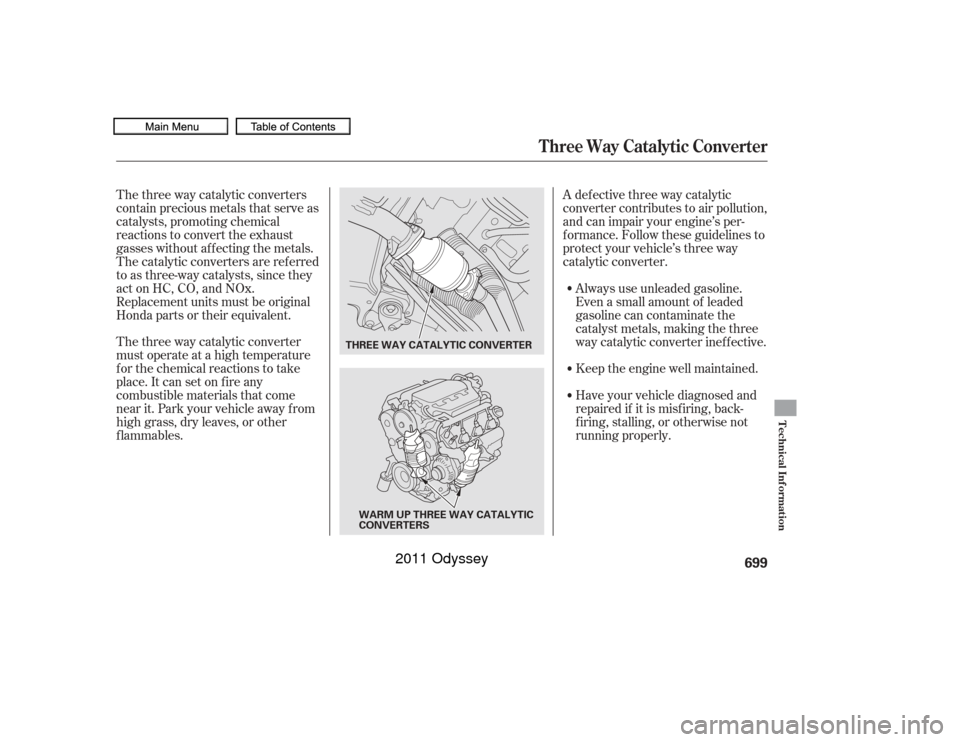
The three way catalytic converter
must operate at a high temperature
for the chemical reactions to take
place. It can set on f ire any
combustible materials that come
near it. Park your vehicle away from
high grass, dry leaves, or other
f lammables.Keep the engine well maintained.
Have your vehicle diagnosed and
repaired if it is misf iring, back-
f iring, stalling, or otherwise not
running properly.
The three way catalytic converters
contain precious metals that serve as
catalysts, promoting chemical
reactions to convert the exhaust
gasses without af f ecting the metals.
The catalytic converters are ref erred
to as three-way catalysts, since they
act on HC, CO, and NOx.
Replacement units must be original
Honda parts or their equivalent.
A defective three way catalytic
converter contributes to air pollution,
and can impair your engine’s per-
f ormance. Follow these guidelines to
protect your vehicle’s three way
catalytic converter.
Always use unleaded gasoline.
Even a small amount of leaded
gasoline can contaminate the
catalyst metals, making the three
way catalytic converter inef f ective.
Three Way Catalytic Converter
T echnical Inf ormation
699
THREE WAY CATALYTIC CONVERTER
WARM UP THREE WAY CATALYTIC
CONVERTERS
10/07/17 11:07:32 31TK8600_704
2011 Odyssey