2011 FORD KUGA Park
[x] Cancel search: ParkPage 1852 of 2057
The TCM detects uphill driving by comparing the
engine load transmitted by the PCM with the engine
speed. If the engine load increases and the engine
speed falls, then the TCM causes the transaxle to
shift to a lower transmission range in order to
increase the traction force.
Downhill driving
The TCM detects downhill driving by comparing
the engine load and engine speed values
transmitted by the PCM with the OSS sensor
signal. In order to prevent overloading of the
vehicle brakes, the TCM causes the transaxle to
shift to a lower transmission range.
Hill-hold function
If the vehicle is stopped on an uphill incline, the
TCM detects this through the faster drop in engine
speed compared with the drop in engine speed
when stopping on the flat. In this situation, the
hydraulics are actuated by the TCM in such a way
that the vehicle is prevented from rolling back. This
function is not used on steep inclines.
If the vehicle is parked on an uphill incline (ignition
switched off), the hill-hold function is not active
when pulling away.
Altitude correction
Lower air density results in reduced engine
performance. In order to compensate for this
operating situation, the TCM changes the shift
points.
Selector lever lock
To prevent the selector lever being accidentally
moved from the P or N position, the vehicle also
has an electrically operated selector lever lock.
This blocks the locking pin in the locking segment
and thus locks the selector lever in the P or N
position.
Shifting from P into another transmission
range
To be able to move the selector lever from P into
another transmission range, the ignition must be
switched on and the brake pedal must be
depressed (stop light switch on). The TCM detects
the position of the brake pedal via the CAN data
bus and the engaged transmission range from the
TR sensor.
The signal is then transferred from the TCM to the
select-shift switch module in order to activate the
solenoid valve in the selector mechanism
assembly.
In position P, the solenoid valve is activated and
the locking pin is pulled in so that the lock button
on the selector lever can be pressed as usual to
engage another transmission range.
In the selector mechanism assembly there is a Hall
sensor which is affected by a permanent magnet
on the gate of the selector mechanism assembly.
If the selector lever is moved from the P position,
both the Hall sensor and the selector lever lock
solenoid are simultaneously deactivated, to prevent
the selector from being kept in the N position.
If the ignition is set to "I" or "0" the solenoid valve
is deactivated. When the selector lever is in the P
position, it is mechanically locked because it has
no voltage.
Shifting from N into another transmission
range
The conditions are the same as for shifting from P
into another transmission range.
However, the lock button on the selector lever must
be pressed to be able to select R or P.
Power flow through the transmission
Clutches and brakes
G1163605en2008.50 Kuga8/2011
307-01-31
Automatic Transmission/Transaxle
— Vehicles With:
5-Speed Automatic Transaxle - AW55 AWD
307-01- 31
DESCRIPTION AND OPERATION
TO MODEL INDEX
BACK TO CHAPTER INDEX
FORD KUGA 2011.0MY WORKSHOP REPAIR MANUAL
Page 1853 of 2057
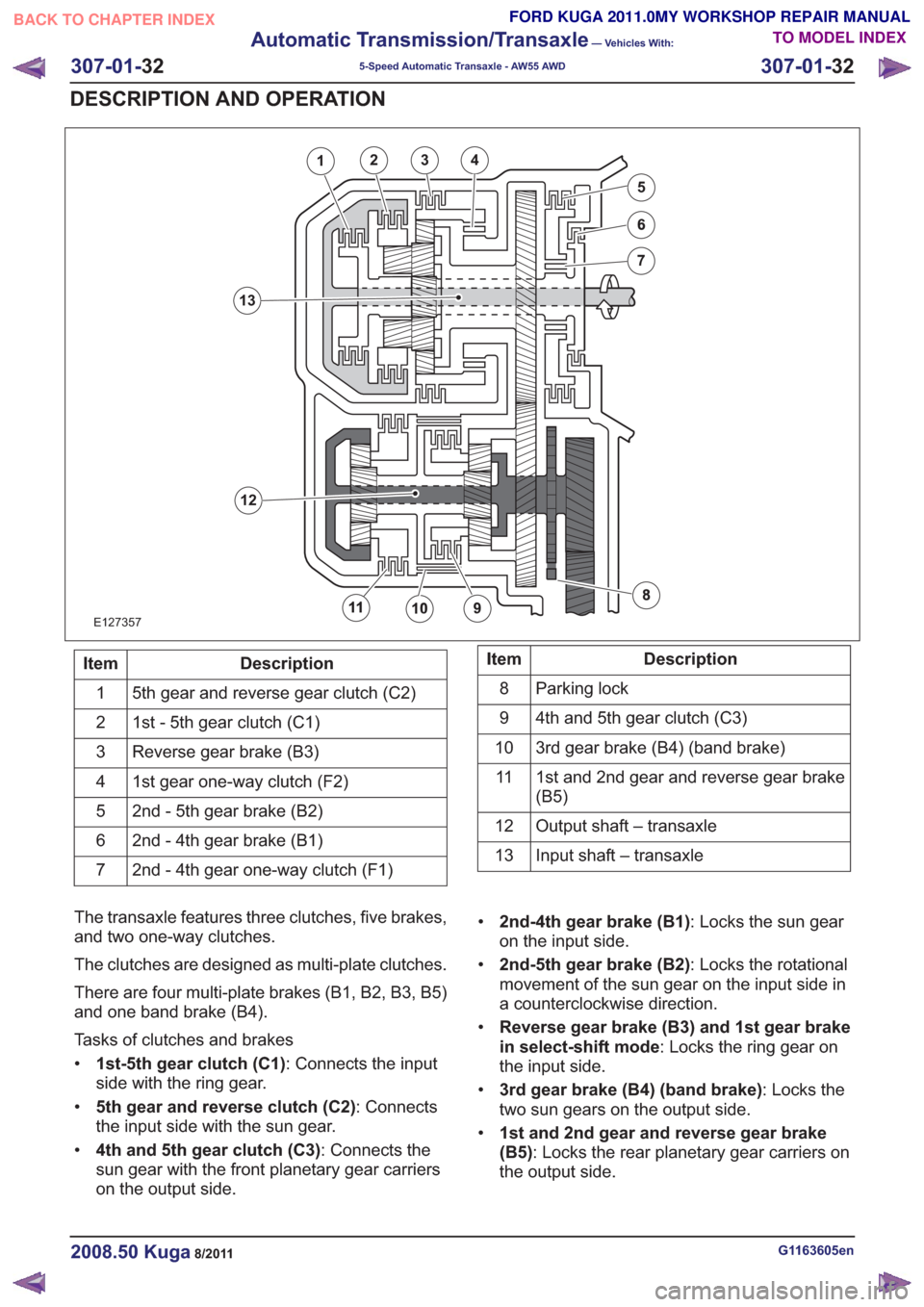
E127357
1234
5
12
13
Description
Item
5th gear and reverse gear clutch (C2)
1
1st - 5th gear clutch (C1)
2
Reverse gear brake (B3)
3
1st gear one-way clutch (F2)
4
2nd - 5th gear brake (B2)
5
2nd - 4th gear brake (B1)
6
2nd - 4th gear one-way clutch (F1)
7Description
Item
Parking lock
8
4th and 5th gear clutch (C3)
9
3rd gear brake (B4) (band brake)
10
1st and 2nd gear and reverse gear brake
(B5)
11
Output shaft – transaxle
12
Input shaft – transaxle
13
The transaxle features three clutches, five brakes,
and two one-way clutches.
The clutches are designed as multi-plate clutches.
There are four multi-plate brakes (B1, B2, B3, B5)
and one band brake (B4).
Tasks of clutches and brakes
• 1st-5th gear clutch (C1) : Connects the input
side with the ring gear.
• 5th gear and reverse clutch (C2) : Connects
the input side with the sun gear.
• 4th and 5th gear clutch (C3) : Connects the
sun gear with the front planetary gear carriers
on the output side. •
2nd-4th gear brake (B1) : Locks the sun gear
on the input side.
• 2nd-5th gear brake (B2) : Locks the rotational
movement of the sun gear on the input side in
a counterclockwise direction.
• Reverse gear brake (B3) and 1st gear brake
in select-shift mode : Locks the ring gear on
the input side.
• 3rd gear brake (B4) (band brake) : Locks the
two sun gears on the output side.
• 1st and 2nd gear and reverse gear brake
(B5) : Locks the rear planetary gear carriers on
the output side.
G1163605en2008.50 Kuga8/2011
307-01- 32
Automatic Transmission/Transaxle
— Vehicles With:
5-Speed Automatic Transaxle - AW55 AWD
307-01- 32
DESCRIPTION AND OPERATION
TO MODEL INDEX
BACK TO CHAPTER INDEX
FORD KUGA 2011.0MY WORKSHOP REPAIR MANUAL
Page 1854 of 2057
•2nd-4th one-way clutch (F1) : Locks the
rotational movement of the sun gear on the input
side in a counterclockwise direction, if 2nd-5th
gear brake (B2) is applied. •
1st gear one-way clutch (F2) : Locks the
rotational movement of the ring gear on the input
side in a counterclockwise direction.
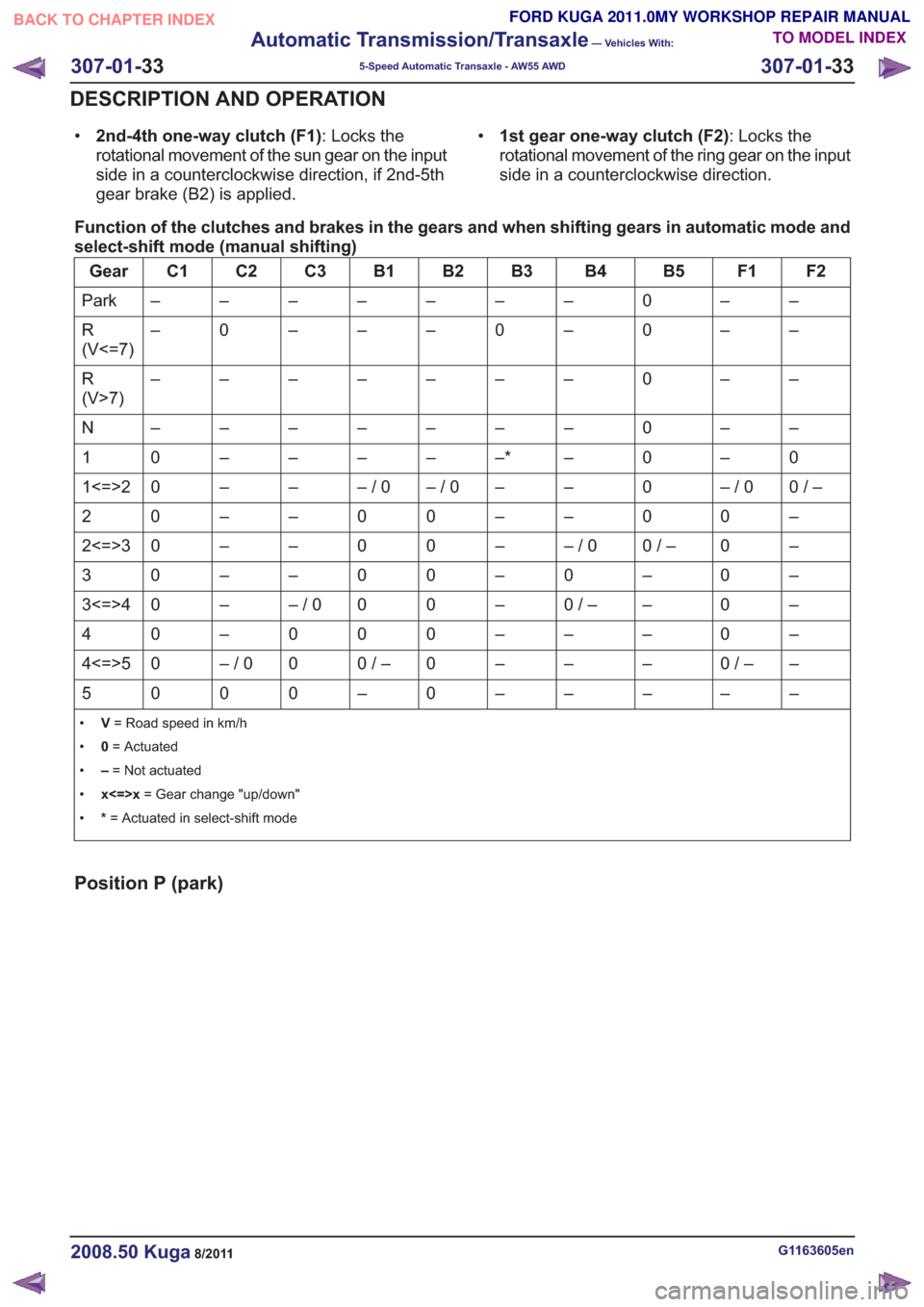
Function of the clutches and brakes in the gears and when shifting gears in automatic mode and
select-shift mode (manual shifting)
F2
F1
B5
B4
B3
B2
B1
C3
C2
C1
Gear
––
0
–––––––
Park
––
0
–0–––0–R
(V<=7)
––
0
–––––––R
(V>7)
––
0
–––––––N
0–
0
–
–*
––––01
0/–
–/0
0
––
–/0
–/0
––01<=>2
–0
0
––00––02
–0
0/–
–/0
–00––02<=>3
–0
–
0–00––03
–0
–
0/–
–00
–/0
–03<=>4
–0
–
––000–04
–
0/–
–
––0
0/–
0
–/0
04<=>5
––
–
––0–0005
• V= Road speed in km/h
• 0= Actuated
• –= Not actuated
• x<=>x = Gear change "up/down"
• *= Actuated in select-shift mode
Position P (park)
G1163605en2008.50 Kuga8/2011
307-01- 33
Automatic Transmission/Transaxle
— Vehicles With:
5-Speed Automatic Transaxle - AW55 AWD
307-01- 33
DESCRIPTION AND OPERATION
TO MODEL INDEX
BACK TO CHAPTER INDEX
FORD KUGA 2011.0MY WORKSHOP REPAIR MANUAL
Page 1855 of 2057
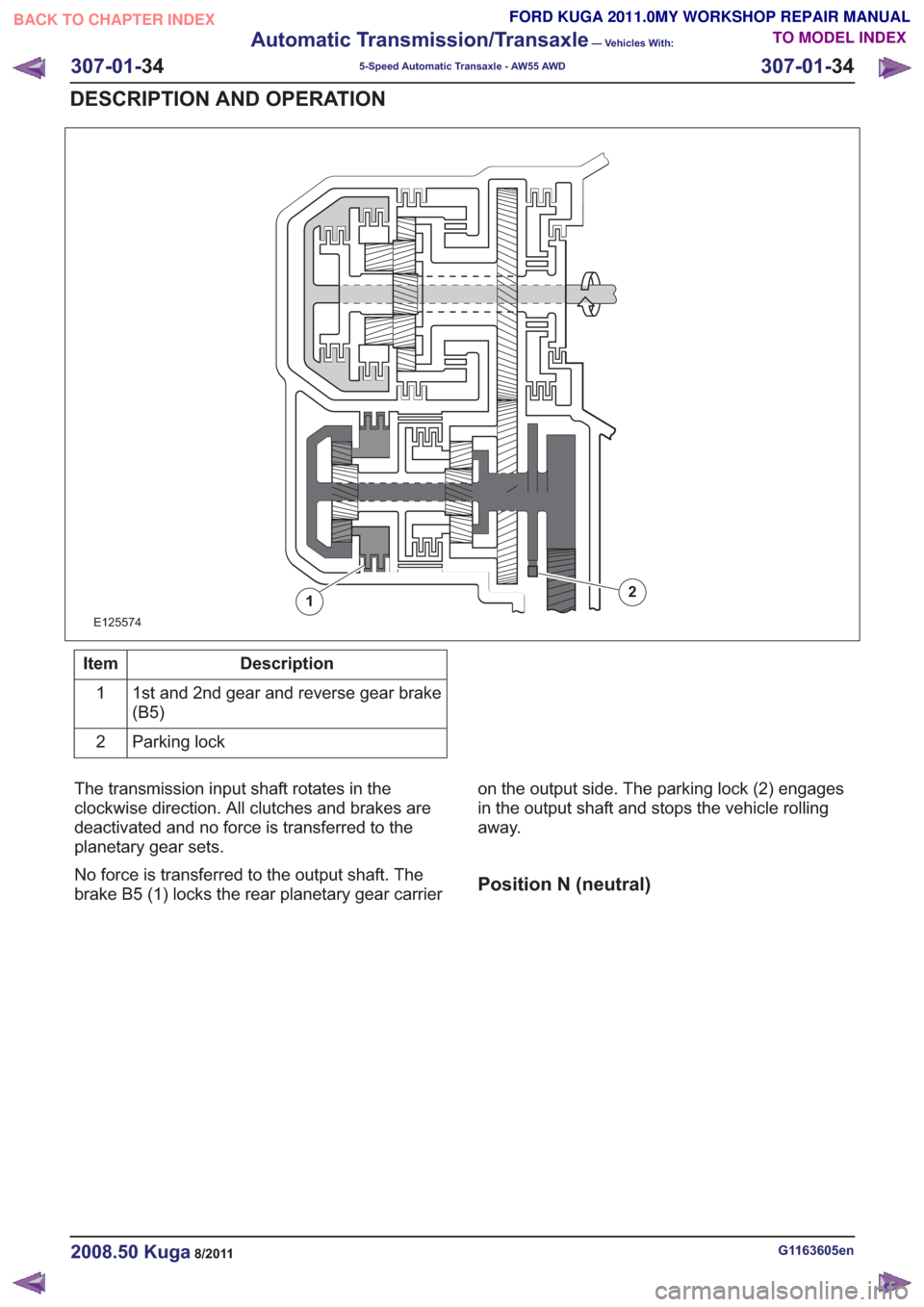
E125574
12
Description
Item
1st and 2nd gear and reverse gear brake
(B5)
1
Parking lock
2
The transmission input shaft rotates in the
clockwise direction. All clutches and brakes are
deactivated and no force is transferred to the
planetary gear sets.
No force is transferred to the output shaft. The
brake B5 (1) locks the rear planetary gear carrier on the output side. The parking lock (2) engages
in the output shaft and stops the vehicle rolling
away.
Position N (neutral)
G1163605en2008.50 Kuga8/2011
307-01-
34
Automatic Transmission/Transaxle
— Vehicles With:
5-Speed Automatic Transaxle - AW55 AWD
307-01- 34
DESCRIPTION AND OPERATION
TO MODEL INDEX
BACK TO CHAPTER INDEX
FORD KUGA 2011.0MY WORKSHOP REPAIR MANUAL
Page 1856 of 2057
E125575
1
2
Description
Item
Parking lock
1
1st and 2nd gear and reverse gear brake
(B5)
2
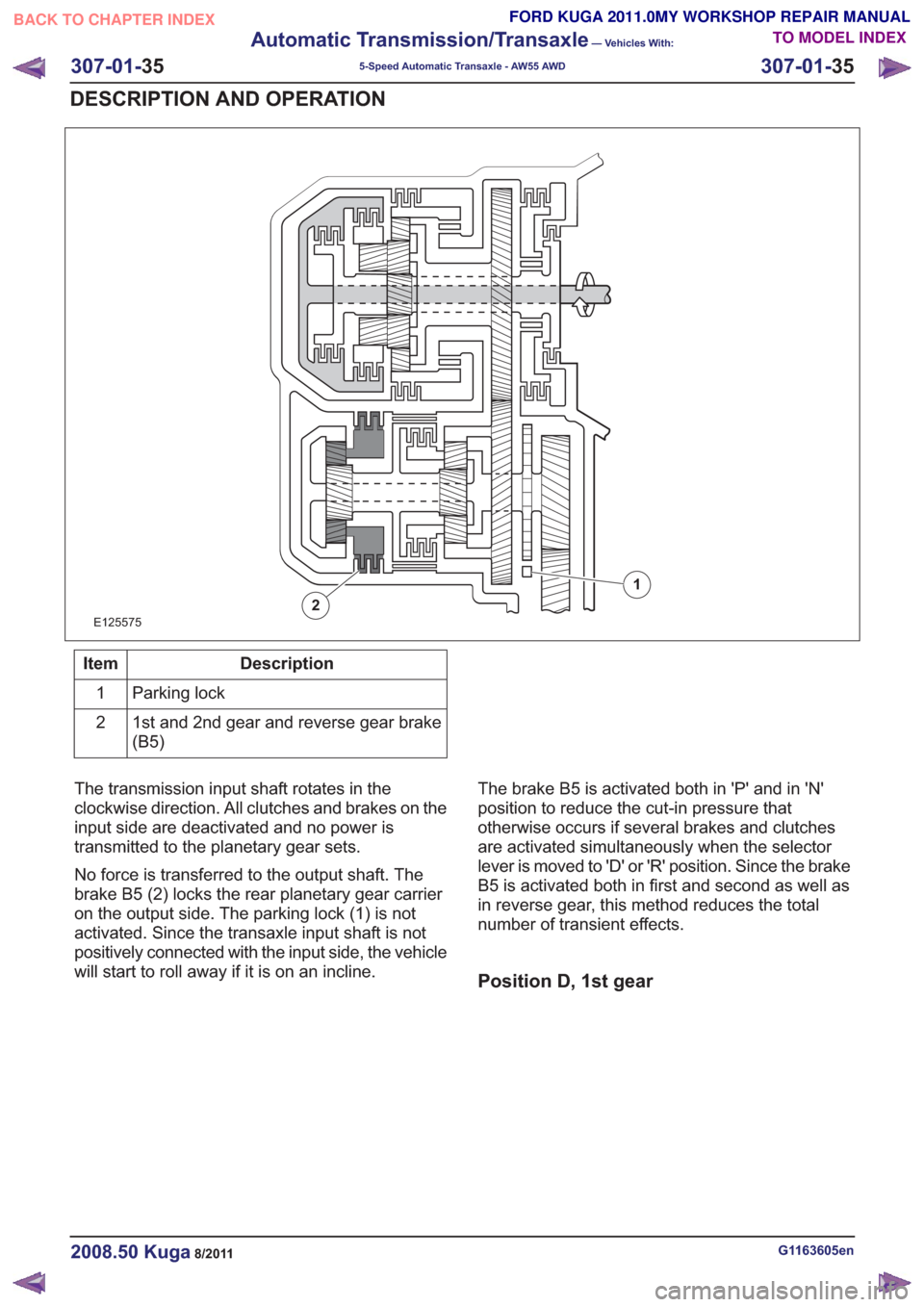
The transmission input shaft rotates in the
clockwise direction. All clutches and brakes on the
input side are deactivated and no power is
transmitted to the planetary gear sets.
No force is transferred to the output shaft. The
brake B5 (2) locks the rear planetary gear carrier
on the output side. The parking lock (1) is not
activated. Since the transaxle input shaft is not
positively connected with the input side, the vehicle
will start to roll away if it is on an incline. The brake B5 is activated both in 'P' and in 'N'
position to reduce the cut-in pressure that
otherwise occurs if several brakes and clutches
are activated simultaneously when the selector
lever is moved to 'D' or 'R' position. Since the brake
B5 is activated both in first and second as well as
in reverse gear, this method reduces the total
number of transient effects.
Position D, 1st gear
G1163605en2008.50 Kuga8/2011
307-01-
35
Automatic Transmission/Transaxle
— Vehicles With:
5-Speed Automatic Transaxle - AW55 AWD
307-01- 35
DESCRIPTION AND OPERATION
TO MODEL INDEX
BACK TO CHAPTER INDEX
FORD KUGA 2011.0MY WORKSHOP REPAIR MANUAL
Page 1868 of 2057
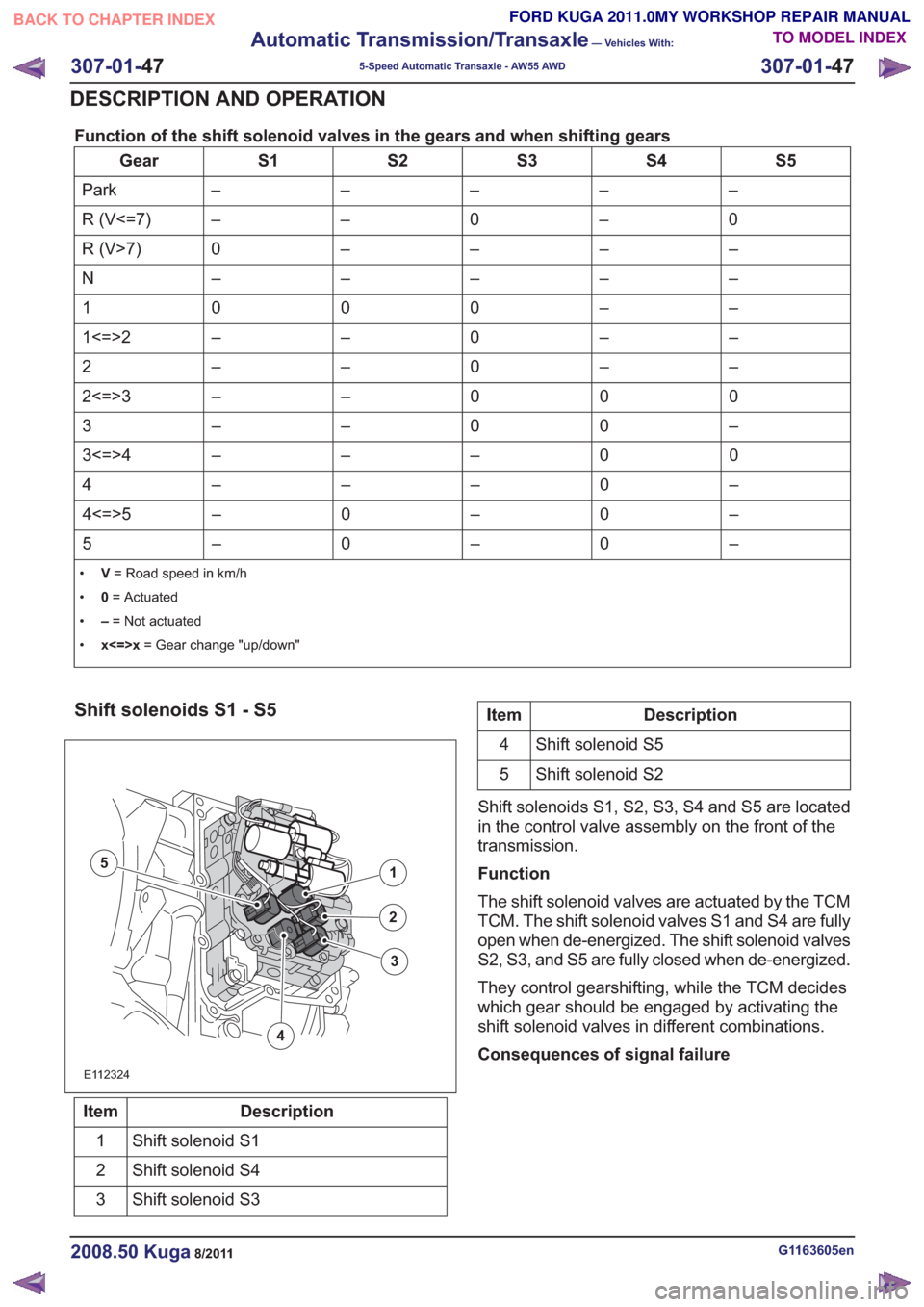
Function of the shift solenoid valves in the gears and when shifting gears
S5
S4
S3
S2
S1
Gear
–
–
–
–
–
Park
0
–
0
–
–
R (V<=7)
–
–
–
–
0
R (V>7)
–
–
–
–
–
N
–
–
0
0
0
1
–
–
0
–
–
1<=>2
–
–
0
–
–
2
0
0
0
–
–
2<=>3
–
0
0
–
–
3
0
0
–
–
–
3<=>4
–
0
–
–
–
4
–
0
–
0
–
4<=>5
–
0
–
0
–
5
• V= Road speed in km/h
• 0= Actuated
• –= Not actuated
• x<=>x = Gear change "up/down"
Shift solenoids S1 - S5
E112324
1
2
4
5
3
Description
Item
Shift solenoid S1
1
Shift solenoid S4
2
Shift solenoid S3
3
Description
Item
Shift solenoid S5
4
Shift solenoid S2
5
Shift solenoids S1, S2, S3, S4 and S5 are located
in the control valve assembly on the front of the
transmission.
Function
The shift solenoid valves are actuated by the TCM
TCM. The shift solenoid valves S1 and S4 are fully
open when de-energized. The shift solenoid valves
S2, S3, and S5 are fully closed when de-energized.
They control gearshifting, while the TCM decides
which gear should be engaged by activating the
shift solenoid valves in different combinations.
Consequences of signal failure
G1163605en2008.50 Kuga8/2011
307-01- 47
Automatic Transmission/Transaxle
— Vehicles With:
5-Speed Automatic Transaxle - AW55 AWD
307-01- 47
DESCRIPTION AND OPERATION
TO MODEL INDEX
BACK TO CHAPTER INDEX
FORD KUGA 2011.0MY WORKSHOP REPAIR MANUAL
Page 1874 of 2057
well as vehicle speed, driving comfort is improved
by linear actuation of the TCC.
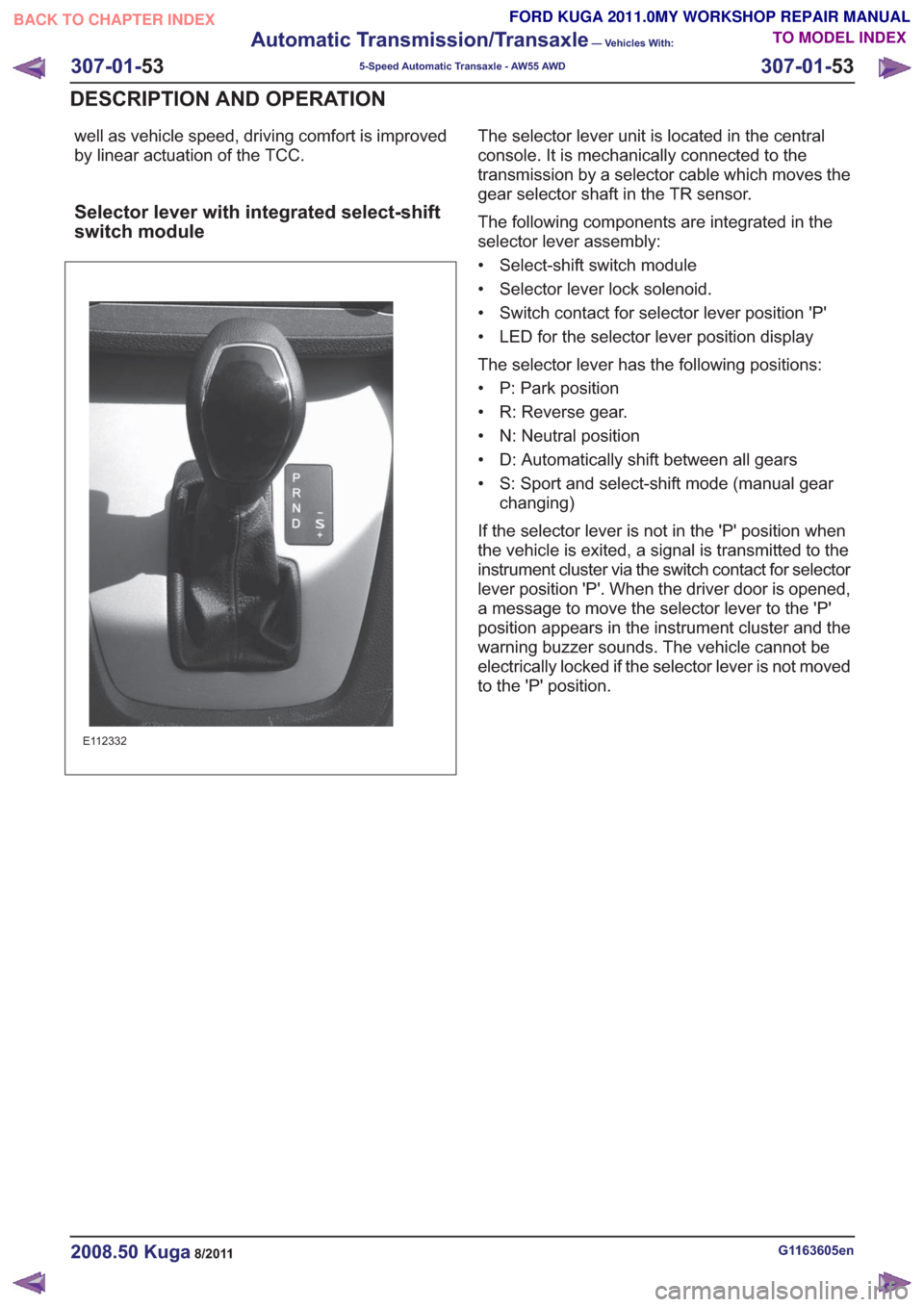
Selector lever with integrated select-shift
switch module
E112332
The selector lever unit is located in the central
console. It is mechanically connected to the
transmission by a selector cable which moves the
gear selector shaft in the TR sensor.
The following components are integrated in the
selector lever assembly:
• Select-shift switch module
• Selector lever lock solenoid.
• Switch contact for selector lever position 'P'
• LED for the selector lever position display
The selector lever has the following positions:
• P: Park position
• R: Reverse gear.
• N: Neutral position
• D: Automatically shift between all gears
• S: Sport and select-shift mode (manual gearchanging)
If the selector lever is not in the 'P' position when
the vehicle is exited, a signal is transmitted to the
instrument cluster via the switch contact for selector
lever position 'P'. When the driver door is opened,
a message to move the selector lever to the 'P'
position appears in the instrument cluster and the
warning buzzer sounds. The vehicle cannot be
electrically locked if the selector lever is not moved
to the 'P' position.
G1163605en2008.50 Kuga8/2011
307-01- 53
Automatic Transmission/Transaxle
— Vehicles With:
5-Speed Automatic Transaxle - AW55 AWD
307-01- 53
DESCRIPTION AND OPERATION
TO MODEL INDEX
BACK TO CHAPTER INDEX
FORD KUGA 2011.0MY WORKSHOP REPAIR MANUAL
Page 1879 of 2057
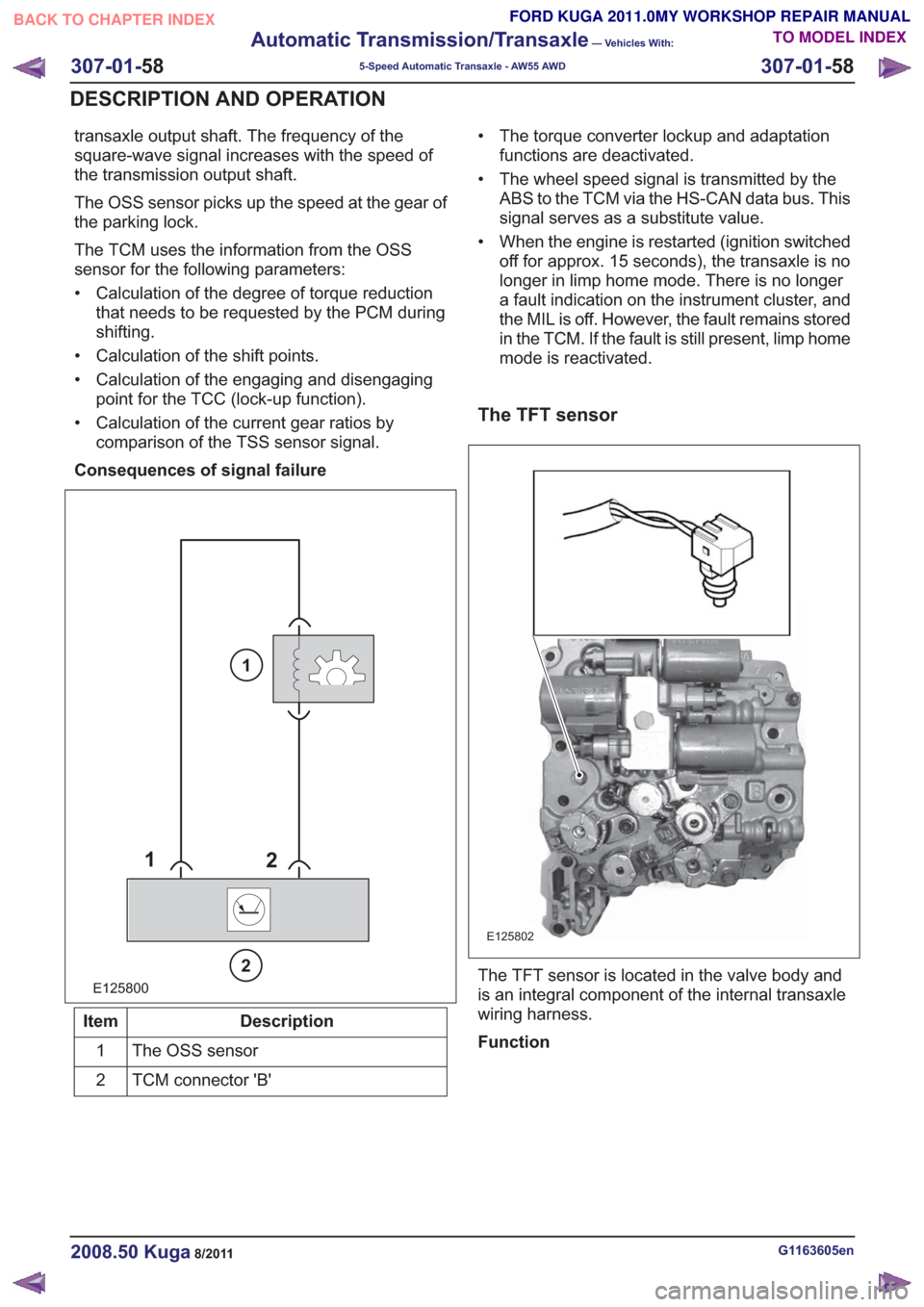
transaxle output shaft. The frequency of the
square-wave signal increases with the speed of
the transmission output shaft.
The OSS sensor picks up the speed at the gear of
the parking lock.
The TCM uses the information from the OSS
sensor for the following parameters:
• Calculation of the degree of torque reductionthat needs to be requested by the PCM during
shifting.
• Calculation of the shift points.
• Calculation of the engaging and disengaging point for the TCC (lock-up function).
• Calculation of the current gear ratios by comparison of the TSS sensor signal.
Consequences of signal failure
E125800
1 2
2
1
Description
Item
The OSS sensor
1
TCM connector 'B'
2 • The torque converter lockup and adaptation
functions are deactivated.
• The wheel speed signal is transmitted by the ABS to the TCM via the HS-CAN data bus. This
signal serves as a substitute value.
• When the engine is restarted (ignition switched off for approx. 15 seconds), the transaxle is no
longer in limp home mode. There is no longer
a fault indication on the instrument cluster, and
the MIL is off. However, the fault remains stored
in the TCM. If the fault is still present, limp home
mode is reactivated.
The TFT sensor
E125802
The TFT sensor is located in the valve body and
is an integral component of the internal transaxle
wiring harness.
Function
G1163605en2008.50 Kuga8/2011
307-01- 58
Automatic Transmission/Transaxle
— Vehicles With:
5-Speed Automatic Transaxle - AW55 AWD
307-01- 58
DESCRIPTION AND OPERATION
TO MODEL INDEX
BACK TO CHAPTER INDEX
FORD KUGA 2011.0MY WORKSHOP REPAIR MANUAL