2011 FORD F150 wheel
[x] Cancel search: wheelPage 259 of 461

Note:Do not exceed trailer weight of 5,000 lb (2,268 kg) when towing
with bumper only.
Exceeding the maximum GCWR could result in extensive damage
to your vehicle and personal injury.
Your vehicle’s load capacity is designated by weight, not by volume, so
you cannot necessarily use all available space when loading a vehicle.
Towing a trailer places an additional load on your vehicle’s engine,
transmission, axle, brakes, tires and suspension. Inspect these
components carefully periodically during, and after any towing operation.
Follow these guidelines to ensure safe towing:
•Do not tow a trailer until your vehicle has been driven at least
1,000 miles (1,600 km).
•Consult your local motor vehicle laws for towing a trailer.
•Refer to the instructions included with towing accessories for the
proper installation and adjustment specifications.
•Thoroughly prepare your vehicle for towing. Refer toPreparing to
towin this chapter.
•Stay within your vehicle’s load limits.
•Use extra caution when driving while trailer towing. Refer toDriving
while you towin this chapter.
•Service your vehicle more frequently if you tow a trailer. Refer to
Special operating conditionsin theScheduled Maintenance Guide
chapter.
For load specification terms found on the label and instructions on
calculating your vehicle’s load, refer toVehicle loading - with and
without a trailerin this chapter. Remember to figure in the tongue load
of your loaded vehicle when figuring the total weight.
WARNING:Do not exceed the GVWR or the GAWR specified on
the certification label.
WARNING:Towing trailers beyond the maximum recommended
gross trailer weight exceeds the limit of the vehicle and could
result in engine damage, transmission damage, structural damage, loss
of vehicle control, vehicle rollover and personal injury.
Tires, Wheels and Loading
259
2011 F-150(f12)
Owners Guide, 1st Printing
USA(fus)
Page 260 of 461
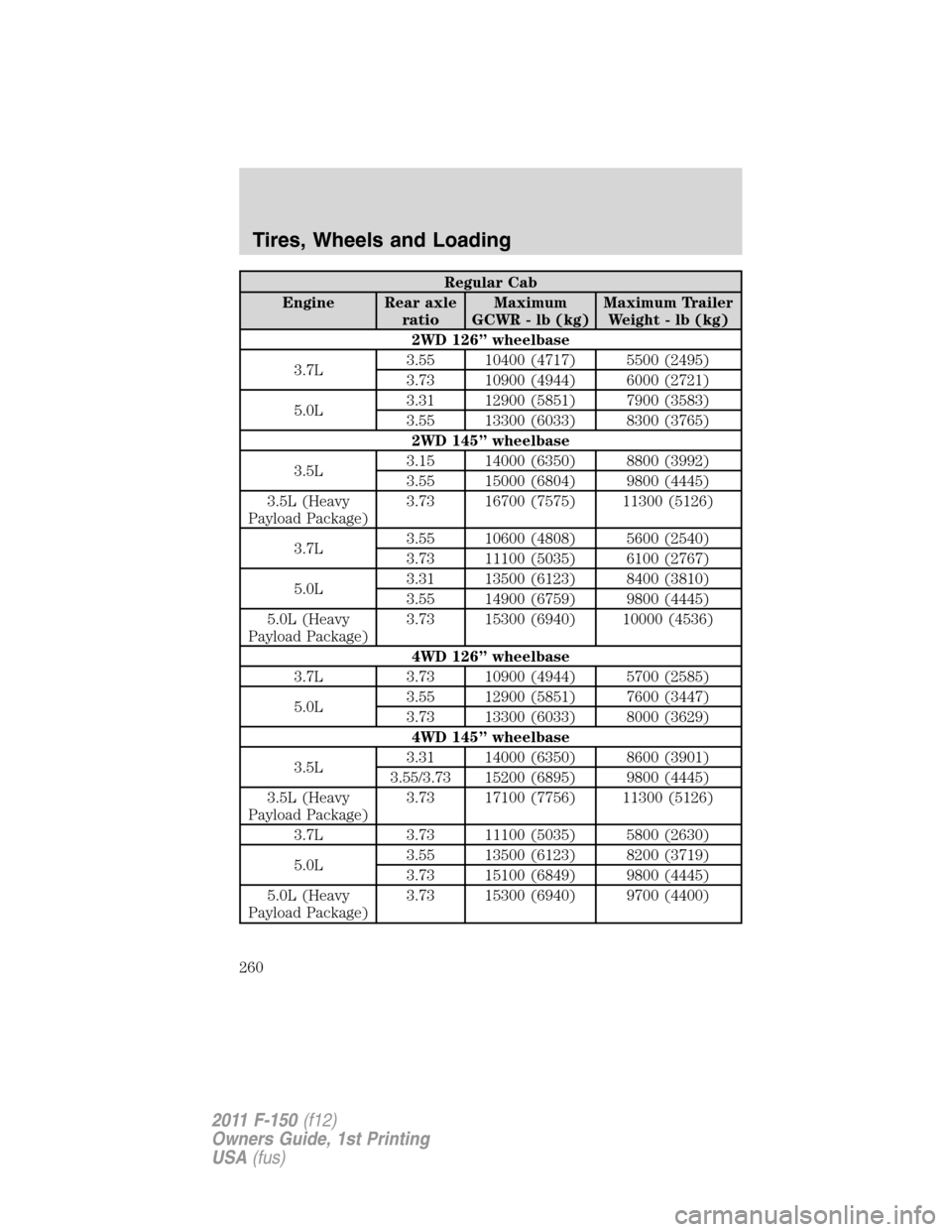
Regular Cab
Engine Rear axle
ratioMaximum
GCWR - lb (kg)Maximum Trailer
Weight - lb (kg)
2WD 126” wheelbase
3.7L3.55 10400 (4717) 5500 (2495)
3.73 10900 (4944) 6000 (2721)
5.0L3.31 12900 (5851) 7900 (3583)
3.55 13300 (6033) 8300 (3765)
2WD 145” wheelbase
3.5L3.15 14000 (6350) 8800 (3992)
3.55 15000 (6804) 9800 (4445)
3.5L (Heavy
Payload Package)3.73 16700 (7575) 11300 (5126)
3.7L3.55 10600 (4808) 5600 (2540)
3.73 11100 (5035) 6100 (2767)
5.0L3.31 13500 (6123) 8400 (3810)
3.55 14900 (6759) 9800 (4445)
5.0L (Heavy
Payload Package)3.73 15300 (6940) 10000 (4536)
4WD 126” wheelbase
3.7L 3.73 10900 (4944) 5700 (2585)
5.0L3.55 12900 (5851) 7600 (3447)
3.73 13300 (6033) 8000 (3629)
4WD 145” wheelbase
3.5L3.31 14000 (6350) 8600 (3901)
3.55/3.73 15200 (6895) 9800 (4445)
3.5L (Heavy
Payload Package)3.73 17100 (7756) 11300 (5126)
3.7L 3.73 11100 (5035) 5800 (2630)
5.0L3.55 13500 (6123) 8200 (3719)
3.73 15100 (6849) 9800 (4445)
5.0L (Heavy
Payload Package)3.73 15300 (6940) 9700 (4400)
Tires, Wheels and Loading
260
2011 F-150(f12)
Owners Guide, 1st Printing
USA(fus)
Page 261 of 461
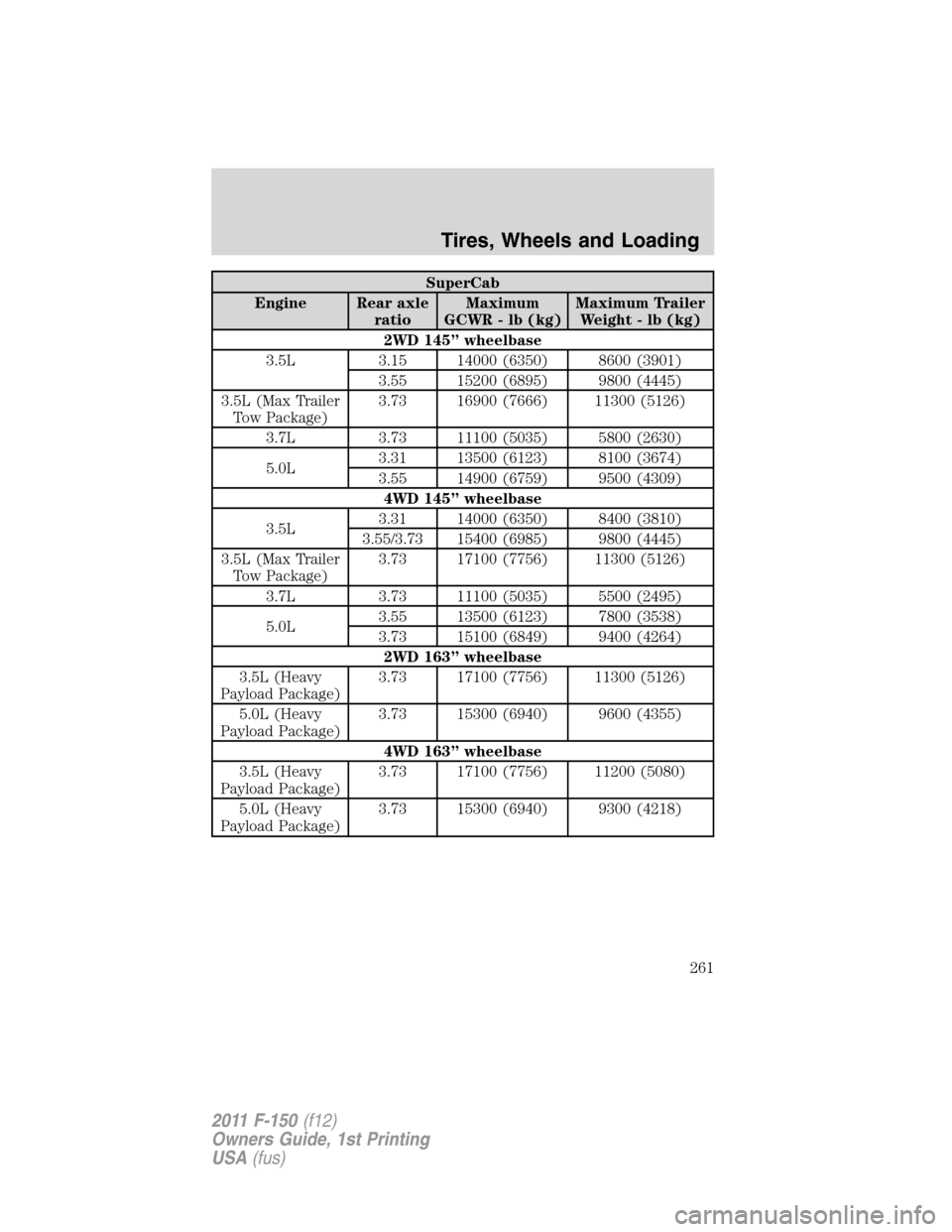
SuperCab
Engine Rear axle
ratioMaximum
GCWR - lb (kg)Maximum Trailer
Weight - lb (kg)
2WD 145” wheelbase
3.5L 3.15 14000 (6350) 8600 (3901)
3.55 15200 (6895) 9800 (4445)
3.5L (Max Trailer
Tow Package)3.73 16900 (7666) 11300 (5126)
3.7L 3.73 11100 (5035) 5800 (2630)
5.0L3.31 13500 (6123) 8100 (3674)
3.55 14900 (6759) 9500 (4309)
4WD 145” wheelbase
3.5L3.31 14000 (6350) 8400 (3810)
3.55/3.73 15400 (6985) 9800 (4445)
3.5L (Max Trailer
Tow Package)3.73 17100 (7756) 11300 (5126)
3.7L 3.73 11100 (5035) 5500 (2495)
5.0L3.55 13500 (6123) 7800 (3538)
3.73 15100 (6849) 9400 (4264)
2WD 163” wheelbase
3.5L (Heavy
Payload Package)3.73 17100 (7756) 11300 (5126)
5.0L (Heavy
Payload Package)3.73 15300 (6940) 9600 (4355)
4WD 163” wheelbase
3.5L (Heavy
Payload Package)3.73 17100 (7756) 11200 (5080)
5.0L (Heavy
Payload Package)3.73 15300 (6940) 9300 (4218)
Tires, Wheels and Loading
261
2011 F-150(f12)
Owners Guide, 1st Printing
USA(fus)
Page 262 of 461
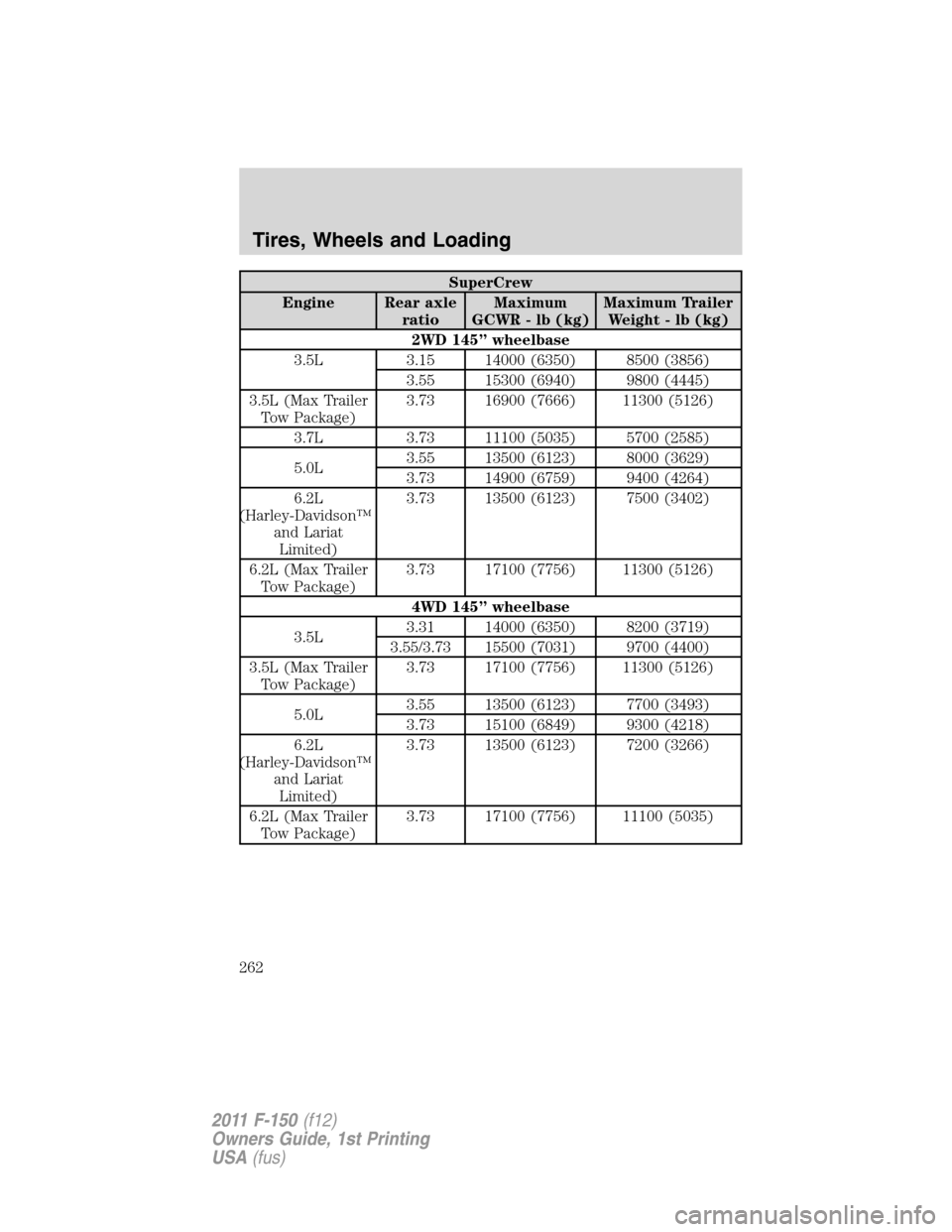
SuperCrew
Engine Rear axle
ratioMaximum
GCWR - lb (kg)Maximum Trailer
Weight - lb (kg)
2WD 145” wheelbase
3.5L 3.15 14000 (6350) 8500 (3856)
3.55 15300 (6940) 9800 (4445)
3.5L (Max Trailer
Tow Package)3.73 16900 (7666) 11300 (5126)
3.7L 3.73 11100 (5035) 5700 (2585)
5.0L3.55 13500 (6123) 8000 (3629)
3.73 14900 (6759) 9400 (4264)
6.2L
(Harley-Davidson™
and Lariat
Limited)3.73 13500 (6123) 7500 (3402)
6.2L (Max Trailer
Tow Package)3.73 17100 (7756) 11300 (5126)
4WD 145” wheelbase
3.5L3.31 14000 (6350) 8200 (3719)
3.55/3.73 15500 (7031) 9700 (4400)
3.5L (Max Trailer
Tow Package)3.73 17100 (7756) 11300 (5126)
5.0L3.55 13500 (6123) 7700 (3493)
3.73 15100 (6849) 9300 (4218)
6.2L
(Harley-Davidson™
and Lariat
Limited)3.73 13500 (6123) 7200 (3266)
6.2L (Max Trailer
Tow Package)3.73 17100 (7756) 11100 (5035)
Tires, Wheels and Loading
262
2011 F-150(f12)
Owners Guide, 1st Printing
USA(fus)
Page 263 of 461
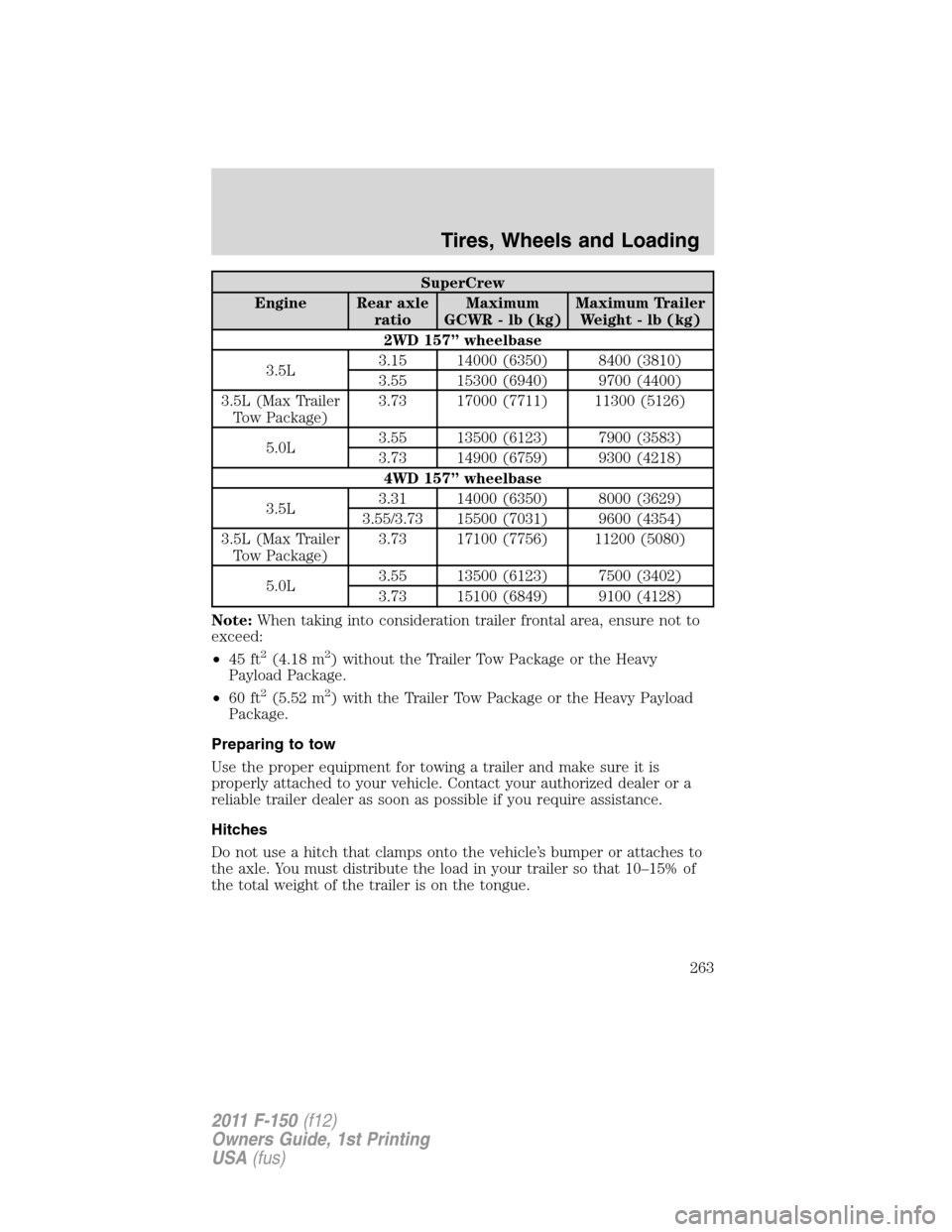
SuperCrew
Engine Rear axle
ratioMaximum
GCWR - lb (kg)Maximum Trailer
Weight - lb (kg)
2WD 157” wheelbase
3.5L3.15 14000 (6350) 8400 (3810)
3.55 15300 (6940) 9700 (4400)
3.5L (Max Trailer
Tow Package)3.73 17000 (7711) 11300 (5126)
5.0L3.55 13500 (6123) 7900 (3583)
3.73 14900 (6759) 9300 (4218)
4WD 157” wheelbase
3.5L3.31 14000 (6350) 8000 (3629)
3.55/3.73 15500 (7031) 9600 (4354)
3.5L (Max Trailer
Tow Package)3.73 17100 (7756) 11200 (5080)
5.0L3.55 13500 (6123) 7500 (3402)
3.73 15100 (6849) 9100 (4128)
Note:When taking into consideration trailer frontal area, ensure not to
exceed:
•45 ft
2(4.18 m2) without the Trailer Tow Package or the Heavy
Payload Package.
•60 ft
2(5.52 m2) with the Trailer Tow Package or the Heavy Payload
Package.
Preparing to tow
Use the proper equipment for towing a trailer and make sure it is
properly attached to your vehicle. Contact your authorized dealer or a
reliable trailer dealer as soon as possible if you require assistance.
Hitches
Do not use a hitch that clamps onto the vehicle’s bumper or attaches to
the axle. You must distribute the load in your trailer so that 10–15% of
the total weight of the trailer is on the tongue.
Tires, Wheels and Loading
263
2011 F-150(f12)
Owners Guide, 1st Printing
USA(fus)
Page 264 of 461
Weight-distributing hitch
When hooking-up a trailer using a weight-distributing hitch, always use
the following procedure:
1. Park the vehicle (without the trailer) on a level surface.
2. Measure the height of the top of the front wheel opening on the
fender, this is H1.
3. Attach the trailer to the vehicle without the weight distributing bars
connected.
4. Measure the height of the top of the front wheel opening on the
fender a second time, this is H2.
5. Install and adjust the tension in the weight distributing bars so that
the height of the front fender is approximately halfway between H1 and
H2.
6. Check that the trailer is level. If not level, adjust the ball height
accordingly and repeat Steps 3–6.
WARNING:Do not adjust a weight-distributing hitch to any
position where the rear bumper of the vehicle is higher than it
was before attaching the trailer. Doing so will defeat the function of
the weight-distributing hitch, which may cause unpredictable handling,
and could result in serious personal injury.
Safety chains
Always connect the trailer’s safety chains to the frame or hook retainers
of the vehicle hitch. To connect the trailer’s safety chains, cross the
chains under the trailer tongue and allow slack for turning corners.
If you use a rental trailer, follow the instructions that the rental agency
gives to you.
Do not attach safety chains to the bumper.
Trailer brakes
Electric brakes and manual, automatic or surge-type trailer brakes are
safe if installed properly and adjusted to the manufacturer’s
specifications. The trailer brakes must meet local and Federal
regulations.
Tires, Wheels and Loading
264
2011 F-150(f12)
Owners Guide, 1st Printing
USA(fus)
Page 265 of 461

WARNING:Do not connect a trailer’s hydraulic brake system
directly to your vehicle’s brake system. Your vehicle may not
have enough braking power and your chances of having a collision
greatly increase.
The braking system of the tow vehicle is rated for operation at the
GVWR not GCWR.
Integrated trailer brake controller (if equipped)
Your vehicle may be equipped with a fully integrated electronic trailer
brake controller (TBC). When used properly, the TBC helps ensure
smooth and effective trailer braking by powering the trailer’s electric
brakes with a proportional output based on the towing vehicle’s brake
pressure.
WARNING:The Ford TBC has only been verified to be
compatible with trailers having electric-actuated drum brakes
(one to four axles) and not hydraulic surge or electric-over-hydraulic
types. It is the responsibility of the customer to ensure that the trailer
brakes are adjusted appropriately, functioning normally and all electric
connections are properly made. Failure to do so may result in loss of
vehicle control, crash or serious injury.
The TBC user interface consists of
the following:
1.+/- (GAIN adjustment
buttons):Pressing these buttons
adjusts the TBC’s power output to
the trailer brakes (in
0.5 increments). The GAIN setting
can be increased to a maximum of
10.0 or decreased to a minimum of 0 (no trailer braking). Pressing and
holding a button raises or lowers the setting continuously. The gain
setting displays in the message center as follows: TBC GAIN = XX.X.
The trailer brake controller (TBC) is designed to display three items of
information in the instrument cluster message center. These are: gain
setting, output bar graph, and trailer connectivity status. They appear in
the message center as follows:
•TBC GAIN = XX.X NO TRAILER:The instrument cluster message
center displays the current gain setting during a given ignition cycle
and when adjusting the gain. This message is also displayed during
12
TRAILER BRAKE
-+
Tires, Wheels and Loading
265
2011 F-150(f12)
Owners Guide, 1st Printing
USA(fus)
Page 266 of 461

manual activation without a trailer connected or when gain
adjustments are made with no trailer connected.
•TBC GAIN = XX.X OUTPUT = //////:When the vehicle’s brake pedal
is pushed, or when the manual control is activated, bar indicators
illuminate in the instrument cluster message center to indicate the
amount of power going to the trailer brakes relative to the brake pedal
or manual control input. One bar indicates the least amount of output
with six bars indicating maximum output.
•TRAILER CONNECTED:This message is displayed when a correct
trailer wiring connection (a trailer with electric trailer brakes) has
been sensed during a given ignition cycle.
•TRAILER DISCONNECTED:This message is displayed and
accompanied by a single chime, when a trailer connection was
determined and then a disconnection, either intentionally or
unintentionally, has been sensed during a given ignition cycle. It is also
displayed if a truck or trailer wiring fault occurs causing the trailer to
appear disconnected. This message is also displayed during manual
activation without a trailer connected.
2.Manual control lever:Slide the control lever to the left to activate
power to the trailer’s electric brakes independent of the tow vehicle’s
brakes (see the followingProcedure for adjusting GAINsection for
instructions on proper use of this feature). If the manual control is
activated while the brake is also applied, the greater of the two inputs
determines the power sent to the trailer brakes.
•Stop lamps:Activating the TBC manual control lever illuminates both
the trailer brake lamps and the tow vehicle brake lamps except the
center high-mount stop lamp (presuming proper trailer electrical
connection). Pressing the vehicle brake pedal also illuminates both
trailer and vehicle brake lamps.
Procedure for adjusting GAIN:
The GAIN setting is used to set the TBC for the specific towing
condition and should be changed as towing conditions change. Changes
to towing conditions include trailer load, vehicle load, road conditions
and weather.
The GAIN should be set to provide the maximum trailer braking
assistance while ensuring the trailer wheels do not lock when braking;
locked trailer wheels may lead to trailer instability.
Note:This should only be performed in a traffic-free environment at
speeds of approximately 20–25 mph (30–40 km/h).
Tires, Wheels and Loading
266
2011 F-150(f12)
Owners Guide, 1st Printing
USA(fus)