2011 FORD C MAX brake
[x] Cancel search: brakePage 81 of 296

Downloaded from www.Manualslib.com manuals search engine WARNING LAMPS AND
INDICATORS
The following warning lamps and
indicators illuminate when the ignition is
switched on:
•
ABS
• Airbag
• Brake system
• ESP off
• Frost
• Low fuel
• Stability control (ESP)
If a warning or indicator lamp does not
illuminate when the ignition is switched
on, it indicates a malfunction. Have the
system checked by properly trained
technician.
ABS warning lamp If it illuminates when you are
driving, this indicates a
malfunction. You will continue
to have normal braking (without ABS).
Have the system checked by a properly
trained technician as soon as possible.
Airbag warning lamp If it illuminates when you are
driving, this indicates a
malfunction. Have the system
checked by a properly trained technician.
Blind spot monitor indicator It will illuminate when this
feature is deactivated or in
conjunction with a message.
See Blind Spot Monitor (page 74). See
Information Messages (page 90). Brake system lamp It illuminates when the parking
brake is engaged.
WARNING
Reduce your speed gradually and
stop your vehicle as soon as it is safe
to do so. Use your brakes with care.
If it illuminates when you are driving, check
that the parking brake is not engaged. If
the parking brake is not engaged, this
indicates a malfunction. Have the system
checked by a properly trained technician
immediately.
Cruise control indicator
It will illuminate when you have
set a speed using the cruise
control system. See Using
Cruise Control (page 158).
Direction indicators Flashes during operation. A
sudden increase in the rate of
flashing warns of a failed
indicator bulb. See Changing a Bulb
(page 62).
Engine warning lamp If it illuminates with the engine
running, this indicates a
malfunction. If it flashes when
you are driving, reduce the speed of your
vehicle immediately. If it continues to
flash, avoid heavy acceleration or
deceleration. Have the system checked by
a properly trained technician immediately. CAUTION
If the engine warning lamp illuminates
in conjunction with a message, have
the system checked as soon as
possible. 79
Instrument Cluster E124823 E71340
Page 96 of 296
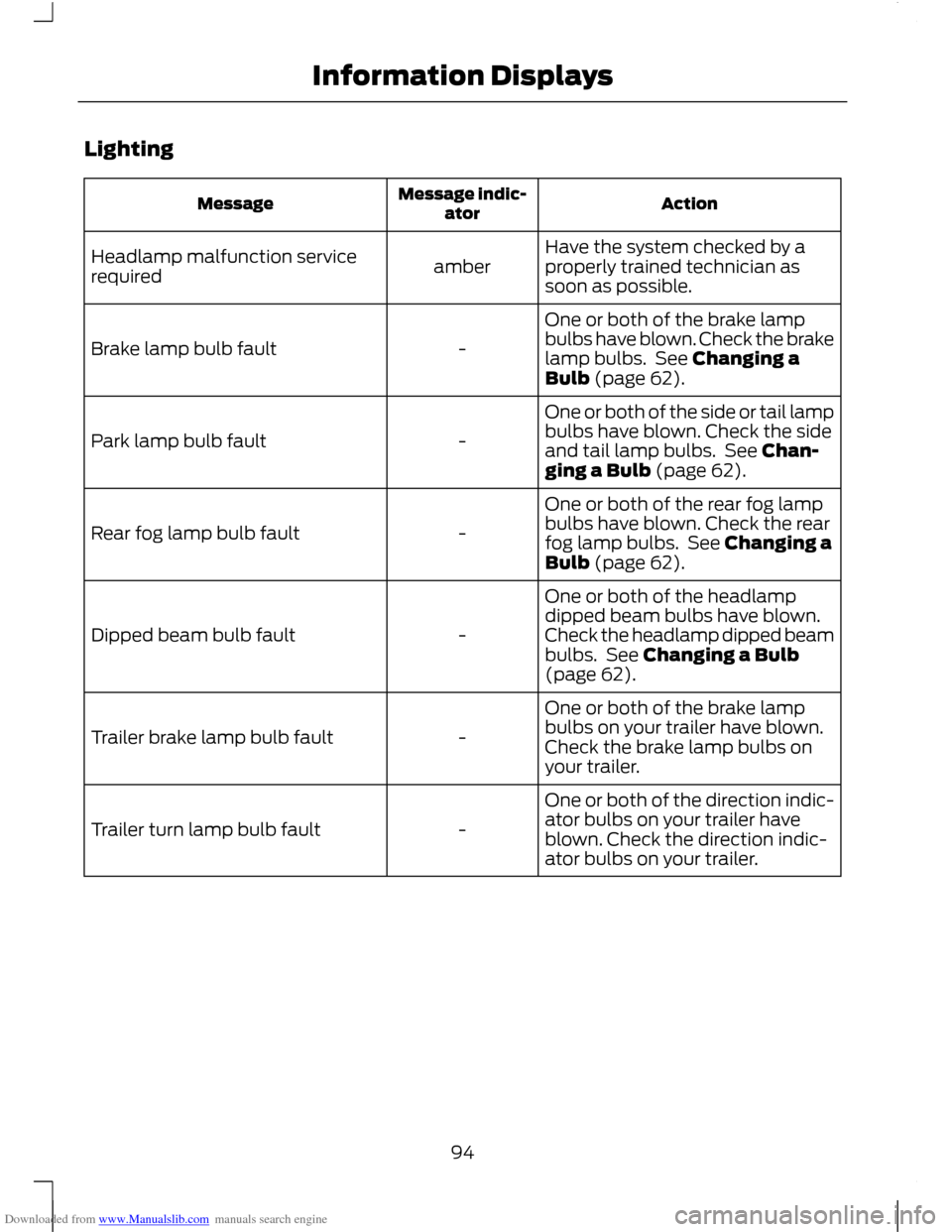
Downloaded from www.Manualslib.com manuals search engine Lighting
Action
Message indic-
ator
Message
Have the system checked by a
properly trained technician as
soon as possible.
amber
Headlamp malfunction service
required
One or both of the brake lamp
bulbs have blown. Check the brake
lamp bulbs. See Changing a
Bulb (page 62).
-
Brake lamp bulb fault
One or both of the side or tail lamp
bulbs have blown. Check the side
and tail lamp bulbs. See Chan-
ging a Bulb (page 62).
-
Park lamp bulb fault
One or both of the rear fog lamp
bulbs have blown. Check the rear
fog lamp bulbs. See Changing a
Bulb (page 62).
-
Rear fog lamp bulb fault
One or both of the headlamp
dipped beam bulbs have blown.
Check the headlamp dipped beam
bulbs. See Changing a Bulb
(page 62).
-
Dipped beam bulb fault
One or both of the brake lamp
bulbs on your trailer have blown.
Check the brake lamp bulbs on
your trailer.
-
Trailer brake lamp bulb fault
One or both of the direction indic-
ator bulbs on your trailer have
blown. Check the direction indic-
ator bulbs on your trailer.
-
Trailer turn lamp bulb fault
94
Information Displays
Page 97 of 296

Downloaded from www.Manualslib.com manuals search engine Maintenance
Action
Message indic-
ator
Message
Stop your vehicle as soon as it is
safe to do so and switch off the
ignition. Have the system checked
by a properly trained technician as
soon as possible.
red
High engine temperature stop
safely
Check the brake fluid level. See
Brake and Clutch Fluid Check
(page 191).
red
Brake fluid level low service now
Stop the vehicle as soon as safely
possible. Have the system
checked by a properly trained
technician immediately.
red
Brake system malfunction stop
safely
Stop the vehicle as soon as safely
possible and switch off the engine
immediately. Have the system
checked by a properly trained
technician immediately.
red
Engine malfunction service now
See Engine Oil Check (page 190).
amber
Engine oil level low check level
Have the system checked by a
properly trained technician as
soon as possible.
amber
Water detected in fuel service
required
Have the system checked by a
properly trained technician as
soon as possible.
amber
Engine malfunction service now
Have the system checked by a
properly trained technician.
-
Engine oil change due
Check the washer fluid level. See
Washer Fluid Check (page 192).
-
Washer fluid level low
95
Information Displays
Page 99 of 296

Downloaded from www.Manualslib.com manuals search engine Action
Message
indicator
Message
See Keyless Starting (page 129).
-
Press brake to start
See Keyless Starting (page 129).
-
Press clutch to start
See Keyless Starting (page 129).
-
Press brake and clutch
to start
See Diesel Particulate Filter (page 130).
-
Engine preheating
See Diesel Particulate Filter (page 130).
-
Cleaning exhaust filter
See Diesel Particulate Filter (page 130).
-
Filter cleaning
complete
Start-stop Action
Message
indicator
Message
Switch the ignition off before leaving the vehicle
if the system has shut down the engine. See
Using start-stop (page 133).
red
Auto StartStop Switch
ignition off
The engine needs to be restarted, press the clutch
pedal to start. See Using start-stop (page 133).
-
Auto StartStop Press
clutch to start engine
Select neutral for the system to restart the engine.
See Using start-stop (page 133).
-
Auto StartStop Select
neutral
The system is not functioning. A manual restart is
required.
-
Auto StartStop Manual
Start required
Transmission Action
Message indic-
ator
Message
Under certain driving conditions it
is possible that the clutches in the
transmission can overheat. In
these circumstances it is neces-
sary to press the brake pedal and
stop the vehicle to prevent further
red
Transmission too hot press brake
overheating. Select N
(NEUTRAL) or P (PARK) and
97
Information Displays
Page 100 of 296

Downloaded from www.Manualslib.com manuals search engine Action
Message indic-
ator
Message
apply the foot brake and parking
brake until the transmission has
cooled and the message disap-
pears from the display. If the
vehicle is driven with this message
active you may experience vehicle
judder as a further overheat
warning.
The transmission is too hot. In
these extreme conditions the
transmission will disengage drive
in order to prevent damage due to
overheating. You will not be able
to drive until the transmission has
red
Transmission overheating stop
safely
cooled. Select N (NEUTRAL) or
P (PARK) and apply the foot
brake and parking brake until the
transmission has cooled and the
message disappears from the
display.
Have the system checked by a
properly trained technician as
soon as possible.
red
Transmission malfunction service
now
Under certain driving conditions it
is possible that the clutches in the
transmission can overheat. In
these circumstances it is neces-
sary to press the brake pedal and
stop the vehicle to prevent further
amber
Transmission too hot press brake
overheating. Select N
(NEUTRAL) or P (PARK) and
apply the foot brake and parking
brake until the transmission has
cooled and the message disap-
pears from the display.
Have the system checked by a
properly trained technician as
soon as possible.
amber
Transmission limited function
check handbook
98
Information Displays
Page 101 of 296

Downloaded from www.Manualslib.com manuals search engine Action
Message indic-
ator
Message
At low outside temperatures, after
starting the engine, it may take the
transmission several seconds to
engage R (REVERSE) or D
(DRIVE). Keep the brake pedal
depressed until these messages
disappear from the display.
-
Transmission warming up please
wait
See Automatic Transmission
(page 141). See Starting and
Stopping the Engine (page 127).
-
Transmission not in Park select P
Tyre pressure monitoring system Action
Message indic-
ator
Message
The pressure in one or more tyres
has dropped. Check as soon as
possible.
amber
Check tyre pressures
Permanent malfunction. Have
your vehicle checked by a properly
trained technician.
amber
Tyre pressure sys malfunction
service required
99
Information Displays
Page 129 of 296

Downloaded from www.Manualslib.com manuals search engine GENERAL INFORMATION
General points on starting
If the battery has been disconnected the
vehicle may exhibit some unusual driving
characteristics for approx. 8 kilometres (5
miles) after reconnecting the battery.
This is because the engine management
system must realign itself with the engine.
Any unusual driving characteristics during
this period may be disregarded.
Starting the engine by towing or
pushing
WARNING
To prevent damage you must not
push or tow start your vehicle. Use
booster cables and a booster battery.
See Jump-Starting the Vehicle (page
197). IGNITION SWITCH
WARNING
Never return the key to position 0 or
I when the vehicle is in motion.
0 The ignition is off.
I The ignition and all main electrical circuits
are disabled.
Note:
Do not leave the ignition key in this
position for too long to avoid discharging
the battery. II The ignition is switched on. All electrical
circuits are operational. Warning lamps
and indicators illuminate. This is the key
position when driving. You must also select
it when being towed.
III The starter motor is activated. Release
the key as soon as the engine starts.
STEERING WHEEL LOCK
WARNING
Always check that the steering is
unlocked before attempting to move
your vehicle.
Vehicles without keyless starting
To activate the steering wheel lock;
1. Remove the key from the ignition
switch.
2. Turn the steering wheel.
Vehicles with keyless starting
Note: The steering wheel lock will not
activate when the ignition is on or the
vehicle is moving.
Your vehicle has an electronically
controlled steering wheel lock. This
operates automatically.
The steering wheel lock will activate after
a short period of time once you have
parked your vehicle and the passive key is
outside of the vehicle, or when you lock the
vehicle. See Keyless Entry (page 43).
Deactivating the steering wheel lock
Switch the ignition on, or:
Vehicles with automatic transmission
• Press the brake pedal.
Vehicles with manual transmission
• Press the clutch pedal.
127
Starting and Stopping the EngineE72128
Page 130 of 296

Downloaded from www.Manualslib.com manuals search engine STARTING A PETROL ENGINE
Note:
You can only operate the starter for
a maximum of 30 seconds at a time.
Cold or hot engine
All vehicles CAUTION
When the temperature is below -20°C
(-4°F), switch the ignition on for at
least one second before starting the
engine. This will make sure that the
maximum fuel pressure is established for
starting the engine. Vehicles with manual transmission
Note:
Do not touch the accelerator pedal.
1. Fully depress the clutch pedal.
2. Start the engine.
Vehicles with automatic transmission
Note: Do not touch the accelerator pedal.
1. Select park or neutral.
2. Fully depress the brake pedal.
3. Start the engine.
All vehicles
If the engine does not start within 15
seconds, wait for a short period and try
again.
If the engine does not start after three
attempts, wait 10 seconds and follow the
Flooded engine procedure.
If you have difficulty starting the engine
when the temperature is below -25°C
(-13°F), press the accelerator pedal
between ¼ to ½ of its travel and try again. Flooded engine
Vehicles with manual transmission
1. Fully depress the clutch pedal.
2.
Fully depress the accelerator pedal and
hold it there.
3. Start the engine.
Vehicles with automatic transmission
1. Select park or neutral.
2. Fully depress the accelerator pedal and
hold it there.
3. Fully depress the brake pedal.
4. Start the engine.
All vehicles
If the engine does not start, repeat the
Cold or hot engine procedure.
Engine idle speed after starting
The speed at which the engine idles
immediately after starting will vary
depending on the engine temperature.
If the engine is cold then the idle speed will
automatically be increased in order to heat
the catalytic converter as quickly as
possible. This makes sure that vehicle
emissions are kept to an absolute
minimum.
The idle speed will slowly decrease to the
normal level as the catalytic converter
warms up.
STARTING A DIESEL ENGINE
Cold or hot engine
All vehicles
Note: When the temperature is below -15°C
(5°F), you may need to crank the engine for
up to 25 seconds.
128
Starting and Stopping the Engine