2011 CHEVROLET VOLT battery
[x] Cancel search: batteryPage 385 of 516

Black plate (19,1)Chevrolet Volt Owner Manual - 2011
Vehicle Care 10-19
Cooling System
(High Voltage Battery)
During vehicle operation and
also during charging, the high
voltage battery cells in the
vehicle are kept within a normal
operating temperature range.
If the temperature rises above this
temperature, the battery cooling
system turns on the air conditioning
compressor and cools the coolant
until the correct temperature is
reached. If the temperature falls
below this temperature, a high
voltage heater, located in the
battery, heats the coolant until the
correct temperature is reached.
What to Use
The high voltage battery coolant
reservoir in the vehicle is filled
with a 50/50 mixture of DEX-COOL
engine coolant and deionized water.
If using this mixture, nothing else
needs to be added.
Checking Coolant
The vehicle must be on a level
surface when checking the coolant
level.
The high voltage battery
coolant reservoir is located
on the passenger side of the
engine compartment. SeeEngine
Compartment Overview on
page 10‑10 for more information
on location.Check to see if coolant is visible
in the high voltage battery coolant
reservoir. If coolant is visible but the
coolant level is below the cold fill
line, there could be a leak in the
cooling system.
The high voltage battery coolant
should only be serviced by a
qualified technician.
Page 394 of 516

Black plate (28,1)Chevrolet Volt Owner Manual - 2011
10-28 Vehicle Care
Battery
This vehicle has a high voltage
battery and a standard 12‐volt
battery.
If the vehicle is in a crash, the
sensing system may shut down
the high voltage system. When this
occurs, the high voltage battery is
disconnected and the vehicle will
not start. The SERVICE VEHICLE
SOON message in the Driver
Information Center (DIC), will be
displayed. Before the vehicle can
be operated again, it must be
serviced at your dealer.
See“If a Crash Occurs” under
Collision Damage Repair on
page 13‑10 for additional
information. If an airbag has
inflated, see What Will You See
after an Airbag Inflates? on
page 3‑31. Only a trained service technician
with the proper knowledge and
tools should inspect, test, or replace
the high voltage battery. See your
dealer if the high voltage battery
needs service. The dealer has
information on how to recycle
the high voltage battery. There
is also information available at
http://www.recyclemybattery.com.
Keep the vehicle plugged in, even
when fully charged, to keep the high
voltage battery temperature ready
for the next drive. This is important
when outside temperatures are
extremely hot or cold.
A vehicle cover, which can reduce
sun loading on the vehicle and
improve high voltage battery life,
is available from your dealer.
Refer to the replacement number
shown on the original battery label
when a new 12‐volt battery is
needed.{DANGER
Battery posts, terminals, and
related accessories contain lead
and lead compounds, chemicals
known to the State of California
to cause cancer and reproductive
harm. Wash hands after handling.
Vehicle Storage
{WARNING
12‐volt batteries have acid that
can burn you and gas that can
explode. You can be badly hurt
if you are not careful. See
Jump
Starting on page 10‑79 for tips on
working around a battery without
getting hurt.
Page 395 of 516

Black plate (29,1)Chevrolet Volt Owner Manual - 2011
Vehicle Care 10-29
Extended Storage
Remove the 12‐volt battery black,
negative (−) cable from the battery
to keep the 12‐volt battery from
running down or use a battery
trickle charger.
In addition, to avoid potential
damage to the high voltage battery,
perform the following recommended
steps:
.Store the high voltage battery
with 1/2 charge or less.
.Always store the vehicle in an
environment between−10°C
(14°F) and 30°C (86°F).
.Vehicle storage at extreme
temperatures can cause damage
to the high voltage battery.
Remember to reconnect the 12‐volt
battery when ready to drive the
vehicle.
Propulsion System Start
Check
{WARNING
When you are doing this
inspection, the vehicle could
move suddenly. If the vehicle
moves, you or others could be
injured.
1. Before starting this check, be sure there is enough room
around the vehicle. 2. Firmly apply both the electric
parking brake and the regular
brake. See Electric Parking
Brake on page 9‑35.
Do not use the accelerator
pedal, and be ready to turn
off the propulsion system
immediately if it starts.
3. Try to start the propulsion system in each gear. The vehicle
should start only in P (Park) or
N (Neutral). If the vehicle starts
in any other position, contact
your dealer for service.
Page 405 of 516

Black plate (39,1)Chevrolet Volt Owner Manual - 2011
Vehicle Care 10-39
Engine Compartment Fuse Block
A fuse puller is located in the engine
compartment fuse block.
The vehicle may not be equipped
with all of the fuses, relays, and
features shown. Mini Fuses Usage
1 Engine Control
Module
–Switched
Power
2 Emissions
3 Not Used Mini Fuses Usage
4 Ignition
Coils/Injectors
5 Empty
6a Empty
6b Rear Defogger
(Lower Grid)
7 Empty
8 Empty
9 Heated Mirrors
10 Air Conditioning
Control Module
11 Traction
Power Inverter
Module
–Battery
12 Cabin Heater Pump
and Valve
13 Empty
14 Empty
Page 406 of 516
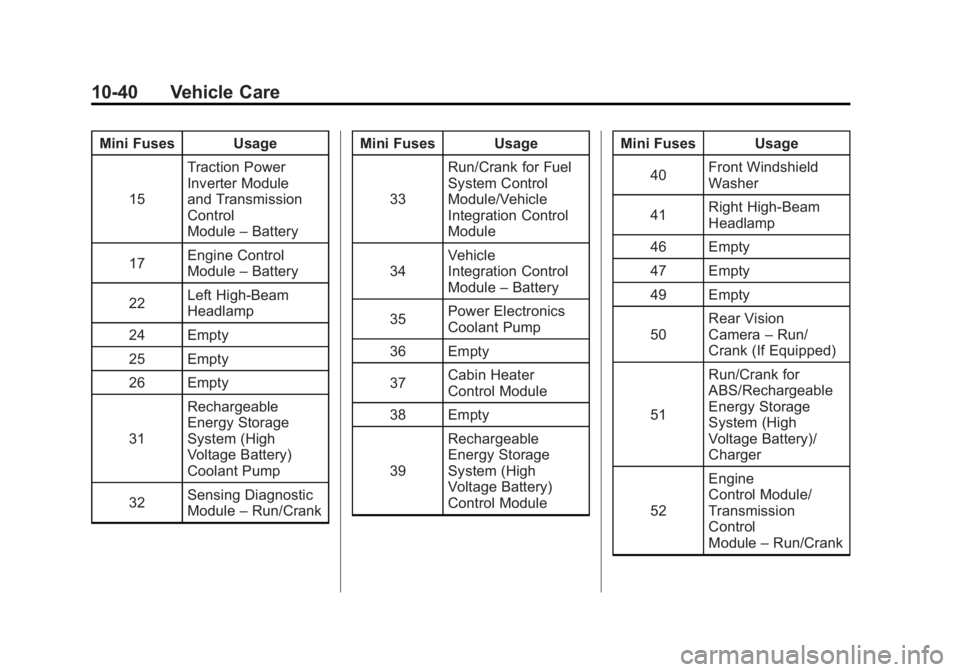
Black plate (40,1)Chevrolet Volt Owner Manual - 2011
10-40 Vehicle Care
Mini Fuses Usage15 Traction Power
Inverter Module
and Transmission
Control
Module
–Battery
17 Engine Control
Module
–Battery
22 Left High‐Beam
Headlamp
24 Empty
25 Empty
26 Empty
31 Rechargeable
Energy Storage
System (High
Voltage Battery)
Coolant Pump
32 Sensing Diagnostic
Module
–Run/Crank Mini Fuses Usage
33 Run/Crank for Fuel
System Control
Module/Vehicle
Integration Control
Module
34 Vehicle
Integration Control
Module
–Battery
35 Power Electronics
Coolant Pump
36 Empty
37 Cabin Heater
Control Module
38 Empty
39 Rechargeable
Energy Storage
System (High
Voltage Battery)
Control Module Mini Fuses Usage
40 Front Windshield
Washer
41 Right High‐Beam
Headlamp
46 Empty
47 Empty
49 Empty
50 Rear Vision
Camera
–Run/
Crank (If Equipped)
51 Run/Crank for
ABS/Rechargeable
Energy Storage
System (High
Voltage Battery)/
Charger
52 Engine
Control Module/
Transmission
Control
Module
–Run/Crank
Page 445 of 516

Black plate (79,1)Chevrolet Volt Owner Manual - 2011
Vehicle Care 10-79
Jump Starting
Jump starting is connecting jumper
cables between the two vehicles to
enable vehicle starting. If the Volt
or another vehicle has a run‐down
12‐volt battery, it can be jump
started using good condition
jumper cables. There are different
procedures depending on if the Volt
has a run‐down battery or another
vehicle has a run‐down battery.
Read the appropriate procedures
that follow.
{WARNING
The high voltage battery
cannot be jump started either
with another vehicle or battery
charger. Personal injury, death,
or damage to the vehicle could
result.
{WARNING
Batteries are dangerous and can
cause injury. Batteries contain
acid and can explode or ignite.
They contain electricity that can
burn. Follow the exact steps
provided or injuries could occur.
Using an open flame near a
battery can cause battery gas
to explode; you or others could
be hurt. Battery acid can cause
blindness.
Be sure the battery in the other
vehicle has enough water.
Add water if the level is low.
A low water level could cause
explosive gas to be present.
Battery fluid contains acid that
can burn. If battery fluid gets in
eyes or on skin; flush with water
and get medical help immediately.
{WARNING
Electric fans can start up
even when the engine is not
running and can cause injury.
Keep hands, clothing, and tools
away from any underhood
electric fans.
Notice: Ignoring these steps
could result in costly damage
to the vehicle that would not be
covered by the warranty.
Trying to start the vehicle by
pushing or pulling it will not
work, and it could damage the
vehicle.
Page 446 of 516

Black plate (80,1)Chevrolet Volt Owner Manual - 2011
10-80 Vehicle Care
Jump Starting the Volt
If the Volt won't start, the 12‐volt
battery may be run down. To jump
start the Volt use the underhood
remote positive (+) and negative (−)
terminals.
1. The other vehicle used to jumpstart the Volt must have a 12‐volt
battery with a negative ground
system.
Notice: Only use a vehicle
that has a 12-volt system with
a negative ground for jump
starting. If the other vehicle does
not have a 12-volt system with a
negative ground, both vehicles
can be damaged.
2. Park both vehicles close enough so that the jumper cables can
reach both vehicles' positive (+)
and negative (−) terminals.
The vehicles must not touch
each other. It could cause an
unwanted ground connection
that could damage both vehicles'
electrical systems. Put both vehicles in P (Park) for
an automatic transmission or
electric drive unit. For a manual
transmission, place the vehicle
in N (Neutral) and set the
parking brake.
Notice: If the radio or other
accessories are left on during
the jump starting procedure, they
could be damaged. The repairs
would not be covered by the
warranty. Always turn off the
radio and other accessories
when jump starting the vehicle.
3. Turn off the ignition on the other vehicle. Turn off the radio,
all lamps, and accessories that
are not needed in both vehicles.
Unplug accessories from the
cigarette lighter or the accessory
power outlets. This avoids
sparks and helps save both
batteries and accessories.
4. Locate the positive (+) and negative (−) terminals on the
other vehicle.
5. Open the hood to locate thepositive (+) and negative (−)
terminals on your Volt. Open the
access cover (A) for the remote
positive (+) terminal. The remote
negative terminal (B) for the Volt
is a stud marked GND (−) on
the driver side of the engine
compartment.
Page 447 of 516

Black plate (81,1)Chevrolet Volt Owner Manual - 2011
Vehicle Care 10-81
6. Check that the jumper cablesdo not have loose or missing
insulation or a shock could
result and the vehicles could
be damaged.
Before connecting the jumper
cables, here are some basic
things to know. Positive (+)
jumper cable goes to positive (+)
battery terminal or a remote
positive (+) terminal if available.
Negative (−) jumper cable goes
to negative (−) battery terminal
or a remote negative (−) terminal
if available. Do not connect
positive (+) to negative (−) or
there will be a short that may
damage the battery and other
parts of the vehicle. Notice:
If the jumper cables
are connected or removed in
the wrong order, electrical
shorting may occur and damage
the vehicle. The repairs would
not be covered by the vehicle
warranty. Always connect and
remove the jumper cables in the
correct order, making sure that
the cables do not touch each
other or other metal.
Connecting the Jumper Cables
1. Connect the red positive (+) jumper cable to the remote
positive (+) terminal (A) of your
Volt. Do not let the other end
of the cable touch metal.
2. Connect the other end of the red positive (+) jumper cable to the
positive (+) terminal of the other
vehicle. 3. Connect the black negative (−)
jumper cable to the negative (−)
battery terminal of the other
vehicle battery. Do not let the
other end touch anything until
the next step.
4. Connect the other end of the black negative (−) jumper cable
to the remote negative (−)
terminal of your Volt.
5. Push the POWER
Obutton
to start. This will wake up the
electronics on the Volt. After the
instrument cluster initializes,
the Volt will use power from
the high voltage battery to
charge the 12‐volt battery.
The jumper cables can then
be disconnected. If the Volt
does not start, call your dealer
or Roadside Assistance.
See Roadside Assistance
Program on page 13‑6.