2011 CHEVROLET VOLT battery
[x] Cancel search: batteryPage 355 of 516
Black plate (53,1)Chevrolet Volt Owner Manual - 2011
Driving and Operating 9-53
The system may be thermally
conditioning the battery during
any of the states above, requiring
electrical energy to be transferred
to the vehicle.
If the vehicle is plugged in and
vehicle power is on, the CSI will be
on solid green. The same is true
during a remote start if the vehicle
is plugged in.
If the vehicle is plugged in and the
CSI is off, a charging fault has been
detected. See“Charge Cord Status
Indicators” later in this section.
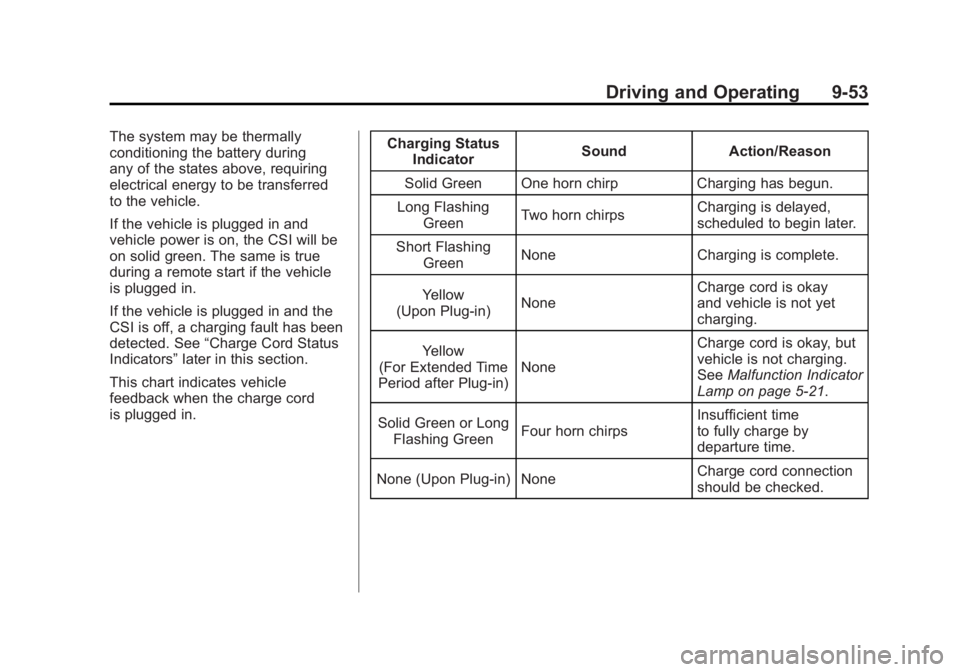
This chart indicates vehicle
feedback when the charge cord
is plugged in. Charging Status
Indicator Sound Action/Reason
Solid Green One horn chirp Charging has begun.
Long Flashing Green Two horn chirps Charging is delayed,
scheduled to begin later.
Short Flashing Green None Charging is complete.
Yellow
(Upon Plug‐in) None Charge cord is okay
and vehicle is not yet
charging.
Yellow
(For Extended Time
Period after Plug‐in) None Charge cord is okay, but
vehicle is not charging.
See
Malfunction Indicator
Lamp on page 5‑21.
Solid Green or Long Flashing Green Four horn chirps Insufficient time
to fully charge by
departure time.
None (Upon Plug‐in) None Charge cord connection
should be checked.
Page 357 of 516

Black plate (55,1)Chevrolet Volt Owner Manual - 2011
Driving and Operating 9-55
A portable charge cord used to
charge the vehicle high voltage
battery is stored under the rear
luggage compartment.
The charge cord used to charge the
vehicle is a high‐powered electrical
device. During normal operation, the
AC wall plug of the charge cord may
feel warm. The AC wall plug must fit
tightly into an AC outlet that is in
good condition.
{WARNING
Using the charge cord with a
worn or damaged AC outlet
may cause burns or start a fire.
Periodically, check the AC wall
plug and charge cord while the
vehicle is charging. If the AC wall
plug feels hot, unplug the charge
cord and have the AC outlet
replaced by a qualified electrician.
Replace the charge cord if the AC
wall plug or cord are damaged.
Do not use an AC outlet that is
worn or damaged.
{WARNING
An extension cord should not
be used to charge the vehicle.
Use of an extension cord may
increase the risk of electric
shock or other hazards.
If an extension cord is used
because of limited access
to 120V AC power, use the
following safeguards:
The 120V AC outlet should be
GFCI protected.
The extension cord should be:
.GFCI protected.
.12 or 14 gage, 3 conductor.
.Rated for outdoor.
Charge Cord Status Indicators
The charge cord status indicators
illuminate green or flashing red to
identify the charge cord status.
When both indicators are green,
the vehicle can be charged. If any
indicators are flashing red, the
charge cord will not permit vehicle
charging.
A flashing red AC PRESENT (A)
indicates the AC voltage is out of
range.
Flashing red AC PRESENT (A) and
FAULT (B) indicate the AC outlet
does not have a proper safety
ground. Charging is not permitted
for safety reasons. The AC outlet
must be repaired or another outlet
source should be used.
Page 358 of 516

Black plate (56,1)Chevrolet Volt Owner Manual - 2011
9-56 Driving and Operating
A flashing red FAULT (B) indicates a
charge cord fault. The charge cord
will attempt to reset automatically.
If the flashing red FAULT (B)
continues for more than
30 seconds, unplug the charge
cord from the wall to reset. If the
fault remains, see your dealer for
service.
Charge Level Button
Two charge levels are available by
pressing the charge level button.
Select reduced or normal level.
The charge level cannot be
changed when the vehicle plug is
plugged into the charge port on the
vehicle. If the charge level button
is pressed while the vehicle plug is
plugged into the charge port on the
vehicle, the charge level indicatorswill flash briefly. To change the
charge level, unplug the vehicle
plug from the charge port on the
vehicle and select the desired
charge level.
Normal Level:
This level is
recommended. All four charge
level indicators will be lit.
Reduced Level: Use when the
electrical current is limited. Two
charge level indicators will be lit.
Vehicle Plug
The vehicle plug attaches to the
charge port on the vehicle. There
is a flashlight built into the vehicle
plug that can be used by squeezing
the vehicle plug lever. The flashlight
will turn off when the connection is
complete and the lever is released.
Electrical Requirements
for Battery Charging
The AC outlet must have a
grounded, dedicated, 15 amp or
greater, three‐prong wall plug.
That means there should be no
other major appliances connected
to the same circuit. If it is not a
dedicated circuit, the current rating
of the outlet circuit breaker could
be exceeded and cause it to trip
or open. The vehicle can be
charged in the reduced level mode.
See “Charge Level Button” in this
section. Reduced level mode allows
a non‐dedicated circuit to be used
but increases the charging time.
This vehicle is capable of being
charged with a variety of standard
vehicle charging equipment.
Page 359 of 516
Black plate (57,1)Chevrolet Volt Owner Manual - 2011
Driving and Operating 9-57
The following are the minimum
requirements for circuits used to
charge this vehicle:
.120V/15Amp
.240V/20Amp
Charging equipment with a
rating of at least 240V/20Amp
will provide the fastest charging
time to recharge the high voltage
battery. 240V/40Amp circuits
provide flexibility for future vehicle
charging needs. Contact your
dealer for more information.
Do not use non‐grounded electrical
plug adapters.
Notice: Do not use portable or
stationary backup generating
equipment to charge the vehicle.
This may cause damage to the
vehicle's charging system. Only
charge the vehicle from utility
supplied power.
Fuel
Use of the recommended fuel
is an important part of the proper
maintenance of this vehicle.
To help keep the engine clean
and maintain optimum vehicle
performance, we recommend
the use of gasoline advertised as
TOP TIER Detergent Gasoline.
Look for the TOP TIER label on
the fuel pump to ensure gasoline
meets enhanced detergency
standards developed by auto
companies. A list of marketers
providing TOP TIER Detergent
Gasoline can be found at
www.toptiergas.com.
Use premium unleaded gasoline
with a posted octane rating of 91
or higher. If the octane is less than
91, you could damage the engine.
If heavy knocking is heard when
using gasoline rated at 91 octane
or higher, the engine needs service.
Page 365 of 516

Black plate (63,1)Chevrolet Volt Owner Manual - 2011
Driving and Operating 9-63
Conversions and
Add-Ons
Add-On Electrical
Equipment
Notice:Do not add anything
electrical to the vehicle unless
you check with your dealer first.
Some electrical equipment can
damage the vehicle and the
damage would not be covered
by the vehicle's warranty. Some
add-on electrical equipment can
keep other components from
working as they should. Add-on equipment can drain the
vehicle's 12‐volt battery, even if the
vehicle is not operating.
The vehicle has an airbag system.
Before attempting to add anything
electrical to the vehicle, see
Servicing the Airbag-Equipped
Vehicle on page 3‑38
andAdding
Equipment to the Airbag-Equipped
Vehicle on page 3‑38.
Page 367 of 516

Black plate (1,1)Chevrolet Volt Owner Manual - 2011
Vehicle Care 10-1
Vehicle Care
General Information
General Information . . . . . . . . . . 10-3
California Proposition65 Warning . . . . . . . . . . . . . . . . . 10-3
California Perchlorate Materials Requirements . . . . 10-3
Accessories and Modifications . . . . . . . . . . . . . . . 10-4
Lifting the Vehicle . . . . . . . . . . . . 10-5
Vehicle Checks
Doing Your Own Service Work . . . . . . . . . . . . . . . 10-8
Hood . . . . . . . . . . . . . . . . . . . . . . . . 10-9
Engine Compartment Overview . . . . . . . . . . . . . . . . . . 10-10
Engine Oil . . . . . . . . . . . . . . . . . . 10-12
Engine Oil Life System . . . . . 10-15
Engine Air Cleaner/Filter . . . . 10-16 Cooling System (Engine) . . . 10-18
Cooling System (High
Voltage Battery) . . . . . . . . . . . 10-19
Cooling System (Power Electronics and Charger
Modules) . . . . . . . . . . . . . . . . . . 10-20
Engine Coolant . . . . . . . . . . . . . 10-21
Engine Overheating . . . . . . . . 10-23
Power Steering Fluid . . . . . . . 10-24
Washer Fluid . . . . . . . . . . . . . . . 10-24
Brakes . . . . . . . . . . . . . . . . . . . . . 10-25
Brake Fluid . . . . . . . . . . . . . . . . . 10-26
Battery . . . . . . . . . . . . . . . . . . . . . 10-28
Propulsion System Start Check . . . . . . . . . . . . . . . . . . . . . 10-29
Electrical Drive Unit Shift Lock Control Function
Check . . . . . . . . . . . . . . . . . . . . . 10-30
Park Brake and P (Park) Mechanism Check . . . . . . . . 10-30
Wiper Blade Replacement . . . . . . . . . . . . . . 10-31
Headlamp Aiming
Headlamp Aiming . . . . . . . . . . 10-32
Bulb Replacement
Bulb Replacement . . . . . . . . . . 10-34
Halogen Bulbs . . . . . . . . . . . . . . 10-34
Headlamps . . . . . . . . . . . . . . . . . 10-34
Back-Up Lamps . . . . . . . . . . . . 10-35
License Plate Lamp . . . . . . . . 10-36
Replacement Bulbs . . . . . . . . . 10-37
Electrical System
High Voltage Devices andWiring . . . . . . . . . . . . . . . . . . . . . 10-37
Electrical System Overload . . . . . . . . . . . . . . . . . . 10-37
Engine Compartment Fuse Block . . . . . . . . . . . . . . . . . . . . . 10-38
Instrument Panel Fuse Block (Left Side) . . . . . . . . . . . . . . . . 10-42
Instrument Panel Fuse Block (Right Side) . . . . . . . . . . . . . . . 10-43
Rear Compartment Fuse Block . . . . . . . . . . . . . . . . . . . . . 10-45
Page 374 of 516

Black plate (8,1)Chevrolet Volt Owner Manual - 2011
10-8 Vehicle Care
Vehicle Checks
Doing Your Own
Service Work
{WARNING
Never try to do your own
service on high voltage battery
components. You can be injured
and the vehicle can be damaged
if you try to do your own service
work. Service and repair of these
high voltage battery components
should only be performed by a
trained service technician with
the proper knowledge and tools.
Exposure to high voltage
can cause shock, burns, and
even death. The high voltage
components in the vehicle can
only be serviced by technicians
with special training.(Continued)
WARNING (Continued)
High voltage components are
identified by labels. Do not
remove, open, take apart,
or modify these components.
High voltage cable or wiring has
orange covering. Do not probe,
tamper with, cut, or modify high
voltage cable or wiring.
{WARNING
You can be injured and the
vehicle could be damaged if you
try to do service work on a vehicle
without knowing enough about it.
.Be sure you have sufficient
knowledge, experience,
the proper replacement
parts, and tools before
attempting any vehicle
maintenance task.(Continued)
WARNING (Continued)
.Be sure to use the proper
nuts, bolts, and other
fasteners. Metric and
English fasteners can be
easily confused. If the wrong
fasteners are used, parts
can later break or fall off.
You could be hurt.
If doing some of your own service
work, use the proper service
manual. It tells you much more
about how to service the vehicle
than this manual can. To order the
proper service manual, see Service
Publications Ordering Information
on page 13‑12.
This vehicle has an airbag system.
Before attempting to do your own
service work, see Airbag System
Check on page 3‑40.
Page 377 of 516

Black plate (11,1)Chevrolet Volt Owner Manual - 2011
Vehicle Care 10-11
A. Engine Coolant Surge Tankand Pressure Cap. See Engine
Coolant on page 10‑21.
B. Engine Air Cleaner/Filter on
page 10‑16.
C. Engine Oil Dipstick. See Engine
Oil on page 10‑12.
D. High Voltage Battery Coolant Reservoir and Pressure Cap.
See Cooling System (Engine)
on page 10‑18 orCooling
System (High Voltage Battery)
on page 10‑19 orCooling
System (Power Electronics
and Charger Modules) on
page 10‑20. E. Engine Cover.
F. Engine Oil Fill Cap. See
Engine
Oil on page 10‑12.
G. Power Electronics Coolant Reservoir and Pressure Cap.
See Cooling System (Engine)
on page 10‑18 orCooling
System (High Voltage Battery)
on page 10‑19 orCooling
System (Power Electronics
and Charger Modules) on
page 10‑20.
H. Brake Fluid Reservoir. See “Brake Fluid” under
Brakes on page 10‑25.
I. High Voltage Cables (Orange Color). J. Remote Positive (+) Terminal.
See Jump Starting on
page 10‑79.
K. Power Electronics Module.
L. Windshield Washer Fluid Reservoir. See “Adding Washer
Fluid” under Washer Fluid on
page 10‑24.
M. Remote Negative (−) Terminal. See Jump Starting on
page 10‑79.
N. Engine Compartment Fuse
Block on page 10‑38.