Page 327 of 430

Black plate (51,1)Chevrolet HHR Owner Manual - 2011
(C) Aspect Ratio:A two‐digit number that
indicates the tire height‐to‐width measurements.
For example, if the tire size aspect ratio is 60, as
shown in item C of the illustration, it would mean
that the tire's sidewall is 60 percent as high as it
is wide.
(D) Construction Code
:A letter code is used to
indicate the type of ply construction in the tire.
The letter R means radial ply construction; the
letter D means diagonal or bias ply construction;
and the letter B means belted‐bias ply
construction.
(E) Rim Diameter
:Diameter of the wheel in
inches.
(F) Service Description
:These characters
represent the load index and speed rating of the
tire. The load index represents the load carrying
capacity a tire is certified to carry. The speed
rating is the maximum speed a tire is certified to
carry a load.
Tire Terminology and Definitions
Air Pressure:The amount of air inside the tire
pressing outward on each square inch of the tire.
Air pressure is expressed in pounds per square
inch (psi) or kilopascal (kPa).
Accessory Weight
:This means the combined
weight of optional accessories. Some examples of
optional accessories are, automatic transmission,
power steering, power brakes, power windows,
power seats, and air conditioning.
Aspect Ratio
:The relationship of a tire's height to
its width.
Belt
:A rubber coated layer of cords that is
located between the plies and the tread. Cords
may be made from steel or other reinforcing
materials.
Bead
:The tire bead contains steel wires wrapped
by steel cords that hold the tire onto the rim.
Bias Ply Tire
:A pneumatic tire in which the plies
are laid at alternate angles less than 90 degrees
to the centerline of the tread.
6-51
Page 344 of 430
Black plate (68,1)Chevrolet HHR Owner Manual - 2011
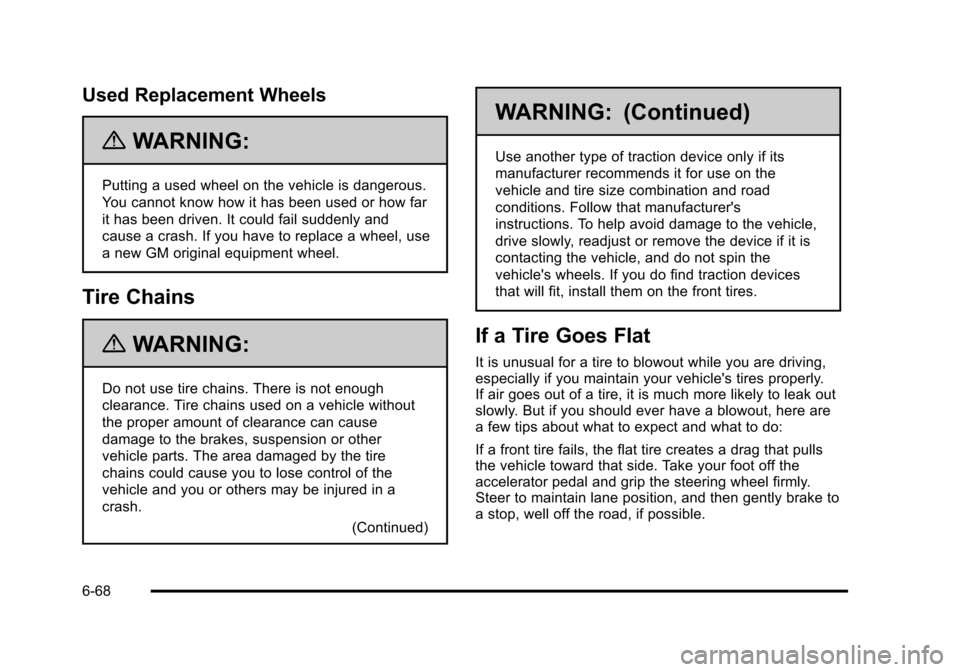
Used Replacement Wheels
{WARNING:
Putting a used wheel on the vehicle is dangerous.
You cannot know how it has been used or how far
it has been driven. It could fail suddenly and
cause a crash. If you have to replace a wheel, use
a new GM original equipment wheel.
Tire Chains
{WARNING:
Do not use tire chains. There is not enough
clearance. Tire chains used on a vehicle without
the proper amount of clearance can cause
damage to the brakes, suspension or other
vehicle parts. The area damaged by the tire
chains could cause you to lose control of the
vehicle and you or others may be injured in a
crash.(Continued)
WARNING: (Continued)
Use another type of traction device only if its
manufacturer recommends it for use on the
vehicle and tire size combination and road
conditions. Follow that manufacturer's
instructions. To help avoid damage to the vehicle,
drive slowly, readjust or remove the device if it is
contacting the vehicle, and do not spin the
vehicle's wheels. If you do find traction devices
that will fit, install them on the front tires.
If a Tire Goes Flat
It is unusual for a tire to blowout while you are driving,
especially if you maintain your vehicle's tires properly.
If air goes out of a tire, it is much more likely to leak out
slowly. But if you should ever have a blowout, here are
a few tips about what to expect and what to do:
If a front tire fails, the flat tire creates a drag that pulls
the vehicle toward that side. Take your foot off the
accelerator pedal and grip the steering wheel firmly.
Steer to maintain lane position, and then gently brake to
a stop, well off the road, if possible.
6-68
Page 345 of 430
Black plate (69,1)Chevrolet HHR Owner Manual - 2011
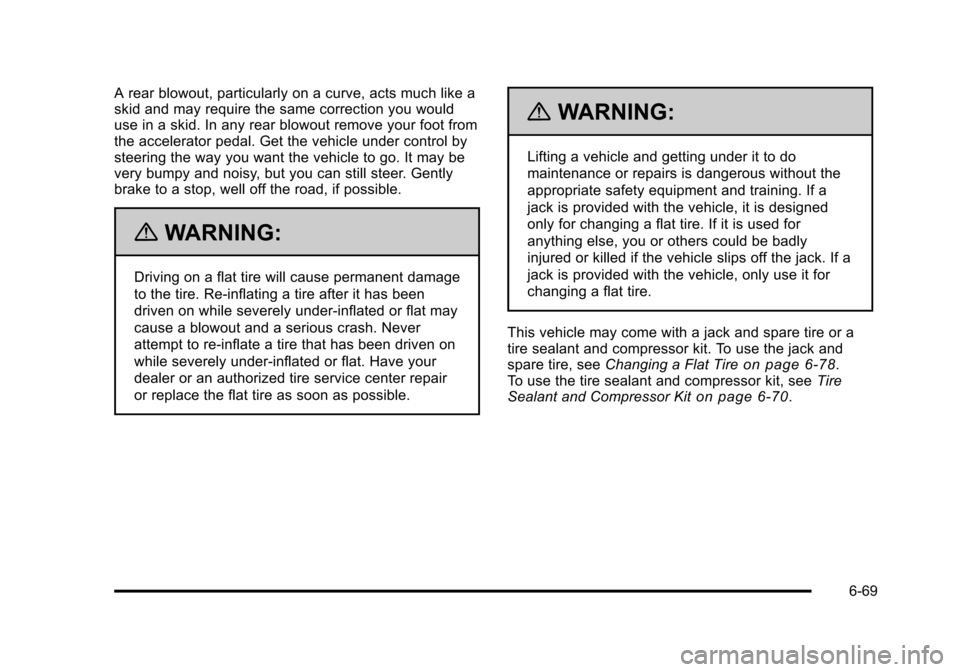
A rear blowout, particularly on a curve, acts much like a
skid and may require the same correction you would
use in a skid. In any rear blowout remove your foot from
the accelerator pedal. Get the vehicle under control by
steering the way you want the vehicle to go. It may be
very bumpy and noisy, but you can still steer. Gently
brake to a stop, well off the road, if possible.
{WARNING:
Driving on a flat tire will cause permanent damage
to the tire. Re-inflating a tire after it has been
driven on while severely under-inflated or flat may
cause a blowout and a serious crash. Never
attempt to re-inflate a tire that has been driven on
while severely under-inflated or flat. Have your
dealer or an authorized tire service center repair
or replace the flat tire as soon as possible.
{WARNING:
Lifting a vehicle and getting under it to do
maintenance or repairs is dangerous without the
appropriate safety equipment and training. If a
jack is provided with the vehicle, it is designed
only for changing a flat tire. If it is used for
anything else, you or others could be badly
injured or killed if the vehicle slips off the jack. If a
jack is provided with the vehicle, only use it for
changing a flat tire.
This vehicle may come with a jack and spare tire or a
tire sealant and compressor kit. To use the jack and
spare tire, see Changing a Flat Tire
on page 6‑78.
To use the tire sealant and compressor kit, see Tire
Sealant and Compressor Kit
on page 6‑70.
6-69
Page 379 of 430
Black plate (103,1)Chevrolet HHR Owner Manual - 2011
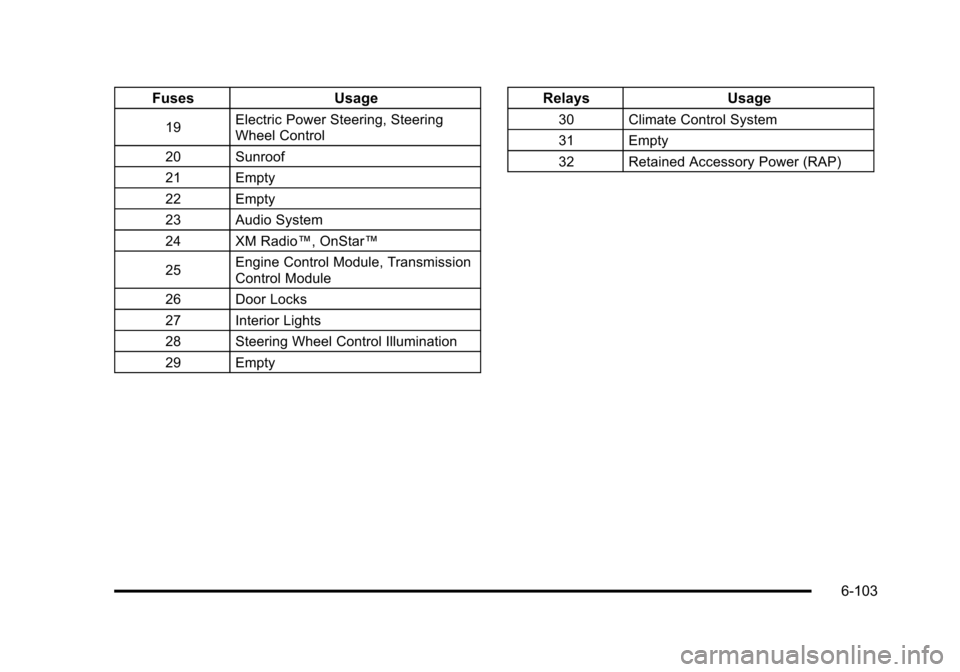
FusesUsage
19Electric Power Steering, Steering
Wheel Control
20 Sunroof
21 Empty
22 Empty
23 Audio System
24 XM Radio™, OnStar™
25 Engine Control Module, Transmission
Control Module
26 Door Locks
27 Interior Lights
28 Steering Wheel Control Illumination
29 Empty
Relays Usage
30 Climate Control System
31 Empty
32 Retained Accessory Power (RAP)
6-103
Page 380 of 430
Black plate (104,1)Chevrolet HHR Owner Manual - 2011
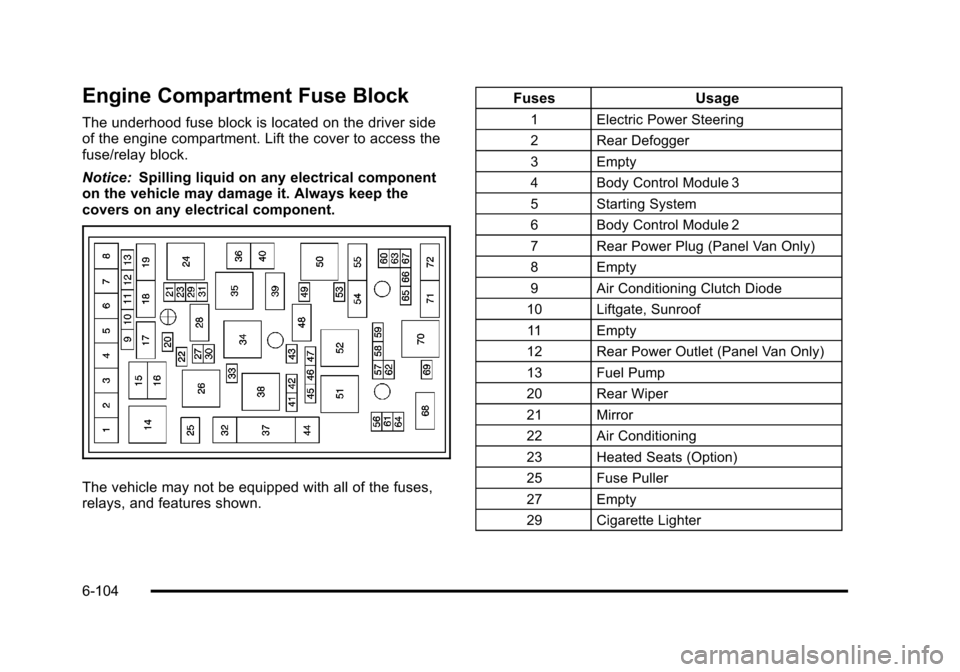
Engine Compartment Fuse Block
The underhood fuse block is located on the driver side
of the engine compartment. Lift the cover to access the
fuse/relay block.
Notice:Spilling liquid on any electrical component
on the vehicle may damage it. Always keep the
covers on any electrical component.
The vehicle may not be equipped with all of the fuses,
relays, and features shown. Fuses Usage
1 Electric Power Steering
2 Rear Defogger
3 Empty
4 Body Control Module 3
5 Starting System
6 Body Control Module 2
7 Rear Power Plug (Panel Van Only)
8 Empty
9 Air Conditioning Clutch Diode
10 Liftgate, Sunroof 11 Empty
12 Rear Power Outlet (Panel Van Only)
13 Fuel Pump
20 Rear Wiper
21 Mirror
22 Air Conditioning
23 Heated Seats (Option)
25 Fuse Puller
27 Empty
29 Cigarette Lighter
6-104
Page 388 of 430
Black plate (4,1)Chevrolet HHR Owner Manual - 2011
.Fluids visual leak check (or every 12 months,
whichever occurs first). A leak in any system must
be repaired and the fluid level checked.
.Engine air cleaner filter inspection. SeeEngine Air
Cleaner/Filter on page 6‑20.
.Brake system inspection (or every 12 months,
whichever occurs first).
.Steering and suspension inspection. Visual
inspection for damaged, loose, or missing parts or
signs of wear.
.Body hinges and latches, key lock cylinders, and
rear compartment hinges lubrication. See
Recommended Fluids and Lubricants
on
page 7‑8. More frequent lubrication may be
required when the vehicle is exposed to a
corrosive environment. Applying silicone grease on
weatherstrips with a clean cloth makes them last
longer, seal better, and not stick or squeak.
.Restraint system component check. See Checking
the Restraint Systems on page 2‑73.
.Fuel system inspection for damage or leaks.
.Exhaust system and nearby heat shields
inspection for loose or damaged components.
Additional Required Services
Every 12 000 km/7,500 Miles
.Rotate tires. Tires should be rotated every
12 000 km/7,500 miles. See Tire Inspection and
Rotation on page 6‑60.
At Each Fuel Stop
.Engine oil level check. See Engine Oilon
page 6‑16.
.Engine coolant level check. See Engine Coolanton page 6‑24.
.Windshield washer fluid level check. See
Windshield Washer Fluid on page 6‑30.
Once a Month
.Tire inflation pressures check. See Inflation - Tire
Pressure on page 6‑54.
.Tire wear inspection. See Tire Inspection and
Rotation on page 6‑60.
.Sunroof track and seal inspection, if equipped. See
Sunroof on page 3‑48.
7-4
Page 391 of 430
Black plate (7,1)Chevrolet HHR Owner Manual - 2011
Automatic Transmission Shift Lock
Control Function Check
{WARNING:
When you are doing this inspection, the vehicle
could move suddenly. If the vehicle moves, you or
others could be injured.
1. Before starting this check, be sure there is enough room around the vehicle. It should be parked on a
level surface.
2. Firmly apply the parking brake. See Parking Brake
on page 3‑30.
Be ready to apply the regular brake immediately if
the vehicle begins to move. 3. With the engine off, turn the ignition to ON/RUN,
but do not start the engine. Without applying the
regular brake, try to move the shift lever out of
P (Park) with normal effort. If the shift lever moves
out of P (Park), contact your dealer for service.
Ignition Transmission Lock Check
While parked, and with the parking brake set, try to turn
the ignition to LOCK/OFF in each shift lever position.
.For automatic transmission vehicles, the ignition
should turn to LOCK/OFF only when the shift lever
is in P (Park). The ignition key should come out
only in LOCK/OFF.
.For manual transmission vehicles, the ignition key
should come out only in LOCK/OFF.
Turn the steering wheel to the left and to the right.
It should only lock when turned to the right.
Contact your dealer if service is required.
7-7
Page 412 of 430
Black plate (14,1)Chevrolet HHR Owner Manual - 2011
Reporting Safety Defects to General
Motors
In addition to notifying NHTSA (or Transport Canada) in
a situation like this, notify General Motors.
Call 1-800-222-1020, or write:Chevrolet Motor Division
Chevrolet Customer Assistance Center
P.O. Box 33170
Detroit, MI 48232-5170
In Canada, call 1-800-263-3777 (English) or
1-800-263-7854 (French), or write:
General Motors of Canada Limited
Customer Communication Centre,
Mail Code: CA1-163-005
1908 Colonel Sam Drive
Oshawa, Ontario L1H 8P7
Service Publications Ordering
Information
Service Manuals
Service Manuals have the diagnosis and repair
information on the engines, transmission, axle,
suspension, brakes, electrical, steering, body, etc.
Service Bulletins
Service Bulletins give additional technical service
information needed to knowledgeably service General
Motors cars and trucks. Each bulletin contains
instructions to assist in the diagnosis and service of
your vehicle.
Owner Information
Owner publications are written specifically for owners
and intended to provide basic operational information
about the vehicle. The Owner Manual includes the
Maintenance Schedule for all models.
In-Portfolio: Includes a Portfolio, Owner Manual, and
Warranty Booklet.
RETAIL SELL PRICE: $35.00 (U.S.) plus handling and
shipping fees
Without Portfolio: Owner Manual only.
RETAIL SELL PRICE: $25.00 (U.S.) plus handling and
shipping fees
8-14