2011 CHEVROLET CORVETTE check engine
[x] Cancel search: check enginePage 173 of 428
Black plate (53,1)Chevrolet Corvette Owner Manual - 2011
Instruments and Controls 5-53
You can receive more than one
tire pressure message at a time.
To read other messages that may
have been sent at the same time,
press the RESET button. If a tire
pressure message appears on the
DIC, stop as soon as you can. Have
the tire pressures checked and set
to those shown on the Tire Loading
Information label. SeeRun-Flat
Tires on page 10‑59, Vehicle Load
Limits on page 9‑14, Tire Pressure
on page 10‑66, and Tire Pressure
Monitor System on page 10‑68.
The DIC also shows the tire
pressure values. See Driver
Information Center (DIC) on
page 5‑25.
To acknowledge the message, press
the RESET button. A message
reappears every 10 minutes until the
condition is corrected.Transmission Messages
SERVICE TRANSMISSION
This message displays when there
is a problem with the transmission.
See your dealer for service.
SHIFT TO PARK
If the vehicle has an automatic
transmission, this message displays
if the vehicle is not in P (Park)
when the engine is being turned off.
The vehicle will be in ACCESSORY
Once the shift lever is moved to
P (Park), the vehicle will turn off.
The vehicle will remain in
ACCESSORY, without the 20 minute
time-out period, until the shift lever
is moved to P (Park) or until the
driver presses the pushbutton to
restart the vehicle. See Ignition
Positions on page 9‑20 for more
information.
TRANSMISSION HOT IDLE
ENGINE
This message displays and four
chimes sound if the transmission
fluid temperature rises above
132°C (270°F) or rises rapidly.
The transmission may shift gears
or apply the torque converter clutch
to reduce the fluid temperature.
Driving aggressively or driving
on long hills can cause the
transmission fluid temperature
to be higher than normal. If this
message appears, you may
continue to drive at a slower speed.
Monitor the transmission fluid
temperature and allow it to cool
to at least 110°C (230°F). The
transmission fluid temperature can
be monitored with the gauges button
on the DIC. See “DIC Operation and
Displays” underDriver Information
Center (DIC) on page 5‑25 and
Automatic Transmission Fluid on
page 10‑23. Also check the engine
coolant temperature. If it is also
hot, see Engine Overheating on
page 10‑34.
Page 229 of 428
Black plate (7,1)Chevrolet Corvette Owner Manual - 2011
Climate Controls 8-7
Maintenance
Passenger Compartment
Air Filter
The passenger compartment air
filter removes certain particles from
the air including pollen and dust
particles. Reductions in airflow,
which may occur more often in
dusty areas, indicate that the
filter may need to be replaced.
SeeMaintenance Replacement
Parts on page 11‑8.
Notice: Driving without a
passenger compartment air filter
in place can cause water and
small particles, like paper and
leaves, to be pulled into your
climate control system which may
cause damage to it. Make sure
you always replace the old filter
with a new one. The passenger compartment air
filter is located on the passenger
side of the engine compartment
near the battery. See
Engine
Compartment Overview on
page 10‑10.
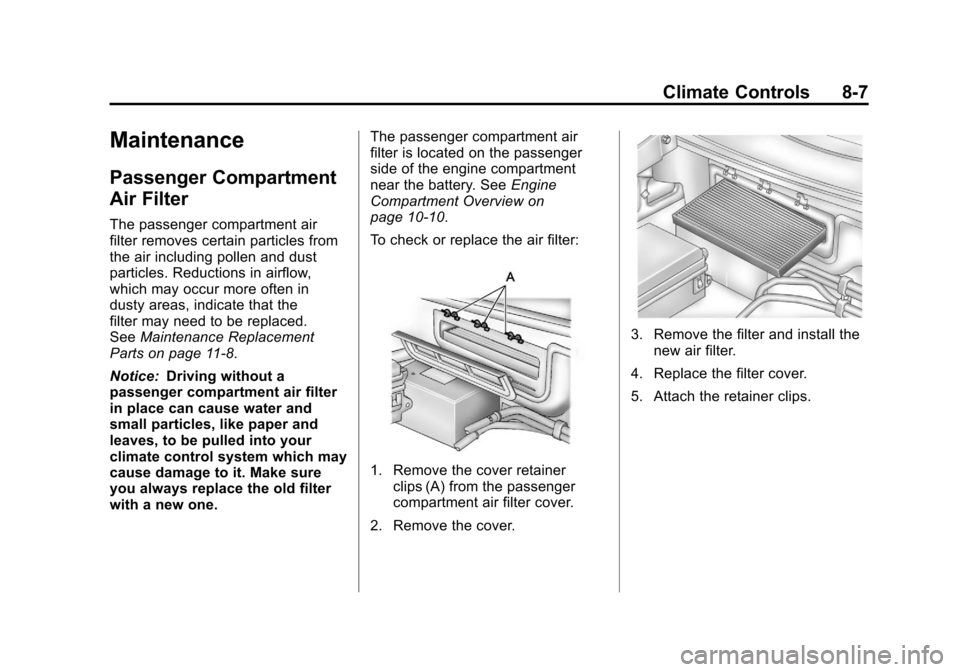
To check or replace the air filter:
1. Remove the cover retainer clips (A) from the passenger
compartment air filter cover.
2. Remove the cover.
3. Remove the filter and install the new air filter.
4. Replace the filter cover.
5. Attach the retainer clips.
Page 237 of 428
Black plate (7,1)Chevrolet Corvette Owner Manual - 2011
Driving and Operating 9-7
Racing or Other
Competitive Driving
Racing or competitive driving
may affect the vehicle warranty.
See the warranty book before
using the vehicle for racing or
other competitive driving.
Notice:If you use the vehicle
for racing or other competitive
driving, the engine may use more
oil than it would with normal use.
Low oil levels can damage the
engine. For information on how
to add oil, see Engine Oil on
page 10‑15.
Z06, ZR1, and Grand Sport Only:
Be sure to check the oil level
often during racing or other
competitive driving and keep the
level at or near the upper mark
that shows the proper operating
range on the engine oil dipstick. Except Z06, ZR1, and Grand
Sport: Be sure to check the oil
level often during racing or other
competitive driving and keep the
level at or near 1 L (1 quart) above
the upper mark that shows the
proper operating range on the
engine oil dipstick. After the
competitive driving, remove
excess oil so that the level on
the dipstick is not above the
upper mark that shows the
proper operating range.
Z06, ZR1, and Grand Sport
Only: For racing or competitive
driving, it is recommended that
the brake fluid be replaced with a
high performance brake fluid that
has a dry boiling point greater than
279°C (534°F). After conversion to
the high performance brake fluid,
follow the brake fluid service
recommendations outlined by the
fluid manufacturer. Do not use
silicone or DOT‐5 brake fluids.Z06, ZR1, and Grand Sport Only:
For racing or competitive driving, it
is recommended that the loading of
the vehicle be limited to the driver
only, with no other cargo, and that
tires be inflated to 180 kPa (26 psi)
for a maximum speed of 230 km/h
(143 mph).
If the vehicle is a Z06, ZR1,
or Grand Sport model, it has
greaseable outer ends on both
of the rear toe‐links. Under
normal use, lubrication should
be performed as described in
the maintenance schedule.
See
Scheduled Maintenance on
page 11‑2 andRecommended
Fluids and Lubricants on page 11‑6.
If using the vehicle for racing,
lubrication should be performed
at the end of each racing day.
See your dealer for lubrication
and make sure any needed
repairs are made at once. Proper
procedures for performing these
services can be found in the service
manual. See Service Publications
Ordering Information on page 13‑15.
Page 240 of 428
Black plate (10,1)Chevrolet Corvette Owner Manual - 2011
9-10 Driving and Operating
Other Rainy Weather Tips
Besides slowing down, other wet
weather driving tips include:
.Allow extra following distance.
.Pass with caution.
.Keep windshield wiping
equipment in good shape.
.Keep the windshield washer fluid
reservoir filled.
.Have good tires with proper
tread depth. SeeTires on
page 10‑58.
.Turn off cruise control.
Highway Hypnosis
Always be alert and pay attention
to your surroundings while driving.
If you become tired or sleepy, find
a safe place to park your vehicle
and rest. Other driving tips include:
.Keep the vehicle well ventilated.
.Keep interior temperature cool.
.Keep your eyes moving
—scan
the road ahead and to the sides.
.Check the rearview mirror and
vehicle instruments often.
Hill and Mountain Roads
Driving on steep hills or through
mountains is different than driving
on flat or rolling terrain. Tips for
driving in these conditions include:
.Keep the vehicle serviced and in
good shape.
.Check all fluid levels and brakes,
tires, cooling system, and
transmission.
.Shift to a lower gear when going
down steep or long hills.
{WARNING
If you do not shift down, the
brakes could get so hot that they
would not work well. You would
then have poor braking or even
none going down a hill. You could
crash. Shift down to let the engine
assist the brakes on a steep
downhill slope.
{WARNING
Coasting downhill in N (Neutral)
or with the ignition off is
dangerous. The brakes will
have to do all the work of slowing
down and they could get so hot
that they would not work well.
You would then have poor braking
or even none going down a hill.
You could crash. Always have the
engine running and the vehicle in
gear when going downhill.
Page 242 of 428
Black plate (12,1)Chevrolet Corvette Owner Manual - 2011
9-12 Driving and Operating
Blizzard Conditions
Being stuck in snow can be in a
serious situation. Stay with the
vehicle unless there is help nearby.
If possible, use theRoadside
Assistance Program (United States
and Canada) on page 13‑8 or
Roadside Assistance Program
(Mexico) on page 13‑10. To get
help and keep everyone in the
vehicle safe:
.Turn on the hazard warning
flashers.
.Tie a red cloth to an outside
mirror.
{WARNING
Snow can trap engine exhaust
under the vehicle. This may
cause exhaust gases to get
inside. Engine exhaust contains
Carbon Monoxide (CO) which
(Continued)
WARNING (Continued)
cannot be seen or smelled. It can
cause unconsciousness and even
death.
If the vehicle is stuck in the snow:
.Clear away snow from around
the base of your vehicle,
especially any that is blocking
the exhaust pipe.
.Check again from time to
time to be sure snow does
not collect there.
.Open a window about 5 cm
(2 in) on the side of the
vehicle that is away from the
wind to bring in fresh air.
.Fully open the air outlets
on or under the instrument
panel.(Continued)
WARNING (Continued)
.Adjust the climate control
system to a setting that
circulates the air inside
the vehicle and set the fan
speed to the highest setting.
See Climate Control System
in the Index.
For more information about
carbon monoxide, see Engine
Exhaust on page 9‑26.
Snow can trap exhaust gases
under your vehicle. This can
cause deadly CO (Carbon
Monoxide) gas to get inside.
CO could overcome you and kill
you. You cannot see it or smell it,
so you might not know it is in your
vehicle. Clear away snow from
around the base of your vehicle,
especially any that is blocking the
exhaust.
Page 249 of 428
Black plate (19,1)Chevrolet Corvette Owner Manual - 2011
Driving and Operating 9-19
For the first 80 km (500 miles):
.Avoid full throttle starts and
abrupt stops.
.Do not exceed 4,000 rpm.
.Avoid driving at any one
constant speed, fast or slow,
including the use of cruise
control.
.Avoid downshifting to brake
or slow the vehicle when the
engine speed will exceed
4000 rpm.
.Do not let the engine labor.
Never lug the engine in high
gear at low speeds. With a
manual transmission, shift to
the next lower gear. This rule
applies at all times, not just
during the break-in period.For the first 2 414 km (1,500 miles):
.Do not participate in track
events, sport driving schools,
or similar activities during the
first 2 414 km (1,500 miles).
.Check engine oil with every
refueling and add if necessary.
Oil and fuel consumption may be
higher than normal during the
first 2 414 km (1,500 miles).
Front Air Dam
The vehicle is equipped with a front
air dam which has minimal ground
clearance.
Vehicles with the ZR-1 package,
or Z‐06 vehicles with RPO ULZ,
also come with a splitter made from
carbon fiber.
{WARNING
ZR‐1s, and Z‐06s with RPO ULZ,
contain parts made from carbon
fiber.
(Continued)
WARNING (Continued)
When damaged, the exposed
edges can be very sharp.
A person could be injured
by these sharp edges. Use
caution when washing the
vehicle, coming in contact with,
or removing damaged carbon
fiber parts. See your dealer for
replacement.
Under normal operation, these
components will occasionally
contact some road surfaces
(speed bumps, driveway
ramps, etc.). This can be heard
inside the vehicle as a scraping
noise. This is normal and does
not indicate a problem.
Use care when approaching bumps
or objects on road surfaces and
avoid them when possible.
Page 253 of 428
Black plate (23,1)Chevrolet Corvette Owner Manual - 2011
Driving and Operating 9-23
Notice:Cranking the engine for
long periods of time, by pressing
the START button immediately
after cranking has ended, can
overheat and damage the
cranking motor, and drain the
battery. Wait at least 15 seconds
between each try, to allow the
cranking motor to cool down.
The vehicle has a
Computer-Controlled
Cranking System. This feature
assists in starting the engine
and protects components.
Once cranking has been initiated,
the engine continues cranking
for a few seconds or until the vehicle
starts. If the engine does not start,
cranking automatically stops after
15 seconds to prevent cranking
motor damage. To prevent gear
damage, this system also prevents
cranking if the engine is already
running. Notice:
The engine is designed
to work with the electronics in
the vehicle. If electrical parts
or accessories are added, you
could change the way the engine
operates. Before adding electrical
equipment, check with your
dealer. If you do not, the engine
might not perform properly. Any
resulting damage would not be
covered by the vehicle warranty.
Stopping the Engine
If the vehicle has an automatic
transmission, move the shift lever
to P (Park) and press and hold the
Acc. (Off/Accessory) button, located
on the instrument panel, until the
engine shuts off. If the shift lever
is not in P (Park), the engine shuts off and the vehicle goes into the
Accessory Mode. The DIC displays
SHIFT TO PARK. Once the shifter is
moved to P (Park), the vehicle turns
off. If the vehicle has a manual
transmission, it is recommended
that you move the shift lever to
R (Reverse) and set the parking
brake after you turn off the engine
by pressing and holding the Acc.
(Off/Accessory) button.
If the keyless access transmitter is
not detected inside the vehicle when
it is turned to off, the DIC displays
NO FOB
–OFF OR RUN?.
See Key and Lock Messages on
page 5‑42 for more information.
Page 264 of 428
Black plate (34,1)Chevrolet Corvette Owner Manual - 2011
9-34 Driving and Operating
Downshifting
(Manual Transmission)
Do not downshift into the gear
shown below at a speed greater
than shown in the table:1 (First) 80 km/h (50 mph)
2 (Second) 119 km/h (74 mph)
3 (Third) 163 km/h
(101 mph)
4 (Fourth) 209 km/h
(130 mph)
Notice: If you skip more than one
gear when you downshift, or if
you race the engine when you
release the clutch pedal while
downshifting, you could damage
the engine, clutch, driveshaft or
the transmission. Do not skip
gears or race the engine when
downshifting. The six-speed transmission has
a spring that centers the shift
lever near 3 (Third) and 4 (Fourth).
This spring helps you know which
gear you are in when you are
shifting. Be careful when shifting
from 1 (First) to 2 (Second) or
downshifting from 6 (Sixth) to
5 (Fifth). The spring will try to pull
the shift lever toward 4 (Fourth) and
3 (Third). Make sure you move the
lever into 2 (Second) or 5 (Fifth).
If you let the shift lever move in the
direction of the pulling, you may end
up shifting from 1 (First) to 4 (Fourth)
or from 6 (Sixth) to 3 (Third).
Brakes
Antilock Brake
System (ABS)
This vehicle has the Antilock
Brake System (ABS), an advanced
electronic braking system that helps
prevent a braking skid.
When the engine is started and
the vehicle begins to drive away,
ABS checks itself. A momentary
motor or clicking noise might be
heard while this test is going on,
and it might even be noticed that
the brake pedal moves a little.
This is normal.
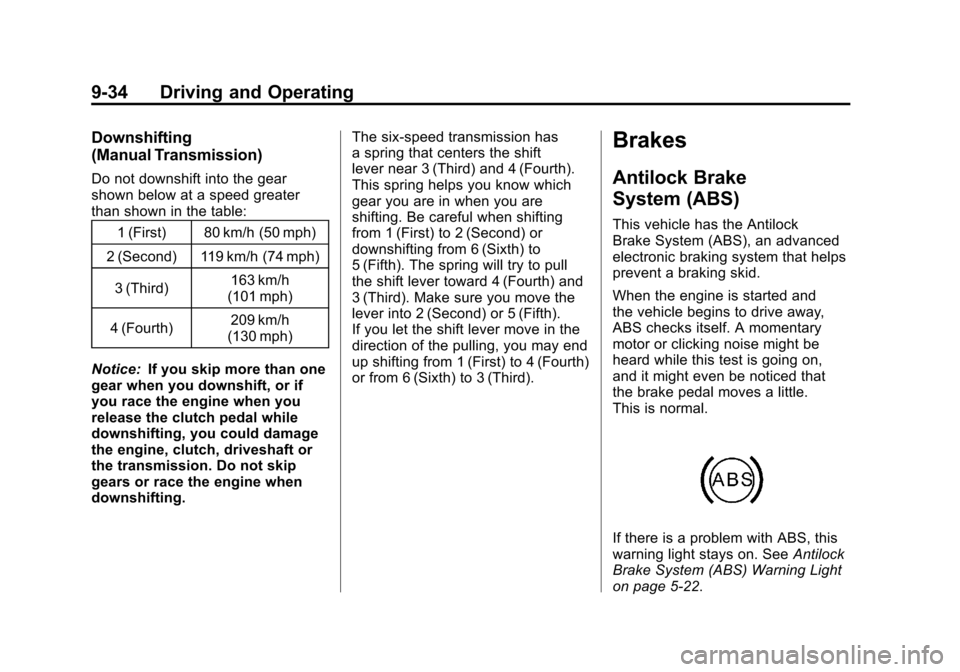
If there is a problem with ABS, this
warning light stays on. See
Antilock
Brake System (ABS) Warning Light
on page 5‑22.