2011 CHEVROLET AVEO seats
[x] Cancel search: seatsPage 158 of 328
Black plate (2,1)Chevrolet Aveo Owner Manual - 2011
8-2 Climate Controls
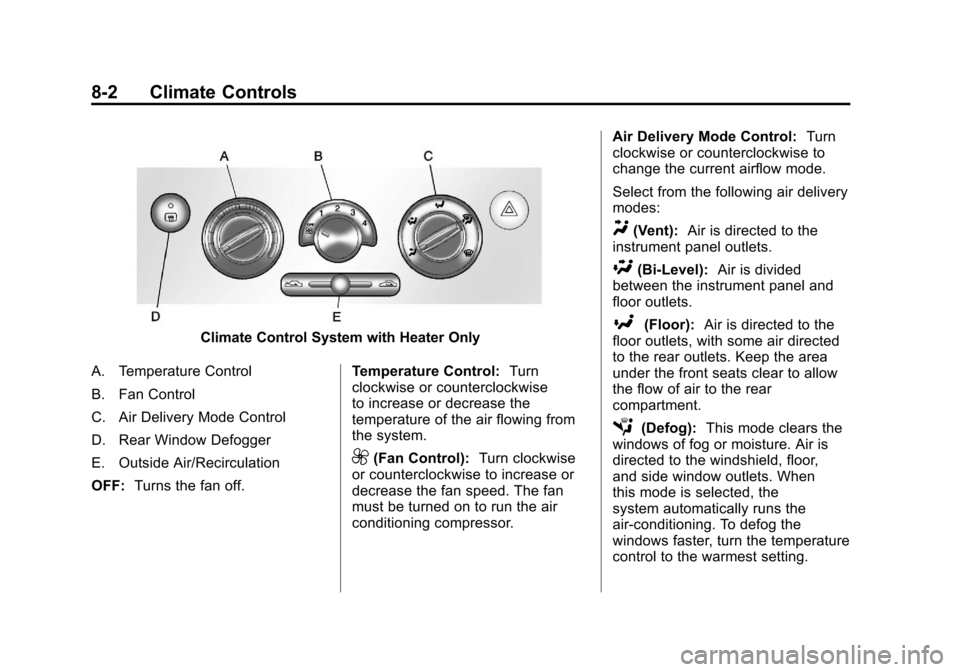
Climate Control System with Heater Only
A. Temperature Control
B. Fan Control
C. Air Delivery Mode Control
D. Rear Window Defogger
E. Outside Air/Recirculation
OFF: Turns the fan off. Temperature Control:
Turn
clockwise or counterclockwise
to increase or decrease the
temperature of the air flowing from
the system.
9(Fan Control): Turn clockwise
or counterclockwise to increase or
decrease the fan speed. The fan
must be turned on to run the air
conditioning compressor. Air Delivery Mode Control:
Turn
clockwise or counterclockwise to
change the current airflow mode.
Select from the following air delivery
modes:
Y(Vent): Air is directed to the
instrument panel outlets.
\(Bi-Level): Air is divided
between the instrument panel and
floor outlets.
[(Floor): Air is directed to the
floor outlets, with some air directed
to the rear outlets. Keep the area
under the front seats clear to allow
the flow of air to the rear
compartment.
É(Defog): This mode clears the
windows of fog or moisture. Air is
directed to the windshield, floor,
and side window outlets. When
this mode is selected, the
system automatically runs the
air-conditioning. To defog the
windows faster, turn the temperature
control to the warmest setting.
Page 160 of 328
Black plate (4,1)Chevrolet Aveo Owner Manual - 2011
8-4 Climate Controls
:(Outside Air):This mode
brings outside air into the vehicle.
For vehicles with a recirculation
button, press the button until the
recirculation mode is turned off. The
vehicle then returns to the outside
air mode.
For vehicles with a lever, move the
lever to choose the outside
air mode.
Rear Window and Outside
Mirror Defogger
For vehicles with a rear window and
outside mirror defogger, they only
work when the ignition is turned to
ON/RUN.
The rear window defogger uses a
warming grid to remove fog or frost
from the rear window.
<(Rear Window Defogger):
Press to turn the rear window and
outside mirror defogger on or off. An
indicator light comes on to show
that the feature is on. If the vehicle does not have air
conditioning, the rear window
defogger may turn off about
10 minutes after the button is
pressed. If it remains on, it can be
turned off by pressing
If the vehicle has air conditioning,
the rear window defogger turns off
about 10 minutes after the button is
pressed. The defogger can also be
turned off by turning the engine off.
Notice: Do not use anything
sharp on the inside of the rear
window. If you do, you could cut
or damage the warming grid, and
the repairs would not be covered
by the vehicle warranty. Do not
attach a temporary vehicle
license, tape, a decal, or anything
similar to the defogger grid.
Air Vents
To open an outlet, press on its
cover. Turn the cover to change the
direction of the airflow.
Operation Tips
.Clear away any ice, snow or
leaves from the air inlets at the
base of the windshield that may
block the flow of air into the
vehicle.
.Use of non-GM approved hood
deflectors may adversely affect
the performance of the system.
.Keep the path under the front
seats clear of objects to help
circulate the air inside of the
vehicle more effectively.
Page 178 of 328
Black plate (16,1)Chevrolet Aveo Owner Manual - 2011
9-16 Driving and Operating
The GVWR includes the weight
of the vehicle, all occupants,
fuel and cargo. Never exceed
the GVWR for your vehicle,
or the Gross Axle Weight
Rating (GAWR) for either the
front or rear axle.
If there is a heavy load, it should
be spread out. See“Steps for
Determining Correct Load Limit”
earlier in this section.
{WARNING
Do not load the vehicle any
heavier than the Gross
Vehicle Weight Rating
(GVWR), or either the
maximum front or rear Gross
Axle Weight Rating (GAWR).
(Continued)
WARNING (Continued)
This can cause systems to
break and change the way the
vehicle handles. This could
cause loss of control and a
crash. Overloading can also
shorten the life of the vehicle.
Notice : Overloading the
vehicle may cause damage.
Repairs would not be covered
by the vehicle warranty. Do
not overload the vehicle.
If you put things inside your
vehicle —like suitcases,
tools, packages, or anything
else —they will go as fast as
the vehicle goes. If you have to
stop or turn quickly, or if there is
a crash, they will keep going.{WARNING
Things you put inside the
vehicle can strike and injure
people in a sudden stop or
turn, or in a crash.
.Put things in the cargo
area of the vehicle. Try to
spread the weight evenly.
.Never stack heavier
things, like suitcases,
inside the vehicle so that
some of them are above
the tops of the seats.
.Do not leave an
unsecured child
restraint in the vehicle.
.When you carry something
inside the vehicle, secure
it whenever you can.
.Do not leave a seat folded
down unless you need to.
Page 187 of 328
Black plate (25,1)Chevrolet Aveo Owner Manual - 2011
Driving and Operating 9-25
Running the Vehicle
While Parked
It is better not to park with the
engine running. But if you ever have
to, here are some things to know.
{WARNING
Idling a vehicle in an enclosed
area with poor ventilation is
dangerous. Engine exhaust may
enter the vehicle. Engine exhaust
contains Carbon Monoxide (CO)
which cannot be seen or smelled.
It can cause unconsciousness
and even death. Never run the
engine in an enclosed area that
has no fresh air ventilation. For
more information, seeEngine
Exhaust on page 9‑24.
{WARNING
It can be dangerous to get out of
the vehicle if the automatic
transmission shift lever is not fully
in P (Park) with the parking brake
firmly set. The vehicle can roll. Do
not leave the vehicle when the
engine is running unless you
have to. If you have left the
engine running, the vehicle can
move suddenly. You or others
could be injured. To be sure the
vehicle will not move, even when
it is on fairly level ground, always
set the parking brake and move
the automatic transmission shift
lever to P (Park), or the manual
transmission shift lever to Neutral.
Follow the proper steps to be sure
the vehicle will not move. If the
vehicle has an automatic
transmission, see Shifting Into Park
(Automatic Transmission) on
page 9‑21.
Automatic
Transmission
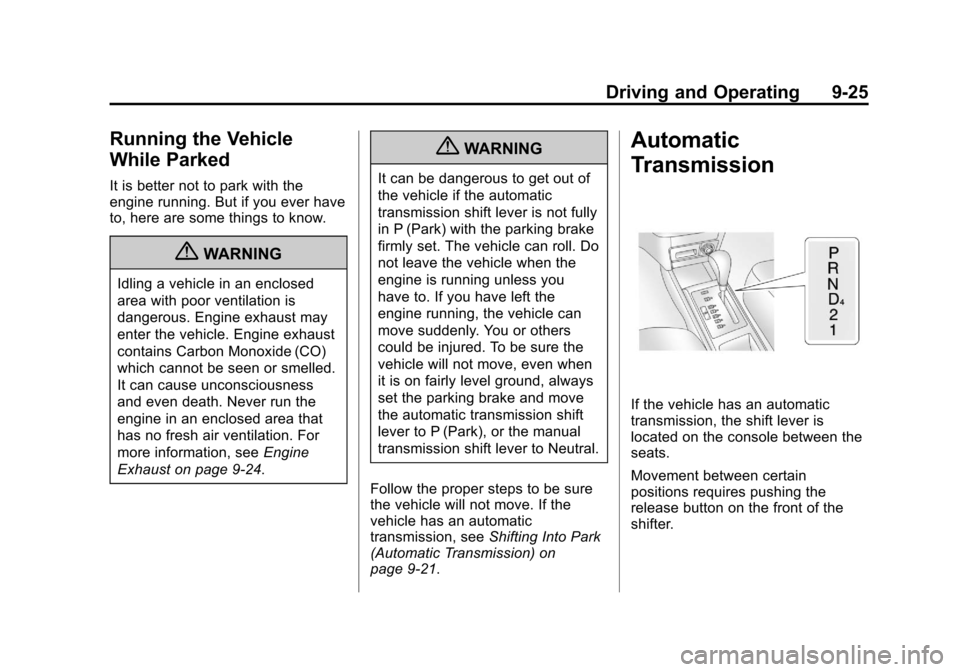
If the vehicle has an automatic
transmission, the shift lever is
located on the console between the
seats.
Movement between certain
positions requires pushing the
release button on the front of the
shifter.
Page 193 of 328
Black plate (31,1)Chevrolet Aveo Owner Manual - 2011
Driving and Operating 9-31
Remember: ABS does not change
the time needed to get a foot up to
the brake pedal or always decrease
stopping distance. If you get too
close to the vehicle in front of you,
there will not be enough time to
apply the brakes if that vehicle
suddenly slows or stops. Always
leave enough room up ahead to
stop, even with ABS.
Using ABS
Do not pump the brakes. Just hold
the brake pedal down firmly and let
antilock work. You might feel a slight
brake pedal pulsation or hear some
noise, but this is normal.
Braking in Emergencies
At some time, nearly every driver
gets into a situation that requires
hard braking.
If the vehicle has ABS, it allows the
driver to steer and brake at the
same time. However, if the vehicle
does not have ABS, the first
reaction—to hit the brake pedal hard and hold it down
—might be
the wrong thing to do. The wheels
can stop rolling. Once they do, the
vehicle cannot respond to the
driver's steering. Momentum will
carry it in whatever direction it was
headed when the wheels stopped
rolling. That could be off the road,
into the very thing the driver was
trying to avoid, or into traffic.
If the vehicle does not have ABS,
use a “squeeze” braking technique.
This gives maximum braking while
maintaining steering control. Do this
by pushing on the brake pedal with
steadily increasing pressure. In an
emergency, you will probably want
to squeeze the brakes hard without
locking the wheels. If you hear or
feel the wheels sliding, ease off the
brake pedal. This helps retain
steering control.
In many emergencies, steering can
help more than even the very best
braking.
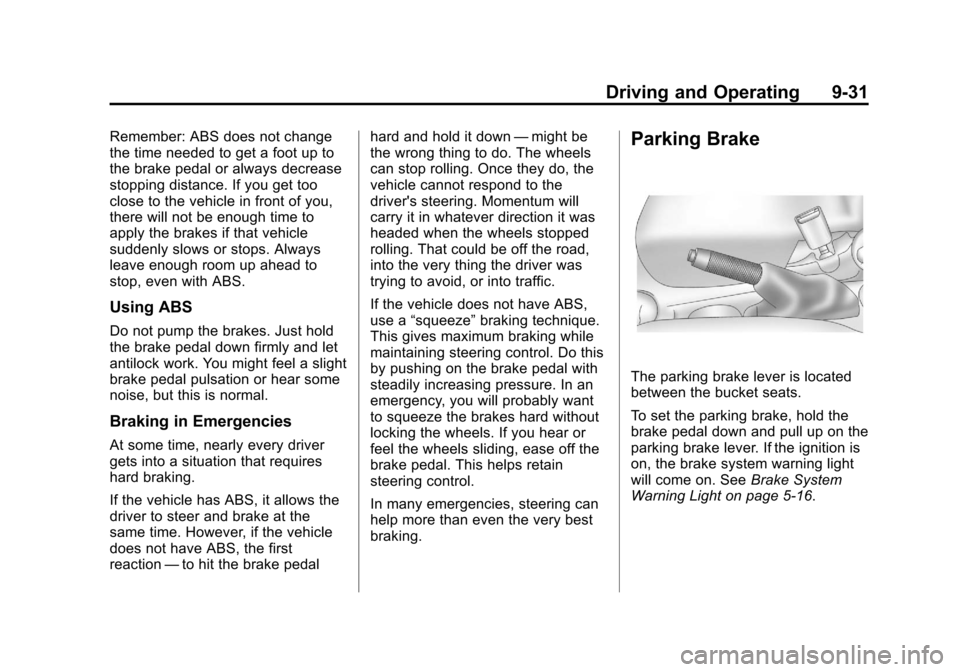
Parking Brake
The parking brake lever is located
between the bucket seats.
To set the parking brake, hold the
brake pedal down and pull up on the
parking brake lever. If the ignition is
on, the brake system warning light
will come on. See Brake System
Warning Light on page 5‑16.
Page 248 of 328

Black plate (46,1)Chevrolet Aveo Owner Manual - 2011
10-46 Vehicle Care
Accessory Weight:This
means the combined weight
of optional accessories.
Some examples of optional
accessories are, automatic
transmission, power steering,
power brakes, power windows,
power seats, and air
conditioning.
Aspect Ratio
:The relationship
of a tire's height to its width.
Belt
:A rubber coated layer of
cords that is located between
the plies and the tread. Cords
may be made from steel or other
reinforcing materials.
Bead
:The tire bead contains
steel wires wrapped by steel
cords that hold the tire onto
the rim. Bias Ply Tire
:A pneumatic tire
in which the plies are laid at
alternate angles less than
90 degrees to the centerline of
the tread.
Cold Tire Pressure
:The
amount of air pressure in a tire,
measured in kPa (kilopascal)
or psi (pounds per square inch)
before a tire has built up heat
from driving. See Tire Pressure
on page 10‑48.
Curb Weight
:The weight of a
motor vehicle with standard and
optional equipment including the
maximum capacity of fuel, oil,
and coolant, but without
passengers and cargo.
DOT Markings
:A code molded
into the sidewall of a tire
signifying that the tire is in
compliance with the U.S.
Department of Transportation
(DOT) motor vehicle safety
standards. The DOT code includes the Tire Identification
Number (TIN), an alphanumeric
designator which can also
identify the tire manufacturer,
production plant, brand, and
date of production.
GVWR
:Gross Vehicle Weight
Rating. See Vehicle Load Limits
on page 9‑12.
GAWR FRT
:Gross Axle Weight
Rating for the front axle. See
Vehicle Load Limits on
page 9‑12.
GAWR RR
:Gross Axle Weight
Rating for the rear axle. See
Vehicle Load Limits on
page 9‑12.
Intended Outboard Sidewall
:
The side of an asymmetrical tire,
that must always face outward
when mounted on a vehicle.
Kilopascal (kPa)
:The metric
unit for air pressure.
Page 319 of 328

Black plate (1,1)Chevrolet Aveo Owner Manual - 2011
INDEX i-1
A
Accessories andModifications . . . . . . . . . . . . . . . . . 10-4
Add-On Electrical Equipment . . . . . . . . . . . . . . . . . . . 9-40
Adjustments Lumbar, Front Seats . . . . . . . . . . . 3-4
Air Cleaner/Filter, Engine . . . . . 10-16
Air Filter, Passenger Compartment . . . . . . . . . . . . . . . . . 8-5
Air Vents . . . . . . . . . . . . . . . . . . . . . . . 8-4
Airbag System
Check . . . . . . . . . . . . . . . . . . . . . . . . 3-37
How Does an AirbagRestrain? . . . . . . . . . . . . . . . . . . . 3-29
Passenger Sensing
System . . . . . . . . . . . . . . . . . . . . . . 3-31
What Makes an Airbag Inflate? . . . . . . . . . . . . . . . . . . . . . . 3-29
What Will You See After
an Airbag Inflates? . . . . . . . . . . 3-30
When Should an Airbag Inflate? . . . . . . . . . . . . . . . . . . . . . . 3-28
Where Are the Airbags? . . . . . . 3-26 Airbags
Adding Equipment to the
Vehicle . . . . . . . . . . . . . . . . . . . . . . 3-36
Passenger Status Indicator . . . 5-12
Readiness Light . . . . . . . . . . . . . . 5-12
Servicing Airbag-Equipped Vehicles . . . . . . . . . . . . . . . . . . . . . 3-36
System Check . . . . . . . . . . . . . . . . 3-24
Alarm System Anti-Theft . . . . . . . . . . . . . . . . . . . . . 2-10
AM-FM Radio . . . . . . . . . . . . . . . . . . . 7-3
Antenna
Multi-Band . . . . . . . . . . . . . . . . . . . . 7-10
Anti-Theft Alarm System . . . . . . . . . . . . . . . . 2-10
Antilock Brake
System (ABS) . . . . . . . . . . . . . . . . 9-30
Warning Light . . . . . . . . . . . . . . . . . 5-17
Appearance Care Exterior . . . . . . . . . . . . . . . . . . . . . 10-76
Interior . . . . . . . . . . . . . . . . . . . . . . 10-80
Ashtrays . . . . . . . . . . . . . . . . . . . . . . . . 5-7
Assistance Program, Roadside . . . . . . . . . . . . . . . . . . . . . 13-6 Audio Players . . . . . . . . . . . . . . . . . 7-10
CD . . . . . . . . . . . . . . . . . . . . . . . . . . . 7-10
Audio System Backglass Antenna . . . . . . . . . . . . 7-9
Fixed Mast Antenna . . . . . . . . . . . 7-9
Radio Reception . . . . . . . . . . . . . . . 7-8
Automatic Transmission . . . . . . . 9-25
Fluid . . . . . . . . . . . . . . . . . . . . . . . . 10-13
Shift Lock ControlFunction Check . . . . . . . . . . . 10-28
Auxiliary Devices . . . . . . . . . . . . . . 7-15
B
Battery . . . . . . . . . . . . . . . . . . . . . . . 10-27
Inadvertent Power Saver . . . . . . 6-5
Jump Starting . . . . . . . . . . . . . . . 10-70
Blade Replacement, Wiper . . . 10-30
Brake System Warning Light . . . 5-16
Brakes . . . . . . . . . . . . . . . . . . . . . . . . 10-24 Antilock . . . . . . . . . . . . . . . . . . . . . . . 9-30
Fluid . . . . . . . . . . . . . . . . . . . . . . . . 10-26
Parking . . . . . . . . . . . . . . . . . . . . . . . 9-31
Braking . . . . . . . . . . . . . . . . . . . . . . . . . 9-3
Break-In, New Vehicle . . . . . . . . . 9-17
Page 322 of 328

Black plate (4,1)Chevrolet Aveo Owner Manual - 2011
i-4 INDEX
Engine (cont.)Pressure Light . . . . . . . . . . . . . . . . 5-18
Running While Parked . . . . . . . . 9-25
Starting . . . . . . . . . . . . . . . . . . 1-4, 9-19
Engine Oil Life System . . . . . . . . . . . . . . . . . 10-12
Event Data Recorders . . . . . . . . 13-15
Extender, Safety Belt . . . . . . . . . . 3-22
Exterior Lamp Controls . . . . . . . . . 6-1
F
Filter Engine Air Cleaner . . . . . . . . . 10-16
Flash-to-Pass . . . . . . . . . . . . . . . . . . . 6-2
Flashers, Hazard Warning . . . . . . 6-3
Flat Tire . . . . . . . . . . . . . . . . . . . . . . 10-61 Changing . . . . . . . . . . . . . . . . . . . 10-64
Floor Mats . . . . . . . . . . . . . . . . . . . . 10-83
Fluid Automatic Transmission . . . . 10-13
Brakes . . . . . . . . . . . . . . . . . . . . . . 10-26
Power Steering . . . . . . . . . . . . . 10-23
Washer . . . . . . . . . . . . . . . . . . . . . 10-24 Fog Lamps
Bulb Replacement . . . . . . . . . . . . . 6-4
Front Fog Lamps Light . . . . . . . . . . . . . . . . . . . . . . . . . . 5-20
Front Seats Adjustment . . . . . . . . . . . . . . . . . . . . 3-3
Front Storage . . . . . . . . . . . . . . . . . . . 4-1
Front Turn Signal
Bulb Replacement . . . . . . . . . . 10-32
Fuel . . . . . . . . . . . . . . . . . . . . . . . . . . . 9-34 Additives . . . . . . . . . . . . . . . . . . . . . 9-36
Filling a Portable Fuel
Container . . . . . . . . . . . . . . . . . . . 9-39
Filling the Tank . . . . . . . . . . . . . . . 9-37
Fuels in Foreign Countries . . . . 9-36
Gasoline Specifications . . . . . . . 9-35
Gauge . . . . . . . . . . . . . . . . . . . . . . . . 5-10
Low Fuel Warning Light . . . . . . . 5-20
Recommended . . . . . . . . . . . . . . . 9-35
Requirements, California . . . . . 9-35
Fuel Economy
Driving . . . . . . . . . . . . . . . . . . . . . . . . 1-22 Fuses
Engine Compartment
Fuse Block . . . . . . . . . . . . . . . . 10-37
Fuses and Circuit Breakers . . . . . . . . . . . . . . . . . . 10-36
Instrument Panel Fuse Block . . . . . . . . . . . . . . . . . . . . . . 10-40
G
Gasoline
Specifications . . . . . . . . . . . . . . . . . 9-35
Gauges Engine Coolant
Temperature . . . . . . . . . . . . . . . . 5-11
Fuel . . . . . . . . . . . . . . . . . . . . . . . . . . 5-10
Odometer . . . . . . . . . . . . . . . . . . . . . . 5-9
Speedometer . . . . . . . . . . . . . . . . . . 5-9
Tachometer . . . . . . . . . . . . . . . . . . . . 5-9
Trip Odometer . . . . . . . . . . . . . . . . . 5-9
Warning Lights and Indicators . . . . . . . . . . . . . . . . . . . . 5-7