2011 AUDI TT ROADSTER wheel
[x] Cancel search: wheelPage 219 of 260

Replacing run-flat tires and rims
Appl ies to vehicles: with Run -flat tires
Your vehicle was especially designed to use
special run-flat tires .
You may use and combine only approved run
flat t ires and spec ial matching rims that have
been designed for run -flat tires. Mount ing
special run-flat t ires on standard wheels will
not work and will not provide the advantages
fo the run-falt featu re. Neve r use specia l run
flat t ires on standard wheel rims .
After driving with a tire in the run-flat mode,
a lways have the vehicle and affected tire(s)
and rim(s) inspected by an autho rized Aud i
dealer . T ir es that have been driven in the run
flat mode must be replaced.
A WARNING
Use of damaged run-flat tires and rims can
cause vehicle damage that can lead to loss
o f vehicle control, a crash and ser ious per
sonal injury.
- Always have the veh icle and affected
t ire(s) and rim(s) inspected by an author
ized Audi dealer after driving a t ire in the
run-f lat mode.
- Tires that have been driven in the run
flat mode must be rep laced.
Tire s an d wheel s 21 7
•
•
Page 220 of 260

218 What do I do now?
What do I do now?
Trunk escape handle
In case of an emergency, the rear lid can be
opened from the inside using the trunk es
cape handle.
Fig. 157 Luggage compartment: Trunk escape handle
... To open the trunk lid pull the handle down
as indicated by the -arrow- ~
fig. 157.
The trunk escape handle inside the storage
compartment is made of fluorescent materia l
to g low in the dark.
A WARNING
The trunk escape handle is to be used only
in an emergency.
Vehicle tool kit
The tools are stored underneath the floor
panel in the luggage compartment.
Fig. 158 Luggage compa rtmen t: vehicle tool kit
... Swing the Luggage compartment floor up
wards .
... Remove the vehicle tool k it.
The on board tool kit includes: -
Hook for removing wheel covers *
- Plastic clip to remove wheel bo lt covers•
- Wheel bolt wrench
-Alignment pin for changing wheels
- Screwdriver with reversible blade
- Replacement bit (reversible Torx bit for
chang ing lamps)
- Open ended wrench 10 x 13
- Towing eye
Note : some of the on board items listed above
are provided on certain models only or are op
tiona l extras .
A WARNING ~
-Using a bumper jack to raise the vehicle
will damage the bumper system. The
jack may slip, caus ing injury .
- Never support your vehicle on cinder
b locks, bricks or other objects. These
may not be able to support the load and
could cause injury when they fail.
- Never start or run the eng ine while the
veh icle is supported by the jack.
- If you must work under the vehicle, al
ways use safety stands specifically de
signed for th is purpose.
- Never use the hexagonal socket in the
handle of the screwdriver to loosen or
tighten the wheel bolts.
Tire repair
General and safety pointers
Appl ies to vehicles: wit h Tire Mobility Sys tem
Tire repair is intended only for temporary,
short-term use.
Fig. 159 Tire damage for whic h t he Tir e Mob ility Sys-
tem is not suited
II>
Page 224 of 260
222 What do I do now ?
@ Tips
After a tire repair, have the sealant bottle
rep laced at a dealership . This restores full
functionality to the Tire Mob ility System.
What should I be
aware of when
changing a tire?
General information
The follow ing sections will provide you with
important information o n how to change a
tire using the vehicle tool kit.
However , we recommend that you have a
qua lified service center change the tire and
pe rform all work associated with changing it .
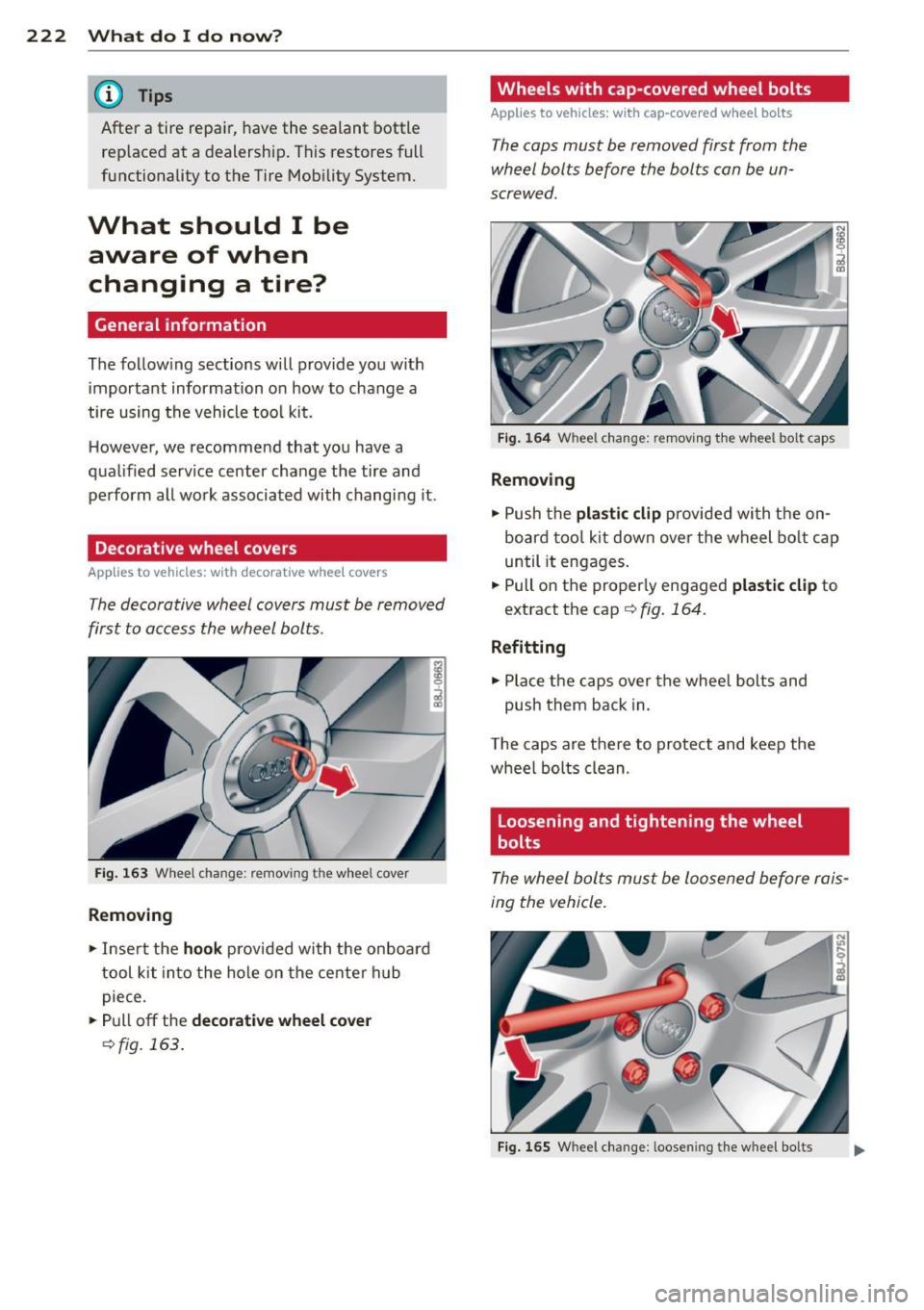
Decorative wheel covers
Applies to vehicles: with decorative wheel covers
The decorative wheel covers must be removed
first to access the wheel bolts .
Fig. 1 63 Wheel ch an ge : remo ving th e wh eel cove r
Removing
,.. In se rt the hook provided wi th t he on board
tool kit into the hole on the center h ub
piece .
,.. Pull
off the decorat ive wheel cover
Q fig . 163 .
' Wheels with cap-covered wheel bolts
Applies to vehicles: with cap-covered wheel bolts
The caps must be removed first from the
wheel bolts before the bolts can be un
screwed .
Fig . 164 W heel c hange: re moving th e wh eel bolt cap s
Removing
,.. Push the plasti c clip provided wi th the on
board too l kit down over the wheel bo lt cap
until it engages .
,.. Pull on th e properly engaged
pla stic clip to
extract the cap
Q fig. 164 .
Refitting
,.. Place the c aps over the whee l bolts and
push them back in.
T he caps are the re to protect and keep the
whee l bolts clean .
Loosening and tightening the wheel
bolts
The wheel bolts must be loosened before rais
ing the vehicle.
Fi g. 16 5 W hee l cha nge : loose ning t he wh eel bol ts
Page 225 of 260

Loosening
• Fit the wheel bolt wrench over the wheel
bolt and push it down as far as it will go .
• Close your grip aro und the
end of the
wrench handle for maximum torque and
turn the wheel bolts
counter-clockwise
about one single turn in the direction of ar
row
¢ fig . 165.
Tightening
• Fit the wheel bolt wrench over the wheel
bo lt and push it down as far as it will go .
• Close your gr ip around the
end of the
wrench handle for max imum torque and
turn each wheel bolt
clockwise until it sits
t ight .
& WARNING
-Using force without cont rol to speed the
wheel change up can cause the vehicle to
slip off the jack and cause serious per
sonal inj uries.
-Do not loosen the wheel bolts more than
one turn
before you raise the veh icle with
the jack. -Risk of inj ury!
(j) Tips
-Never try and use the hexagonal socket
in the handle of the screwdriver to loos
en or tighten the wheel bolts.
- If a whee l bolt sits very tight, you may
find it easier to loosen by carefully push
ing down on the end of the whee l bolt
wrench w ith
one foot only . As you do,
hold on to the car to keep yourse lf stable
and take care not to slip.
What do I do now? 223
Raising the vehicle
The vehicle must be lifted with the jack first
before the wheel can be removed .
Fig . 166 Chang ing a w hee l: mo unting points for t he
jack
Fig. 1 67 Close-up: proper position ing of jack
• App ly the parking brake firmly to prevent
your vehicle from rolling unintentionally.
• Move the
selector lever to position P.
• Posit ion the jack below the door sill under
the
mounting point that is closest to the
wheel to be changed
¢ fig. 166.
• Extend the jack under the lifting poi nt on
the door sill until its arm is posit ioned di
rectly under the lifting point ¢.&_ .
• Align the jack so that its arm ®¢
fig. 167
engages in the designated lifting point in
the door s ill and the movable base ® lies
flat on the ground. The base @ must be
ver
tical
under the lifting point@.
• Wind the jack up further until the flat tire
comes off the ground ¢
_&.
The jack must be installed only at the places
indicated ¢
fig. 166 . Ther e is exactly one loca
tion for each wheel. The jack must not be
positioned at any othe r location
¢ .& .
An unstable surface under the jack ca n cause
the vehicle to slip off the jack. Always provide .,._
Page 226 of 260

224 What do I do now?
a firm base for the jack on the ground. If nec
essary place a sturdy board or similar support
under the jack. On
hard, slippery surfaces
(such as tile s) use a rubber mat or similar to
prevent the jack from slipping¢,&.
A WARNING
- You or your passengers could be injured
wh ile changing a wheel if you do not fol
low safety p recautions:
- Positioning the jack under the vehicle
at any other place than those indicated
above may damage the vehicle or may result in personal injuries.
- A soft or unstable surface under the
jack may ca use the vehicle to slip off
the jack. Always provide a firm base for the jack on the ground . If necessary,
use a sturdy board under the jack.
- On hard, slippery surface (such as tiles)
use a rubber mat or s imilar to prevent
the jack from slipping.
- To help prevent injury to yourself and
your passengers:
- Do not raise the vehicle unti l yo u are
sure the jack is securely engaged.
- Passengers must not remain in the ve
hicle when it is jacked up.
- Make sure that passengers wait in a
safe p lace away from the vehicle and
well away from the roadway and traffic.
- Make sure jack position is correct, ad
just as necessa ry and then continue to
raise the jack .
@ Note
A floor jack or the pads on the hoist arms
must
not be positioned at the points
shown
-arrows-.
Taking the wheel off
F ollow these instructions step-by-step for
changing the wheel .
Fig. 168 Whee l cha nge: us ing th e screwd river ha nd le
(with the blad e removed ) to turn t he bolts
Fig. 169 Whee l change: alignment pin inside the top
h ole
After you have loosened all wheel bolts and
raised the vehicle off the ground, pe rform the
f ol low ing steps to remove and replace the
whee l:
Removing the wheel
.,. Use the hexagonal socket in the screwdriv
er handle
to completely turn out the top
most whee l bolt and set it aside on a
clean
surface ¢fig. 168.
... Screw the threaded end of the alignment
pin
from the tool kit hand-tight into the
now vacant bolt hole¢
fig. 169 .
.. Then completely unscrew the other wheel
bolts as described above .
.. Take off the wheel leaving the alignment pin
in the bolt hole .
Putting on the wheel
... Lift the spare wheel and carefully s lide it
over the alignment pin to guide it in place
¢(0.
Page 227 of 260

~ Use the hexagonal socket in the screwdriver
handle to screw in and tighten all wheel
bo lts
slightly .
~ Unscrew the alignment pin and insert and
t ighten the remaining wheel bolt s light ly
like the rest.
~ T urn the jack handle counter-clockw ise to
l ower the vehicle unti l the jack is fully re
leased .
~ Use the whee l bolt w rench to t ighten al l
whee l bolts firmly <=>
page 222 . Tighten
them
crosswise, from one bolt to the (ap
proximate ly) opposite one, to keep the
whee l cente red.
Q;) Note
When removing or installing the wheel,
the rim could hit the brake rotor and dam
age the rotor. Work carefully and have a
second person help you.
(D} Tips
Never use the hexagonal socket in the han
dle of the screwdriver to loosen or t ighten
the wheel bolts .
- Pull the reversib le b lade from the screw
driver before yo u use the hexagonal
socket in the handle to t urn the whee l
bo lts .
- When mounting tires with
unid irectional
tread design
make su re the tread pat
te rn is poi nted the r ight way
<=> page 226.
- The wheel bolts should be clea n and easy
to tu rn . Check for d irt and corrosion on
the mat ing s urfaces of both the wheel
and the hub. Rem ove a ll dirt from these
su rfaces before rem ounting the wheel.
Notes on wheel change
Please read the information <=> page 205 , New
tires and replacing tires and wheels ,
if you are
going to use a spare t ire which is different
from the tires on your ve hicle.
Afte r you change a tire :
What do I do now? 225
-Check the tire pre ssure on the spare imme
diately after mounting.
- Have the whe el bolt tightening torque
checked with a torque wrench as soon a s
possible by your authorized Audi dealer or
a qualified service station.
- With steel and alloy wheel rim s, the wheel
bolt s are cor rectly tightened at a torque of
90 ft lb (120 Nm ).
- If you noti ce while changing a tire that the
wheel bolts are corroded and difficult to
turn , then they should be replaced before
you check the tightening to rque.
- Replace the flat tire w ith a new one and
have it installed on your vehicle as soon as
possible. Remount the whee l co ver.
Until then , dr ive with extra care and at re
duced speeds.
A WARNING
- If you are going to equ ip your vehicle
w it h tires o r rims which differ from those
which were factory installed, then be
sure to rea d the information
¢ page 205,
New tire s and replacing tires and
wheels.
- Always sto re the too ls secu rely in lug
gage com partmen t. Othe rwise , in a n ac
cident or s udden m aneuver they cou ld fly
forwa rd, causing inj ury to passengers in
the vehicle.
(D Note
D o not use comme rcially ava ilab le tire
se alants . Ot herwise, t he e lectr ic al c ompo
nen ts of the tire pressu re monitoring sys
tem will no lo nger work p roperly and the
sensor fo r the tire pressure mon itor ing
system will have to be rep laced by a quali
fied workshop. •
•
Page 239 of 260

General information Explanation of
technical data
Some of the technical data listed in this man
ual require further explanation.
The tecical data for your vehicle are listed in
the charts starting on
c:> page 239 . This chap
ter p rovides general informa tion, notes and
restr ictions wh ich app ly to these data .
Vehicle identification
The key data are given on the vehicle identifi
ca tion number
(V IN) pla te and the vehicle da
ta sticker.
F ig. 1 85 Vehicle Ident ificat io n Num ber {V lN) p la te: lo
cation o n dr iver's s ide dash pa nel
Fi g. 18 6 Th e ve hicle ident ificat ion label -inside the
l u ggage co mpartme nt
The Vehicle Identification Number (VlN)
is located on the d river's side so tha t it is v is i
b le from the outside through the windshield -
see
c!) fig. 185.
The vehicle identification label
i s located in the luggage compartment in t he
sp are wheel well.
General inform ation 23 7
The label c:> fig. 186 shows the fo llow ing vehi
cle data :
(D Productio n con trol No .
@ Vehicle identification No.
@ Type code numbe r
@ Type designat ion/en gine o utp ut in K ilo -
watts
® Engine and t ransmission code letter
® Pa in t No./Interior
(J) Optional equipment No.'s
Vehicle da ta 2 to 7 are a lso fo und in your W ar
ran ty
& Maintenance booklet .
The safety compliance sticker is your assurance that your new vehicle com
plies wi th a ll applicab le Fede ral Motor Vehicle
S afety S tandards which were in effect at the
time the ve hicl e was manufactured. You can
find this sticke r on the left door jamb. It
shows the month and yea r of prod uction and
the vehicle ident ificat ion number of yo ur vehi
cle (perforation) as well as the Gross Vehicle
Weight Rating (GVWR) and the Gross Axle
Weight Rating (GAWR) .
The high voltage warning label is located on the lock carrier.
The spark ignition system complies with
the Canadian standard ICES-002.
Weights
Gro ss Vehicle Weight Rating
The Gross Vehicle Weight Rat ing (GVWR), and
the Gross Axle Weight Rating (GAWR) for
front and rear are listed on a sticker on the left door jamb.
The Gross Vehicle Weight Rat ing includes the
weight of the bas ic vehicle plus fu ll fuel tank,
oi l and coo lant, plus maximum load, which in
cludes passenger we ight (150 lbs/68 kg per
designated seating position) and luggage
weight .
Page 244 of 260

24 2 Con sum er Inf orm ation
steadi ly reduced the scope of maintenance
and repairs which can be carried out by vehicle
owners.
Als o, sa fe ty a nd en vir onm ent al con
cerns p lace very strict limits on the nature of
repairs and adjustments to engine and trans
miss ion parts which an owner can perform .
Maintenance, adjustments and repa irs usua lly
require special tools, testing dev ices and oth
er equipment available to specially trained
workshop personnel in order to assure proper pe rformance, reliab ility and safety of the vehi
cle and its many systems .
Improper maintenance, adjustments and re pa irs can impair the operation and reliab ility
of your vehicle and even void your vehicle war
ranty. Therefore , proof of servic ing in accord
ance w ith the ma intenance schedule may be a
condition for upholding a poss ible warranty
claim made within the warranty period.
Above all, operational safety can be adversely
affected, c reating unnecessary risks for you
and your passengers .
If in doubt about any se rv icing, have it done
by your author ized Audi dealer or any other
p roperly equipped and qualified workshop .
We strong ly urge you to give yo ur a utho rized
Aud i dealer the opportunity to perfo rm all
schedu led maintenance and necessary repairs .
Your dea ler has the facilities, original parts
and trained spec ialists to keep your vehicle
running properly .
Performing limit ed ma int enance your self
The following pages describe a limited num
ber of proced ures which can be performed on
your ve hicle with ordinary too ls, shou ld the
need arise and trained personnel be unavaila
ble. Before performing any of these proce
dures, always thoroughly read all of the app li
cable text and carefully follow the instruc
tions given . Always rigorously observe the
WARNINGS p rovided.
Before you chec k anything in th e eng ine
co mpartm ent , alway s re ad and h eed all
WA RNINGS
c::> .&. and c::> .&. in Working in the
engine compartment on page 178.
_& WARNING
- Ser ious personal injury may occur as a re
sult of improperly performed mainte
nance, adjustments or repa irs .
- Always be extremely careful when work
ing on the vehicle . Always follow com
monly accepted safety pract ices and gen
eral common sense. Never r is k personal
inju ry.
- Do not attempt any of the maintenance ,
checks or repairs descr ibed on the fol
lowing pages if you are not fu lly fam iliar
with these or other procedures with re
spect to the vehicle, or are uncertain how
to proceed .
- Do not do any work without the proper
too ls and equipment. Have the necessa ry
work done by your author ized A udi deal
er or another proper ly equipped and
qualified workshop.
- The engine compartment of any motor
veh icle is a potentially hazardous area.
Never reach into the area around or
touch the radiator fan. It is temperature controlled and can sw itch on suddenly -
even when the engine is off and the igni
tion key has been removed. The rad iator
fan switches on automa tical ly when the
coo lant reaches a certain temperature
and will continue to run until the coo lant
temperature drops .
- Always remove the ign ition key before
anyone gets under the vehicle.
- Always support your veh icle with safety
stands if it is necessary to work under
neath the vehicle. The jack supplied with
the vehicle is not adequate for this pur pose and cou ld collapse causing serious
personal injury.
- If you must work underneath the vehicle with the wheels on the ground, always
make sure the vehicle is on leve l ground,
that the wheels a re a lways secure ly
b locked and that the engine cannot be
started.