2011 AUDI TT ROADSTER warning
[x] Cancel search: warningPage 210 of 260

208 Tires and wheels
-For technical reasons, it is not generally
possible to use the whee l rims from oth
er vehicles. This can hold true for wheels
of the same vehicle type.
- If the spare tire is different from the
tires that you have mounted on your ve hicle (for example winter tires or wide
profile tires), then use the spare t ire for a
short period of time only and drive with
extra care. Replace the flat tire with the
tire match ing the others on your vehicle
as soon as possible.
- Never drive without the valve stem cap.
The valves could get damaged.
@ For the sake of the environment
Dispose of old tires in accordance with the
local requ irements.
Uniform tire quality grading
- T read wear
- Traction AA A B (
- Temperature ABC
Quality grades can be found where applicable
on the tire side wall between tread shoulder
and maximum sect ion width ¢
page 205,
fig . 150 .
For example: Tread wear 200, Traction AA,
Temperature A.
All passenger car tires must conform to Feder
al Safety Requirements in addition to these
grades.
Tread wear
The tread wear grade is a comparative rating
based on the wear rate of the tire when tested
under controlled conditions on a specified
government test course.
F or example, a tire graded 150 would wear
one and one half (11/2) times as well on the
government course as a tire graded 100.
The relat ive performance of tires depends
upon the actua l conditions of their use, how -ever, and may depart significantly from the
norm due to variations in driving habits, serv
ice practices and differences in road character
istics and climate.
Traction
The traction grades, from highest
to lowest,
are AA, A, Band
C. Those grades represent the
tire's ability to stop on wet pavement as measured under contro lled conditions on
specified government test surfaces of asphalt and concrete. A tire marked C may have poor
traction performance ¢
,&.
Temperature
The temperature grades are A (the highest),
B, and C, representing the tire's resistance to
the generation of heat and its ability to dissi pate heat when tested under controlled condi
t ions on a specified indoor labo ratory test
wheel.
Sustained h igh temperature can cause the
material of the tire to degenerate and reduce
tire life, and excessive temperature can lead
to sudden tire failure ¢ ,&.
The grade C corresponds to a level of perform
ance which all passenger car tires must meet
under the Federal Motor Vehicle Safety Stand
ard No. 109. Grades Band A represent h igher
levels of performance on the laboratory test
whee l than the minimum required by law.
A WARNING
The traction grade assigned to this tire is
based on straight -ahead braking traction
tests, and does not include acceleration,
cornering, hydroplaning or peak traction
characterist ics .
A WARNING i- -
The temperature grade for this tire is es-
tablished for a tire that is properly inflated
and not overloaded . Excess ive speed, un
derinflation, or excessive loading, either
separately or in combinat ion, can cause
heat buildup and possible tire failure.
Page 211 of 260

Winter tires
Winter tires can improve vehicle handling on
snow and ice . At temperatures below 45 °F
(7 °C) we recommend changing to winter
tires.
In some heavy snow areas, local governments may require true winter or "snow " tires, those
with ve ry deeply cut tread. These t ires shou ld
only be used in pa irs and be insta lled on all
fou r wheels. Ma ke sure yo u pu rchase snow
tires that are the same size and construction
type as the other tires on your vehicle .
If your vehicle is equipped with all -wheel
d rive*, this wi ll improve tract ion during w inter
driving, even with the standard tires . Howev
er, we strong ly recommend t hat you always
eq uip a ll four whe els on your v ehicle with cor
rectly fitted winter t ires o r all -season tires,
when winter ro ad conditions are expec ted.
T his also improves the vehicle's braking per
formance and reduces stopping distances .
Summe r tires provide less grip on ice and
snow.
W inter tires (snow tir es) must a lways be fitted
on all four whee ls .
Ask yo ur autho rized Aud i dea ler o r qualified
wo rkshop fo r permi tted
w inter tire siz es . Use
only radia l wi nter tires.
W inte r tir es lose the ir effectiveness when the
tread is worn down to a depth of 0.15 7 inch
(4 mm) .
Only drive with winter tires under winter con
d it ions . Summer tires hand le better when
there is no snow or ice on the roads and the
temperature is above 45 °F ( 7 °C).
I f you have a flat tire, see notes on spa re
wheel <=?
page 205.
Please always remember that w inter tires may
h ave a lower speed rating than the t ires origi
na lly installed on your veh icle at the t ime it
was manufactured. Plea se see <=?
page 206,
Speed rating (letter code)
for a List ing of the
speed rat ing letter codes and the maxim um
speed at whic h the tir es can be driven.
Tire s an d wheel s 209
The speed rating letter code (¢ page 196) is
o n the side wall of the tir e<=?
page 205.
A WARNING
Winter t ires have maximum speed limits
that may be lower than your vehicle 's max
imum speed. Always know the max imum
speed before driv ing off . Never drive faster
than the speed permitted for you r specific
winter tires . This wi ll cause damage to the
tires leadi ng to an accident and ser ious
personal injury to you and your passen
gers .
A WARNING ,._.__
Driving faster than the maximum speed
for which the winter tires on your vehicle
were designed can cause tire fail ure in
cluding a blowout and sudden deflation, loss of contro l, crashes and ser ious per
sonal injuries. Have worn or damaged tires
replaced immediately .
- Wi nter tires have maximum speed rating
that may be lower than your vehicle's
maximum speed .
- Never drive faster than the speed for
which the w inter or othe r tires installed
on you r vehicle a re rated .
A WARNING
Always ad just yo ur dr iv ing to the road and
traffic condit ions . Never let the good ac
celeration of the winter t ires and al l-wheel
drive tempt yo u into ta king extra risks. Al
ways remember:
- When braking, an all-wheel drive veh icle
handles in the same way as a front drive
vehicle .
- Drive ca re fully and reduce your speed on
icy and slippery roads, even w inter t ires
cannot help under black ice conditions .
@ For the sake of the environment
Use summer tires when weather condi
tions permit. They are qu iete r, do not wear
as quickly and reduce fuel consumpt ion .
•
•
-
Page 212 of 260

210 Tir es and whe els
Snow chains
Snow chains may be fitted only to the front
wheels, and only to certain tire sizes. Ask your
authorized Audi dealer on which tire sizes
snow chains can be used.
If you are going to use snow chains , then you
must install them on the front wheels at
least.
The snow chains must have low-profile links
and must not be thicker than 0.53 inch
(13.S mm), including the lock .
Remove wheel center covers and tr im discs
before putting snow cha ins on your vehicle
¢ Q) . For safety reasons cover caps must the n
be fitted over the whee l bolts. These are avai l
ab le from authorized Audi dea lers.
A WARNING
Using the wrong snow chains for yo ur vehi
cle or installing them incorrectly can in
crease the risk of loss of control leading to
ser ious personal inj ury.
- Snow chains are ava ilable in different
sizes. Always make sure to follow the in
struct ions provided by the snow chain
manufacturer .
- When driving w ith snow chains never
dr ive faster than the speed permitted for
your specific snow cha ins.
- Always observe local regulat ions.
([) Note
-Remove snow chains before driving on
roads not covered with snow to avoid
damaging tires and wear ing the snow
chains down unnecessar ily.
- Snow chains, which come into direct con
tact with the wheel rim, can scratch or
damage it. Therefore, make sure that the
snow chains are suitably covered. Check
the position of the snow chains after
driving a few yards and correct if neces
sa ry. Follow the i nstructions from the
snow cha in manufacture r when doing so.
(D Tips
Where snow chains are mandatory on cer
tain roads, th is normally a lso applies to ve
hicles with All Whee l Dr ive.
Wheel bolts
Wheel bolts must always be tightened to the
correct torque.
T he design of wheel bo lts is matched to the
factory installed rims. If different rims are fit
ted, the correct whee l bolts with the right
l ength and correctly shaped bolt heads must
be used. Th is ensures that wheels are fitted
securely and that the brake system functions correctly.
In certa in circumstances, you may not use
whee l bolts from a different vehicle -even if it
is the same model
¢page 243.
A WARNING
-Imp roperly t ightened or ma inta ined wheel
bo lts can become loose causing loss of
control, a coll is ion and serious pe rsonal in
jury.
- Always keep t he wheel bo lts and the
threads in the wheel hubs clean so the
wheel bo lts can turn easily and be prop
erly tightened.
- Never grease or oil the wheel bolts and
the threads in the whee l hubs . They can
become loose while driving if g reased or
oiled, even if tightened to the specified
torque.
- Onl y use whee l bolts that belong to the
rim being installed.
- Never use different wheels bo lts on yo ur
vehicle .
- Always maintain the correct tightening
torque for the whee l bolts to reduce the
risk of a whee l loss. If the tightening tor
que of the whee l bolts is too low, they
can loosen and come out when the vehi
cle is mov ing. If the tightening torque is
too high, the wheel bolts a nd threads
II>-
Page 214 of 260
212 Tires and wheels
Tire pressure
monitoring system
General notes
Appl ies to vehicles: with tire pressure monitoring system
Each tire, including the spare (if provided),
should be checked monthly when cold and in
f lated to the inflation pressure recommended
by the vehicle manufacturer on the vehicle
placard or tire inflation pressure label. (If your
vehicle has t ires of a different size than the
size indicated on the vehicle placard or tire in
flation pressure label, you should determine
the proper tire inflation pressure for those
tires.)
As an added safety feature, your vehicle has
been equipped with a tire pressure monitoring
system (TPMS) that illuminates a low tire
pressure telltale when one or more of your
tires is significantly under-inflated. According
ly, when the low tire pressure telltale illumi
nates, you should stop and check your tires as
soon as possible, and inflate them to the proper pressure. Driving on a significantly un
der-inflated tire causes the tire to overheat
and can lead to tire failure. Under-inflation al
so reduces fuel efficiency and tire tread life,
and may affect the vehicle's handling and
stopping ability.
Please note that the TPMS is not a substitute
for proper tire maintenance, and it is the driv
er's responsib ility to ma inta in correct tire
pressure , even if under-inflation has not
reached the level to trigger illumination of the
TPMS low tire pressure telltale.
Your veh icle has also been equ ipped with a
TPMS malfunction indicato r to indicate when
the system is not operating properly. The
TPMS malfunction indicato r is combined with
the low tire pressure telltale. When the sys
tem detects a malfunction, the telltale will
f lash for approximately one minute and then
remain continuously illuminated. This se
quence will continue upon subsequent vehicle
start-ups as long as the ma lfunction exists. When the
malfunction indicator is illuminat
ed, the system may not be ab le to detect or
s ignal low tire pressure as intended. TPMS
malfunctions may occur for a variety of rea
sons, including the installation of replace
ment or alternate tires or wheels on the vehi
cle that prevent the TPMS from functioning
properly. Always check the TPMS malfunction
telltale after replacing one or more tires or
wheels on your vehicle to ens ure that the re
placement or alternate ti res and wheels allow
the TPMS to continue to function properly.
Tire pressure indicator appears
Applies to veh icles : w ith tire pressure monitoring system
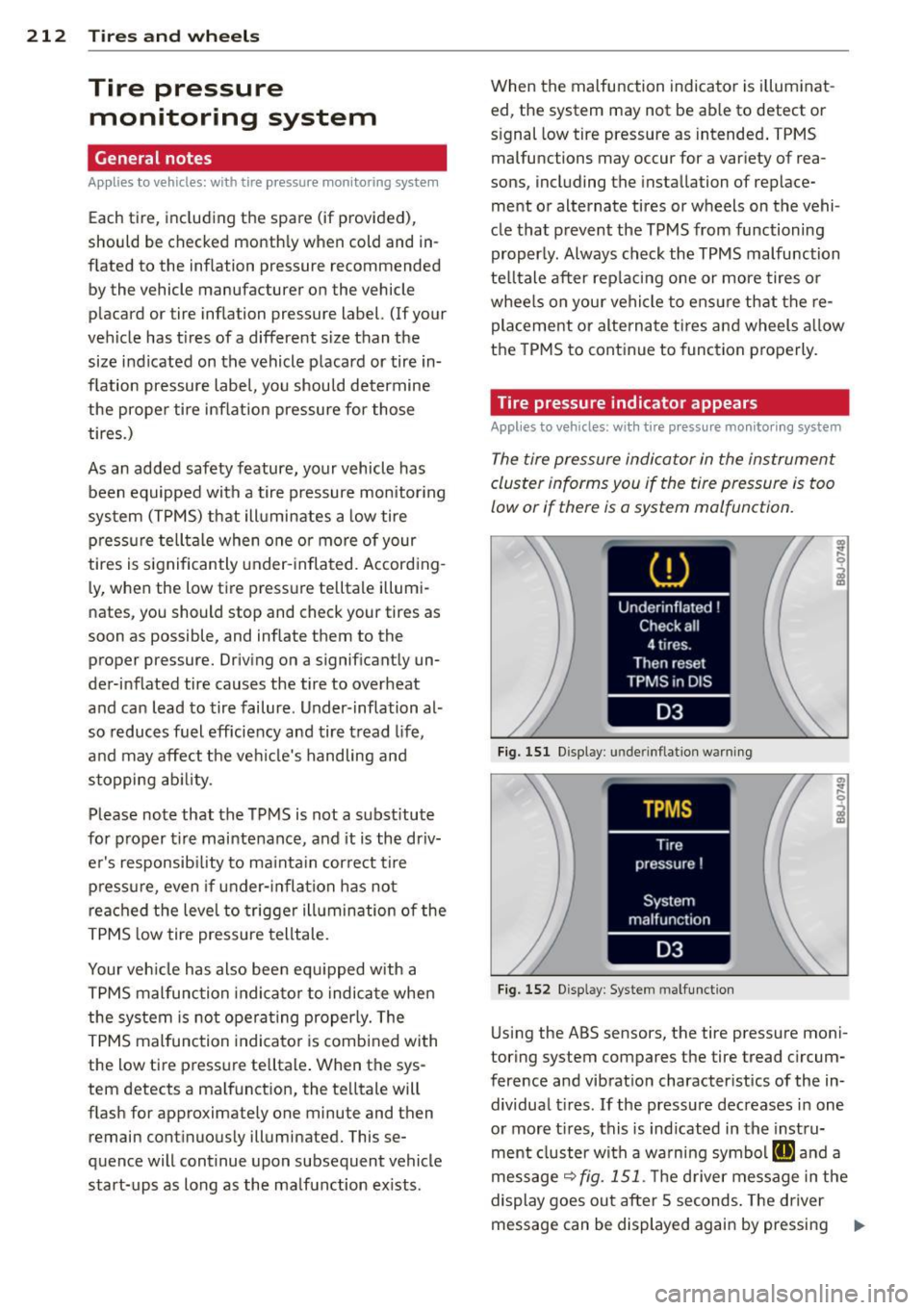
The tire pressure indicator in the instrument
cluster informs you if the tire pressure is too
low or if there is a system malfunction.
Fig. 151 Display : underinflatio n warning
Fig. 152 Display: System malfunction
Using the ABS sensors, the tire pressure moni
toring system compares the tire tread circum
ference and vibration characteristics of the in dividual tires. If the pressure decreases in one
or more t ires, this is indicated in the instru
ment cluster with a warning symbol
g and a
message
r=:> fig. 151. Th e driver message in the
display goes out after 5 seconds. The driver
message can be displayed again by pressing
11--
Page 215 of 260

the !CHECK I button @c:> page 10, fig. 3. If on
l y one tire is affected, the display will indicate
its pos ition.
The tire p ress ure moni to ring m ust be reset in
the menu display each time the pressures are
adjusted (e .g. when switc hing between parti
a l and full load pressure) or after chang ing or
replac ing a tire on your vehicle
c:> page 214.
You can find the recommended tire pressures
for your vehicle on the label on the driver's
door p illar
c:> page 198.
Tire tread circumference and vibration charac
ter istics can change and cause a tire pressure
warn ing if:
- the tire pressure in one or more t ires is too
low,
- the tire has structural damage,
- the tire pressure was changed, whee ls rotat -
ed or replaced but the TPMS was not reset
c:> page 214 .
Warning symbol s
[@] Loss of pressure in at least one tire c:> ,&..
Check the ti re or tires and rep lace or repair if
necessary . The indicator light
RI] in the instru
ment cluster also illuminates
r=:>page 13.
Check/correct the pressures of all four tires
and reset TPMS in the menu display.
11@1@1 < T ire Pressure Monitoring Sys tem) Tire
p re ss ure! Sy stem malfunction. JfllAl@ ap
pears after switching the ignition on or while
driving
r=:> fig. 152 and the indicator light RI] in
the instrument cluster blinks for approxi
mately one minute and then stays on, there is
a system malfunction . See your author ized
Aud i dealer as soon as possible.
.&, WARNING
- If the t ire pressure indicator appea rs in
the instrument cl uster d isplay, one or
more o f you r tires is s ignificantly under
inflated. Reduce your speed immediately
and avoid any hard steering or bra king
maneuvers. Stop as soon as possible and
check the t ires and the ir pressures. In
flate the tire pressure to the proper pres-
.
Tire s an d wheel s 213
sure as indicated on the vehicle's tire
pressure labe l
r=:>page 198. Driving on a
significantly under-inflated tire causes
the t ire to overheat and can lead to tire
fa ilure . Unde r-inflation also is l ikely to
impair the vehicle's handling and stop
ping ability.
- The d rive r is respons ib le for maintaining
the co rrect tire pressures. You must
check the tire pressures regularly.
- Unde r ce rtain conditions (such as a spo r
ty driving style, winter conditions or u n
p aved roads), the pressu re monitor indi
ca tor may be delayed.
- Ask you r authorized Aud i dea le r i f run
f lat tires may be used on your vehicle.
Your vehicle registration becomes invalid
if you use these t ires when not perm it
ted. Damage to your vehicle or accidents
could a lso result.
- If you switch between standard and run
flat tires, an autho rized Audi dealer o r
qualified workshop must reprogram the
contro l modu le.
(D Tips
- The tire pressure monitor ing system
stops work ing when there is an ESP/ABS
ma lfunction.
- Us ing snow c hains may res ult in a system
ma lfunction.
- Tires wit h the identification "AO" or "RO"
have been specially matched with yo ur
Audi. We recommend using on ly these
tires because they meet the highest
standards regarding safety and dr iv ing
character istics when used correctly. Your
authorized Audi dealer wi ll gladly pro
vide you with more information .
•
•
Page 217 of 260
Returning to the Start menu
"' Pre ss the I Reset ! button longer than 2 sec
onds to return from any menu leve l to the
Start menu .
(D Tips
Before resetting the TPMS, the current
pressures of
all four tire s must correspond
to the specified values. Adjust the tire
pressure and reset the pressure in the tire
pressure monitoring system according to
the load you are carrying
c::;, page 198.
Run-flat tires
Introduction
Applies to vehicles: with Run-flat tires
Run-flat tires help keep you moving if a tire
goes flat.
Reinforced s idewalls give the tires run-flat ca
pability if tire pressure is lost.
We recommend that run-flat tires only be
mounted on vehicles that were originally
equ ipped w ith these special tires at the facto
ry and have a Tire Pressure Monitor ing Sys
tem.
Run-flat t ires can be ident ifi ed by th e lett ers
"RSC" on the tire sidewall.
If you do change the tires on yo ur vehicle from
normal to run-flat tires, you must buy the
specia l rims required for run-flat tires, and the
Ti re Pressure Monito ring System must be re
programmed by an a uthorized Audi dea ler or
other qualified workshop.
What do run-flat tires do?
These special tires have run-flat capabilities
that help keep you moving if a tire loses pres
sure and goes flat. Under favorable cond itions
tires can be driven
at l ea st 30 mil es (SO km ),
but you must not d rive fa ste r than SO mph
(80 km /h)
c::;, page 216, Driving with run-flat
tires .
Tire s an d wheel s 215
When it is not po ssible to continue
driv ing , ev en with run-flat tire s?
- If the Electronic Stabilization Program (ESP)
is not work ing or keeps coming on.
- If the Tire Pressure Monitoring System does
not work.
- If the tire has been severely damaged, in a
crash, for example. The tread can separate
from a damaged tire as the wheel turns, and
hit parts of the vehicle, such as the fuel tank
filler neck, fuel lines or brake lines.
- Do not continue driving if severe vibration
occurs or if the t ire starts to smoke because
the tire is ru nning hot.
- Do not continue driving if damage to the
tire, such as cracks in the sidewall, appears.
A WARNING
Improper use of run-flat tires can cause
vehicle damage that can lead to loss of ve h icl e cont ro l, a c rash and serious personal
in Jury.
- Run-flat tires can only be used with spe
cial rims.
- Run-flat tires must always be monito red
with a prope rly p rogrammed Tire Pre
ssure Monito ring System.
- Always inspect a tire that has lost air to
make sure it is sa fe to dr ive with the tire
in the run-flat mode.
- Never d rive with run-f lat t ires that have
been damaged in a co llision.
- Never d rive with run-flat t ires if heat
bu ild-up causes the tire to give off
smoke.
- Never d rive with run-f lat t ires if the vehi
cle shakes or vibrates severely.
- Never d rive with a run-flat ti re that de
velops s idewa ll cracks or other damage
while in use.
- I f you sw itch between standa rd and run
f lat ti res, an aut horiz ed Aud i dealer o r
qu alified wor kshop must reprogram the
con tro l mod ule.
•
•
Page 218 of 260

216 Tires and wheels
Run-flat tires have special characteristics
and requirements, that are very different
from conventiona l tires. Run-flat tires re
quire special rims for run-flat use and can
not be used on conventional wheel rims.
(D Tips
- If you are not able to continue driving
with run-flat tires, please seek professio
nal assistance .
- Please contact your authorized Audi
dealer or Audi of America, Inc. if you
have questions about tires and r ims.
Driving with run-flat tires
App lies to vehicles: with Run -flat tires
Handling characteristics change when tire
pressure is low .
Driving on tires with low tire pressure changes
the way a vehicle handles, particularly when
cornering and braking . The handling charac
teristics of run-flat tires do not seem to
change a lot even when dr iving on low pres
sure or in the run-flat mode . Nevertheless you
must still take special precautions when oper
ating a vehicle on run-flat tires when tire pres
sure is low or the tire(s) is fla t:
"'The Electronic Stabilization Program (ESP)
must be switched on.
> Never drive faste r than 50 mph (80 km/h)
¢,& .
"'Plan ahead when driving and anticipate
what you will have to do considering traffic
and road conditions up ahead.
"' Accelerate carefully.
"' Avoid unnecessary and sudden steer ing and
braking maneuvers .
"' Reduce your speed in plenty of time before
i ntersections, curves and other places where
you may have to react quickly.
Please see:
¢ page 215, When it is not possi
ble to continue driving, even with run-flat
tires?
Handling characteristics change when
driving with low air pressure or with flat
tires even with special run-flat tires
A low pressure or flat front tire affects vehicle
handling characterist ics by pulling the vehicle
slightly to the side whe re the tire is mounted
and reduces braking performance .
A low pressure or flat
rear tire also affects
driving characteristics by pulling to the s ide
where the tire is mounted and also reduces
braking performance . The effect on vehicle
handling is most noticeable when driving
aro und curves .
A WARNING
Changed vehicle hand ling characteristics
when driving in the run-flat mode can
cause loss of vehicle control, a crash and
serious personal injury.
- Driving on special run-flat tires in the
run-flat mode will change vehicle han
dling characterist ics dur ing braking,
when cornering and under heavy acceler
ation .
- Never drive faster than the max imum
rated speed of 50 mph (80 km/h) when
driving in the run-flat mode.
- Always adjust vehicle speed to traff ic,
road and weather conditions and drive
slower than the maximum rated speed if
necessary weathe r and road cond it ion s
are taken into account.
- Always obey speed limits and other traf
f ic laws.
(D Note
We always recommend driving with even
more care when using these special tires in
the run-flat mode. Always avoid sudden
maneuve rs.
Page 219 of 260

Replacing run-flat tires and rims
Appl ies to vehicles: with Run -flat tires
Your vehicle was especially designed to use
special run-flat tires .
You may use and combine only approved run
flat t ires and spec ial matching rims that have
been designed for run -flat tires. Mount ing
special run-flat t ires on standard wheels will
not work and will not provide the advantages
fo the run-falt featu re. Neve r use specia l run
flat t ires on standard wheel rims .
After driving with a tire in the run-flat mode,
a lways have the vehicle and affected tire(s)
and rim(s) inspected by an autho rized Aud i
dealer . T ir es that have been driven in the run
flat mode must be replaced.
A WARNING
Use of damaged run-flat tires and rims can
cause vehicle damage that can lead to loss
o f vehicle control, a crash and ser ious per
sonal injury.
- Always have the veh icle and affected
t ire(s) and rim(s) inspected by an author
ized Audi dealer after driving a t ire in the
run-f lat mode.
- Tires that have been driven in the run
flat mode must be rep laced.
Tire s an d wheel s 21 7
•
•