2011 AUDI R8 SPYDER weight
[x] Cancel search: weightPage 142 of 244

140 Child Safety
The tension on the safety belt for the front
passenger seat will be different for an adult
who is properly using the safety belt as com
pared to the tension on the be lt when it is
used to attach a child restraint to the seat.
The sensor below the latch for the safety belt
for the front seat passenger measures the
Child restraints and Advanced Airbags
Regardless of the ch ild restraint t hat you use,
make sure that it has been certified to meet
United States Fede ral Motor Vehicle Safety
Standards and has been certified by its manu
facturer for use with an airbag . If in excep
tional c ircumstances you must use it on the
front passenger seat, caref ully read all of the
information on c hild safety and Advanced A ir
bags and heed all of the applicable WARN
INGS . Make certain that the child restraint is
correctly recognized by the weight-sensing mat i nside the front passenge r seat, that the
fro nt passenger airbag is turned off and that
the airbag status is a lways correctly signaled
by the
PASSENGER AIR BAG O FF light.
M any types and models of child restra ints
have been ava ilable over the years, new mod
e ls are in troduced regularly incorporating new
and improved designs and older models are
taken out of prod uction. Child restraints are
Subpart A -Car bed child restraints
Model
Ange l Guard Ange l Ride AA2403 FOF
Subpart B -Rear-facing child restraints
Model
C en tury SmartFit 4543
Cosco Arriva 22-013PAW and base 22-999WHO
Evenflo D iscovery Adjust Right 2 12
Evenflo First Cho ice 204
Graco Infant 8457
Graco Snugride
Peg Perego Primo Viaggio SIP IMUN00US tension on the belt. The input from th
is sen
sor is then used with the weight to "decide",
whether there is a child restra int with a typical
1 year-old chi ld on the front passenger seat
and whether or not the airbag must be turned
off .
not standard ized . Child rest raints of the same
type typ ically have different weights and sizes
and different 'foo tpr ints,' the size and shape
of the bottom of the chi ld restra int tha t sits
on the seat, when they are insta lled on a vehi
cle seat. These diffe rences make it virtually
impossible to certify compliance with the re
quirements for advanced airbags with each
and every ch ild restra int that has ever been
sold in the past or will be sold over the course of the useful l ife of your veh icle .
For t his reason, the United States National
Highway Traffic Safety Adm inistrat ion has
published a list of spec ific type, makes and
models of chi ld restraints that must be used
to certify comp liance of the Advanced Airbag
System in your veh icle with the suppression
requirements of Federal Motor Vehicle Safety
Standard 208. These chi ld restraints are:
Manufactured on or after
September 25, 2007
Manufactured on or after
December 1, 1999
September 25, 2007 December 1, 1999
December 1, 1999
December 1, 1999
September 25, 2007
September 25, 2007
Page 143 of 244
Child Safety 141
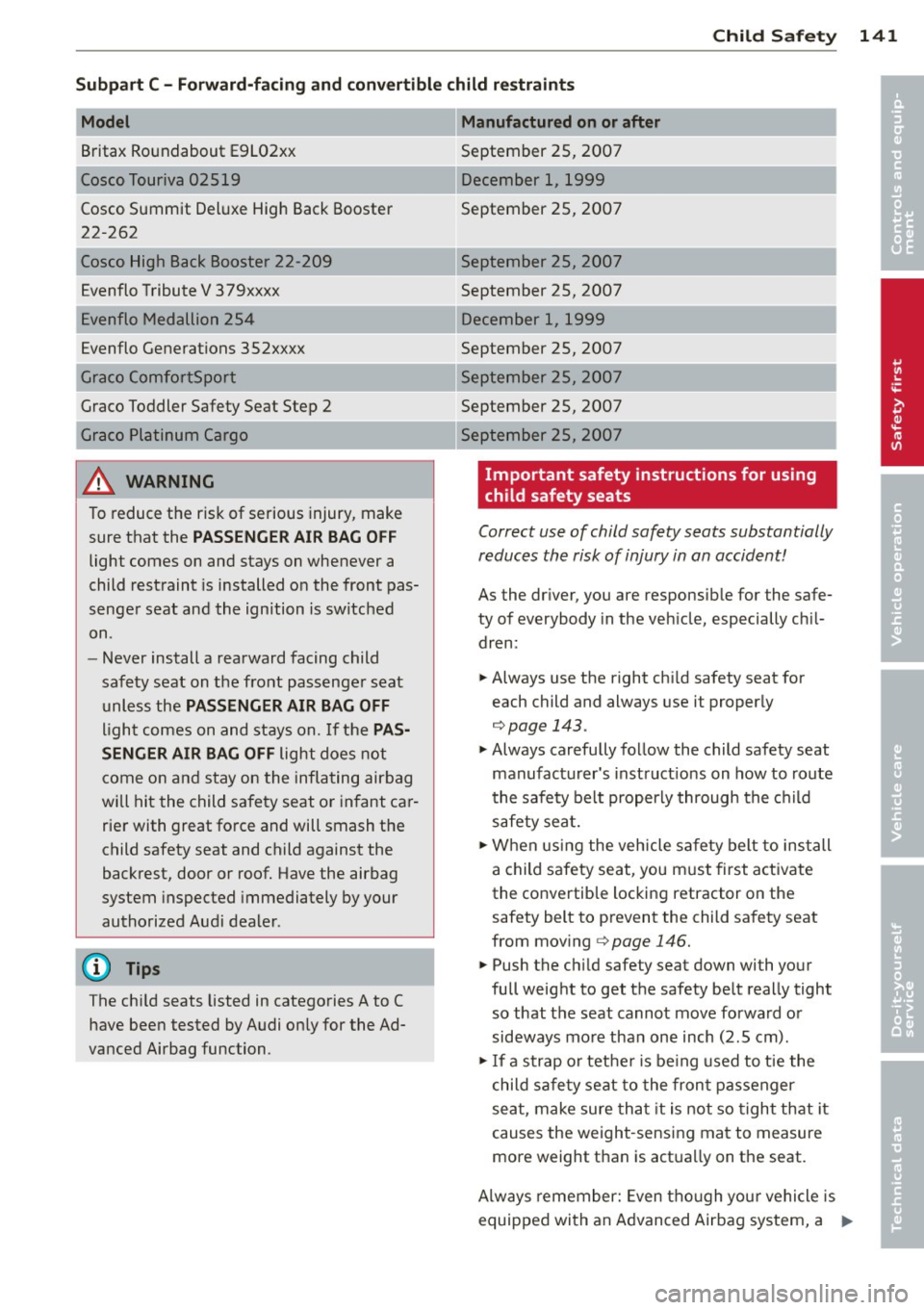
Subpart
C -Forward-facing and convertible child restraints
Model
Britax Roundabout E9L02xx
Cosco Touriva 02519
Cosco Summit Deluxe High Back Booster
22-262
Cosco High Back Booster 22-209
Manufactured on or after
September 25, 2007
December 1, 1999
September 25, 2007
September 25, 2007
September 25, 2007
Evenflo Tribute V 379xxxx
E venflo Medallion 254
----------
Evenflo Generations 352xxxx
Graco ComfortSport
----~-,
December 1, 1999
September 25, 2007
September 25, 2007
September 25, 2007
Graco Toddler Safety Seat Step 2
Graco Platinum Cargo
-------
& WARNING
To reduce the risk of serious injury, make
sure that the
PASSENGER AIR BAG OFF
light comes on and stays on whenever a
child restraint is installed on the front pas
senger seat and the ignition is switched
on .
- Never install a rearward facing child
safety seat on the front passenger seat
unless the
PASSENGER AIR BAG OFF
light comes on and stays on. If the PAS
SENGER AIR BAG OFF
light does not
come on and stay on the inflating airbag
will hit the child safety seat or infant car
rier with great force and will smash the
child safety seat and child against the
backrest, door or roof. Have the airbag
system inspected immediately by your
authorized Audi dealer .
(D Tips
The child seats listed in categories A to C
have been tested by Audi only for the Ad
vanced Airbag function. September 25, 2007
Important safety instructions for using
child safety seats
Correct use of child safety seats substantially
reduces the risk of injury in an accident!
As the driver, you are responsible for the safe
ty of everybody in the veh icle, especially ch il
dren:
.., Always use the right chi ld safety seat for
each child and always use it properly
¢page 143.
.., Always carefully follow the child safety seat
manufacturer's instruct ions on how to route
the safety belt properly through the child
safety seat.
.., When using the vehicle sa fety belt to install
a child safety seat, you must first activate
the convertib le locking retractor on the
safety belt to prevent the child safety seat
from moving ¢
page 146.
.., Push the ch ild safety seat down with your
full weight to get the safety belt really tight
so that the seat cannot move forward or
sideways more than one inch (2 .5 cm).
"'If a strap or tethe r is being used to tie the
child safety seat to the front passenger
seat , make sure that it is not so tight that it
causes the weight-sensing mat to measure
more weight than is actua lly on the seat.
Always remember: Even though your vehicle is
equipped with an Advanced Airbag system, a .,..
•
•
Page 146 of 244

144 Child Safet y
Convertible child safety seats
Properly used convertible child safety seats
can help protect toddlers and children over
age one who weigh between
20 and 40 lbs. (9
and 18 kg) in a crash.
Fig . 13 1 Schematic overv iew: in stallat ion of t he seat
us ing the ve hicle's safety belt system
~ When using the vehicle safety belt to install
a ch ild safety seat, you must first activate
the convertible locking retractor on the safety belt to prevent the c hild safety seat
from movi ng
Qpage 146.
~ Push the child safety seat down with your
full weight to get the safety belt rea lly tight
so that the seat cannot move forward or
sideways more than one inch (2.5 cm)
Qpage 146.
A toddler or child is usually too large for an in
fant restraint if it is more than one year old
and weighs more than 20 lbs. (9 kg) .
Toddlers and c hildren who are o lder than one
year up to about 4 years o ld and weigh more
than 20 lbs. (9 kg) up to 40 lbs. (18 kg) must
a lways be properly restrained in a child safety
seat certified for their size and weight
Qfig. 131 .
&_ WARNING
Not using a ch ild safety seat, us ing the
w rong ch ild safety seat or improperly in
stal ling a child re straint increases the risk
o f se rious persona l injury and de ath in a
co llision or othe r eme rgency s ituation.
- Children on t he front seat of a ny car,
even w ith Advanced A irbags, can be seri
ous ly injured or even killed when an air -bag inflates. A chi
ld in a rearward-facing
child safety seat installed on the front
passenger seat will be serious ly injured
and can be killed if the front airbag in
flates -even with an Advanced Airbag
System .
- The inflating airbag will h it the ch ild
safety seat or infant carrie r with great
for ce and will smash the child saf ety seat
and child aga inst the ba ckrest, doo r or
roof.
- Neve r install a rearward facing child
safety sea t on the fron t passenger sea t
un less t he
PASSENGER AIR BAG OFF
light comes on and stays on. If the PAS
SENGER AIR BAG OF F
light does not
come on and stay on have the airbag sys
tem inspected immediately by your au
thorized Audi dealer.
- Always read and heed all WARNINGS
whenever us ing a child restrained in ave
h icle is being used
¢ page 109, Safety
belts,
Q page 117, Airbag system and
Q page 138, Important things to know .
&_ WARNING
--
If exceptional circumstances require the
use of a fo rward-facing child restraint on
the front pa ssenger 's sea t, the child's safe
ty and we ll-bei ng req uire t hat the fo llow
i ng spec ial precautions be taken:
- Make sure the forward- facing seat has
been designed and cert ified by its man u
facturer for use on a front seat with a
passenger front and side airbag.
- Always follow the manufacturer 's in
structions p rovided with the chi ld safety
seat or carrie r.
- A lways move the front passenger seat in
to the rearmost position of the passen ger seat's fore and aft adjustment range,
and as far away from the airbag as possib le before installing t he ch ild restraint.
- Always make sure that nothing prevents
the front passenger 's seat from being
moved to the rearmost position in its
fore and aft adjustment range .
Page 147 of 244

-Always make sure the backrest 1s in an
upr ight position .
- Make sure that the
PASSENGER AIR BAG
OFF
light comes on and stays on all the
t ime whenever the ignition is switched
on.
- If the light does not stay on, perform the
checks
c;, page 128, Monitoring the Ad
vanced Airbag System.
- If the PASSENGER AIR BAG OFF light
does not come on and stay on have the
airbag system inspected immed iate ly by
your authorized Aud i dealer .
Booster seats and safety belts
Properly used booster seats can help protect
children weighing between about 40 lbs. and
80 lbs. (18 kg and 36 kg) who are less than 4
ft. 9 in. (57 inches/1 .45 meters) tall .
Fig. 132 Passenger seat : child proper ly rest ra in ed in a
booster seat
The vehicle's safety belts alone will not fit
most children until they are at least 4
ft. 9 in.
(57 inches/1.45 meters) tall and weigh about
80 lbs. (36 kg). Booster seats raise these chil
dren up so that the safety belt will pass prop
e rly over the stronger parts of their bodies
and the safety belt can help protect them in a
crash .
• Do not use the convertible locking retractor
when using the vehicle's safety belt to re
strain a child on a booster seat.
• Always position the shou lder portion of the
safety belt midway over the child's shoulder .
• Always make sure that the shoulder portion
of the safety belt never rests against or
across the ch ild's neck.
Child Safety 145
• Always make sure that the chi ld can properly
wear the lap portion of the belt low across
the th ighs or pelvis and
never over the
stomach or abdomen.
Children up to at least 8 years old (over 40
lbs. or
18 kg) are best protected in child safe
ty seats designed for their age and weight . Ex
perts say that the skeletal structure , particu
larly the pelvis, of these children is not fully
developed, and they must not use the vehicle
safety belts without a suitable ch ild restra int.
It is usually best to put these children in ap
propr iate booster seats . Be sure the booster
seat meets all applicable safety standards .
Booster seats raise the seating position of the
child and reposition both the lap and shoulder
parts of the safety belt so that they pass
across the ch ild's body in the right places . The
routing of the belt over the child's body is very
im portant for the child's protect ion, whether
or not a booster seat is used.
Children who are at least 4
ft. 9 in . (57 in
ches/1.45 meters) tall can generally use the
vehicle 's three point lap and shoulder belts.
Never use the lap belt port ion of the vehicle's
safety belt alone to restra in any child, regard
less of how big the chi ld is. A lways remember
that children do not have the pronounced pel
vic structure required for the proper function
of lap belt portion of the vehicle's three point
lap and shoulder belts. The child's safety ab
solutely requires that a lap belt portion of the
safety belt be fastened snugly and as low as
poss ible around the pelvis. Never let the lap
belt portion of th e safety be lt pass over the
child's stomach or abdomen.
In a crash, a irbags must inflate within a blink
of an eye and with considerable force . In order
to do its job, the airbag needs room to inflate
so that it will be there to protect th e occupant
as the occupant moves forwa rd into the air
bag .
A vehi cle occupant who is out of position and
too close to the airbag gets in t he way of an
inflating airbag. When an occupa nt is too
close, he or she will be struck violently and
Ill-
Page 149 of 244
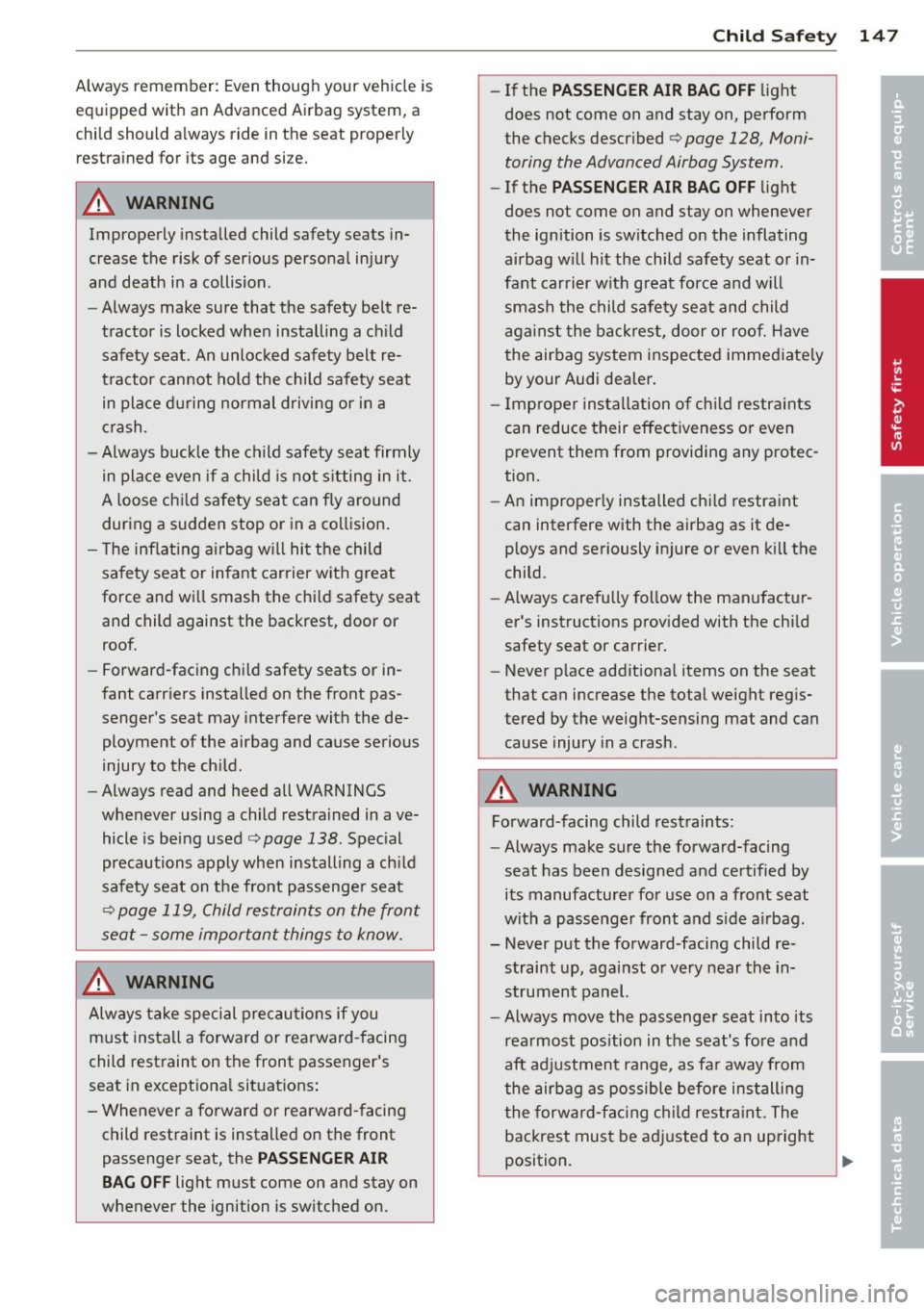
Always remember: Even though your vehicle is
equipped with an Advanced Airbag system, a
child should always ride in the seat properly restrained for its age and si ze.
_&. WARNING
Improperly installed child safety seats in
crease the risk of serious personal injury
and death in a collision .
- Always make sure that the safety belt re
tractor is locked when installing a child
safety seat . An unlocked safety belt re
tractor cannot hold the child safety seat
in place during normal driving or in a
crash.
- Always buckle the child safety seat firmly
in place even if a child is not sitting in it.
A loose child safety seat can fly around
during a sudden stop or in a collision.
- The inflating airbag will hit the child
safety seat or infant carrier with great
force and will smash the child safety seat
and child against the backrest, door or
roof.
- Forward-facing child safety seats or in
fant carriers installed on the front pas
senger's seat may interfere with the de ployment of the airbag and cause serious
injury to the child.
- Always read and heed all WARNINGS
whenever using a child restrained in ave
hicle is being used
r::;,page 138. Special
precautions apply when installing a child
safety seat on the front passenger seat
r::;, page 119, Child restraints on the front
seat -some important things to know.
_&. WARNING
-
Always take special precautions if you
must install a forward or rearward-facing
child restraint on the front passenger's
seat in exceptional situations:
- Whenever a forward or rearward-facing child restraint is installed on the front
passenger seat, the
PASSENGER AIR
BAG OFF
light must come on and stay on
whenever the ignition is switched on.
Child Safety 147
- If the PASSENGER AIR BAG OFF light
does not come on and stay on, perform
the checks described
r::;, page 128, Moni
toring the Advanced Airbag System.
- If the PASSENGER AIR BAG OFF light
does not come on and stay on whenever
the ignition is switched on the inflating
airbag will hit the child safety seat or in
fant carrier with great force and will
smash the child safety seat and child
against the backrest, door or roof. Have
the airbag system inspected immediately
by your Audi dealer.
- Improper installation of child restraints
can reduce their effectiveness or even prevent them from providing any protec
tion.
- An improperly installed child restraint
can interfere with the airbag as it de ploys and seriously injure or even kill the
child.
- Always carefully follow the manufactur
er's instructions provided with the child
safety seat or carrier.
- Never place additional items on the seat
that can increase the total weight regis
tered by the weight-sensing mat and can
cause injury in a crash.
_&. WARNING
Forward-facing child restraints:
- Always make sure the forward-facing
seat has been designed and certified by
its manufacturer for use on a front seat
with a passenger front and side airbag.
- Never put the forward-facing child re straint up, against or very near the in
strument panel.
- Always move the passenger seat into its
rearmost position in the seat's fore and
aft adjustment range, as far away from
the airbag as possible before installing
the forward-facing child restraint. The
backrest must be adjusted to an upright
position. •
•
Page 150 of 244

148 Child Safety
-Make sure t hat the PASSENGER AIR BAG
OFF
light comes on and stays on all the
time whenever the ignition is switched on .
A WARNING
Rearward -fac ing ch ild restra ints:
- A ch ild in a rearward-facing child safety
seat installed on the front passenger
seat will be ser iously injured and can be
killed if the front airbag inflates - even
with an Advanced Airbag System.
- The inflating a irbag will hit the child
safety seat or infant carri er wit h great
force and w ill smash the ch ild safety seat
and child against the b ackrest, door or
roof.
- Alway s be espe cially caref ul if you must
ins tall a re arwa rd fa cing child s afety seat
on the front passenge r seat in exception
al circumstances .
- A tight tether st rap on a rearward-facing
child rest raint attached to the front pas
senger seat can put too much pressu re
on the weight-mat in the seat and reg is
ter a heavier weight in the Advanced A ir
bag System. The heav ier we ight regis
tered can make the system work as
though an adult were on the seat and de
ploy the Advanced Ai rbag when it must
be s uppressed causing ser ious o r even
f a tal inj ury to the child .
- Make su re that the
PASSENGER AIR BAG
OFF
light comes on and s tays on all the
t ime whe never the ignition i s switched
on.
- Never install a rearward facing child
safety seat on the front passenger seat
unless the
PASSENGER AIR BAG OFF
light comes on and stays on . If t he PAS·
SENGER AIR BAG OFF
light does not
come on and stay on the inflating airbag
will hit the child safety seat or infant car
rie r with great fo rce and will smash the
child safety seat and child against the
backrest, door or roof. Have the airbag
system inspected immediately by your
au thori zed Au di d ealer .
Activating the convertible locking
retractor
Use the convertible locking retractor to se
cu re a child re strain t.
Always heed the ch ild safety sea t manufactur
er's instr uctions when installing a child re
st ra in t in your veh icle . To a ctivate the conve r
t ible lo cking re tractor:
.,. Place t he ch ild restraint on a seat .
.,. Slowly pu ll the belt
all the way out .
.,. Route i t around or th roug h the child re
s train t belt pa th
~ .&, .
.,. Push the ch ild safety seat down with you r
full weight to get the safety be lt really tight.
.,. Insert the belt tongue into the buckle for
that seating position .
.,. Guide the safety belt back i nto the retractor
until the be lt lies flat and snug o n the child
safety seat.
"" Yo u should hear a "cl icking " noise as the
be lt winds back into the inertia ree l. Test the
convert ible lo cki ng re tr actor by pulling on
t he belt. You s hould no longer be ab le to
pull t he be lt out of the retrac to r. T he con
vertible locking retracto r is now activated .
.,. Make s ure that the red release button is fac
ing away from the child rest raint so that it
can be unbuckled quick ly.
.,. Pull on the belt to make sure the safety be lt
is properly tight and fastened so that the
s e at ca nnot move forwa rd or sideways more
than one inch ( 2.S cm).
A WARNING
Using the wrong child res traint o r an i m
pr operly ins talled chi ld restraint can cause
se rious pe rsonal injury or deat h in a c rash.
- Always ma ke sure tha t t he safe ty belt re-
trac to r i s loc ked when insta lling a child
safety seat. An un locke d safety belt re
tracto r cannot hold the child safety seat
in place dur ing norma l dr iving o r in a
crash.
- Always buckle the child sa fety seat firmly
-
in place even if a ch ild is not sitt ing in it. ~
Page 191 of 244

Tires and wheels
Tires
General notes
Tires may be the least appreciated and most
abused parts of a motor vehicle .
Tires may be the least appreciated and most
abused parts of a motor vehicle . T ires are,
however, one of the most important parts of a
vehicle, particularly considering the compara
tively small patch of rubber on each tire that
assures that a ll- important contact between
you, you r vehicle and the road.
Maintaining the correct tire pressure, mak ing
sure that your vehicle and its tires do not have
to carry mo re weight than they can safely han
d le, avoiding damage from road hazards and
r eg ularly inspect ing t ires for damage i nclud
ing cuts, slashes irregu la r wear and ove rall
condition are the most important things that
you can do to he lp avoid s udden tire failure in
cluding tread separat ion and blowouts.
A voidin g damage
If yo u have to d rive over a curb or similar ob
stacle, drive very slow ly and as close as possi
b le at a right angle to the curb.
A lways keep chemicals incl ud ing grease, o il ,
gasoline and brake fluid off the t ires .
I nspect the t ires regularly for damage (cuts,
cracks or b listers, etc.). Remove any fo reign
bod ies embedde d in the treads.
Storing tires Mark tires when you remove them to indicate
the direction of rotation . T his ensures you to
be ab le to mount them correctly when you re
i nstall them .
When removed, the whee ls or t ires should be
sto red in a cool, d ry and preferably dark place .
Store tires in a vertical pos ition if they are not
mounted on r ims, in a horizontal pos it ion if
they are mounted on rims .
Tires an d wheel s 189
New tires
New ti res h ave to be broken in~& .
The tread depth of new t ires may vary, accord
ing to the type a nd make of t ire and the tread
patte rn.
H idden damage
Damage to tires and r ims is ofte n not readily
visible . If you notice unusual v ib rat ion or the
vehicle pulls to one s ide, th is may ind icate
that one of the t ires has been damaged . T he
ti res m ust be chec ked immed iate ly by an au
thorized Audi dea le r or q ua lified wor kshop .
Unidirectional tires
A un idirectional tire can be identified by ar
rows on the sidewa ll, that po int in the direc
tion the t ire is designed to rotate. You must
f ol low the specified di rection o f rotation . T his
is necessary so that these tires can develop
their optimum characteristics regarding grip,
road noise, wear and hydrop laning resistance.
For more information
~ page 216.
A WARNING
New tires or t ires that are o ld, worn or
damaged cannot provide maximum con
trol and braking ability .
-
-New tires tend to be slippery and must
be broken in. To reduce the r isk of losing
control, a co llision and ser ious personal
in ju ries, d rive with special ca re for the
fi rst 350 m iles ( 560 km).
- Driving with worn or damaged tires can
lead to loss of control, sudden tire fail
ure, including a blowout and sudden de
fl ation, cras hes and se riou s personal in
juries . Have wo rn or damaged t ires re
placed immediate ly.
- Ti res age even if they are not being used
and can fail sudden ly, especially at hig h
speeds. Tires that are more than 6 years
old can only be used in an emergency
and then w ith special care and at low
speed.
•
•
Page 192 of 244

190 Tire s and wheel s
-Never mount used tires on yo ur vehicle if
yo u are not sure of their "previous histo
ry." Old used tires may have been dam
aged even though the damage cannot be
seen that can lead to sudden tire failure
and loss of vehicle control.
Glossary of tire and loading terminology
Accessory weight
means t he comb ined we ight (in excess of
those standard items which may be rep laced)
of R t ron ic, powe r stee ring, powe r brakes,
power w indows , power sea ts, r ad io , a nd hea t
e r, to the extent that these i tems are available
as facto ry -in stalled equipment (whether in
stalled or not).
Aspect ratio
means t he ratio o f the heigh t to the w idth of
the tire in percen t. Numbers of 55 or lower in
d icate a low sidewall fo r improved s teer ing re
sponse and better overall handling on dry
pavement.
Bead
means t he pa rt of the t ire that is made o f
steel wires, wrapped o r reinforce d by p ly cor ds
and that is shaped to fi t the r im.
Bead separation
means a b reakdown of the bond between
components in the bead.
Cord
means the s trands forming the plies in the
tire .
Cold tire inflation pre ssure
means t he tire pressure recommended by the
ve hicle manufacture r for a tire of a designated
si ze that has not been dr iven for more than a
couple of miles (kilometers) at low speeds in
the three hour period before the tire pressure i s measu red or adjusted. -
If you notice un usua l vibration or if the
veh icle pulls to one side when driv ing, a l
ways stop as soon as it is safe to do so and check the wheels and tires for dam
age.
Curb weight
means the we ight of a motor ve hicle w ith
standard equipment includ ing the max imum
capa city of fuel, o il, and coolant, a ir cond i
ti on ing and addi tional weig ht o f option al
equipmen t.
Extra load tire
means a tire designed to operate at higher
loads and at highe r inflat ion p ress ures tha n
the cor responding standard tire . Extr a load
t ir es my be i dent ified as "XL", "xl", "E X T RA
LO AD", or "RF" on t he sidewall.
Gross Axle Weight Rating ( "GAWR ")
means the load-carry ing capacity of a s ingle
axle system , measured at the tire-ground in
te rfaces .
Gross Vehicle Weight Rating ( "GVWR ")
means the maximum total loaded we ight of
the vehicle.
Groove
means the space between two adjacent tread
ribs .
Load rat ing (code )
means the maximum load that a tire is rated
to carry fo r a given inflation press ure. Yo u
may not fi nd this information on all tires be
ca use it is not required by law.
Maximum load rating
me ans the lo ad r ati ng for a tire a t the m axi
mum perm issib le inf lation pressure for that
ti re .