Page 508 of 592
508 5-2. Steps to take in an emergency
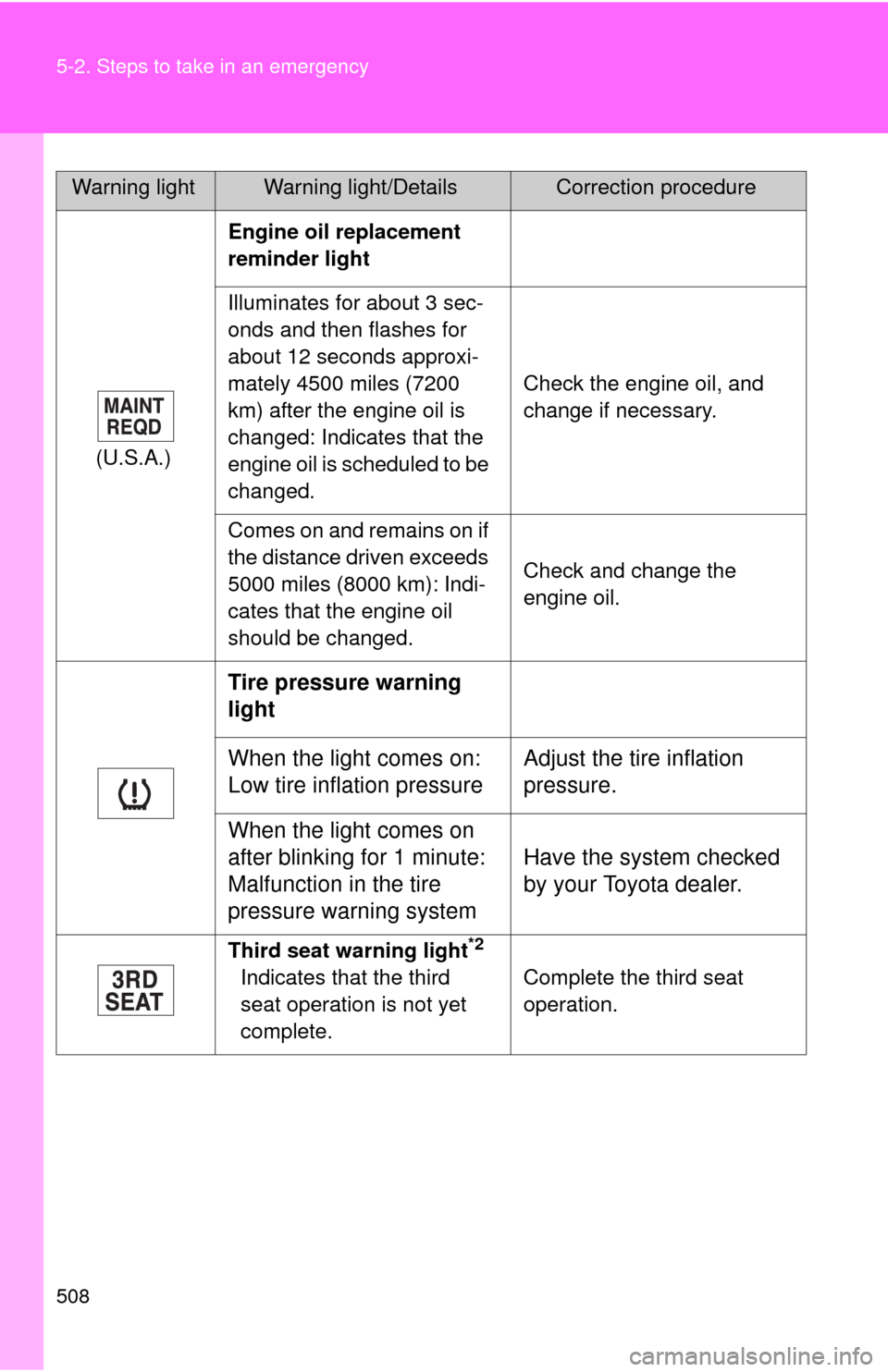
(U.S.A.)Engine oil replacement
reminder light
Illuminates for about 3 sec-
onds and then flashes for
about 12 seconds approxi-
mately 4500 miles (7200
km) after the engine oil is
changed: Indicates that the
engine oil is scheduled to be
changed.
Check the engine oil, and
change if necessary.
Comes on and remains on if
the distance driven exceeds
5000 miles (8000 km): Indi-
cates that the engine oil
should be changed. Check and change the
engine oil.
Tire pressure warning
light
When the light comes on:
Low tire inflation pressure
Adjust the tire inflation
pressure.
When the light comes on
after blinking for 1 minute:
Malfunction in the tire
pressure warning system Have the system checked
by your Toyota dealer.
Third seat warning light*2
Indicates that the third
seat operation is not yet
complete. Complete the third seat
operation.
Warning lightWarning light/DetailsCorrection procedure
Page 510 of 592

510 5-2. Steps to take in an emergency
■Front passenger detect ion sensor and passenger seat belt reminder
● If luggage is placed on the front passenger seat, the front passenger
detection sensor may cause the warning light to flash, even if a passen-
ger is not sitting in the seat.
● If a cushion is placed on the seat, the sensor may not detect a passen-
ger, and the warning light may not operate properly.
■ Changing the engine oil (U.S.A. only)
Make sure to reset the oil change system. ( P. 442)
■
When the tire pressure warning light comes on
Check the tire inflation pressure and adjust to the appropriate level.
Pushing the tire pressure warning reset switch does not turn off the tire
pressure warning light.
■The tire pressure warning light ma y turn on due to natural causes
The tire pressure warning light may turn on due to natural causes such
as natural air leaks or tire inflation pressure changes caused by temper-
ature. In this case, adjusting the ti re inflation pressure will turn off the
warning light (after several minutes).
■When a tire is replaced with a sp are tire (vehicles without run-flat
tires)
The compact spare tire is not equipped with the tire pressure warning
valve and transmitter. If a tire goes flat, the tire pressure warning light will
not turn off even though the flat tire is replaced with the spare tire.
Replace the spare tire with the repair ed tire and adjust the proper tire
inflation pressure. The ti re pressure warning light will turn off after sev-
eral minutes.
Page 512 of 592

512 5-2. Steps to take in an emergency
CAUTION
■If the tire pressure warning light comes on
Be sure to observe the following precautions. Failure to do so could
cause loss of vehicle control and re sult in death or serious injury.
●Vehicles with run-flat tires:
• Decelerate to the lowest appropr iate speed as soon as possible.
Do not drive over 55 mph (90 km/h).
• Check and adjust the tire inflation pressure immediately.
• If the tire pressure warning light comes on even after tire inflation pressure adjustment, it is probable that you have a flat tire. Have
the tire replaced by the nearest Toyota dealer.
• Avoid abrupt maneuvering and brak ing. If the vehicle tires deterio-
rate, you could lose control of th e steering wheel or the brakes.
●Vehicles with standard tires:
• Stop your vehicle in a safe place as soon as possible. Adjust the
tire inflation pressure immediately.
• If the tire pressure warning light comes on even after tire inflation pressure adjustment, it is probable that you have a flat tire. Check
the tires. If the tire is flat, change to the spare tire and have the flat
tire repaired by the nearest Toyota dealer.
• Avoid abrupt maneuvering and brak ing. If the vehicle tires deterio-
rate, you could lose control of th e steering wheel or the brakes.
■If a blowout or sudden air leakage should occur
The tire pressure warning system may not activate immediately.
Page 513 of 592
5
When trouble arises
513
5-2. Steps to take in an emergency
CAUTION
■Maintenance of the tires
Each tire, including the spare (if provided), should be checked monthly
when cold and inflated to the inflation pressure recommended by the
vehicle manufacturer on the vehicle
placard or tire inflation pressure
label (tire and load information label). (If your vehicle has tires of a differ-
ent size than the size indicated on the vehicle placard or tire inflation
pressure label [tire and load information label], you should determine the
proper tire inflation pr essure for those tires.)
As an added safety feature, your vehicle has been equipped with a tire
pressure monitoring system (TPMS-ti re pressure warning system) that
illuminates a low tire pressure telltal e (tire pressure warning light) when
one or more of your tires is significantly under-inflated. Accordingly,
when the low tire pressure telltale (tire pre ssure warning light) illumi-
nates, you should stop and check your tires as soon as possible, and
inflate them to the proper pressure. Driving on a significantly under-
inflated tire causes the tire to overheat and can lead to tire failure.
Under-inflation also reduces fuel effi ciency and tire tread life, and may
affect the vehicle's hand ling and stopping ability.
Please note that the TPMS (tire pressure warning system) is not a sub-
stitute for proper ti re maintenance, an d it is the driver's responsibility to
maintain correct tire pressure, even if under-inflation has not reached the
level to trigger illu mination of the TPMS low ti re pressure telltale (tire
pressure warning light).
Page 515 of 592
5
When trouble arises
515
5-2. Steps to take in an emergency
If you have a flat tire (vehicles with run-flat tires)
■In some condition (such as at high temperatures)
You cannot continue driving for up to 100 miles (160 km).
■If you cannot distinguish between the standard tires and run-flat
tires
Consult your Toyota dealer.
■For the detailed information on run-flat tires
See the tire warranty book.
NOTICE
■When replacing the tires
When removing or fitting the wheels, tires or the tire pressure warning
valve and transmitter, contact your Toyota dealer as the tire pressure
warning valve and transmitter may be damaged if not handled correctly.
■To avoid damaging the tire pressure warning valves and transmit-
ters
Do not use liquid sealants on flat tires.
Take your vehicle to the nearest Toyota dealer or authorized tire
dealer as soon as possible.
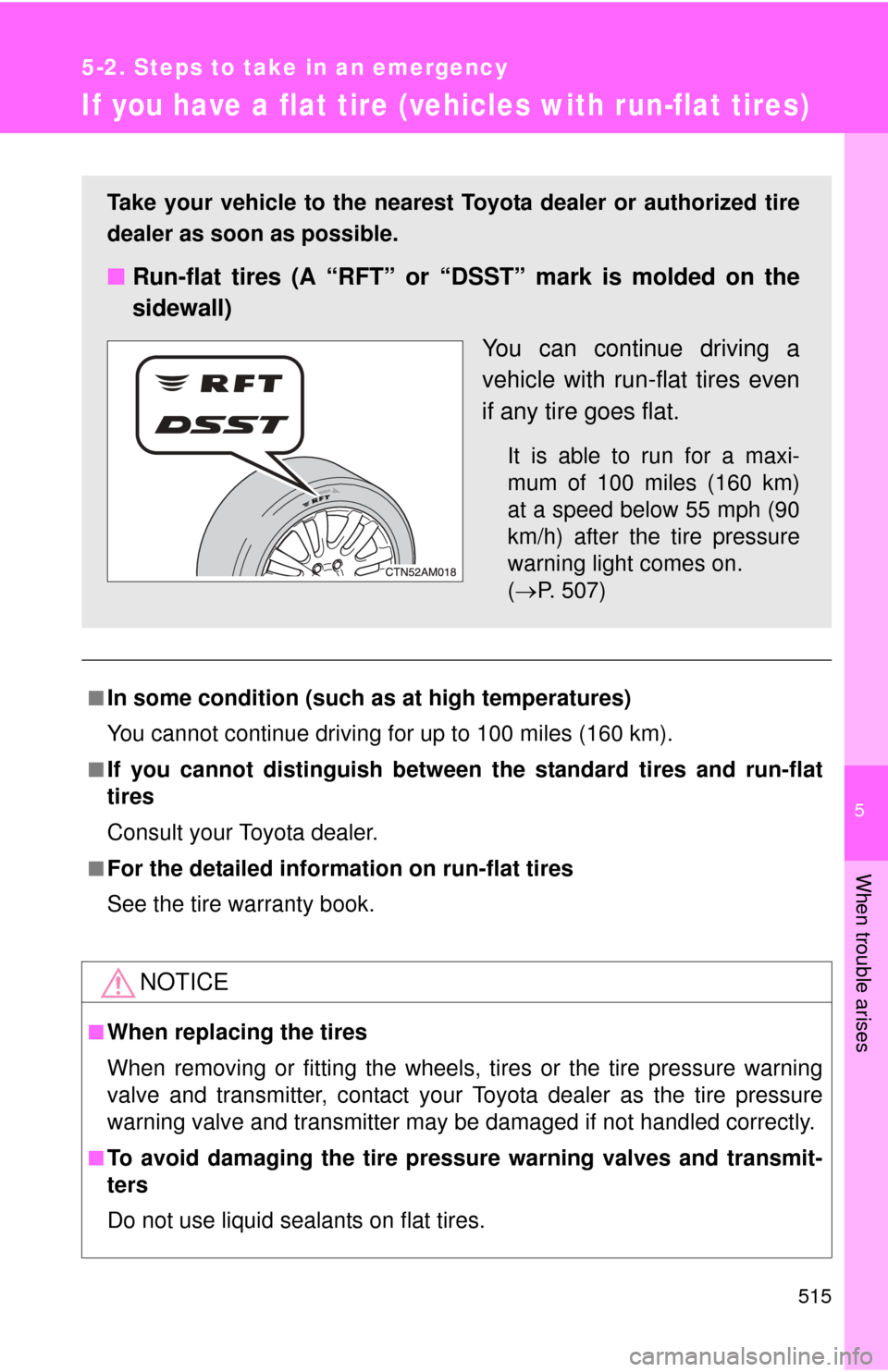
■ Run-flat tires (A “RFT” or “DSST” mark is molded on the
sidewall)
You can continue driving a
vehicle with run-flat tires even
if any tire goes flat.
It is able to run for a maxi-
mum of 100 miles (160 km)
at a speed below 55 mph (90
km/h) after the tire pressure
warning light comes on.
( P. 507)
Page 516 of 592
516
5-2. Steps to take in an emergency
If you have a flat tire (vehicles with standard tires)
Remove the flat tire and replace it with the spare provided.
■Before jacking up the vehicle
●Stop the vehicle on a hard, flat surface.
● Set the parking brake.
● Shift the shift lever to P.
● Stop the engine.
● Turn on the emergency flashers.
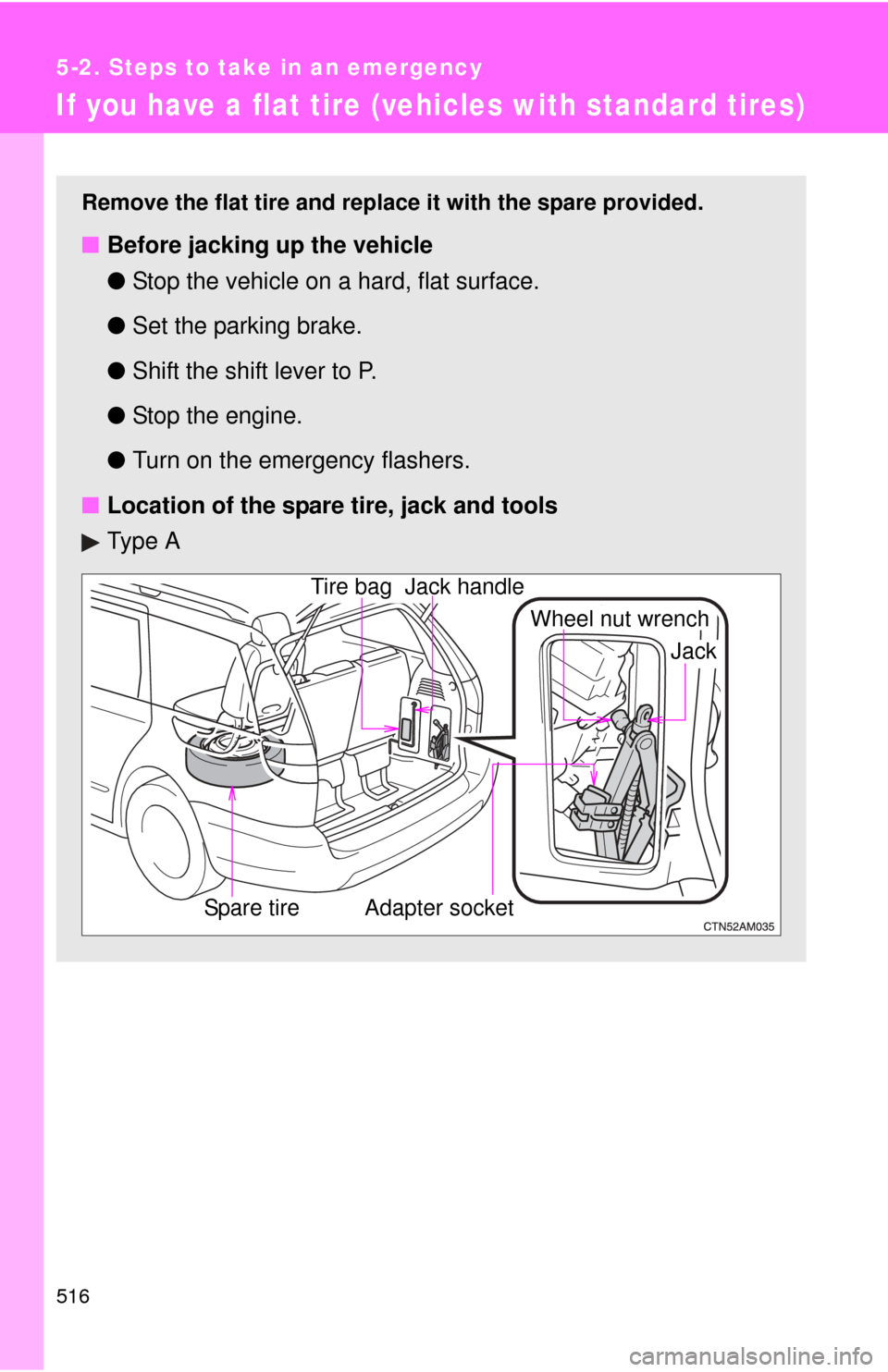
■ Location of the spare tire, jack and tools
Ty p e A
Tire bag Jack handle
Wheel nut wrench
Jack
Spare tire Adapter socket
Page 520 of 592
520 5-2. Steps to take in an emergency
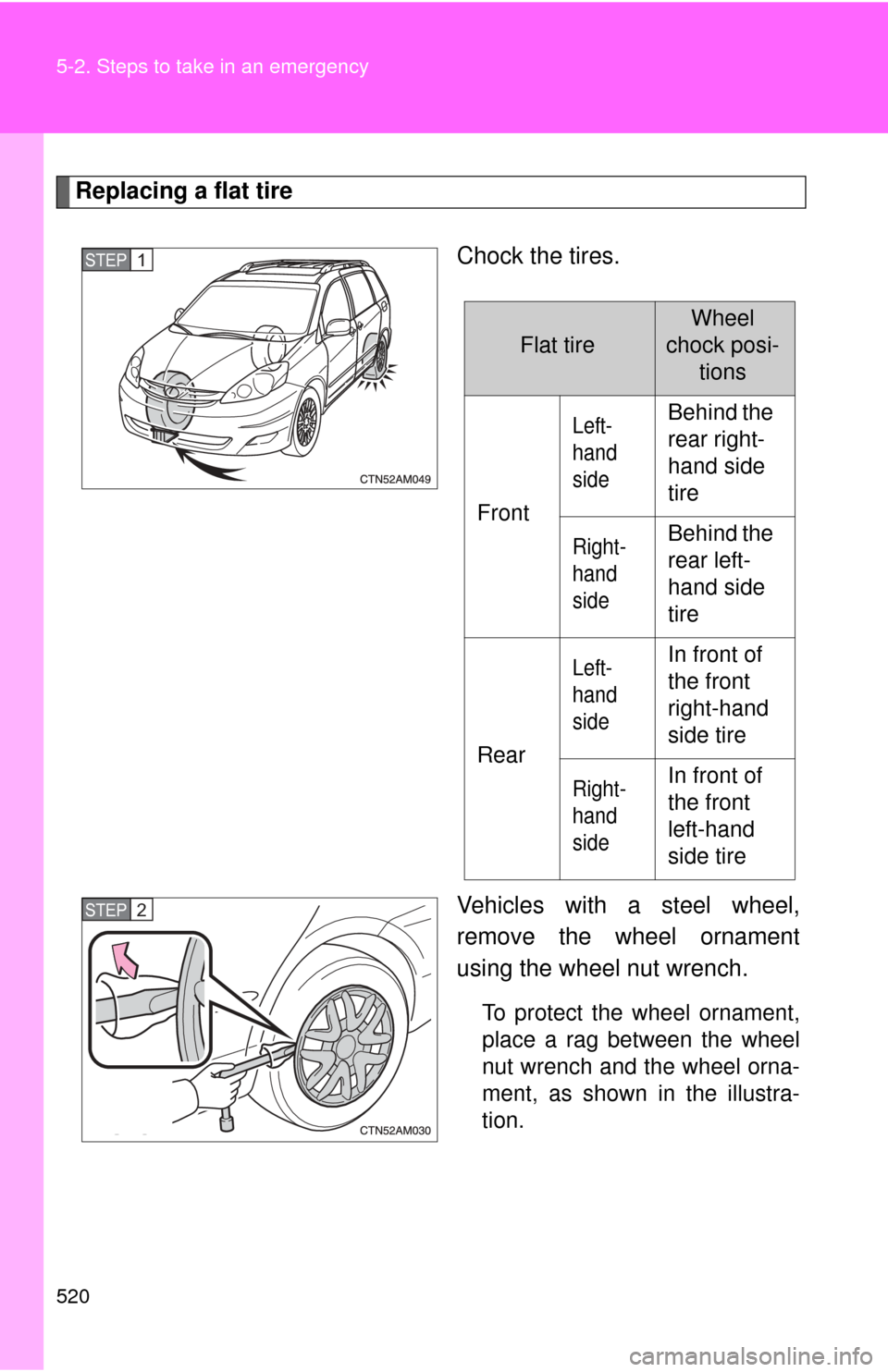
Replacing a flat tireChock the tires.
Vehicles with a steel wheel,
remove the wheel ornament
using the wheel nut wrench.
To protect the wheel ornament,
place a rag between the wheel
nut wrench and the wheel orna-
ment, as shown in the illustra-
tion.
STEP1
Flat tire
Wheel
chock posi- tions
Front
Left-
hand
sideBehind the
rear right-
hand side
tire
Right-
hand
sideBehind the
rear left-
hand side
tire
Rear
Left-
hand
sideIn front of
the front
right-hand
side tire
Right-
hand
sideIn front of
the front
left-hand
side tire
STEP2
Page 523 of 592
5
When trouble arises
523
5-2. Steps to take in an emergency
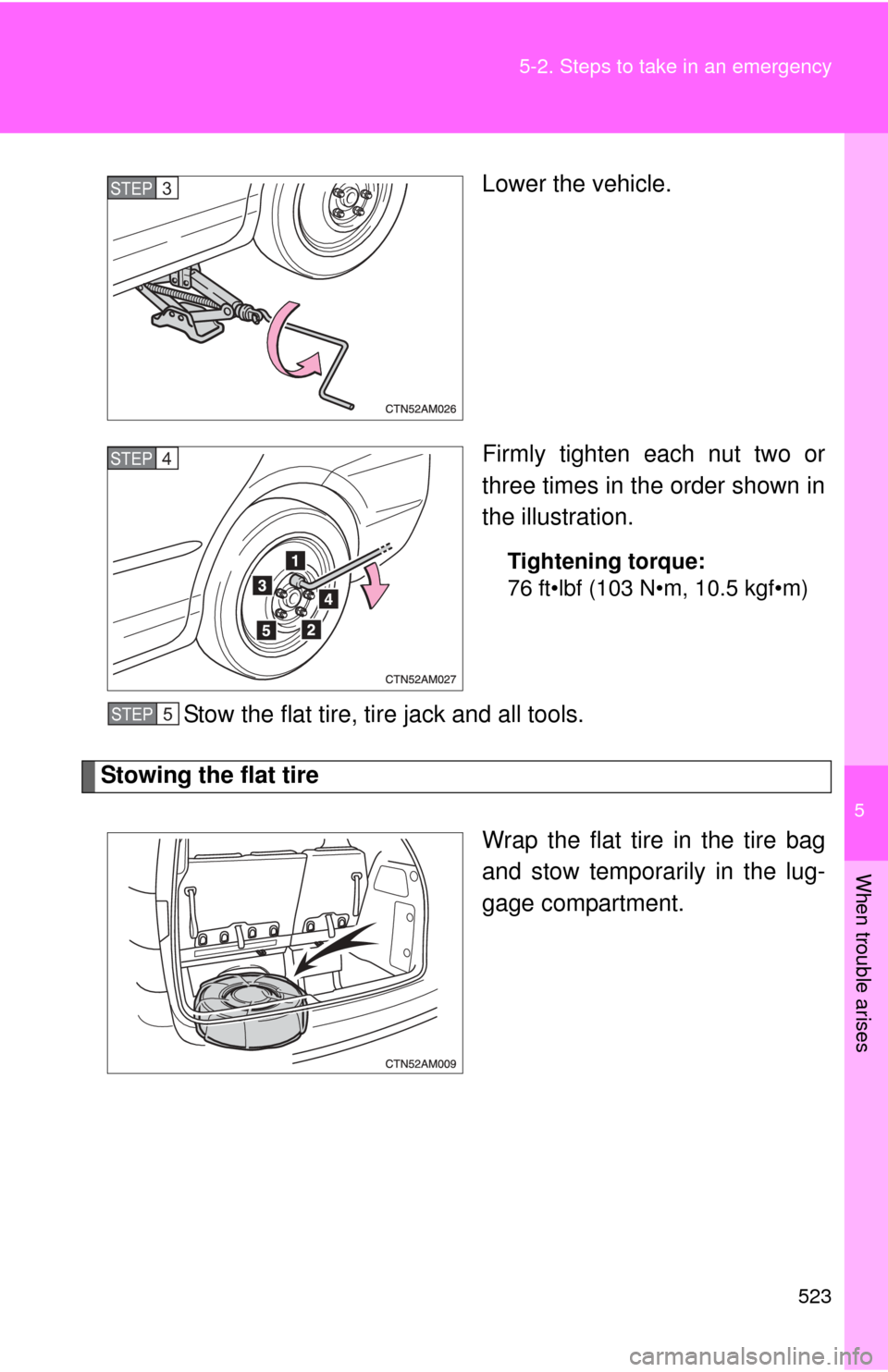
Lower the vehicle.
Firmly tighten each nut two or
three times in the order shown in
the illustration.
Tightening torque:
76 ft•lbf (103 N•m, 10.5 kgf•m)
Stow the flat tire, tire jack and all tools.
Stowing the flat tire
Wrap the flat tire in the tire bag
and stow temporarily in the lug-
gage compartment.
STEP3
STEP4
STEP5