2010 SKODA FABIA bonnet
[x] Cancel search: bonnetPage 43 of 244

Unlocking and locking
42The safe securing system along with the anti-theft alarm system* are, however, deac- tivated during these 30 seconds. When the vehicle is unlocked or locked, the interior lights in the door contact are auto- matically switched on or off. Display of the locking The turn signal lights flash once to confir
m that the vehicle has been correctly locked.
If the vehicle is locked by pr
essing the button and some doors or the boot lid are
not closed, the turn signal lights flash only after closing.
WARNING
If the vehicle is locked from the outside and the safe securing system is acti-vated, there must not be any person in the vehicle as it is then not possible to open either a door or a window from the inside. The locked doors make it more difficult for rescuers to get into th
e vehicle in an emergency - hazard!
Note
Operate the radio remote control only when
the doors and boot lid are closed and
you have visual contact with the vehicle.
Once in the vehicle, you must not press the lock button
of the master key before
inserting the key into the ignition lock in
order to avoid the vehicle being inadvertently
locked and the anti-theft alarm system* being switched on. Should this happen, press the unlock button
of the master key.
Syncronisation of the remote controlIf the vehicle cannot be unlocked by actuatin
g the remote control system then it is
possible that the code in the key and the co
ntrol unit in the vehicle are no longer
synchronised. This can occur when the buttons on the radio-operated key are actuated a number of times outside of the operative
range of the equipment or the battery on
the remote control was replaced. This means it is necessary to
synchronise the code as follows:
press any button on the remote control;
pressing of the button means that the door will unlock with the key within 1
minute.Anti-theft alarm system*DescriptionThe anti-theft alarm system increases the level of protection against people seeking to break into the vehicle. The system triggers audible and visual warning signals if an attempt is made to break into the vehicle. How is the alarm
system activated?
The anti-theft alarm system is activated au
tomatically when the
unlocked vehicle is
locked with the key inserted in the driver's
door or with the remote control key. It is
activated 30 seconds after locking the door. How is the alarm system deactivated? The anti-theft alarm system is deactivated if
the vehicle is unlocked by only using the
radio remote control. The anti-theft alarm system is reactivated if the vehicle is not opened within 30 seconds after transmitting the radio signal. Once you unlock the vehicle by inserting the ke
y into the driver door you then have to
insert the key into the ignition lock and sw
itch the ignition on within 15 seconds after
opening the door in order to deactivate the anti-theft alarm system. The
alarm will be
triggered
if you do
not switch on
the ignition within 15 seconds.
When is the alarm triggered? The following security areas of
the locked vehicle are monitored:
bonnet;
boot lid;
doors;
ignition lock;
vehicle interior*
page 43;
Angle of the vehicle*
page 43;
Decoupling of the attached trailer;
A3
s3j8.a.book Page 42 Tuesday, April 20, 2010 1:10 PM
Page 97 of 244

Starting-off and Driving
96 Automatic engine shut down (stop phase)– Bring the vehicle to a stop (a
pply the handbrake, if necessary).
– Take the vehicle out of gear.– Release the clutch pedal.Automatic engine start (start phase)– Depress the clutch pedal.Activating and deactivating the “START-STOP” systemYou can deactivate and reactivate the “START-STOP” system by pressing the button page 95, fig. 99
.
If the system is deactivated, the warning light lights up in the button.If the vehicle is in the stop phase when pressing the button, the engine starts immedi- ately. The START-STOP system involves compli
cated switching conditions, some of
them cannot be correctly determined with
out servicing. The
general conditions
for the proper functioning of the START-ST
OP system are listed in the following
overview. Conditions for the automatic en
gine shut down (stop phase)
Conditions that enable an auto
matic engine start (start phase)
Conditions that enable an automatic engine start without driver intervention
Gearshift lever in the neutral positionClutch pedal not depressedThe driver has fastened the seat beltThe driver's door is closedThe bonnet is closedThe vehicle is stationaryThe factory-fitted towing device is no
t electrically connected to a trailer
The engine operating temperature is reachedThe charge state of the vehicle battery is sufficientSlope angle / gradient of the vehicle must not be too great
Engine speed is lower than 1200 rpmThe temperature inside the vehicle battery is not too low or too highThe pressure in the brake system is sufficientThe difference between set and actual temperature in the interior is not too greatThe vehicle has exceeded the speed of 3 km/h since the last automatic startNo cleaning cycle is active in
the diesel particle filter*
page 33
The front wheels are not turned excessively (t
he steering angle is less than 3/4 of a
steering wheel revolution)The clutch pedal is pressedThe temperature setting is changed to min./max.Defrosting windscreen is switched onHigh blower speed is setButton for the START-STOP system is pressedThe vehicle moves at a speed of more than 3 km/hThe difference between the set and the actual temperature in the interior is too greatThe battery voltage is too lowThe pressure in the brake system is not sufficient
s3j8.a.book Page 96 Tuesday, April 20, 2010 1:10 PM
Page 101 of 244

Automatic gearbox
100
the right. In the positions
D and
S the gear you have already engaged will be addition-
ally displayed on the display. - Parklock The driven wheels are locked me
chanically in this position.
The Parklock must only be engage
d when the vehicle is stationary
.
If you wish to move the selector lever into
or out of this position, you must press the
Shiftlock button in the handle of the select
or lever and at the same time depress the
brake pedal. - Reverse gear Reverse gear must only be engaged when the vehicle is stationary and the engine idling
.
The brake pedal must be depressed and at
the same time the Shiftlock must be
pressed, if you wish to obtain the selector lever positions
R, P or N.
When the ignition is switched on an
d the selector lever is in position
R, the reverse
lights will come on. - Neutral The transmission is in Neutral in this position. The brake pedal must be depressed (if the le
ver is in its position for longer than 2
seconds) in order to move the selector lever out of the position
N into the position
D,
with the ignition switched on, on a vehicle travelling at less than 5 km/hour or on a stationary vehicle. - Position for driving forward When the selector lever is in this position
, the forward gears are shifted up and down
automatically in line with engine lo
ad, vehicle speed and the dynamic shift
programme. You must depress the brake pedal if you wish to move into position
D from
N when the
vehicle is travelling at less th
an 5 km/hour or is stationary
.
In certain circumstances (e.g. when driving
in mountainous regions or when towing a
trailer) it may be beneficial to
select the manual shift programme
page 102 for a
short time in order to adapt the gearbox
ratios manually to the driving situations.
- Position for sporty style of driving Shifting up later into a higher gear makes it
possible to fully exploit the power potential
of the engine. The gearbox also then shifts down at higher engine speeds as in the posi-tion
D.
The gearbox does not shift into the 6th gear in the position
S, because the maximum
speed is reached with the 5th gear
7).
The Shiftlock on the selector lever grip mu
st be pressed when moving the selector
lever out of the position
D into the position
S.
WARNING
Never move the selector lever into position R or P when driving - risk of an
accident!
When the engine is running and the vehi
cle is stationary, it is necessary to
hold the car with the brake pedal in all the positions of the selector lever (except P and N) since the power transmission is never completely interrupted, also not when the engine is idling - the vehicle creeps.
You must on no account unintentionally operate the throttle (e.g. by hand
from the engine compartment) if a driv
e position is engaged when the car is
stationary. The vehicle would otherwise
immediately start o
ff - also when the
handbrake is firmly applied - risk of an accident!
You must move the selector lever into position P and firmly apply the hand-
brake first before you or any other person opens the bonnet and starts working on the engine when it is running - risk of accident! It is also essential to observe all warnings
page 166, “Working in the engine compartment”.
Selector lever lockAutomatic selector lever lock
With the ignition on, the selector lever is locked when it is in the positions
P and
N. You
must first of all depress the brake pedal in or
der to move the selector lever out of this
position. The warning light
page 31 lights up in the instrument cluster as a
reminder for the driver when the selector lever is in the positions
P and
N.
APARANAD
7)Not valid for vehicles with automatic gearbox DSG.AS
s3j8.a.book Page 100 Tuesday, April 20, 2010 1:10 PM
Page 159 of 244

Taking care of your vehicle and cleaning the vehicle
158
Do not affix any stickers over the inside of
the rear window to avoid damage to the
heating elements of the rear window heater
.
We recommend using a preserva
tive from Škoda genuine accessories offered by your
Škoda dealer.
Caution
Never remove snow or ice from the glass pa
rts with warm or hot water - risk of
formation of cracks in the glass!
When removing snow or ice from the windows and mirror lenses make sure not to
damage the paintwork of the vehicle.The headlight lensesPlease do not use any aggressi
ve cleaning or chemical so
lvent products for cleaning
the front headlights - risk of
damage to the
plastic lenses.
Please use
soap and clean
warm water.
Caution
Never
wipe the headlights dry and do not use any sharp objects for cleaning the plastic
lenses, this may result in damage to the
protective paintwork and consequently in
formation of cracks on the headlight lenses, e.g through effect of chemical products.Door and window sealsThe rubber seals on the doors, boot lid,
bonnet and windows remain supple and last
longer if you treat them from time to time with a rubber care product (e.g. with a spray with silicone-free oil). You also avoid premature wear of the seals and prevent leakages in this way. It is also easier to open the doors. Rubber seals which are well cared for also do not stick together in cold winter weather.Locking cylinderWe recommend that you use the spray from Škoda original accessories with regreasing and anticorrosive effect for de-icing locking cylinders.
Note
When washing your vehicle, ensure that as
little water as possible gets into the locking
cylinders.WheelsSteel wheels You should also thoroughly wash the wheels
and wheel trims when giving your vehicle
its regular wash. This prevents any brake dust, dirt and road salt from sticking to the wheel hubs. You can remove stubborn brake
abrasion adhering to the wheels with an
industrial cleaner. Touch up
any damage to the paintwork on the wheels before rust is
able to form. Light alloy wheels Regular care of light alloy wh
eels is necessary in order to retain their decorative
appearance over long periods. It is particul
arly important to remove any road salt and
brake abrasion from light alloy wheels every two weeks, otherwise the surface will suffer. Wash thoroughly and then treat the wheels with a protective product for light alloy wheels which does not
contain any acidic componen
ts. You should provide the
wheel hubs with a hard wax layer every thre
e months. You must not use any products
which cause abrasion when treating the wheel hubs. Any damage to the paint layer on the wheel hubs must be touched up immediately. We recommend using a preservative from Šk
oda genuine accessories offered by your
Škoda dealer.
WARNING
One should remember when cleaning th
e wheels that moisture, ice and road
salt may adversely affect braking ef
ficiency - risk of an accident!
Note
Severe layers of dirt on the wheels can also
result in wheel imbalance. This may show
itself in the form of a wheel vibration which
is transmitted to the steering wheel which,
in certain circumstances, can
cause premature wear of the
steering. This means it is
necessary to remove the dirt.
s3j8.a.book Page 158 Tuesday, April 20, 2010 1:10 PM
Page 166 of 244

Inspecting and replenishing
165
Using the system
Safety
Driving Tips
General Maintenance
Breakdown assistance
Technical Data
Inspecting and replenishingEngine compartmentBonnet remote releaseBonnet remote release– Pull the unlocking lever on the left below the dash panel
fig. 138
.
The bonnet jumps out of its lock as a result of the spring force.Opening and closing the bonnet.Fig. 139 Radiator grille: Locking lever / se
curing the bonnet with the bonnet support
Opening the bonnet– Unlock the bonnet
fig. 138
.
– Ensure that the arms of the windscreen wipers are correctly in place against the
windscreen
before opening
the bonnet otherwise damage could occur to the
paintwork.
– Pull on the locking lever
fig. 139
- left, the bonnet is then unlocked.
– Grip the bonnet and lift it up.– Take the bonnet support out of its holder and set it in the opening designed for it
fig. 139
- right.
Closing the bonnet– Lift the bonnet slightly and unhook the bonnet support. Press the bonnet support
into the holder designed to hold it.
– Allow the bonnet to drop from a height
of about 30 cm into the lock - bonnet
do
not press down on it
!
WARNING
Never open the bonnet if you see that steam or coolant is flowing out of the
engine compartment - risk of scalding!
Wait long enough until the steam or
coolant has stopped escaping.
For safety reasons, the bonnet must always be properly closed when
driving. One should therefore check that
the lock has in fact engaged properly
after closing the bonnet.
Stop your vehicle immediately while driving if you notice that the lock is not
properly engaged and close the bonnet
properly - risk of an accident!
Caution
Before opening the bonnet, ensure that the arms of the windscreen wipers are
correctly in place against the windscreen. Othe
rwise, there is a risk of damage to the
paintwork.
Fig. 138 Bonnet release lever
s3j8.a.book Page 165 Tuesday, April 20, 2010 1:10 PM
Page 167 of 244

Inspecting and replenishing
166
Working in the engine compartment Particular care is required when carrying out any work in the engine compartment!There is a risk of injuries, scalding, acci
dents and fire when working in the engine
compartment, e.g. inspecting and replenishing oil and other fluids. For this reason, it is essential to comply with the warning instructions stated below and with the general applicable rules of safe
ty. The engine compartment of your car
is a hazardous area
.
WARNING
Never open the bonnet if
you see that steam or coolant is flowing out of the
engine compartment - risk of scalding!
Wait long enough until the steam or
coolant has stopped escaping.
Switch off the engine and pull out the ignition key.
Apply the handbrake firmly.
If your vehicle is fitted with a manual
gearbox, move the gearshift lever into
Neutral, or if it is fitted with automatic gearbox, move the selector lever into position P.
Allow the engine to cool down.
Keep children clear of the engine compartment.
Do not touch any hot engine parts - risk of burns!
Never spill oil and other fluids over the hot engine. Such fluids (e.g. the anti-
freeze contained in the wash liquid) may ignite!
Avoid short circuits in the electrical system - particularly on the battery.
Never place your hand into the radiator fan as long as the engine is still
warm. The fan might suddenly start running!
Never open the cap of the coolant expans
ion bottle as long as the engine is
still warm. The cooling
system is pressurized!
Cover over the cap of the coolant expansion reservoir with a large cloth
when opening it as protection for your
face, hands and arms from hot steam or
hot coolant.
Do not let objects, such as e.g cleaning cloth or tools lie in the engine
compartment.
If you wish to work under the vehicl
e, you must secure the vehicle from
rolling away and support it with suitable supporting blocks: the car jack is not sufficient for this - risk of injury!
In cases where it be necessary to carry out inspection work when the engine
is running there is an additional risk fr
om rotating parts (e.g. the V-ribbed belt,
alternator, radiator fan) and from the high-voltage ignition system. Please observe in addition the following:
Never touch the electrical cabl
es of the ignition system.
Absolutely avoid any jewellery, loose it
ems of clothing or long hair from
getting into the rotating parts of the
engine - Hazard! Therefore remove any
jewellery beforehand, tie up your hair and wear tight fitting clothing.
Please also comply with the warnin
g instructions st
ated below when
carrying out any essential work on the fu
el system or on th
e electrical system:
Always separate the car battery from the electrical system. Do not smoke. Never carry out any work close to naked flames. Always keep a working fire
extinguisher at hand.
Caution
When replenishing fluids in the engine, always
ensure that the fluids are on no account
mixed up. This may result in major oper
ating problems and also vehicle damage!
WARNING (continued)
s3j8.a.book Page 166 Tuesday, April 20, 2010 1:10 PM
Page 168 of 244
Inspecting and replenishing
167
Using the system
Safety
Driving Tips
General Maintenance
Breakdown assistance
Technical Data
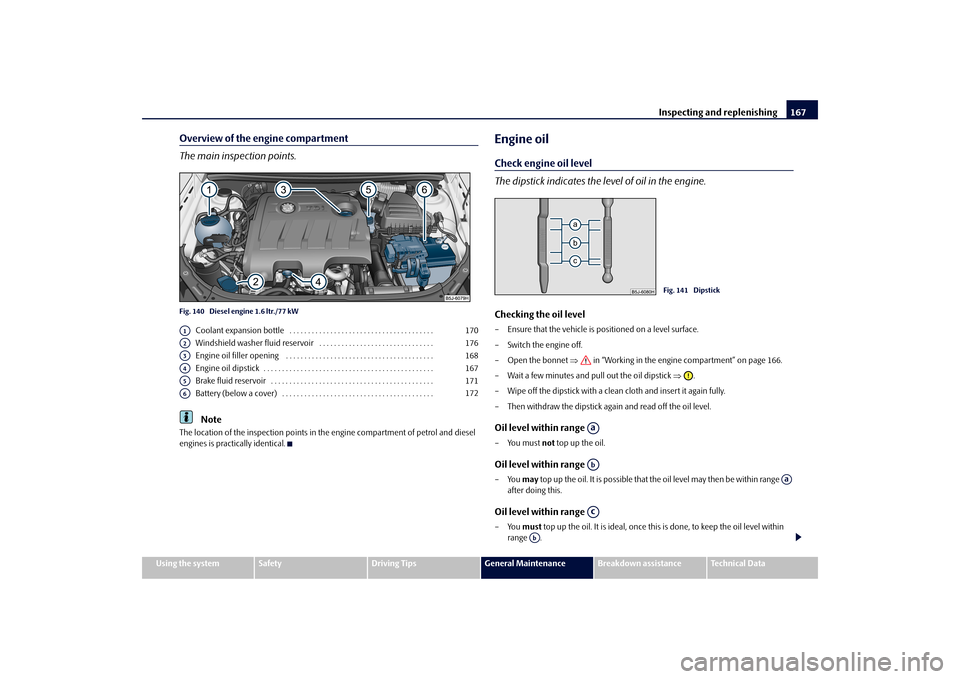
Overview of the engine compartment The main inspection points.Fig. 140 Diesel engine 1.6 ltr./77 kW
Coolant expansion bottle . . . . . . . . . . . . . . . . . . . . . . . . . . . . . . . . . . . . . . . Windshield washer fluid reservoir . . . . . . . . . . . . . . . . . . . . . . . . . . . . . . . Engine oil filler opening . . . . . . . . . . . . . . . . . . . . . . . . . . . . . . . . . . . . . . . .Engine oil dipstick . . . . . . . . . . . . . . . . . . . . . . . . . . . . . . . . . . . . . . . . . . . . . . Brake fluid reservoir . . . . . . . . . . . . . . . . . . . . . . . . . . . . . . . . . . . . . . . . . . . . Battery (below a cover) . . . . . . . . . . . . . . . . . . . . . . . . . . . . . . . . . . . . . . . . .Note
The location of the inspection points in th
e engine compartment of petrol and diesel
engines is practically identical.
Engine oilCheck engine oil level The dipstick indicates the le
vel of oil in the engine.
Checking the oil level– Ensure that the vehicle is po
sitioned on a level surface.
– Switch the engine off.– Open the bonnet
in “Working in the engine compartment” on page 166.
– Wait a few minutes and pull out the oil dipstick
.
– Wipe off the dipstick with a clea
n cloth and insert it again fully.
– Then withdraw the dipstick again and read off the oil level.Oil level within range –You must
not
top up the oil.
Oil level within range –You
may
top up the oil. It is possible that the oil level may then be within range
after doing this.
Oil level within range –You
must
top up the oil. It is ideal, once this
is done, to keep the oil level within
range .
A1
170
A2
176
A3
168
A4
167
A5
171
A6
172
Fig. 141 Dipstick
AaAb
Aa
Ac
Ab
s3j8.a.book Page 167 Tuesday, April 20, 2010 1:10 PM
Page 171 of 244

Inspecting and replenishing
170
Any faults or problems resulting from corrosion may cause a loss of coolant
and, as a consequence of this,
result in major engine damage.
Inspecting the coolant levelThe coolant expansion bottle
is located in the engine compartment on the right.
– Switch the engine off.– Open the bonnet
in “Working in the engine compartment” on page 166.
– Check the level of coolant in the coolant expansion bottle
fig. 142
. The coolant
level when the engine is cold must lie between the “MIN” and “MAX” mark- ings. The level may also rise slightly ab
ove the “MAX” marking when the engine is
warm.
If the coolant level in the reservoir is too lo
w, this is indicated by the warning light in
the instrument cluster
page 29. We nevertheless recommend inspecting the
coolant level directly at the reservoir from time to time. Loss of coolant A loss of coolant is first and foremost an
indication of a leak
in the system. You should
not merely top up the coolant in the reservoir.
It is also important to have the cooling
system inspected without delay by a specialist garage. Losses can only occur through
the pressure relief in the cap of the coolant expansion
bottle which is completely free of leaks if
the coolant boils as a
result of overheating
and is forced out of the cooling system.
WARNING
Read and observe the warning notes
page 166, “Working in the engine
compartment” before working in the engine compartment.
Caution
One should contact a specialist garage as s
oon as possible if the source of overheating
itself cannot be determined and removed,
since there may be grave damage to the
engine.Replenishing the coolant– Switch the engine off. – Allow the engine to cool down.– Place a cloth over the cap of the coolant expansion reservoir
fig. 142
and
unscrew the cap
carefully
by turning it to the left
.
–Top up the coolant.– Screw the cap tight until it is heard to lock. The coolant which you use for replenishing the system, must comply with one specific specification
page 169, “Coolant”. Do not use an al
ternative additive if the coolant
additive G12 PLUS - PLUS is not available in
exceptional cases. Just top up the system
with water and as soon as possible arrange
adjustment to correct
the mixing ratio of
water and coolant additive again by a specialist garage. Only use fresh coolant for topping up the system.Do not fill up over the “MAX” marking! Excess
coolant which is heated up is forced out
of the cooling system through the pressure relief valve in the cap of the coolant compensation bottle. Wait until the engine has cooled down for a
system which has suffered a major loss of
coolant before pouring in coolant. This
is necessary to avoid engine damage.
Fig. 142 Engine compartment: Coolant expansion bottle
AB
AA
s3j8.a.book Page 170 Tuesday, April 20, 2010 1:10 PM