Page 83 of 594

2-56 Seat and restraint systems
2
SRS servicing
N00408500601
NOTE�
When you transfer ownership of the vehicle to another
person, we urge you to alert the new owner that it is
equipped with the SRS and refer that owner to the applica-
ble sections in this owner’s manual.
�
If you decide to junk or scrap your vehicle, we urge you to
first take it to an authorized Mitsubishi Motors dealer so
that the SRS can be made safe for disposal.
�
If any of the following parts needs to be modified for use
by a handicapped person, the advanced airbag system will
be greatly affected. Please consult an authorized Mitsub-
ishi Motors dealer for assistance.
Driver’s seat
Front passenger seat
Front seat belt
Steering wheel
Instrument panel
WA R N I N G
!�
Any maintenance performed on or near the compo-
nents of the SRS should be performed only by an
authorized Mitsubishi Motors dealer. Do not permit
anyone else to do any service, inspection, mainte-
nance or repair on any SRS components or wiring.
Similarly, no part of the SRS should ever be han-
dled, removed or disposed by anyone except an
authorized Mitsubishi Motors dealer.
Improper work methods on the SRS components or
wiring could result in an accidental airbag deploy-
ment or could make the SRS inoperable. Either of
these situations could result in serious injury or
death.
�
Do not modify your steering wheel or any other SRS
component or related vehicle part. For example,
replacement of the steering wheel, or modifications
to the front bumper or body structure can adversely
affect SRS performance and may lead to injury.
�
If your vehicle has received any damage, you should
have the SRS inspected by an authorized Mitsubishi
Motors dealer to make sure it is in proper working
order.
�
Do not modify your front seats, center pillar or cen-
ter console. Such modifications can adversely affect
SRS performance and may lead to injury.
Also, if you discover any tear or open seam in the
seat fabric near the side airbag, have the seat
inspected by an authorized Mitsubishi Motors
dealer.
�
If you find a crack in or damage to the front pillar,
rear pillar, or roof side rail where the curtain airbag
is located, have the SRS inspected by an authorized
Mitsubishi Motors dealer.WA R N I N G
!
BK0105501US.book 56 ページ 2009年8月10日 月曜日 午前10時32分
Page 117 of 594

3-32 Features and controls
3
Starting the engineYour vehicle is equipped with an electronically controlled fuel
injection system. This is a system that automatically controls
fuel injection. There is usually no need to depress the accelera-
tor pedal when starting the engine.
The starter motor should not be run for more than 15 seconds at
a time.
To prevent battery drain, wait a few seconds between attempts
to restart the engine.
Normal conditions
To start your vehicle:
Make sure all occupants are properly seated with seat belts fas-
tened.
1. Press and hold the brake pedal down with your right foot.
2. Press and hold the clutch pedal all the way down (manual
transaxle).NOTE�
For models equipped with a manual transaxle, the starter
will not operate unless the clutch pedal is fully depressed
(Clutch interlock). This is a safety feature.3. On vehicles with manual transaxle, place the gearshift
lever in the “N” (Neutral) position.
On vehicles with Twin Clutch SST, make sure the gear-
shift lever is in the “P” (PARK) position.
NOTE�
On vehicles with Twin Clutch SST, the starter will not
operate unless the gearshift lever is in the “P” (PARK)
position or the gearshift lever is in the “N” (NEUTRAL)
position with the brake pedal depressed.
For safety reasons, start the engine in the “P” (PARK)
position so that the wheels are locked.
4. While pushing the ignition switch from “LOCK” (PUSH
OFF) to “LOCK” (PUSH ON), set the ignition switch to
the “ON” position and confirm that all warning lights and
warning displays are operating properly.
5. Without pressing the accelerator pedal, slowly turn the
ignition switch to the “START” position to start the
engine. Release the ignition switch when the engine starts.
NOTE�
Minor noises may be heard on engine start-up. These will
disappear as the engine warms up.
At extremely cold ambient temperature
If the engine won’t start, press the accelerator pedal about half-
way down while cranking the engine. Release the accelerator
pedal when the engine starts.
BK0105501US.book 32 ページ 2009年8月10日 月曜日 午前10時32分
Page 124 of 594
Features and controls
3-39
3
Normal conditions
To start your vehicle:
Make sure all occupants are properly seated with seat belts fas-
tened.
1. While pushing the lock release buttons (A), remove the
cover of the ignition switch.2. Insert the emergency key into the ignition switch.
3. Insert the F.A.S.T.-key into the emergency key.
BK0105501US.book 39 ページ 2009年8月10日 月曜日 午前10時32分
Page 138 of 594

Features and controls
3-53
3 Door locks
N00509200420
To lock or unlock the driver’s door with the keyTurn the key toward the front of the vehicle to lock the door.
After checking that the door is locked, turn the key back to the
center and remove it. NOTE�
In vehicles equipped with the F.A.S.T.-key, the driver’s
door can be locked and unlocked using the emergency
key.
Refer to “Emergency key” on page 3-33.
WA R N I N G
!�
Make sure all doors are tightly closed and locked
while driving. Locked doors, in combination with the use of seat
belts, can help reduce the risk of ejection in an
accident.
Locked doors can help keep passengers, especially
small children, from opening doors and falling out
of moving vehicles.
Locked doors can help prevent outsiders from
gaining access to your vehicle when you slow or
come to a stop.
�
Lock your vehicle whenever you leave it. Children
who get into unlocked vehicles may not be able to
get out. Children trapped inside vehicles can quickly
be overcome by heat and suffer serious injury or
death due to heat stroke.
�
Never leave children unattended inside a vehicle. In
addition to the risk of heat stroke, children can acti-
vate switches and controls, resulting in an injury or
fatal accident.
1- Insert or remove the key
2- Lock
3- Unlock
BK0105501US.book 53 ページ 2009年8月10日 月曜日 午前10時32分
Page 171 of 594
![MITSUBISHI LANCER EVOLUTION 2010 10.G Owners Manual 3-86 Features and controls
3
Starting the engine
N00542200061
[For vehicles equipped with the F.A.S.T.-key]
For information on operations for vehicles equipped with the
F.A.S.T.-key, refer to “F.A.S](/manual-img/19/7466/w960_7466-170.png "MITSUBISHI LANCER EVOLUTION 2010 10.G Owners Manual 3-86 Features and controls
3
Starting the engine
N00542200061
[For vehicles equipped with the F.A.S.T.-key]
For information on operations for vehicles equipped with the
F.A.S.T.-key, refer to “F.A.S")
3-86 Features and controls
3
Starting the engine
N00542200061
[For vehicles equipped with the F.A.S.T.-key]
For information on operations for vehicles equipped with the
F.A.S.T.-key, refer to “F.A.S.T.-key: Starting the engine” on
page 3-31.
[Except for vehicles equipped with the F.A.S.T.-key]
Your vehicle is equipped with an electronically controlled fuel
injection system, which automatically controls the release of
fuel. There is usually no need to depress the accelerator pedal
when starting the engine.
The starter should not be run for more than 15 seconds at a
time.
To prevent battery drain, wait a few seconds between attempts
to restart the engine. Normal conditionTo start your vehicle:
Make sure all occupants are properly seated with seat belts fas-
tened.
1. Insert the ignition key.
2. Make sure the parking brake is applied.
3. Press and hold the brake pedal down with your right foot.
4. Press and hold the clutch pedal all the way down (manual
transaxle).NOTE�
For models equipped with a manual transaxle, the starter
will not operate unless the clutch pedal is fully depressed
(Clutch interlock). This is a safety feature.5. On vehicles with manual transaxle, place the gearshift
lever in the “N” (Neutral) position.
On vehicles with Twin Clutch SST, make sure the gear-
shift lever is in the “P” (PARK) position.
NOTE�
On vehicles with Twin Clutch SST, the starter will not
operate unless the gearshift lever is in the “P” (PARK)
position or the gearshift lever is in the “N” (NEUTRAL)
position with the brake pedal depressed.
For safety reasons, start the engine in the “P” (PARK)
position so that the wheels are locked.
6. Turn the ignition switch to the “ON” position and make
certain that all warning lights are functioning properly
before starting the engine.
7. Turn the ignition switch to the “START” position without
pressing the accelerator pedal. Release the key when the
engine starts.
At extremely cold ambient temperaturerIf the engine won’t start, press the accelerator pedal all the way
down while cranking the engine. Release the accelerator pedal
when the engine starts.
CAUTION
!�
When starting the engine, make sure that you hold
the brake pedal down. If you start the engine with
your foot on the accelerator pedal, switch to the
brake pedal as soon as the engine has started.
BK0105501US.book 86 ページ 2009年8月10日 月曜日 午前10時32分
Page 268 of 594
Features and controls
3-183
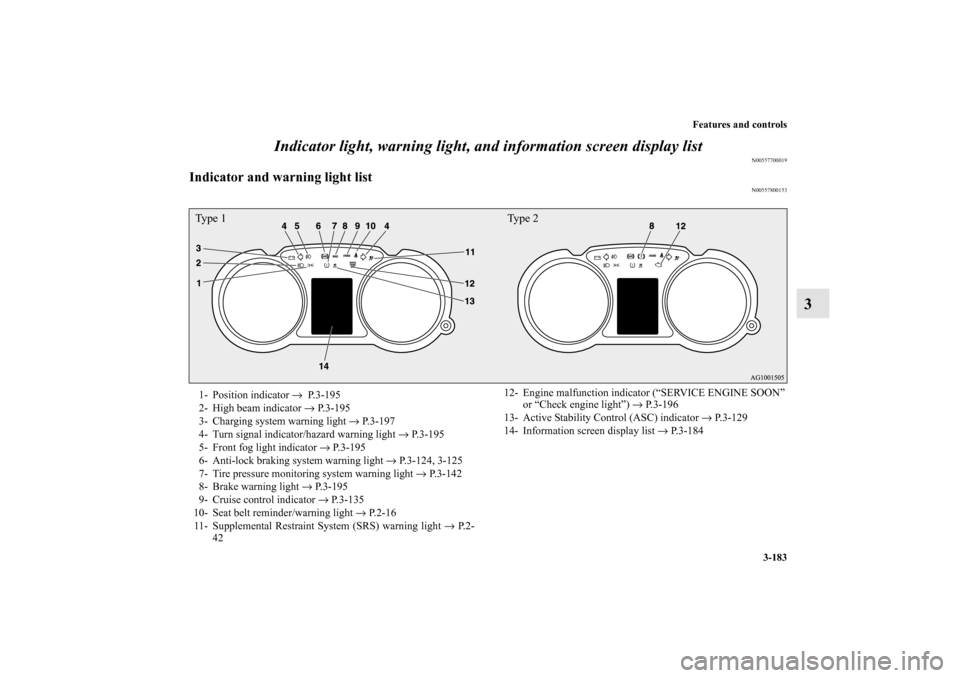
3 Indicator light, warning light, and information screen display list
N00557700019
Indicator and warning light list
N00557800153
Type 1 Type 21- Position indicator → P. 3 - 1 9 5
2- High beam indicator → P.3-195
3- Charging system warning light → P.3-197
4- Turn signal indicator/hazard warning light → P.3-195
5- Front fog light indicator → P.3-195
6- Anti-lock braking system warning light → P.3-124, 3-125
7- Tire pressure monitoring system warning light → P.3-142
8- Brake warning light → P.3-195
9- Cruise control indicator → P.3-135
10- Seat belt reminder/warning light → P.2-16
11- Supplemental Restraint System (SRS) warning light → P. 2 -
4212- Engine malfunction indicator (“SERVICE ENGINE SOON”
or “Check engine light”) → P.3-196
13- Active Stability Control (ASC) indicator → P.3-129
14- Information screen display list → P.3-184
BK0105501US.book 183 ページ 2009年8月10日 月曜日 午前10時32分
Page 275 of 594
3-190 Features and controls
3
�One of the doors or the trunk lid is not
completely closed.
The open door is displayed.�Close the door or trunk lid.
Refer to “Door ajar warning display
screen (With ignition switch in the
“ON” position)” on page 3-171.
�The engine hood is open.�Close the engine hood.
Refer to “Engine hood” on page 7-4.
�The engine is overheated.�Park the vehicle in a safe place and
take corrective measures.
Refer to “Engine overheating” on page
6-6.
�The Twin Clutch SST fluid tempera-
ture is increased.�Park the vehicle in a safe place and
take corrective measures.
Refer to “Twin Clutch SST” on page 3-
93.
�The seat belt is not fastened when the
ignition switch is in the “ON” position.�Wear your seat belt properly. Refer to
“Seat belt warning” on page 2-16.
Screen
Cause
Do this (Reference)
BK0105501US.book 190 ページ 2009年8月10日 月曜日 午前10時32分
Page 348 of 594
Features and controls
3-263
3
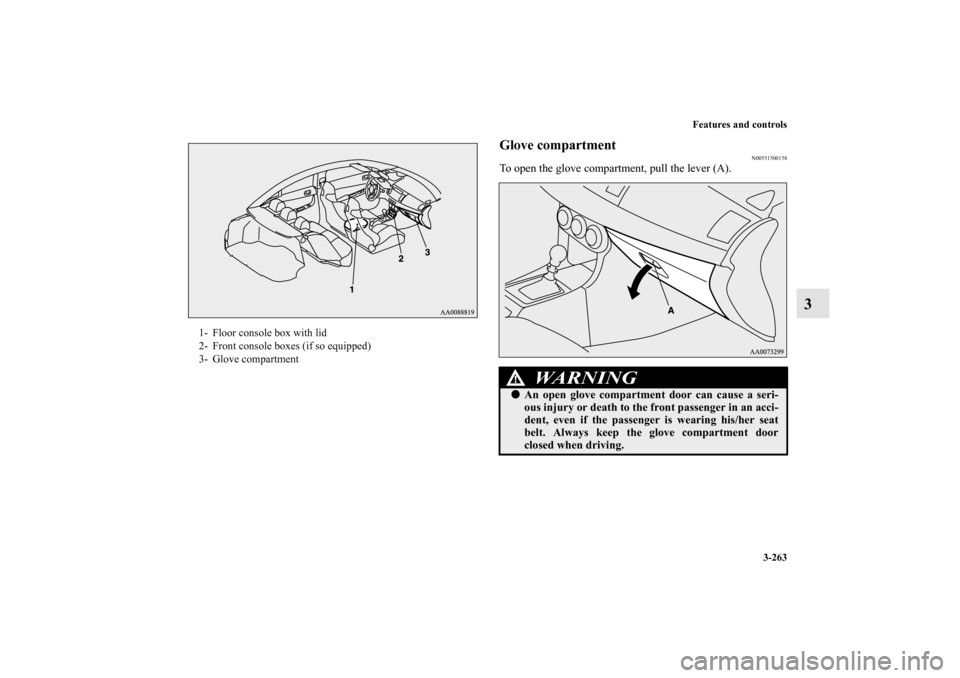
Glove compartment
N00551500158
To open the glove compartment, pull the lever (A).
1- Floor console box with lid
2- Front console boxes (if so equipped)
3- Glove compartment
WA R N I N G
!�
An open glove compartment door can cause a seri-
ous injury or death to the front passenger in an acci-
dent, even if the passenger is wearing his/her seat
belt. Always keep the glove compartment door
closed when driving.
BK0105501US.book 263 ページ 2009年8月10日 月曜日 午前10時32分