Page 398 of 514
Comfort controls
5-79
5
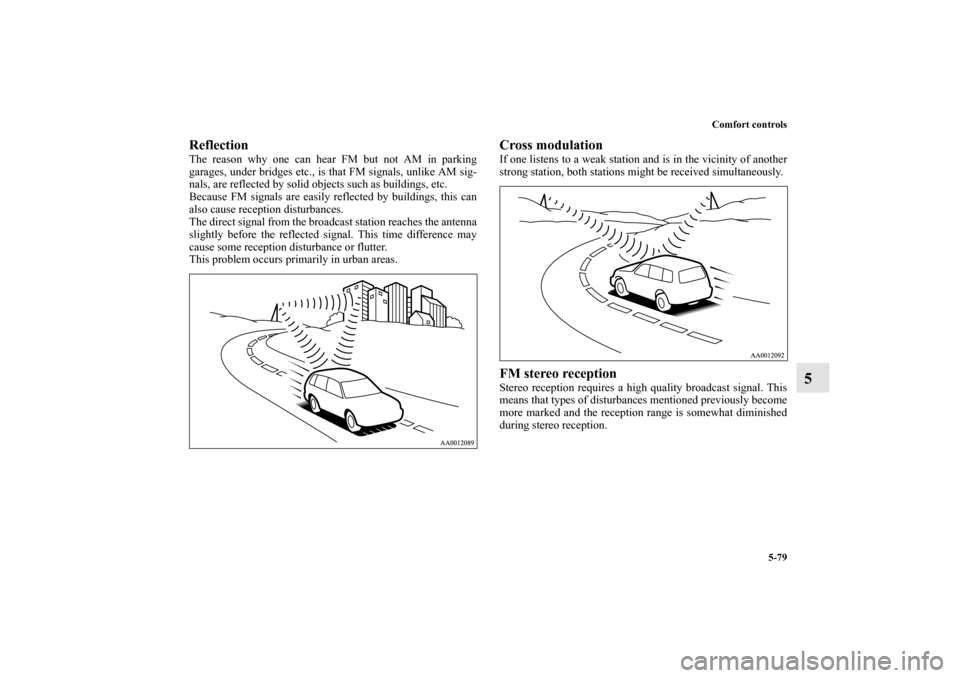
Reflection The reason why one can hear FM but not AM in parking
garages, under bridges etc., is that FM signals, unlike AM sig-
nals, are reflected by solid objects such as buildings, etc.
Because FM signals are easily reflected by buildings, this can
also cause reception disturbances.
The direct signal from the broadcast station reaches the antenna
slightly before the reflected signal. This time difference may
cause some reception disturbance or flutter.
This problem occurs primarily in urban areas.
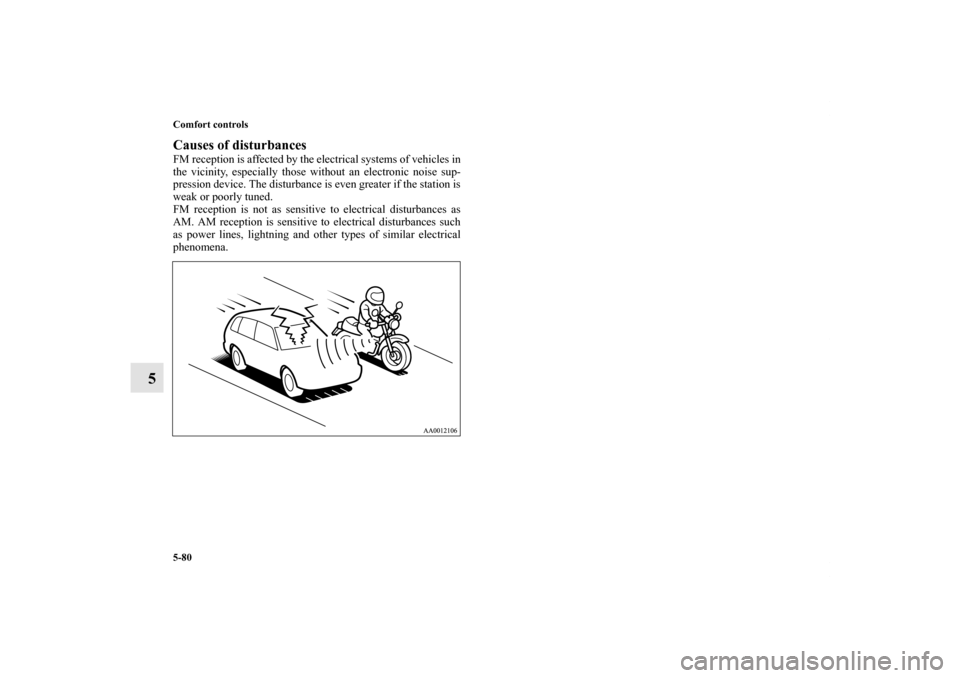
Cross modulation If one listens to a weak station and is in the vicinity of another
strong station, both stations might be received simultaneously. FM stereo reception Stereo reception requires a high quality broadcast signal. This
means that types of disturbances mentioned previously become
more marked and the reception range is somewhat diminished
during stereo reception.
BK0102600US.book 79 ページ 2009年3月30日 月曜日 午後2時2分
Page 399 of 514
5-80 Comfort controls
5
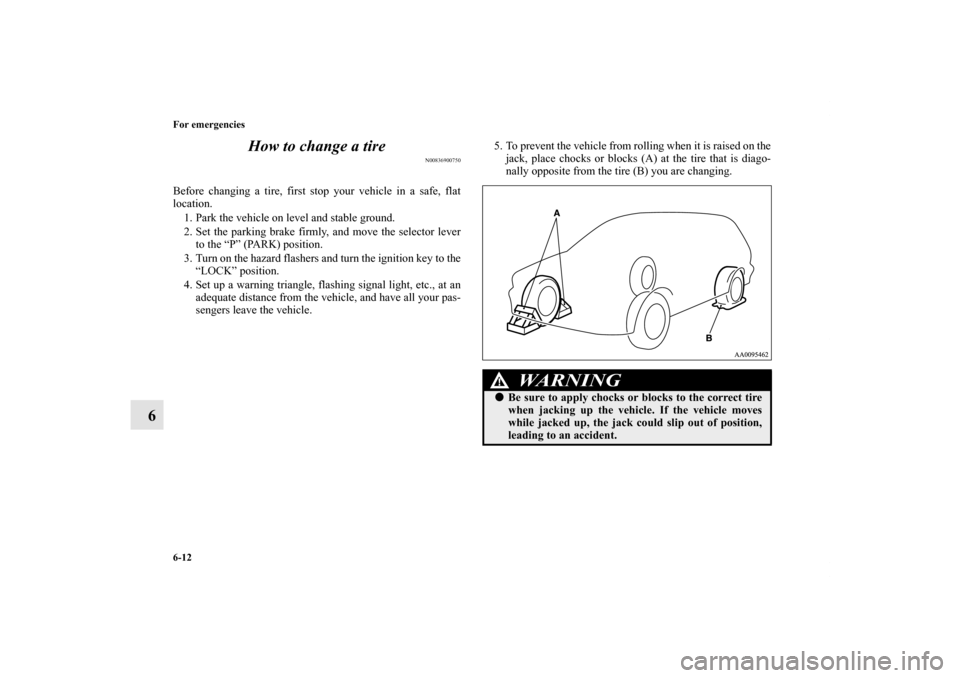
Causes of disturbancesFM reception is affected by the electrical systems of vehicles in
the vicinity, especially those without an electronic noise sup-
pression device. The disturbance is even greater if the station is
weak or poorly tuned.
FM reception is not as sensitive to electrical disturbances as
AM. AM reception is sensitive to electrical disturbances such
as power lines, lightning and other types of similar electrical
phenomena.BK0102600US.book 80 ページ 2009年3月30日 月曜日 午後2時2分
Page 401 of 514
6-2 For emergencies
6If the vehicle breaks down
N00836300103
If your vehicle breaks down on the road, move to the shoulder
and turn on the hazard warning flashers. If there is no shoulder,
or the shoulder is not safe, drive in the right lane slowly, with
the hazard lights flashing, until you come to a safe stopping
place. Keep the flashers flashing. If the engine stops/fails If the engine stops, there will be no power assist to the steering
and brakes, making these difficult to use.
�The brake booster will not work, so the brakes will not
grip well. The brake pedal will be harder to press than
usual.
�Since there is no power steering assist, the steering wheel
will be hard to turn. Turning the steering wheel requires
more effort than usual. When the engine fails at the intersection Get help from your passengers, bystanders, etc. to push the
vehicle and move it to a safe zone.
Jump-starting the engine
N00836400667
If the engine cannot be started because the battery is weak or
dead, you can start it with the battery from another vehicle
using jumper cables.
1. Take off any metal jewelry such as watch bands or brace-
lets that might make an accidental electrical contact.
2. Position the vehicles close enough together so that the
jumper cables can reach, but be sure the vehicles aren’t
touching each other.
WA R N I N G
!�When using jumper cables to start a vehicle, follow
the procedures and be very cautious.
CAUTION
!�Do not try to start your vehicle by pushing or tow-
ing. Vehicles with automatic transaxles cannot be
started this way. Pushing or towing a vehicle that
has a manual transaxle may overheat and damage
the catalytic converter. Also, there is more risk of an
accident when a vehicle is being pushed or towed.
CAUTION
!�Check the other vehicle. It must have a 12-volt bat-
tery. If the other system isn’t 12-volt, both systems
can be damaged.
BK0102600US.book 2 ページ 2009年3月30日 月曜日 午後2時2分
Page 402 of 514

For emergencies
6-3
6
3. You could be injured if the vehicles move. Set the parking
brake firmly on each vehicle. Put an automatic transaxle
in “P” (PARK) or a manual transaxle in “N” (Neutral).
Turn the ignition key to the “LOCK” position. NOTE�Turn off all lights, heater, and other electrical loads. This
will avoid sparks and help save both batteries.
4. Make sure your battery electrolyte is at the proper level.
(Refer to “Battery” on page 7-16.)5. Connect one end of one jumper cable to the positive (+)
terminal of the discharged battery (A), and the other end
to the positive (+) terminal of the booster battery (B).
NOTE�Open the terminal cover before connecting the jumper
cable to the positive terminal of the battery.
(Refer to “Battery” on page 7-16.)
�Use the proper cables suitable for the battery size.
Otherwise heat damage to the cables could result.
�Check the jumper cables for damage and corrosion before
use.
WA R N I N G
!�Turn the ignition key to the “LOCK” position on
both vehicles. Make sure that the cables or your
clothes cannot be caught by the fan or drive belt.
Personal injury could result.
WA R N I N G
!�If the electrolyte fluid is not visible, or looks frozen,
DO NOT ATTEMPT JUMP STARTING!!
The battery might split open or explode if the tem-
perature is below the freezing point or if it is not
filled to the proper level.
BK0102600US.book 3 ページ 2009年3月30日 月曜日 午後2時2分
Page 404 of 514
For emergencies
6-5
6
As your vehicle has anti-lock brakesIf you drive your vehicle with a low battery charge, after the
engine has been started by using jumper cables, the engine may
misfire. This can cause the anti-lock braking system warning
light to blink on and off. This is only due to the low battery
voltage. It is not a problem with the brake system. If this hap-
pens, fully charge the battery and ensure the charging system is
operating properly.
Engine overheating
N00836500222
If the engine coolant temperature gauge indicator moves to the
“H” (hot) position (red zone), the engine may be overheated. If
this happens:
1. Stop the vehicle in a safe place. Turn on the hazard warn-
ing flashers.
2. With the engine still running, carefully raise the engine
hood to vent the engine compartment.
3. Check that the cooling fan is running. If the fan is not
turning, stop the engine immediately and contact an
authorized Mitsubishi Motors dealer or a repair facility of
your choice for assistance.
4. If you see steam or spray coming from under the hood,
turn off the engine.
WA R N I N G
!�To avoid personal injury, keep hands, hair, jewelry
and clothes away from the cooling fan. The cooling
fan can start at any time.
BK0102600US.book 5 ページ 2009年3月30日 月曜日 午後2時2分
Page 411 of 514
6-12 For emergencies
6How to change a tire
N00836900750
Before changing a tire, first stop your vehicle in a safe, flat
location.
1. Park the vehicle on level and stable ground.
2. Set the parking brake firmly, and move the selector lever
to the “P” (PARK) position.
3. Turn on the hazard flashers and turn the ignition key to the
“LOCK” position.
4. Set up a warning triangle, flashing signal light, etc., at an
adequate distance from the vehicle, and have all your pas-
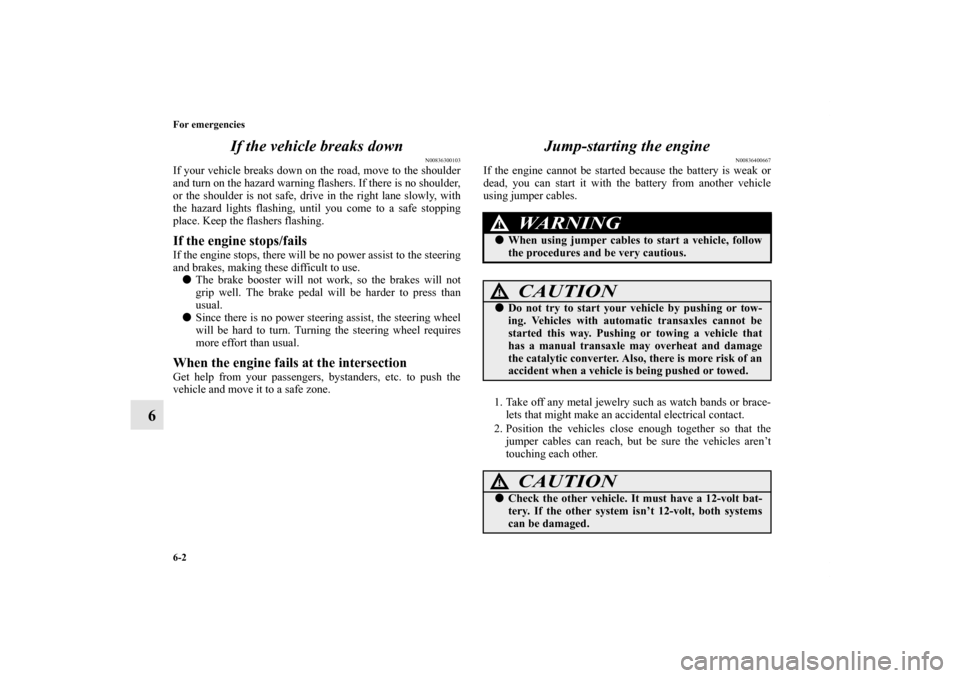
sengers leave the vehicle.5. To prevent the vehicle from rolling when it is raised on the
jack, place chocks or blocks (A) at the tire that is diago-
nally opposite from the tire (B) you are changing.
WA R N I N G
!�Be sure to apply chocks or blocks to the correct tire
when jacking up the vehicle. If the vehicle moves
while jacked up, the jack could slip out of position,
leading to an accident.
BK0102600US.book 12 ページ 2009年3月30日 月曜日 午後2時2分
Page 413 of 514
6-14 For emergencies
6
Compact spare tire
(if so equipped)
The compact spare tire is designed to save space in the luggage
compartment. Its lighter weight makes it easier to use if a flat
tire occurs.
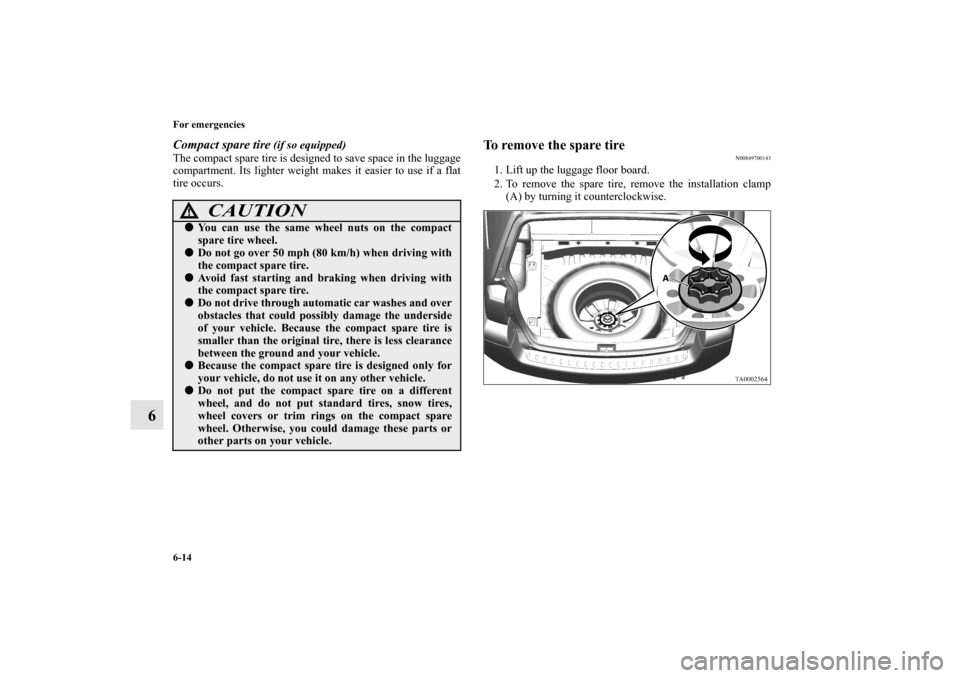
To remove the spare tire
N00849700143
1. Lift up the luggage floor board.
2. To remove the spare tire, remove the installation clamp
(A) by turning it counterclockwise.
CAUTION
!�You can use the same wheel nuts on the compact
spare tire wheel.�Do not go over 50 mph (80 km/h) when driving with
the compact spare tire.�Avoid fast starting and braking when driving with
the compact spare tire. �Do not drive through automatic car washes and over
obstacles that could possibly damage the underside
of your vehicle. Because the compact spare tire is
smaller than the original tire, there is less clearance
between the ground and your vehicle. �Because the compact spare tire is designed only for
your vehicle, do not use it on any other vehicle. �Do not put the compact spare tire on a different
wheel, and do not put standard tires, snow tires,
wheel covers or trim rings on the compact spare
wheel. Otherwise, you could damage these parts or
other parts on your vehicle.
BK0102600US.book 14 ページ 2009年3月30日 月曜日 午後2時2分
Page 416 of 514
For emergencies
6-17
6
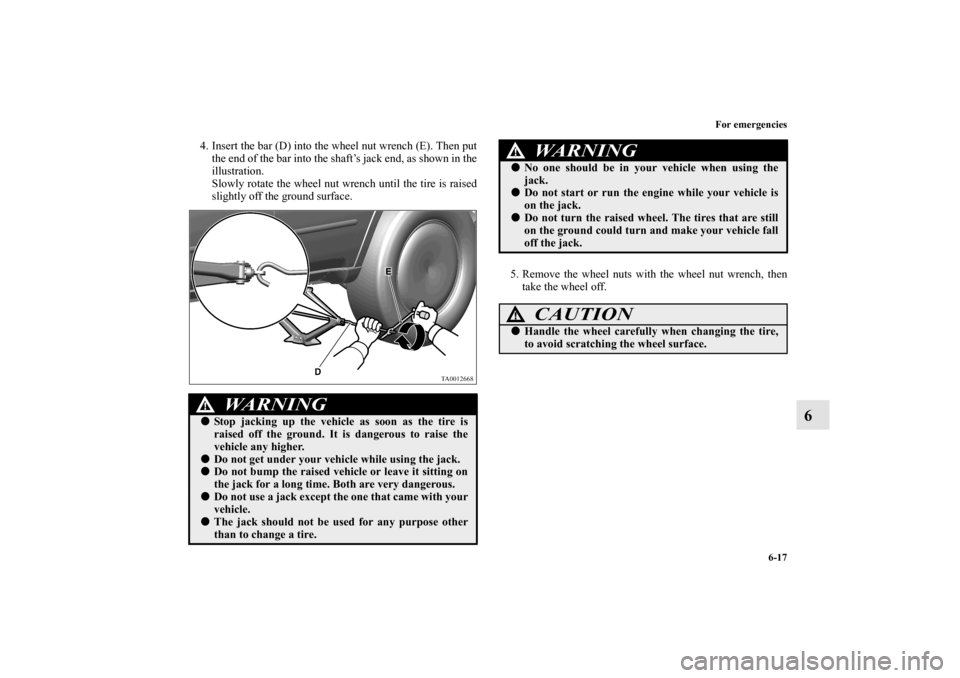
4. Insert the bar (D) into the wheel nut wrench (E). Then put
the end of the bar into the shaft’s jack end, as shown in the
illustration.
Slowly rotate the wheel nut wrench until the tire is raised
slightly off the ground surface.
5. Remove the wheel nuts with the wheel nut wrench, then
take the wheel off.
WA R N I N G
!�Stop jacking up the vehicle as soon as the tire is
raised off the ground. It is dangerous to raise the
vehicle any higher. �Do not get under your vehicle while using the jack. �Do not bump the raised vehicle or leave it sitting on
the jack for a long time. Both are very dangerous. �Do not use a jack except the one that came with your
vehicle. �The jack should not be used for any purpose other
than to change a tire.
�No one should be in your vehicle when using the
jack. �Do not start or run the engine while your vehicle is
on the jack.�Do not turn the raised wheel. The tires that are still
on the ground could turn and make your vehicle fall
off the jack.
CAUTION
!�Handle the wheel carefully when changing the tire,
to avoid scratching the wheel surface.
WA R N I N G
!
BK0102600US.book 17 ページ 2009年3月30日 月曜日 午後2時2分