Page 163 of 371

Driving your vehicle
16
4
1
2
3
4
5
6
7
8
9
If you need to drive in water, stop
your vehicle, set your transfer to
“4WD LOCK” and drive at less than
8 km/h (5 mph).
✽ ✽
NOTICE
• Do not drive in water if the level is
higher than the bottom of the vehi-
cle.
• Check your brake condition once you are out of mud or water. Press
the brake pedal several times as
you move slowly until you feel nor-
mal braking forces return.
• Shorten your scheduled mainte- nance interval if you drive in off-
road conditions such as sand, mud
or water (see “Maintenance
Schedule” in the Index). Always
wash you car thoroughly after off
road use, especially cleaning the
under side of the vehicle.
• Since the driving torque is always applied to the 4 wheels the perfor-
mance of the 4WD vehicle is great-
ly affected by the condition of the
tires. Be sure to equip the vehicle
with four tires of the same size and
type.
• A full time four wheel drive vehi- cle cannot be towed by an ordi-
nary tow truck. Make sure that
the vehicle is placed on a flat bed
truck for moving.WARNING - Wind danger
If you are driving in heavy wind,
the vehicle's higher center of
gravity decreases your steering
control capacity and requires
you to drive more slowly.WARNING - Driving
through water
Drive slowly. If you are driving
too fast in water, the water spray
can get into the engine com-
partment and wet the ignition
system, causing your vehicle to
suddenly stall. If this happens
and your vehicle is in a tilted
position, your vehicle may roll
over.
Page 169 of 371
Driving your vehicle
22
4
1
2
3
4
5
6
7
8
9
Anti-lock brake system (ABS)
(if equipped)The ABS system continuously sens-
es the speed of the wheels. If the
wheels are going to lock, the ABS
system repeatedly modulates the
hydraulic brake pressure to the
wheels.
When you apply your brakes under
conditions which may lock the
wheels, you may hear a “tik-tik’’
sound from the brakes, or feel a cor-
responding sensation in the brake
pedal. This is normal and it means
your ABS system is active.
In order to obtain the maximum ben-
efit from your ABS system in an
emergency situation, do not attempt
to modulate your brake pressure and
do not try to pump your brakes.
Press your brake pedal as hard as
possible or as hard as the situation
warrants and allow the ABS system
to control the force being delivered to
the brakes. Even with the anti-lock brake sys-
tem, your vehicle still requires suf-
ficient stopping distance. Always
maintain a safe distance from the
vehicle in front of you.
Always slow down when cornering. The anti-lock brake system cannot
prevent accidents resulting from
excessive speeds.
On loose or uneven road surfaces, operation of the anti-lock brake
system may result in a longer stop-
ping distance than for vehicles
equipped with a conventional
brake system.
WARNING- ABS Brakes
Your ABS is not a substitute for
good driving judgement. You
can still have an accident. In
fact, your ABS system will not
be able to prevent an accident.
You must especially avoid:
Dangerous driving, such as neglecting safety precautions,
speeding, or driving too close
to the vehicle in front of you.
Driving at high speed in situa- tions providing considerably
less traction, such as wet con-
ditions where hydroplaning
could occur.
Driving too fast on poor road surfaces. The ABS is designed
to improve maximum braking
effectiveness on typical high-
ways and roads in good con-
dition. On poor road surfaces,
the ABS may actually reduce
braking effectiveness.
Page 195 of 371
Driving your vehicle
48
4
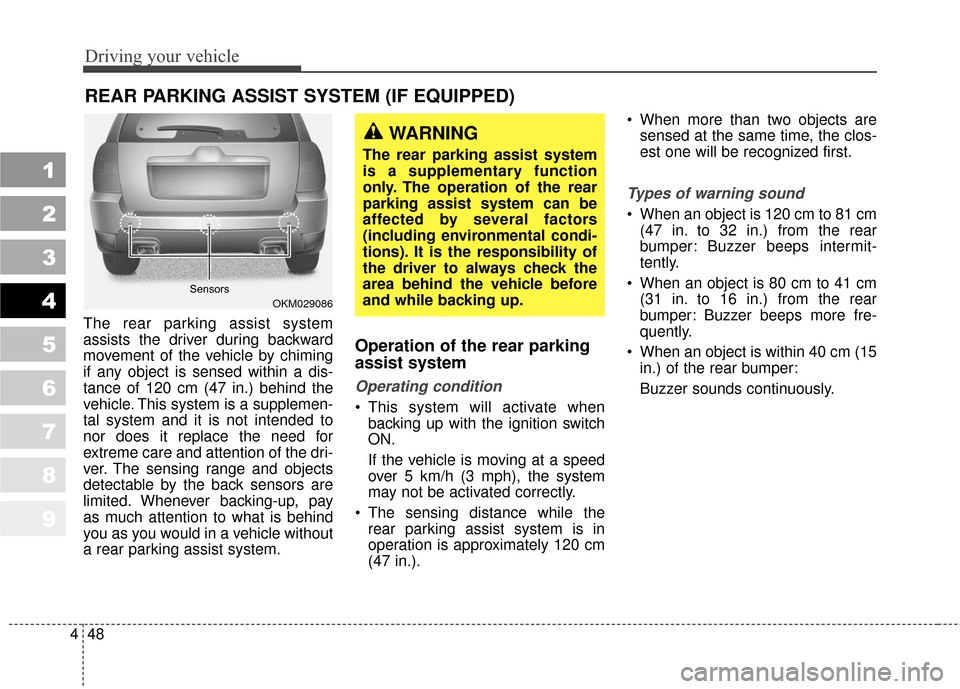
The rear parking assist system
assists the driver during backward
movement of the vehicle by chiming
if any object is sensed within a dis-
tance of 120 cm (47 in.) behind the
vehicle. This system is a supplemen-
tal system and it is not intended to
nor does it replace the need for
extreme care and attention of the dri-
ver. The sensing range and objects
detectable by the back sensors are
limited. Whenever backing-up, pay
as much attention to what is behind
you as you would in a vehicle without
a rear parking assist system.
Operation of the rear parking
assist system
Operating condition
This system will activate when
backing up with the ignition switch
ON.
If the vehicle is moving at a speed
over 5 km/h (3 mph), the system
may not be activated correctly.
The sensing distance while the rear parking assist system is in
operation is approximately 120 cm
(47 in.). When more than two objects are
sensed at the same time, the clos-
est one will be recognized first.
Types of warning sound
When an object is 120 cm to 81 cm(47 in. to 32 in.) from the rear
bumper: Buzzer beeps intermit-
tently.
When an object is 80 cm to 41 cm (31 in. to 16 in.) from the rear
bumper: Buzzer beeps more fre-
quently.
When an object is within 40 cm (15 in.) of the rear bumper:
Buzzer sounds continuously.
REAR PARKING ASSIST SYSTEM (IF EQUIPPED)
1
2
3
4
5
6
7
8
9
OKM029086
WARNING
The rear parking assist system
is a supplementary function
only. The operation of the rear
parking assist system can be
affected by several factors
(including environmental condi-
tions). It is the responsibility of
the driver to always check the
area behind the vehicle before
and while backing up.
Sensors
Page 197 of 371
Driving your vehicle
50
4
✽
✽
NOTICE
This system can only sense objects
within the range and location of the
sensors; It can not detect objects in
other areas where sensors are not
installed. Also, small or slim objects,
such as poles or objects located
between sensors may not be detected
by the sensors.
Always visually check behind the
vehicle when backing up.
Be sure to inform any drivers of the
vehicle that may be unfamiliar with
the system regarding the systems
capabilities and limitations.
✽ ✽NOTICE
If the trailer or towing bar is
installed in your vehicle, the rear
parking assist system could sound
continuously when you back up.
Self-diagnosis
If you don’t hear an audible warning
sound or if the buzzer sounds inter-
mittently when shifting the gear to
the R (Reverse) position, this may
indicate a malfunction in the rear
parking assist system. If this occurs,
have your vehicle checked by an
authorized Kia dealer as soon as
possible.
1
2
3
4
5
6
7
8
9
WARNING
Pay close attention when the
vehicle is driven close to
objects on the road, particularly
pedestrians, and especially chil-
dren. Be aware that some
objects may not be detected by
the sensors, due to the object’s
distance, size or material, all of
which can limit the effective-
ness of the sensor. Always per-
form a visual inspection to
make sure the vehicle is clear of
all obstructions before moving
the vehicle in any direction.
WARNING
Your new vehicle warranty does
not cover any accidents or dam-
age to the vehicle or injuries to
its occupants due to a rear park-
ing assist system malfunction.
Always drive safely and cau-
tiously.
Page 204 of 371
457
Driving your vehicle
1
2
3
4
5
6
7
8
9
✽ ✽
NOTICE
When in operation, the fog lights
consume large amounts of vehicle
electrical power. Only use the fog
lights when visibility is poor.
Unnecessary battery and generator
drain could occur if the fog lights
are used excessively.
Daytime running light
(if equipped)
Daytime Running Lights (DRL) can
make it easier for others to see the
front of your vehicle during the day.
DRL can be helpful in many different
driving conditions, and it is especial-
ly helpful after dawn and before sun-
set.
The DRL system will make your
high-beam headlights turn OFF
when:
1. The head light switch is ON.
2. The parking brake engaged.
3. Engine stops.
Page 228 of 371
481
Driving your vehicle
1
2
3
4
5
6
7
8
9
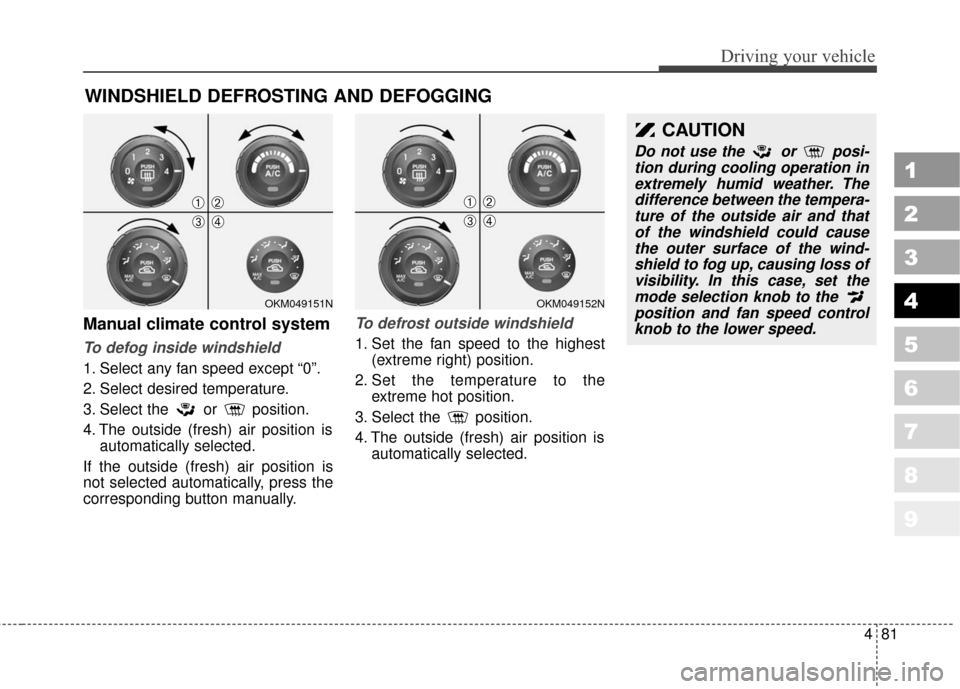
Manual climate control system
To defog inside windshield
1. Select any fan speed except “0”.
2. Select desired temperature.
3. Select the or position.
4. The outside (fresh) air position isautomatically selected.
If the outside (fresh) air position is
not selected automatically, press the
corresponding button manually.
To defrost outside windshield
1. Set the fan speed to the highest (extreme right) position.
2. Set the temperature to the extreme hot position.
3. Select the position.
4. The outside (fresh) air position is automatically selected.
WINDSHIELD DEFROSTING AND DEFOGGING
CAUTION
Do not use the or posi-tion during cooling operation inextremely humid weather. Thedifference between the tempera-ture of the outside air and thatof the windshield could causethe outer surface of the wind-shield to fog up, causing loss ofvisibility. In this case, set themode selection knob to the position and fan speed controlknob to the lower speed.
OKM049151NOKM049152N
➀➁
➂➃
➀➁
➂➃
Page 229 of 371
Driving your vehicle
82
4
1
2
3
4
5
6
7
8
9
Automatic climate control
system
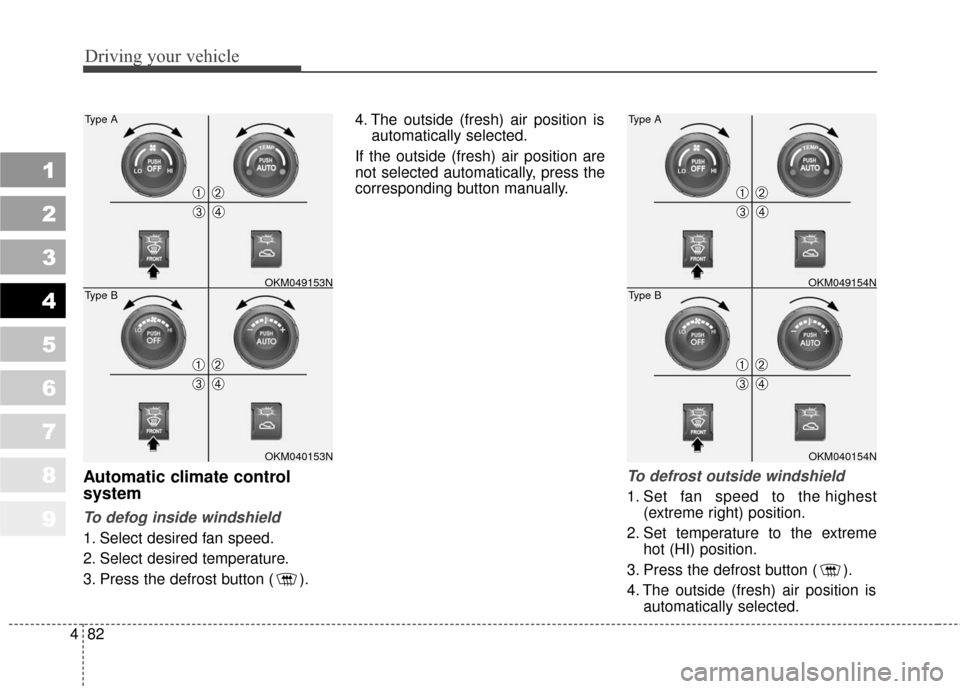
To defog inside windshield
1. Select desired fan speed.
2. Select desired temperature.
3. Press the defrost button ( ). 4. The outside (fresh) air position is
automatically selected.
If the outside (fresh) air position are
not selected automatically, press the
corresponding button manually.
To defrost outside windshield
1. Set fan speed to the highest (extreme right) position.
2. Set temperature to the extreme hot (HI) position.
3. Press the defrost button ( ).
4. The outside (fresh) air position is automatically selected.
OKM049153N
Type A
OKM040153N
Type B
➀➁
➂➃
➀➁
➂➃
OKM049154N
Type A
OKM040154N
Type B
➀➁
➂➃
➀➁
➂➃
Page 241 of 371
59
Driving tips
1
2
3
4
5
6
7
8
9
Driving at night
Because night driving presents more
hazards than driving in the daylight,
here are some important tips to
remember:
Slow down and keep more dis-tance between you and other vehi-
cles, as it may be more difficult to
see at night, especially in areas
where there may not be any street
lights.
Adjust your mirrors to reduce the glare from other driver's head-
lights. Keep your headlights clean and
properly aimed on vehicles not
equipped with the automatic head-
light aiming feature. Dirty or
improperly aimed headlights will
make it much more difficult to see
at night.
Avoid staring directly at the head- lights of oncoming vehicles. You
could be temporarily blinded, and it
will take several seconds for your
eyes to readjust to the darkness.WARNING- Spinning tires
Do not spin the wheels, espe-
cially at speeds more than 56
km/h (35 mph). Spinning the
wheels at high speeds when the
vehicle is stationary could
cause a tire to overheat, explode
and injure bystanders.