Page 422 of 3039
204-269
Flange remover forcing screw
204-305
Remover, Wheel Bearing
204-725
Support Tool, Wheel Hub
204-726
Remover/Installer, Wheel Bearing
204-727A
Installer, Wheel Bearing
Page 423 of 3039
205-491
Hub puller
205-491-1
Adapter nuts Removal
1. WARNING: Make sure to support the vehicle with axle stands.
Raise and support the vehicle.
2. Refer to: Wheel and Tire (204-04 Wheels and Tires, Removal and Installation).
3.
Page 425 of 3039
7.
8.
9.
10.
CAUTION: Do not use a hammer to detach the
halfshaft from the hub assembly, failure to follow this
instruction may result in damage to the halfshaft.
Special Tool(s): 205-491, 205-491-1, 204-269
NOTE: Use an additional wrench to prevent the
component from rotating.
Page 427 of 3039
Installation 14. Special Tool(s): 204-726
1. NOTES:
Make sure bearing is installed in correct direction,
encoder ring incorporated into the inboard seal of the wheel
bearing.
Make sure correct alignment of the bearing is
maintained when installing into the hub carrier.
Special Tool(s): 204-727A, 204-791
Page 428 of 3039
2.
3. NOTE: Make sure the correct alignment of the drive
flange is maintained when installing into the hub carrier
and bearing assembly.
Special Tool(s): 204-726, 204-250
4. CAUTION: The final tightening of the suspension
components must be carried out with the vehicle on its
wheels.
Torque: 90 Nm
5. CAUTION: Install the halfshaft nut finger tight.
NOTE: The wheel hub nut is not tightened at this
stage.
Page 478 of 3039
Wheels and Tires - Wheel and Tire
Removal and Installation
Removal
NOTE: Removal steps in this procedure may contain installation details. Published: 11-May-2011
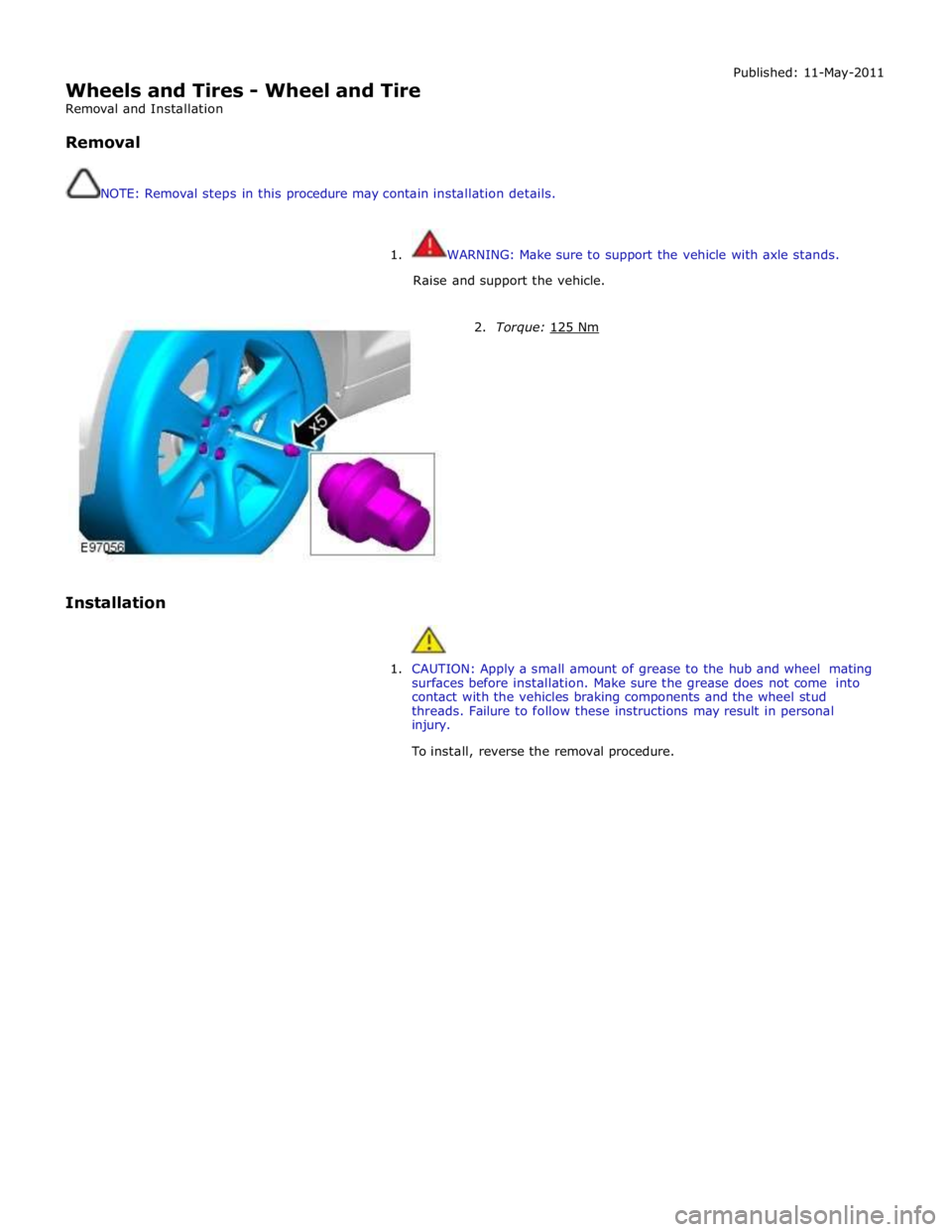
1. WARNING: Make sure to support the vehicle with axle stands.
Raise and support the vehicle.
Installation
2. Torque: 125 Nm
1. CAUTION: Apply a small amount of grease to the hub and wheel mating
surfaces before installation. Make sure the grease does not come into
contact with the vehicles braking components and the wheel stud
threads. Failure to follow these instructions may result in personal
injury.
To install, reverse the removal procedure.
Page 499 of 3039

Driveline System - General Information - Driveline System
Diagnosis and Testing
Principle of Operation Published: 11-May-2011
For a detailed description of driveline operation, refer to the relevant Description and Operation section in the workshop
manual. REFER to:
Driveshaft (205-01 Driveshaft, Description and Operation), Driveshaft (205-01 Driveshaft, Description and Operation), Driveshaft (205-01 Driveshaft, Description and Operation), Rear Drive Axle and Differential (205-02, Description and Operation),
Rear Drive Axle and Differential (205-02, Description and Operation),
Rear Drive Axle and Differential (205-02, Description and Operation),
Rear Drive Halfshafts (205-05 Rear Drive Halfshafts, Description and Operation), Rear Drive Halfshafts (205-05 Rear Drive Halfshafts, Description and Operation), Rear Drive Halfshafts (205-05 Rear Drive Halfshafts, Description and Operation).
Inspection and Verification
CAUTION: Only serviceable items can be renewed or adjusted. Failure to follow this instruction may result in the warranty
of the component being rejected.
Certain driveline trouble symptoms are also common to the engine, transmission, wheel bearings, tires, and other parts of the
vehicle. For this reason, make sure that the cause of the trouble is in the driveline before adjusting, repairing, or installing any
new components. For additional information, refer to Workshop Manual section 100-04 Noise, Vibration and Harshness.
1. Verify the customer concern by carrying out a road test of the vehicle.
2. Visually inspect for obvious signs of mechanical damage and system integrity.
3. If an obvious cause for an observed or reported concern is found, correct the cause (if possible) before proceeding to
the next step.
4. If the concern is not visually evident, verify the symptom and refer to the Symptom Chart.
Identify the Condition
Gear Howl and Whine
Howling or whining of the ring gear and pinion is due to an incorrect gear pattern, gear damage or incorrect bearing preload.
Bearing Whine
Bearing whine is a high-pitched sound similar to a whistle. It is usually caused by worn/damaged pinion bearings, which are
operating at driveshaft speed. Bearing noise occurs at all driving speeds. This distinguishes it from gear whine which is speed
dependent.
As noted, pinion bearings make a high-pitched, whistling noise, usually at all speeds. If however there is only one pinion
bearing that is worn/damaged, the noise may vary in different driving phases.
A wheel bearing noise can be mistaken for a pinion bearing noise.
Chuckle
Chuckle that occurs on the coast driving phase is usually caused by excessive clearance between the differential gear hub and
the differential case bore. www.JagDocs.com
Page 563 of 3039
Published: 11-May-2011
Rear Drive Halfshafts - Rear Drive Halfshafts - System Operation and
Component Description
Description and Operation
System Operation
Rear Drive Halfshafts Component Description
The solid-steel halfshafts are of unequal length, with each halfshaft comprising inner and outer CV (constant velocity) joints.
The CV joints are the 'ball and socket' type packed with grease and protected by gaiters.
The outer CV joint is an interference fit into the wheel hub and secured by a locking nut. The inner CV joint is a slide fit and is
retained in the differential with a spring clip.
www.JagDocs.com