2010 JAGUAR XFR suspension system
[x] Cancel search: suspension systemPage 117 of 3039
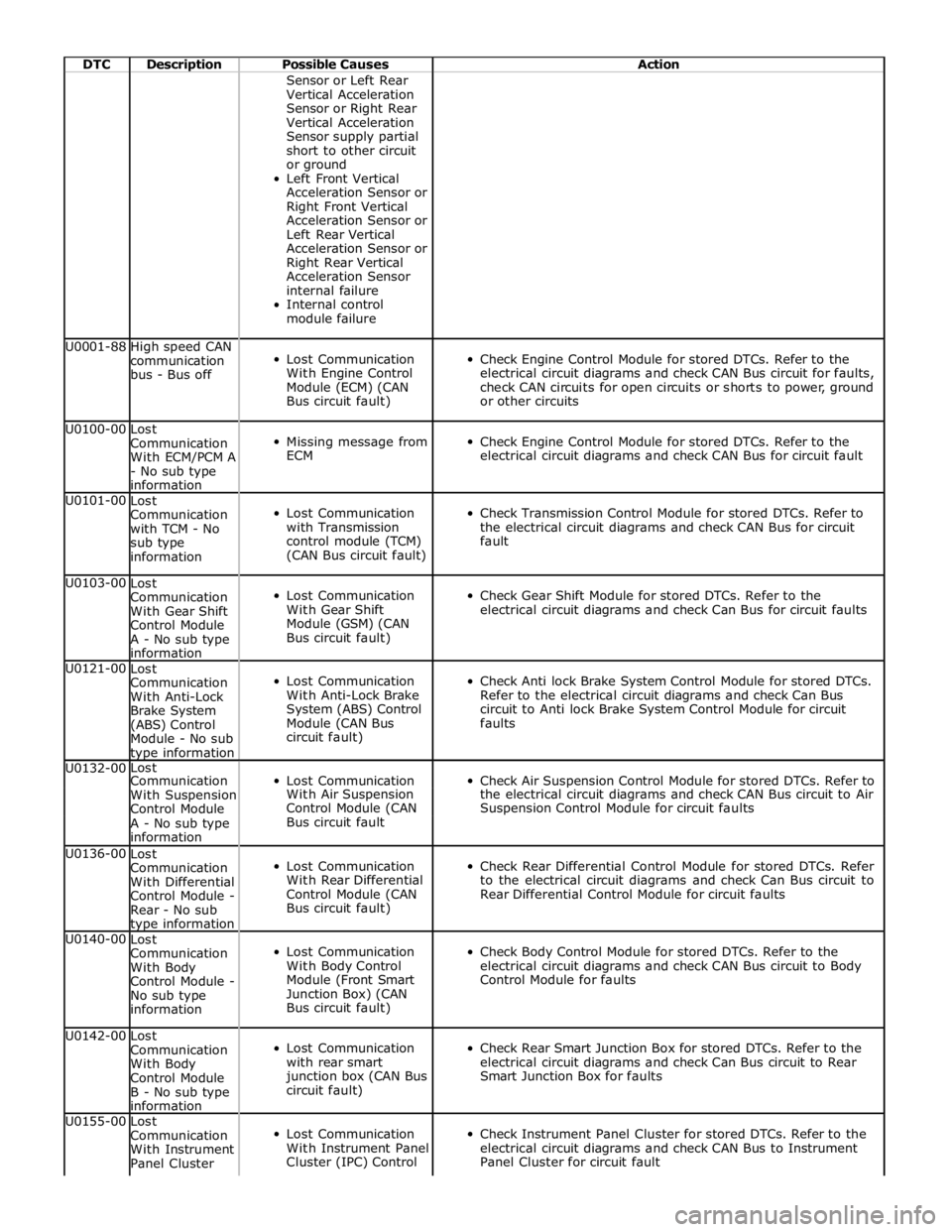
DTC Description Possible Causes Action Sensor or Left Rear
Vertical Acceleration
Sensor or Right Rear
Vertical Acceleration
Sensor supply partial
short to other circuit
or ground
Left Front Vertical
Acceleration Sensor or
Right Front Vertical
Acceleration Sensor or
Left Rear Vertical
Acceleration Sensor or
Right Rear Vertical
Acceleration Sensor
internal failure
Internal control
module failure U0001-88
High speed CAN
communication
bus - Bus off
Lost Communication
With Engine Control
Module (ECM) (CAN
Bus circuit fault)
Check Engine Control Module for stored DTCs. Refer to the
electrical circuit diagrams and check CAN Bus circuit for faults,
check CAN circuits for open circuits or shorts to power, ground
or other circuits U0100-00
Lost
Communication
With ECM/PCM A
- No sub type
information
Missing message from
ECM
Check Engine Control Module for stored DTCs. Refer to the
electrical circuit diagrams and check CAN Bus for circuit fault U0101-00
Lost
Communication
with TCM - No
sub type
information
Lost Communication
with Transmission
control module (TCM)
(CAN Bus circuit fault)
Check Transmission Control Module for stored DTCs. Refer to
the electrical circuit diagrams and check CAN Bus for circuit
fault U0103-00
Lost
Communication
With Gear Shift
Control Module
A - No sub type
information
Lost Communication
With Gear Shift
Module (GSM) (CAN
Bus circuit fault)
Check Gear Shift Module for stored DTCs. Refer to the
electrical circuit diagrams and check Can Bus for circuit faults U0121-00
Lost
Communication
With Anti-Lock
Brake System
(ABS) Control
Module - No sub type information
Lost Communication
With Anti-Lock Brake
System (ABS) Control
Module (CAN Bus
circuit fault)
Check Anti lock Brake System Control Module for stored DTCs.
Refer to the electrical circuit diagrams and check Can Bus
circuit to Anti lock Brake System Control Module for circuit
faults U0132-00 Lost
Lost Communication
Check Air Suspension Control Module for stored DTCs. Refer to Communication With Suspension With Air Suspension the electrical circuit diagrams and check CAN Bus circuit to Air Control Module Control Module (CAN Suspension Control Module for circuit faults A - No sub type Bus circuit fault information U0136-00
Lost
Communication
With Differential
Control Module -
Rear - No sub type information
Lost Communication
With Rear Differential
Control Module (CAN
Bus circuit fault)
Check Rear Differential Control Module for stored DTCs. Refer
to the electrical circuit diagrams and check Can Bus circuit to
Rear Differential Control Module for circuit faults U0140-00
Lost
Communication
With Body
Control Module -
No sub type
information
Lost Communication
With Body Control
Module (Front Smart
Junction Box) (CAN
Bus circuit fault)
Check Body Control Module for stored DTCs. Refer to the
electrical circuit diagrams and check CAN Bus circuit to Body
Control Module for faults U0142-00
Lost
Communication
With Body
Control Module
B - No sub type
information
Lost Communication
with rear smart
junction box (CAN Bus
circuit fault)
Check Rear Smart Junction Box for stored DTCs. Refer to the
electrical circuit diagrams and check Can Bus circuit to Rear
Smart Junction Box for faults U0155-00
Lost
Communication
With Instrument
Panel Cluster
Lost Communication
With Instrument Panel
Cluster (IPC) Control
Check Instrument Panel Cluster for stored DTCs. Refer to the
electrical circuit diagrams and check CAN Bus to Instrument
Panel Cluster for circuit fault
Page 118 of 3039
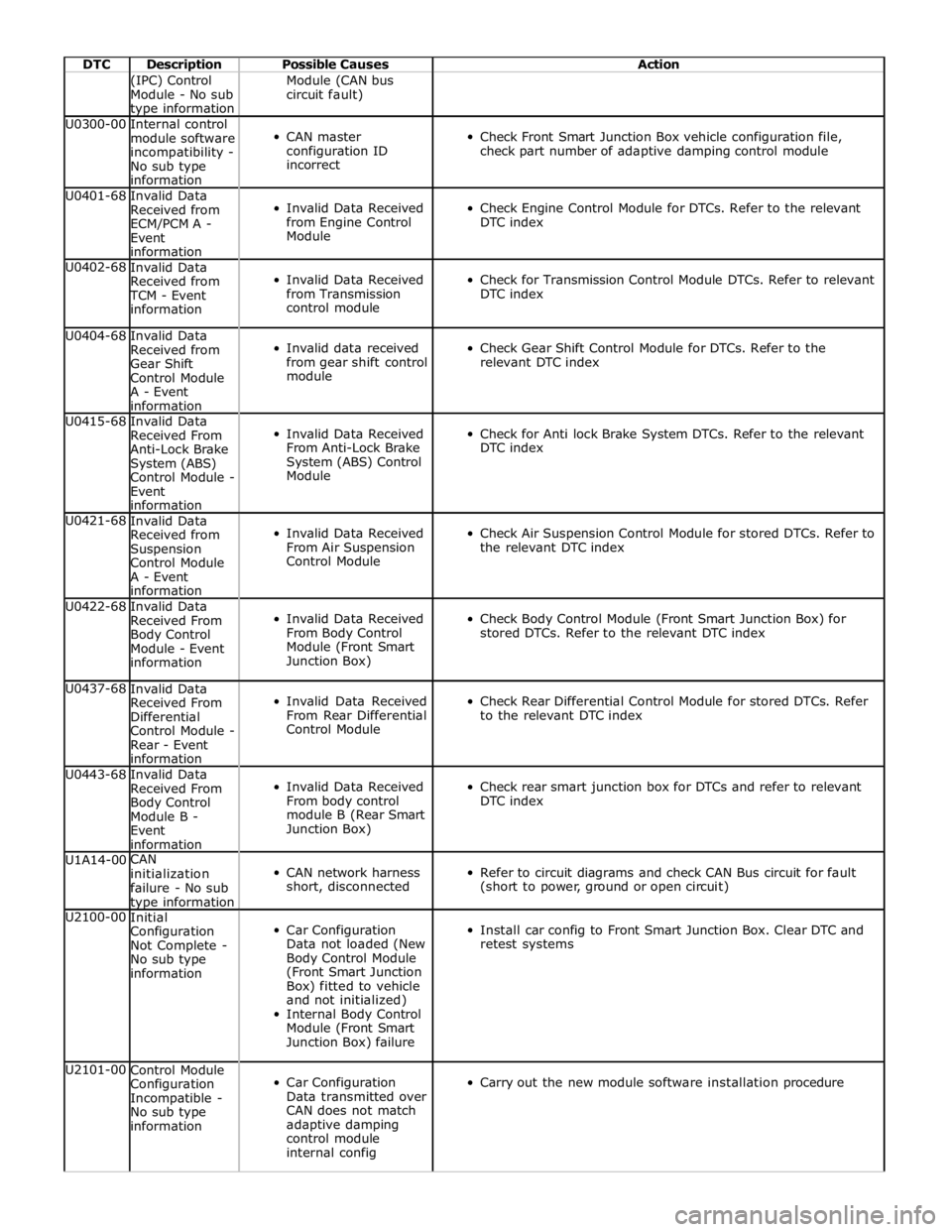
DTC Description Possible Causes Action (IPC) Control
Module - No sub
type information Module (CAN bus
circuit fault) U0300-00
Internal control
module software
incompatibility -
No sub type
information
CAN master
configuration ID
incorrect
Check Front Smart Junction Box vehicle configuration file,
check part number of adaptive damping control module U0401-68
Invalid Data
Received from
ECM/PCM A -
Event
information
Invalid Data Received
from Engine Control
Module
Check Engine Control Module for DTCs. Refer to the relevant
DTC index U0402-68
Invalid Data
Received from TCM - Event
information
Invalid Data Received
from Transmission
control module
Check for Transmission Control Module DTCs. Refer to relevant
DTC index U0404-68
Invalid Data
Received from
Gear Shift
Control Module
A - Event
information
Invalid data received
from gear shift control
module
Check Gear Shift Control Module for DTCs. Refer to the
relevant DTC index U0415-68
Invalid Data
Received From
Anti-Lock Brake
System (ABS)
Control Module -
Event
information
Invalid Data Received
From Anti-Lock Brake
System (ABS) Control
Module
Check for Anti lock Brake System DTCs. Refer to the relevant
DTC index U0421-68
Invalid Data
Received from
Suspension
Control Module
A - Event
information
Invalid Data Received
From Air Suspension
Control Module
Check Air Suspension Control Module for stored DTCs. Refer to
the relevant DTC index U0422-68
Invalid Data
Received From
Body Control
Module - Event
information
Invalid Data Received
From Body Control
Module (Front Smart
Junction Box)
Check Body Control Module (Front Smart Junction Box) for
stored DTCs. Refer to the relevant DTC index U0437-68
Invalid Data
Received From
Differential
Control Module -
Rear - Event
information
Invalid Data Received
From Rear Differential
Control Module
Check Rear Differential Control Module for stored DTCs. Refer
to the relevant DTC index U0443-68
Invalid Data
Received From
Body Control
Module B -
Event
information
Invalid Data Received
From body control
module B (Rear Smart
Junction Box)
Check rear smart junction box for DTCs and refer to relevant
DTC index U1A14-00 CAN
initialization
failure - No sub type information
CAN network harness
short, disconnected
Refer to circuit diagrams and check CAN Bus circuit for fault
(short to power, ground or open circuit) U2100-00
Initial
Configuration
Not Complete -
No sub type
information
Car Configuration
Data not loaded (New
Body Control Module
(Front Smart Junction
Box) fitted to vehicle
and not initialized)
Internal Body Control
Module (Front Smart
Junction Box) failure
Install car config to Front Smart Junction Box. Clear DTC and
retest systems U2101-00
Control Module
Configuration
Incompatible -
No sub type
information
Car Configuration
Data transmitted over
CAN does not match
adaptive damping
control module
internal config
Carry out the new module software installation procedure
Page 240 of 3039

DTC Description Possible Causes Action U0300-00
Internal Control Module
Software
Incompatibility - No
sub type information
Invalid configuration
message is received
Re-configure the speed control module using the
manufacturer approved diagnostic system. Clear
DTCs and re-test. If DTC still logged, suspect
incorrect speed control module installed. Check and
install a new module as required, refer to new
module/component installation note at top of DTC
Index U0300-55
Internal Control Module
Software
Incompatibility - Not
configured
RJB - at least one of the
car configuration
parameters is not
configured
Re-configure the RJB using the manufacturer
approved diagnostic system U0401-00
Invalid Data Received
From ECM/PCM A - No
sub type information
ECM did not respond
properly to speed control
cancel or auto brake
cancel request
Check ECM for related DTCs and refer to relevant
DTC Index U0401-67
Invalid Data Received
From ECM/PCM A -
Signal incorrect after
event
ECM did not respond
properly to speed control
resume request
Check ECM for related DTCs and refer to relevant
DTC Index U0401-81
Invalid Data Received
From ECM/PCM A -
Invalid serial data
received
Invalid data received
from engine control
module
Bus signal/message
failure
Speed control inhibited
by ECM
Check the Engine Control Module for related DTCs
and refer to relevant DTC Index. If U040181 is
logged as historic but no other DTCs have logged in
the engine control module at the same time and
distance, it may be caused by cranking with low
voltage conditions. Check battery and charging
system according to instructions in the battery care
manual. Install the latest Engine Control Module
software using the manufacturer approved diagnostic
system, contact Dealer Technical Support before
replacing components U0415-53
Invalid Data Received
From Anti-Lock Braking
System (ABS) Control
Module - De-activated
Event information
Deactivated
Check the Anti-Lock Braking System Module for
related DTCs and refer to the relevant DTC index U0415-81
Invalid Data Received
From Anti-lock Brake
System (ABS) Control
Module - Invalid serial
data received
Stability assist fault
Check ABS module for related DTCs and refer to
relevant DTC Index U0417-67
Invalid Data Received
From Park Brake
Control Module - Signal
incorrect after event
Parking brake module did
not respond properly to
apply request
Check parking brake module for related DTCs and
refer to relevant DTC Index U0417-81
Invalid Data Received
From Park Brake
Control Module -
Invalid serial data
received
Speed control inhibited
by parking brake module
Check parking brake module for related DTCs and
refer to relevant DTC Index U0418-68
Invalid Data Received
From Brake System
Control Module - Event
information
Event information
Check the Anti-Lock Braking System Module for
related DTCs and refer to the relevant DTC index U0421-81
Invalid Data Received
From Suspension
Control Module 'A' -
Invalid serial data
received
Invalid serial data
received
Check the Suspension Control Module for related
DTCs and refer to the relevant DTC index U0423-81
Invalid Data Received
From Instrument Panel
Control Module -
Invalid serial data
received
Speed control inhibited
by instrument cluster
Check instrument cluster, CJB and RJB for related
DTCs and refer to relevant DTC Index U1A00-88
Private Communication
Network - Bus off
Bus off
The module setting this code has disabled CAN
transmission. Check for other bus off codes. Check
the module and circuits. Refer to the electrical circuit
diagrams. Clear all DTCs and road test the vehicle. If
the concern reoccurs contact Dealer Technical
Page 302 of 3039

and drive half shaft failure, which could cause serious personal injury and extensive vehicle damage. Failure to follow these
instructions may result in personal injury.
CAUTION: The suspension should not be allowed to hang free. When the CV joint is run at a very high angle, extra
vibration as well as damage to the seals and joints can occur.
The rear suspension lower arm should be supported as far outboard as possible. To bring the vehicle to its correct ride height,
the full weight of the vehicle should be supported in the rear by floor jacks. REFER to: (100-02 Jacking and Lifting)
Jacking (Description and Operation), Lifting (Description and Operation).
1. Raise and support the vehicle. REFER to: (100-02 Jacking and Lifting)
Jacking (Description and Operation), Lifting (Description and Operation).
2. Explore the speed range of interest using the Road Test Quick Checks as previously described.
3. Carry out a coast down in neutral. If the vehicle is free of vibration when operating at a steady indicated speed and
behaves very differently in drive and coast, a transmission concern is likely.
Note, however, that a test on the lift may produce different vibrations and noises than a road test because of the effect of the
lift. It is not unusual to find vibrations on the lift that were not found in the road test. If the condition found on the road can
be duplicated on the lift, carrying out experiments on the lift may save a great deal of time.
Exhaust Neutralization Procedure
1. Raise vehicle on lift and slacken all exhaust fixings.
2. With all fixings loose, neutralize the exhaust system.
3. Tighten all fixings to correct torque, starting at the rear-most point working towards the front of the vehicle.
Symptom Chart
Symptom Possible Cause Action High-speed shake
Wheel end vibration
Engine/transmission
Driveline GO to Pinpoint Test A. Tip-in moan
Air cleaner
Power steering
Powertrain
Engine mounts
Exhaust system GO to Pinpoint Test B. Idle boom/shake/vibration, or shudder
Cable(s)/hoses(s)
Intake air distribution and filtering system
Engine mounts
Exhaust system
Belt/pulleys GO to Pinpoint Test C. Wheel end vibration analysis
Suspension/rear drive halfshaft and CV joints
Tires/wheels
Wheel bearings
CV joint boots GO to Pinpoint Test D. Non-axle noise
Trim/mouldings
A/C system
Accessories GO to Pinpoint Test E. Pinpoint Tests
NOTE: These Pinpoint Tests are designed to take the technician through a step-by-step diagnosis procedure to determine
the cause of a condition. It may not always be necessary to follow the chart to its conclusion. Carry out only the Pinpoint Test
steps necessary to correct the condition. Then check operation of the system to make sure the condition is corrected.
After verifying that the condition has been corrected, make sure all components removed have been installed.
PINPOINT TEST A : HIGH-SPEED SHAKE TEST DETAILS/RESULTS/ACTIONS www.JagDocs.com
Page 306 of 3039

Suspension System - General Information -
Vehicle Ride Height Published: 27-Aug-2013
NOTE: All figures are at "Kerb" height - For additional information, refer to Vehicle Ride Height below.
Description Measurement Description Front/Rear Kerb mm (inch) Tolerance mm (inch) Vehicles without supercharger Front 388 (15.28) ±12 (0.5) Rear 391 (15.39) ±12 (0.5) Vehicles with supercharger Front 385 (15.16) ±12 (0.5) Rear 384 (15.12) ±12 (0.5) Vehicles with All wheel drive Front 404 (15.90) ±12 (0.5) Rear 391 (15.39) ±12 (0.5)
Ride height is measured from the centre of the wheel to the apex of the wheel arch, through the wheel centre line.
Kerb - with all fluids at full and a full tank of fuel, no occupants/luggage.
Tires must be inflated to normal pressure -
For additional information, refer to: Specifications (204-04 Wheels and Tires, Specifications). Wheel Alignment - Front Camber
NOTE: *1 Camber Balance = left-hand camber - right-hand camber.
Description Left-hand Right-hand Balance*1 Markets Degrees/Minutes Nominal Tolerance Nominal Tolerance Nominal Tolerance All right-hand drive and Japan Degrees/Minutes -0° 36' ±45' -0° 12' ±45' -0° 24' ±45' Decimal Degrees -0.6° ±0.75° -0.2° ±0.75° -0.4° ±0.75° USA, Canada, Mexico and Dominican Republic
(Federal) Degrees/Minutes -0° 12' ±45' -0° 33' ±45' 0° 21' ±45' Decimal Degrees -0.2° ±0.75° -0.55° ±0.75° 0.35° ±0.75° Rest of world Degrees/Minutes -0° 12' ±45' -0° 24' ±45' 0° 12' ±45' Decimal Degrees -0.2° ±0.75° -0.4° ±0.75° 0.2° ±0.75° Vehicles with All wheel drive Degrees/Minutes -0° 11' ±45' -0º 32' ±0.45' 21' ±45' Decimal Degrees -0.19° ±0.75º -0.54º ±0.75º 0.35º ±0.75° Wheel Alignment - Front Caster
NOTE: *2 Caster Balance = left-hand caster - right-hand caster.
Description Left-hand Right-hand Balance*2 Markets Degrees/Minutes Nominal Tolerance Nominal Tolerance Nominal Tolerance All right-hand drive and Japan Degrees/Minutes 6° 53' ±45' 6° 20' ±45' 0° 33' ±45' Decimal Degrees 6.88° ±0.75° 6.33° ±0.75° 0.55° ±0.75° USA, Canada, Mexico and Dominican Republic
(Federal) Degrees/Minutes 6° 36' ±45' 6° 45' ±45' -0° 8' ±45' Decimal Degrees 6.61° ±0.75° 6.74° ±0.75° -0.14° ±0.75° Rest of world Degrees/Minutes 6° 36' ±45' 6° 36' ±45' 0° 0' ±45' Decimal Degrees 6.61° ±0.75° 6.61° ±0.75° 0° ±0.75° Vehicles with All wheel drive Degrees/Minutes 6° 2' ± 45' 6° 11' ± 45' - 9' ± 45' Decimal Degrees 6.04º ±0.75° 6.19° ± 0.75° -0.15° ± 0.75° Wheel Alignment - Front Toe
Description Total Toe Markets Degrees/Minutes Nominal Tolerance All right-hand drive and Japan Degrees/Minutes 0° 13' ±12' Decimal Degrees 0.22° ±0.20° USA, Canada, Mexico and Dominican Republic (Federal) Degrees/Minutes 0° 13' ±12' Decimal Degrees 0.22° ±0.20° Rest of world Degrees/Minutes 0° 13' ±12' Decimal Degrees 0.22° ±0.20° Vehicles with All wheel drive Degrees/Minutes 16' ± 12' Decimal Degrees 0.27° ± 0.20° Wheel Alignment - Rear Camber (Vehicles without supercharger)
Description Left-hand Right-hand Markets Degrees/Minutes Nominal Tolerance Nominal Tolerance All Markets Degrees/Minutes -0° 47' ±45' -0° 47' ±45' Decimal Degrees -0.78° ±0.75° -0.78° ±0.75° Wheel Alignment - Rear Camber (Vehicles with supercharger)
Description Left-hand Right-hand Markets Degrees/Minutes Nominal Tolerance Nominal Tolerance All Markets Degrees/Minutes -0° 59' ±45' -0° 59' ±45'
Page 308 of 3039

Front Suspension (204-01 Front Suspension, Description and Operation), Front Suspension (204-01 Front Suspension, Description and Operation), Rear Suspension (204-02 Rear Suspension, Description and Operation), Rear Suspension (204-02 Rear Suspension, Description and Operation), Rear Suspension (204-02 Rear Suspension, Description and Operation).
Inspection and Verification
1. Verify the customer concern by carrying out a road test on a smooth road. If any vibrations are apparent, refer to
section 100-04 Noise, Vibration and Harshness.
2. Visually inspect for obvious signs of damage and system integrity.
3. If an obvious cause for an observed or reported condition is found, correct the cause (if possible) before proceeding to
the next step.
4. If the fault is not visually evident, verify the symptom and refer to the following Symptom Chart.
Symptom Chart
Symptom Possible Sources Action Crabbing * Incorrect rear thrust angle. * Check the rear toe adjustment.
REFER to: Rear Toe Adjustment (204-00 Suspension System - General Information, General Procedures). * Front or rear suspension components.
* Inspect the front and rear suspension systems. Repair or
install new suspension components as necessary. * Drive axle damaged. * Install a new rear drive axle/differential.
REFER to: Axle Assembly - V6 3.0L Petrol (205-02 Rear Drive Axle/Differential, Removal and Installation). Drift/Pull * Unequal tire pressure.
* Check and adjust the tire pressures. Inspect the tire for
excessive wear.
REFER to: Specifications (204-04 Wheels and Tires, Specifications). * Incorrect wheel alignment.
* Check and adjust the wheel alignment. REFER to:
(204-00 Suspension System - General Information)
Front Toe Adjustment (General Procedures), Rear Toe Adjustment (General Procedures), Camber and Caster Adjustment (General Procedures). * Tires.
* Check and adjust the tire pressures. Inspect the tire for
excessive wear.
REFER to: Specifications (204-04 Wheels and Tires, Specifications). * Unevenly loaded or overloaded vehicle. * Notify the customer of incorrect vehicle loading. * Damaged steering components. * Check the steering system. * Brake drag. * Check the brakes.
REFER to: Brake System (206-00 Brake System - General Information, Diagnosis and Testing). Mechanical
Damaged tires
Wheel bearing(s)
Loose or damaged front or rear suspension components
Loose, damaged or missing suspension fastener(s)
Incorrect spring usage
Damaged or sagging spring(s)
Damaged or leaking shock absorber(s)
Damaged or leaking strut(s)
Worn or damaged suspension bushing(s)
Loose, worn or damaged steering system components
Damaged axle components Visual Inspection Chart
Page 309 of 3039

Removal and Installation),
Shock Absorber and Spring Assembly (204-02 Rear Suspension, Removal and Installation). Incorrect Tire Wear
* Incorrect tire pressure (rapid center rib
or inner and outer edge wear). * Check and adjust the tire pressure. Inspect the tire for
excessive wear.
REFER to: Specifications (204-04 Wheels and Tires, Specifications). * Excessive front or rear toe (rapid inner
or outer edge wear). * Check and adjust the wheel alignment. REFER to:
(204-00 Suspension System - General Information)
Front Toe Adjustment (General Procedures), Rear Toe Adjustment (General Procedures), Camber and Caster Adjustment (General Procedures). * Excessive negative or positive camber
(rapid inner or outer edge wear). * Check and adjust the wheel alignment. REFER to:
(204-00 Suspension System - General Information)
Front Toe Adjustment (General Procedures), Rear Toe Adjustment (General Procedures), Camber and Caster Adjustment (General Procedures). * Tires out of balance (tires cupped or dished). * Balance the tires. Rough ride * Spring(s)
* Check and install new spring(s) as necessary. REFER to:
Front Shock Absorber (204-01 Front Suspension, Removal and Installation),
Shock Absorber and Spring Assembly (204-02 Rear Suspension, Removal and Installation). Shimmy or Wheel Tramp * Loose wheel nut(s).
* Check and tighten the wheel nuts to specification.
REFER to: Specifications (204-04 Wheels and Tires, Specifications). * Loose front suspension fasteners.
* Check and tighten the suspension fasteners to
specification.
REFER to: Specifications (204-00 Suspension System - General Information, Specifications). * Front wheel bearing(s). * Check the wheel bearings. * Worn or damaged suspension component bushing. * Check and install new components as necessary. * Wheel/tires.
* Check the wheels/tires. Balance or install new
wheel/tires as necessary.
REFER to: Wheels and Tires (204-04 Wheels and Tires, Diagnosis and Testing). * Loose, worn or damaged ball joint(s). * Check the Ball Joint(s). * Loose, worn or damaged steering components. * Check and install new components as necessary. * Front wheel alignment.
* Check and adjust the wheel alignment. REFER to:
(204-00 Suspension System - General Information)
Front Toe Adjustment (General Procedures), Rear Toe Adjustment (General Procedures), Camber and Caster Adjustment (General Procedures). * Shock absorber(s). * Check and install new shock absorber(s) as necessary.
REFER to:
Front Shock Absorber (204-01 Front Suspension, Removal and Installation),
Shock Absorber and Spring Assembly (204-02 Rear Suspension, Removal and Installation). * Spring(s).
* Check and install new springs as necessary. REFER to:
Front Shock Absorber (204-01 Front Suspension, Removal and Installation),
Shock Absorber and Spring Assembly (204-02 Rear Suspension, Removal and Installation). Poor self center action of
the steering * Ball joints. * Check the Ball Joints. * Steering components. * Check and install new components as necessary. Steering wheel off-center * Unequal front or rear toe settings.
* Check and adjust the wheel alignment. REFER to:
(204-00 Suspension System - General Information)
Front Toe Adjustment (General Procedures), Rear Toe Adjustment (General Procedures), Camber and Caster Adjustment (General Procedures). * Steering components. * Check and install new components as necessary. Sway or roll
* Overloaded, unevenly or incorrectly
loaded vehicle. * Notify the customer of incorrect vehicle loading. * Loose wheel nut(s).
* Check and tighten the wheel nut(s) to specification.
REFER to: Specifications (204-04 Wheels and Tires, Specifications). * Coil spring(s).
* Check and install new coil springs as necessary. REFER
to:
Front Shock Absorber (204-01 Front Suspension, Removal and Installation),
Page 310 of 3039

Shock Absorber and Spring Assembly (204-02 Rear Suspension, Removal and Installation). * Loose front stabilizer bar or rear
stabilizer bar. * Check and tighten the stabilizer bar to specification.
REFER to:
Specifications (204-01 Front Suspension, Specifications), Specifications (204-02 Rear Suspension, Specifications). * Worn lower suspension arm stabilizer
bar insulators. * Install new lower suspension arm stabilizer bar as
necessary. REFER to:
Front Stabilizer Bar - 2.7L Diesel (204-01, Removal and
Installation),
Front Stabilizer Bar - V6 3.0L Petrol (204-01 Front Suspension, Removal and Installation),
Front Stabilizer Bar - 4.2L (204-01, Removal and
Installation),
Rear Stabilizer Bar (204-02 Rear Suspension, Removal and Installation). * Shock absorber(s). * Check and install new shock absorber(s) as necessary.
REFER to:
Front Shock Absorber (204-01 Front Suspension, Removal and Installation),
Shock Absorber and Spring Assembly (204-02 Rear Suspension, Removal and Installation). Vehicle Leans to One
Side * Unevenly loaded or overloaded vehicle. * Notify the customer of incorrect vehicle loading. * Front or rear suspension components.
* Inspect the front and rear suspension systems. Repair or
install new suspension components as necessary. * Shock absorber(s). * Check and install new shock absorber(s) as necessary.
REFER to:
Front Shock Absorber (204-01 Front Suspension, Removal and Installation),
Shock Absorber and Spring Assembly (204-02 Rear Suspension, Removal and Installation). * Coil spring(s).
* Check and install new spring(s) as necessary. REFER to:
Front Shock Absorber (204-01 Front Suspension, Removal and Installation),
Shock Absorber and Spring Assembly (204-02 Rear Suspension, Removal and Installation). * Incorrect ride height. Lateral tilt out of
specification. * Check the ride height. Install new spring(s) as
necessary. REFER to:
Front Shock Absorber (204-01 Front Suspension, Removal and Installation),
Shock Absorber and Spring Assembly (204-02 Rear Suspension, Removal and Installation). Vibration/Noise * Tires/wheels.
* Wheel bearings.
* Wheel hubs.
* Brake components.
* Suspension components.
* Steering components. * Check and install new components as necessary. Wander * Unevenly loaded or overloaded vehicle. * Notify the customer of incorrect vehicle loading. * Ball joint(s). * Check the Ball Joint(s). * Front wheel bearing(s). * Check the wheel bearings. * Loose, worn or damaged suspension components. * Check and install new suspension components as necessary. * Loose suspension fasteners.
* Check and tighten the suspension fasteners to
specification.
REFER to: Specifications (204-00 Suspension System - General Information, Specifications). * Steering components. * Check and install new steering components. * Wheel alignment (excessive total front
toe-out). * Check and adjust the wheel alignment. REFER to:
(204-00 Suspension System - General Information)
Front Toe Adjustment (General Procedures), Rear Toe Adjustment (General Procedures), Camber and Caster Adjustment (General Procedures). Component Tests
Ball Joint Inspection
NOTE: The front suspension is shown in the following procedures. The inspection of the rear suspension upper ball joint
is similar.
1. Raise and support the vehicle. REFER to: (100-02 Jacking and Lifting)
Jacking (Description and Operation), Lifting (Description and Operation).
2. Prior to carrying out any inspection of the ball joints, inspect the front wheel bearings.