2010 Hyundai Accent Battery
[x] Cancel search: BatteryPage 248 of 284

6 DO-IT-YOURSELF MAINTENANCE
22
!
CHECKING THE BATTERY
G210A01A-AAT
WARNING:
Batteries can be dangerous! When working with batteries, carefully ob-serve the following precautions to avoid serious injuries. The fluid in the battery contains a strong solution of sulfuric acid, which is poi- sonous and highly corrosive. Be careful not to spill it on yourself or the car. If youdo spill battery fluid on yourself, imme- diately do the following:
OMC055018
G200C01CM-GAT Power Connector
NOTE:
o If the power connector is pulled
up from the fuse panel, the warn- ing chime, audio, clock and inte- rior lamps, etc., will not operate. The following items must be resetafter replacement. - Digital Clock - Trip computer
- Automatic heating and cooling control system
- Audio
o Even though the power connector is pulled up, the battery can stillbe discharged by operation of theheadlights or other electrical de- vices.
Your vehicle is equipped with a power connector to prevent battery discharge if your vehicle is parked without being operated for prolonged periods. Use thefollowing procedures before parking the vehicle for prolonged periods.
1. Turn off the engine.
2. Turn off the headlights and tail lights.
3. Open the driver’s side panel cover
and pull up the power connector.
4. Insert the power connector in the
opposite direction.
G200F01MC
Page 249 of 284
6
DO-IT-YOURSELF MAINTENANCE
23
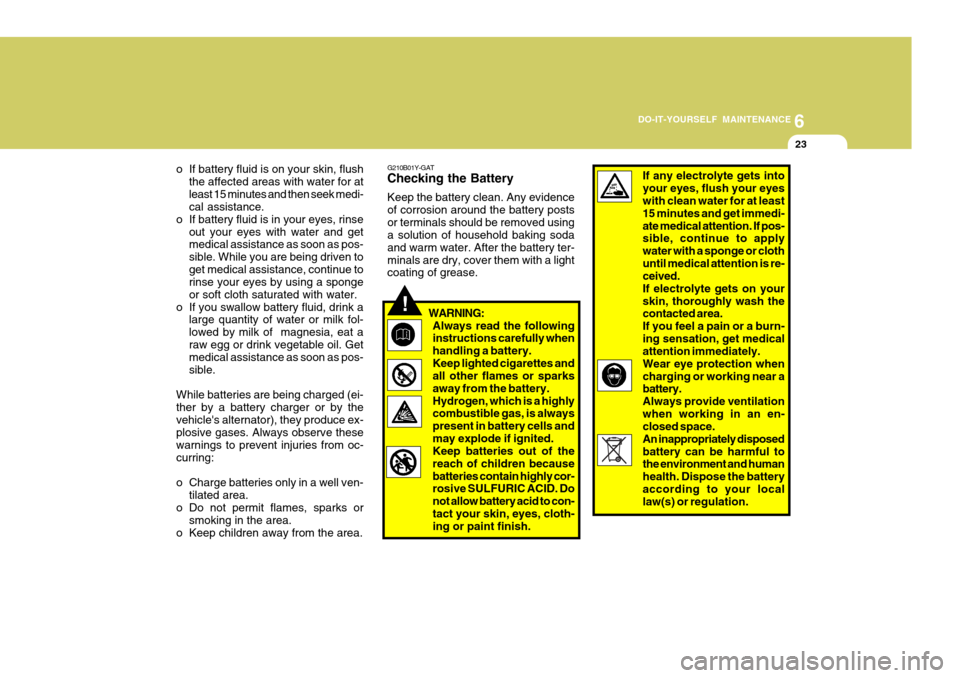
G210B01Y-GAT Checking the Battery Keep the battery clean. Any evidence of corrosion around the battery postsor terminals should be removed using a solution of household baking soda and warm water. After the battery ter-minals are dry, cover them with a light coating of grease.If any electrolyte gets into your eyes, flush your eyes with clean water for at least 15 minutes and get immedi-ate medical attention. If pos- sible, continue to apply water with a sponge or clothuntil medical attention is re- ceived. If electrolyte gets on yourskin, thoroughly wash the contacted area. If you feel a pain or a burn-ing sensation, get medical attention immediately. Wear eye protection whencharging or working near a battery. Always provide ventilationwhen working in an en- closed space. An inappropriately disposedbattery can be harmful to the environment and human health. Dispose the batteryaccording to your local law(s) or regulation.
WARNING:
Always read the following instructions carefully when handling a battery.Keep lighted cigarettes and all other flames or sparks away from the battery.Hydrogen, which is a highly combustible gas, is always present in battery cells andmay explode if ignited. Keep batteries out of the reach of children becausebatteries contain highly cor- rosive SULFURIC ACID. Do not allow battery acid to con-tact your skin, eyes, cloth- ing or paint finish.!
o If battery fluid is on your skin, flush the affected areas with water for at least 15 minutes and then seek medi- cal assistance.
o If battery fluid is in your eyes, rinse
out your eyes with water and getmedical assistance as soon as pos- sible. While you are being driven toget medical assistance, continue to rinse your eyes by using a sponge or soft cloth saturated with water.
o If you swallow battery fluid, drink a large quantity of water or milk fol-lowed by milk of magnesia, eat araw egg or drink vegetable oil. Get medical assistance as soon as pos- sible.
While batteries are being charged (ei-ther by a battery charger or by thevehicle's alternator), they produce ex- plosive gases. Always observe these warnings to prevent injuries from oc-curring:
o Charge batteries only in a well ven- tilated area.
o Do not permit flames, sparks or
smoking in the area.
o Keep children away from the area.
Page 250 of 284

6 DO-IT-YOURSELF MAINTENANCE
24
o When lifting a plastic-cased bat-
tery, excessive pressure on the case may cause battery acid to leak, resulting in personal injury.Lift with a battery carrier or with your hands on opposite corners.
o Never attempt to charge the bat-
tery when the battery cables areconnected.
o The electrical ignition system
works with high voltage.Never touch these components with the engine running or the ignition switched on.
CHECKING ELECTRIC COOLING FANS
!
G220B01A-AAT Checking Engine Cooling Fan The engine cooling fan should come on automatically if the engine coolant tem-perature is high. G220C01TB-GAT Checking Condenser Cooling Fan When the air conditioning is in opera- tion, the condenser cooling fan comeson automatically to be controlled by ECU.G220A01A-AAT
WARNING:
The cooling fan is controlled by en- gine coolant temperature and may sometimes operate even when the engine is not running. Use extremecaution when working near the blades of the cooling fan, so that you are not injured by a rotating fanblade. As the engine coolant temper- ature decreases the fan will automat- ically shut off. This is a normal con-dition.
POWER STEERING FLUID LEVEL
G230A01MC-GAT (If Installed) The power steering fluid level should be checked regularly. To check the power steering fluid level,be sure the ignition is "OFF", then check to make certain that the power steering fluid level is between the "MAX"and "MIN" level markings on the fluid reservoir. OMC055014
Page 254 of 284

6 DO-IT-YOURSELF MAINTENANCE
28
5. Remove the socket cover.
6. Push the bulb spring to remove theheadlight bulb.
7. Remove the protective cap from the replacement bulb and install the new bulb by matching the plastic basewith the headlight hole. Reattach the bulb spring and install the socket cover. Reconnect the power cord.
8. Use the protective cap and carton to dispose of the old bulb.
9.Check for proper headlight aim.
Headlight (Type A)
1. Allow the bulb to cool. Wear eye protection.
2. Open the engine hood and discon- nect the negative (-) post of the battery.
3. Always grasp the bulb by its plastic base, avoid touching the glass.
4. Disconnect the power cord from the back of the headlight.
OMC055022
CAUTION:
o The headlight aiming should be checked by an authorized Hyundai dealer after replacing the head- light bulbs.
o After heavy, driving rain or wash- ing, headlight and taillight lensescould appear frosty. This condi- tion is caused by the temperaturedifference between the lamp in- side and outside. This is similar to the condensa-tion on your windows inside your vehicle during the rain and doesn’t indicate a problem with your ve-hicle. If the water leaks into the lamp bulb circuitry, have the ve- hicle checked by an authorizedHyundai dealer.
!
Page 255 of 284

6
DO-IT-YOURSELF MAINTENANCE
29
Headlight (Type B)
1. Allow the bulb to cool. Wear eye protection.
2. Open the engine hood and discon- nect the negative (-) post of the battery.
3. Always grasp the bulb by its plastic base, avoid touching the glass.
4. Disconnect the power cord from the
back of the headlight.
5. Remove the socket cover by press-ing the tab and pulling up. 6. Push the bulb spring to remove the
headlight bulb.
7. Remove the protective cap from the
replacement bulb and install the new bulb by matching the plastic base with the headlight hole. Reattach the bulb spring.8. Reinstall the socket cover by press-ing the upper tab with the lower tab hooked.
9. Reconnect the power cord.
10. Use the protective cap and carton to
dispose of the old bulb.
11.Check for proper headlight aim.
G270A04MC-1
G270A05MC-1G270A02MC-1
G270A03MC-1
Page 256 of 284
6 DO-IT-YOURSELF MAINTENANCE
30
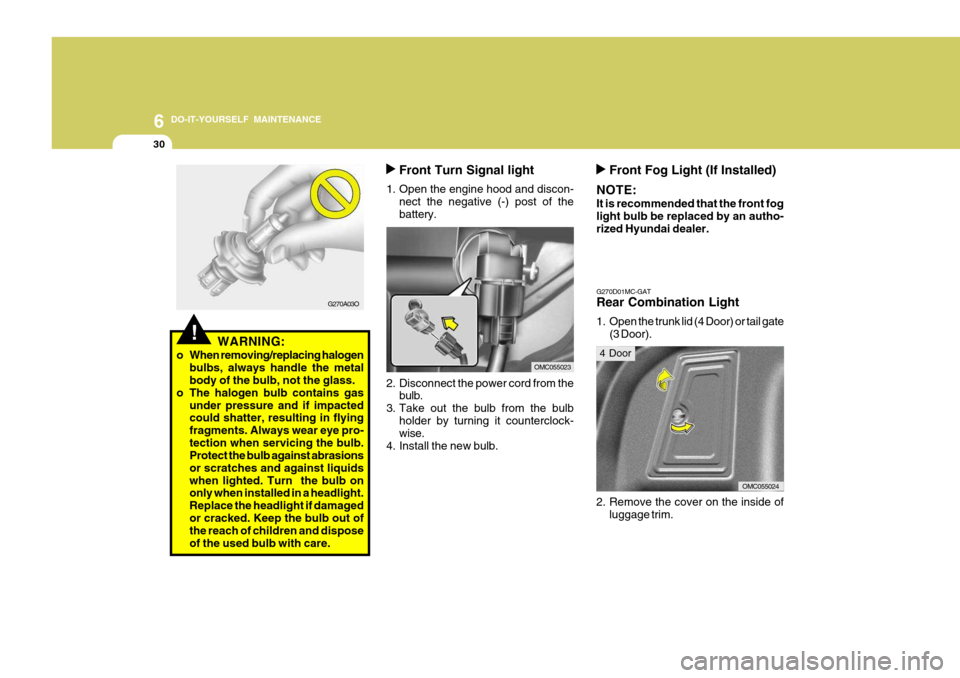
Front Turn Signal light
1. Open the engine hood and discon- nect the negative (-) post of the battery.
2. Disconnect the power cord from the bulb.
3. Take out the bulb from the bulb holder by turning it counterclock- wise.
4. Install the new bulb.
OMC055023
Front Fog Light (If Installed)
NOTE: It is recommended that the front fog light bulb be replaced by an autho- rized Hyundai dealer.
G270D01MC-GAT Rear Combination Light
1. Open the trunk lid (4 Door) or tail gate (3 Door).
OMC055024
2. Remove the cover on the inside of luggage trim.
4 Door
G270A03O
!WARNING:
o When removing/replacing halogen bulbs, always handle the metal body of the bulb, not the glass.
o The halogen bulb contains gas under pressure and if impactedcould shatter, resulting in flying fragments. Always wear eye pro-tection when servicing the bulb. Protect the bulb against abrasions or scratches and against liquidswhen lighted. Turn the bulb on only when installed in a headlight. Replace the headlight if damagedor cracked. Keep the bulb out of the reach of children and dispose of the used bulb with care.
Page 281 of 284

10INDEX
2
A Airbag ........................................................................ 1-44
Curtain airbag ......................................................... 1-53
Driver's and passenger's front airbag ...................... 1-45
Passenger’s front airbag ON/OFF switch ............... 1-49
Side impact airbag .................................................. 1-51
Air Cleaner Filter ........................................................ 6-12
Air Conditioning Care ........................................................................ 6-18
Operation .............................................................. 1-112
Switch ................................................................... 1-112
Antenna ................................................................... 1-125
Ashtray ...................................................................... 1-86
Audio System .......................................................... 1-126
Automatic Heating and Cooling Control System ...... 1-114
Air flow control ...................................................... 1-117
Air intake control switch ....................................... 1-116
Fan speed control ................................................. 1-116
Operation .............................................................. 1-115
BBattery ....................................................................... 6-22
Brake
Anti-lock system ..................................................... 2-13
Checking the brakes ............................................... 6-17
Fluid ........................................................................ 6-17
Practices ................................................................ 2-18
Breaking-In your New Hyundai .................................... 1-5
Bulbs Replacem ent .................................................... 6-27
Bulbs W attage ........................................................... 6-34C
Care of Cassette Tapes ..........................................
1-123
Care of Discs .......................................................... 1-123
Cargo Area Cover .................................................... 1-101
Catalytic Converter ...................................................... 7-3
Child-Protector Rear Door Lock ................................... 1-9
Child Restraint System .............................................. 1-34
Cigarette Lighter ........................................................ 1-84
Climate Control Air Filter ................................ 1-120, 6-19
Clock ......................................................................... 1-84
Clutch
Checking the cluch fluid ......................................... 6-18
Cooling Fans ............................................................. 6-24
Corrosion protection Cleaning the interior .................................................. 4-6
Protecting your Hyundai from corrosion ................... 4-2
Washing and waxing ................................................. 4-4
DDoor Central door locks .................................................. 1-10
Door locks ................................................................ 1-8 Locking, unlocking front doors with a key ................ 1-8
Drink Holder ............................................................... 1-86
Driving
Economical driving ................................................. 2-19
Smooth corneri ng .................................................... 2-21
Winter driving .......................................................... 2-21