Page 289 of 450

Push the f uel f ill door closed until
it latches. Screw the fuel fill cap back on
until it clicks at least once. If you
do not properly tighten the cap,
you will see a ‘‘TIGHTEN FUEL
CAP’’ message on the multi-
inf ormation display. If the system
still detects an evaporative system
leak af ter retightening the cap, the
malf unction indicator lamp may
come on (see page ).Your vehicle’s on board diagnostic
system will detect a loose or missing
f uel f ill cap as an evaporative system
leak. The f irst time a leak is detected
a ‘‘TIGHTEN FUEL CAP’’ message
appears on the multi-inf ormation
display. Turn the engine of f , and conf irm the
f uel f ill cap is installed. If it is, loosen
it, then retighten it until it clicks at
least once. The message should go
off after several days of normal
driving once you tighten or replace
thefuelfillcap.Toscrolltoanother
message, press the INFO button.
The ‘‘TIGHTEN FUEL CAP’’
message will appear each time you
restart the engine until the system
turns the message off.
5.
6.
403
Service Station Procedures
Tighten Fuel Cap Message
286
�����—�
���—�����y�
�������������y���
�)�"���������y�������
�y
2010 Insight
Page 293 of 450

�µ
�µ
�µ
�µ
Fuel economy is not a f ixed number.
It varies based on driving conditions,
driving habits and vehicle condition.
Theref ore, it is not possible f or one
set of estimates to predict f uel
economy precisely f or all drivers in
all environments.
The EPA f uel economy estimates
shownintheexampletotheright
are a usef ul tool f or comparison
when buying a vehicle. EPA
estimates include:
Represents a combination of city and
highway driving. The scale
represents the range of combined
f uel economy f or other vehicles in
the class.
Represents a
mixture of rural and interstate
driving, in a warmed-up vehicle,
typical of longer trips in f ree-f lowing
traf f ic. A range of miles per gallon achieved is also provided.
Represents urban
driving in light traf f ic. A range of
miles per gallon achieved is also
provided.
Provides an estimated annual f uel
cost, based on 15,000 miles in the
U.S. or 20,000 km in Canada per yearmultiplied by the cost per gallon
(based on EPA fuel cost data)
divided by the combined f uel
economy.
For more inf ormation on f uel
economy ratings and factors that
af f ect f uel economy, visit
(Canada: Visit
)
www.
fueleconomy.gov www.
vehicles.gc.ca
Actual Mileage and EPA Fuel
Economy Estimates Comparison.
Combined Fuel Economy
Highway MPG City MPG Estimated Annual Fuel Cost
Fuel Economy
290
Combined Fuel
Economy(Sample U.S. EPA label shown) Estimated Annual
Fuel Cost
City MPG
Highway MPG
�����—�
���—�����y�
�������������y���
�)�"���������y���������y
2010 Insight
Page 294 of 450

�µ�µ
�µ
�µ�µ�µ
Aggressive driving (hard
acceleration and braking)
Excessive idling, accelerating and
braking in stop-and-go traf f ic
Cold engine operation (engines
aremoreefficientwhenwarmed
up)
Driving with a heavy load or the
air conditioner running
Improperly inf lated tires
The f ollowing f actors can lower your
vehicle’s f uel economy:
A properly maintained vehicle
maximizes f uel economy. Poor
maintenance can signif icantly reduce
f uel economy. Always maintain your
vehicle according to the maintenance
messages displayed on the multi-
inf ormation display (see
on page ).
For example: Rapid
acceleration, abrupt cornering,
and hard braking increase fuel
consumption.
Aerodynamic drag has a big ef f ect
on f uel economy at speeds above
45 mph (75 km/h). Reduce your
speed and you reduce the drag.
Trailers, car top carriers, roof
racks and bike racks are also big
contributors to increased drag.
An underinf lated tire increases
‘‘rolling resistance,’’ which reduces
f uel economy.
It puts a heavier
load on the engine, increasing f uel
consumption.
In
particular, a build-up of snow or
mud on your vehicle’s underside
adds weight and rolling resistance.
Frequent cleaning helps your f uel
economy. Idling
results in 0 miles per gallon (0 kms
per liter).
Use the ECON ON mode as much
as possible.
345
CONT INUED
Fuel Economy Factors Use the recommended viscosity
motor oil, displaying the A PI
Certif ication Seal (see page ).
Improving Fuel Economy Owner’s
Maintenance Checks Drive moderately
Observe the speed limit
Maintain proper tire inf lation
A void carrying excess weight in
your vehicle
K eep your vehicle clean
A void excessive idling
348
Vehicle Maint enance Drive Ef f icient ly
Fuel Economy
Bef ore Driving
291
�����—�
���—�����y�
�������������y���
�)�"���������y���������y
2010 Insight
Page 295 of 450
�µ�µ
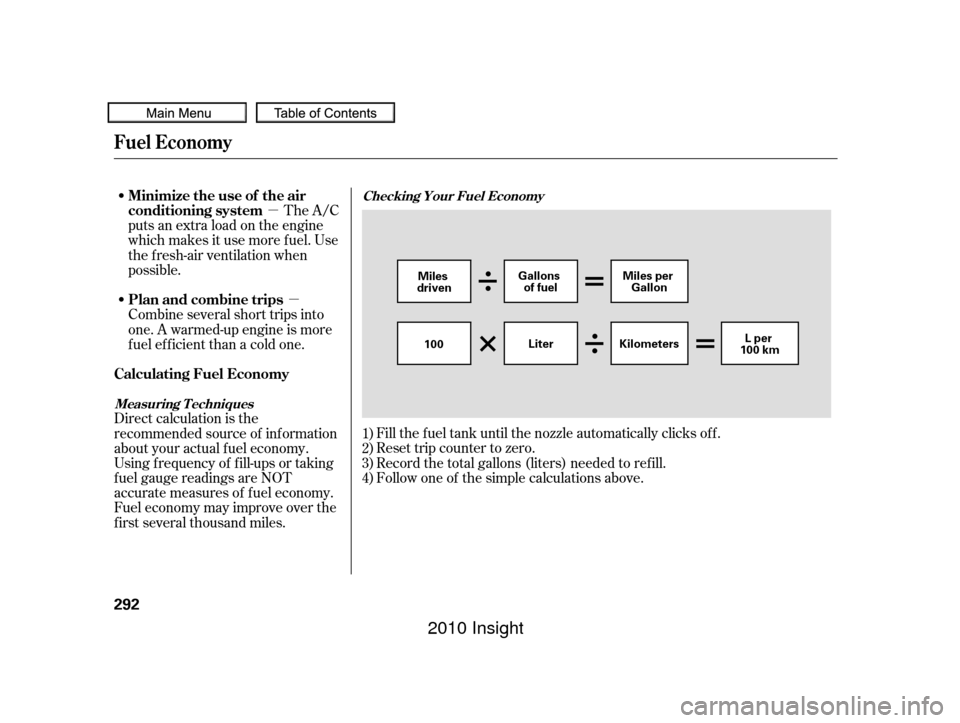
Fill the f uel tank until the nozzle automatically clicks of f .
Reset trip counter to zero.
Record the total gallons (liters) needed to ref ill.
Follow one of the simple calculations above.
The A/C
puts an extra load on the engine
which makes it use more f uel. Use
the f resh-air ventilation when
possible.
Direct calculation is the
recommended source of inf ormation
about your actual f uel economy.
Using f requency of f ill-ups or taking
f uel gauge readings are NOT
accurate measures of f uel economy.
Fuel economy may improve over the
f irst several thousand miles. Combine several short trips into
one. A warmed-up engine is more
f uel ef f icient than a cold one.
1)
2)
3)
4)
Checking Your Fuel Economy
Measuring T echniquesMinimize the use of the air
conditioning system
Calculating Fuel Economy Plan and combine trips
Fuel Economy
292
Miles
driven Gallons
of fuel Miles per
Gallon
100 KilometersLper
100 km
Liter
�����—�
���—�����y�
�������������y���
�)�"���������y���������y
2010 Insight
Page 308 of 450

TheEcoDriveBarontheEcoguide
f eedback display appears on the
multi-inf ormation display while you
drive.During acceleration, the bar
extends to the right of the center
line.
If the bar extends into the
Inef f icient Driving Zones, your
current driving style is not
conducive to good f uel economy. If the bar stays within the Efficient
Driving Zones, your current
driving style is conducive to good
f uel economy. During deceleration, the bar
extends to the left of the center
line.
It is recommended to drive in the D
position f or better f uel ef f iciency.
CONT INUED
Driving Style Eco Drive Bar
Slow, steady
acceleration -
maximizes f uel
economy
Slow deceleration -
maximizes f uel
economy
Moderate
acceleration
Moderate
deceleration
Aggressive/
Inconsistent
acceleration - lowers
fuel economy
Aggressive
deceleration - lowers
fuel economy
Eco Guide FeedbackEco Drive Bar Examples
Ecological Drive A ssist System (Eco A ssist )
Driving
305
ECO
DRIVE
BAR
Acceleration
Monitor
Inefficient Driving Zone
Center Position
Deceleration
Monitor
Inefficient Braking Zone Efficient Zones
ECO ELEMENTS
TM
�����—�
���—�����y�
�������������y���
�)�"���������y�����
���y
2010 Insight
Page 309 of 450
The Ambient Meter (the light
behind the speedometer) changes
color to show the ef f ects of your
driving style. This f eature can be
turned of f (see page ).Fuel Economy
Meter Background Color
103
A mbient Met er
Ecological Drive A ssist System (Eco A ssist )
306
AMBIENT METER
U.S. model is shown. (Background Color)
Green
Blue Green Blue High
Low
TM
�����—�
���—�����y�
�������������y���
�)�"���������y�����
�
�y
2010 Insight
Page 312 of 450

There are three Eco stages, with f ive
plants per stage. As you accumulate
a specif ied number of leaves, you
advance from one stage to the next.
The plant grows leaves f rom lef t to
right, or loses them f rom right to lef t.
A trophy icon appears once you have
reached the maximum third stage
score.Idle duration ECON button usage
Vehicle speed
Braking and accelerating
The scoring system f or points is
based on:Real time scores must accumulate over time to result in a stage change. In order to build lifetime
points and advance to the next stage, you need to keep your efficient driving style every time you
make a trip. It can take several months to move from one stage to the next. Individual results will
vary.
A total of two leaves can be put on each plant icon.
A total of four leaves can be added to each plant icon.
A circular shaped icon, which represents a blossom, can be
added on top of each plant icon with four leaves.
An icon appears once you have reached the maximum score for
each stage and are moving up to the next stage. These icons
appear briefly when the ignition switch is turned off.
Oncethe3rdstagemaximumscoreisreached,thesystem
continues to monitor your driving. If you maintain a fuel
efficient driving style, your score remains at the highest stage.
If you drive less efficiently, points will be deducted and you
maydrop(stagedown)tothepreviousstage.
Stages/Displays and Icons Def inition
Ecological Drive A ssist System (Eco A ssist )
Driving
309
First Stage
Second Stage Third Stage
Maximum Score Icons Second
Stage
First
Stage
Third
Stage
TM
�����—�
���—�����y�
�������������y���
�)�"���������y�����
���y
2010 Insight
Page 348 of 450

�µ�µ�µ
�µ
�µ �µ
Youshouldcheckthefollowing
items at the specif ied intervals. If
you are unsure of how to perf orm
any check, turn to the appropriate
page listed.
Engine oil level Check every
time you fill the fuel tank. See
page .
Engine coolant level Check the
radiator reserve tank every time
youfillthefueltank.Seepage .
Automatic transmission Check
the f luid level monthly. See page .
Brakes Check the f luid level
monthly. See page .
Tires Check the tire pressure
monthly. Examine the tread f or
wear and foreign objects. See page . Lights Check the operation of
the headlights, parking lights,
taillights, high-mount brake light,
turn signals, brake lights, and
license plate light monthly. See
page .
According to state and federal
regulations, Honda will not deny a
claim f or emissions warranty
coverage simply because you did not
maintain the vehicle or do not have
maintenance records to show that
you did. However, any part of that
f ails because of abuse or lack of
required maintenance will not be
covered by this warranty. U.S. Vehicles:
289
356 357
375 359
288
CONT INUED
Owner’s Maintenance Checks
Maintenance, replacement, or
repair of emissions control
devices and systems may be done
by any automotive repair
establishment or individual using
parts that are ‘‘certif ied’’ to EPA
standards.
Maintenance Minder
Maint enance
345
�����—�
���—�����y�
����
�
������y���
�)�"���������y���������y
2010 Insight
