2010 GMC CANYON checking oil
[x] Cancel search: checking oilPage 277 of 448

Service............................................................6-3
Accessories and Modifications..........................6-3
California Proposition 65 Warning.....................6-4
California Perchlorate Materials Requirements.....6-4
Doing Your Own Service Work.........................6-4
Adding Equipment to the Outside of the
Vehicle......................................................6-5
Fuel................................................................6-5
Gasoline Octane............................................6-5
Gasoline Specifications....................................6-6
California Fuel...............................................6-6
Additives.......................................................6-6
Fuels in Foreign Countries...............................6-7
Filling the Tank..............................................6-8
Filling a Portable Fuel Container.....................6-10
Checking Things Under the Hood....................6-10
Hood Release..............................................6-11
Engine Compartment Overview.......................6-12
Engine Oil...................................................6-15
Engine Oil Life System..................................6-18
Engine Air Cleaner/Filter................................6-20
Automatic Transmission Fluid.........................6-21
Manual Transmission Fluid.............................6-25
Hydraulic Clutch...........................................6-26
Cooling System............................................6-27Engine Coolant.............................................6-29
Engine Overheating.......................................6-35
Engine Fan Noise.........................................6-36
Power Steering Fluid.....................................6-37
Windshield Washer Fluid................................6-38
Brakes........................................................6-39
Battery........................................................6-42
Jump Starting...............................................6-43
Rear Axle.......................................................6-47
Four-Wheel Drive
............................................6-48
Front Axle......................................................6-49
Headlamp Aiming...........................................6-50
Bulb Replacement..........................................6-50
Halogen Bulbs..............................................6-50
Headlamps..................................................6-51
Front Turn Signal, Parking and Daytime
Running Lamps (DRL)................................6-52
Center High-Mounted Stoplamp (CHMSL).........6-52
Taillamps, Turn Signal, Stoplamps and
Back-up Lamps.........................................6-53
License Plate Lamp......................................6-54
Replacement Bulbs.......................................6-54
Windshield Wiper Blade Replacement..............6-55
Section 6 Service and Appearance Care
6-1
Page 286 of 448
Filling a Portable Fuel Container
{WARNING:
Never fill a portable fuel container while it is in
the vehicle. Static electricity discharge from the
container can ignite the fuel vapor. You can be
badly burned and the vehicle damaged if this
occurs. To help avoid injury to you and others:
•Dispense fuel only into approved containers.
•Do not fill a container while it is inside a
vehicle, in a vehicle’s trunk, pickup bed,
or on any surface other than the ground.
•Bring the fill nozzle in contact with the inside
of the fill opening before operating the nozzle.
Contact should be maintained until the filling
is complete.
•Do not smoke while pumping fuel.
•Do not use a cellular phone while
pumping fuel.
Checking Things Under
the Hood
{WARNING:
Things that burn can get on hot engine parts and
start a fire. These include liquids like fuel, oil,
coolant, brake fluid, windshield washer and other
fluids, and plastic or rubber. You or others could
be burned. Be careful not to drop or spill things
that will burn onto a hot engine.
6-10
Page 289 of 448
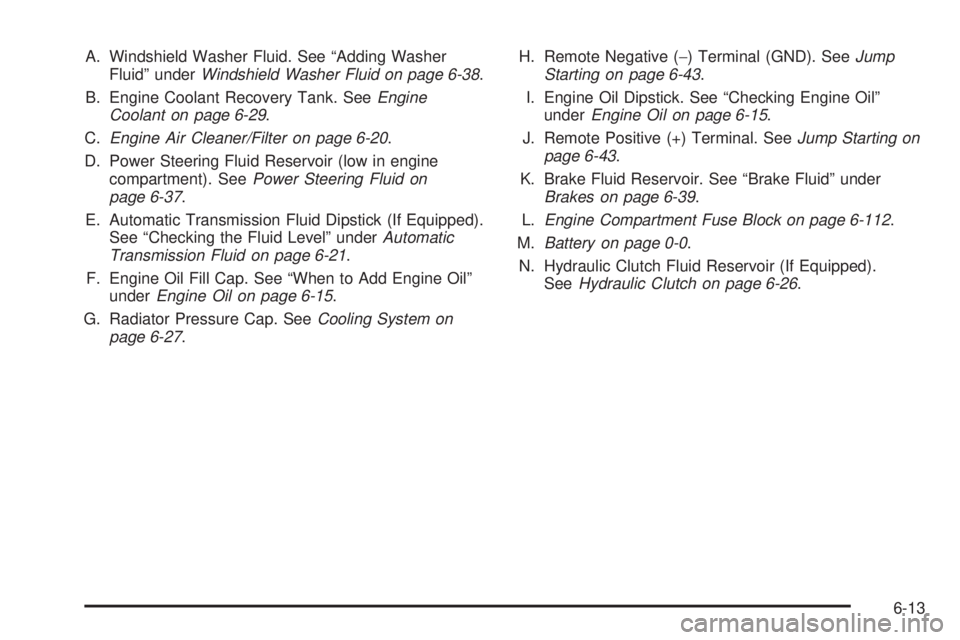
A. Windshield Washer Fluid. See “Adding Washer
Fluid” underWindshield Washer Fluid on page 6-38.
B. Engine Coolant Recovery Tank. SeeEngine
Coolant on page 6-29.
C.Engine Air Cleaner/Filter on page 6-20.
D. Power Steering Fluid Reservoir (low in engine
compartment). SeePower Steering Fluid on
page 6-37.
E. Automatic Transmission Fluid Dipstick (If Equipped).
See “Checking the Fluid Level” underAutomatic
Transmission Fluid on page 6-21.
F. Engine Oil Fill Cap. See “When to Add Engine Oil”
underEngine Oil on page 6-15.
G. Radiator Pressure Cap. SeeCooling System on
page 6-27.H. Remote Negative (−) Terminal (GND). SeeJump
Starting on page 6-43.
I. Engine Oil Dipstick. See “Checking Engine Oil”
underEngine Oil on page 6-15.
J. Remote Positive (+) Terminal. SeeJump Starting on
page 6-43.
K. Brake Fluid Reservoir. See “Brake Fluid” under
Brakes on page 6-39.
L.Engine Compartment Fuse Block on page 6-112.
M.Battery on page 0-0.
N. Hydraulic Clutch Fluid Reservoir (If Equipped).
SeeHydraulic Clutch on page 6-26.
6-13
Page 291 of 448
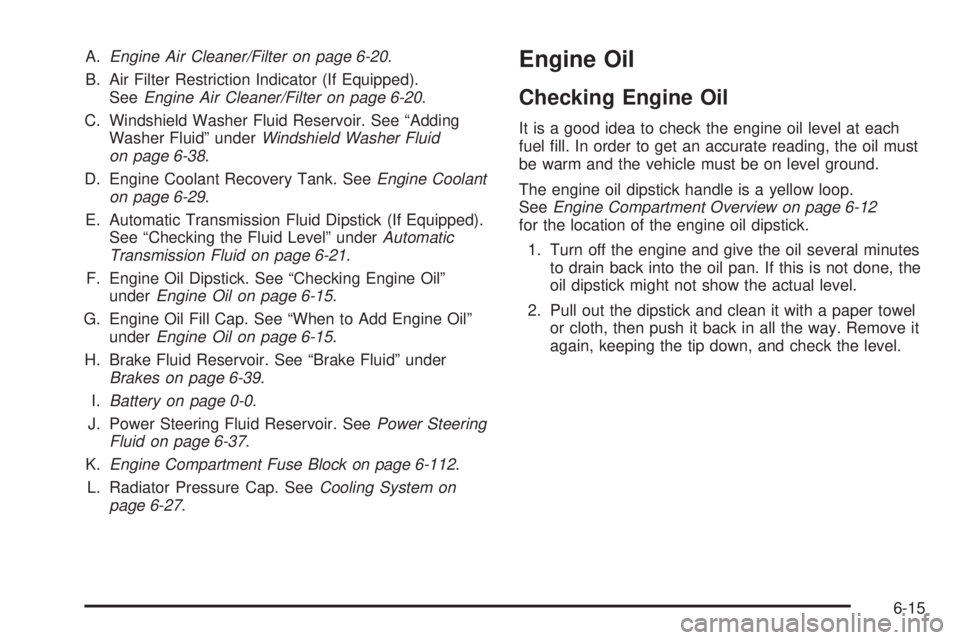
A.Engine Air Cleaner/Filter on page 6-20.
B. Air Filter Restriction Indicator (If Equipped).
SeeEngine Air Cleaner/Filter on page 6-20.
C. Windshield Washer Fluid Reservoir. See “Adding
Washer Fluid” underWindshield Washer Fluid
on page 6-38.
D. Engine Coolant Recovery Tank. SeeEngine Coolant
on page 6-29.
E. Automatic Transmission Fluid Dipstick (If Equipped).
See “Checking the Fluid Level” underAutomatic
Transmission Fluid on page 6-21.
F. Engine Oil Dipstick. See “Checking Engine Oil”
underEngine Oil on page 6-15.
G. Engine Oil Fill Cap. See “When to Add Engine Oil”
underEngine Oil on page 6-15.
H. Brake Fluid Reservoir. See “Brake Fluid” under
Brakes on page 6-39.
I.Battery on page 0-0.
J. Power Steering Fluid Reservoir. SeePower Steering
Fluid on page 6-37.
K.Engine Compartment Fuse Block on page 6-112.
L. Radiator Pressure Cap. SeeCooling System on
page 6-27.Engine Oil
Checking Engine Oil
It is a good idea to check the engine oil level at each
fuel fill. In order to get an accurate reading, the oil must
be warm and the vehicle must be on level ground.
The engine oil dipstick handle is a yellow loop.
SeeEngine Compartment Overview on page 6-12
for the location of the engine oil dipstick.
1. Turn off the engine and give the oil several minutes
to drain back into the oil pan. If this is not done, the
oil dipstick might not show the actual level.
2. Pull out the dipstick and clean it with a paper towel
or cloth, then push it back in all the way. Remove it
again, keeping the tip down, and check the level.
6-15
Page 307 of 448
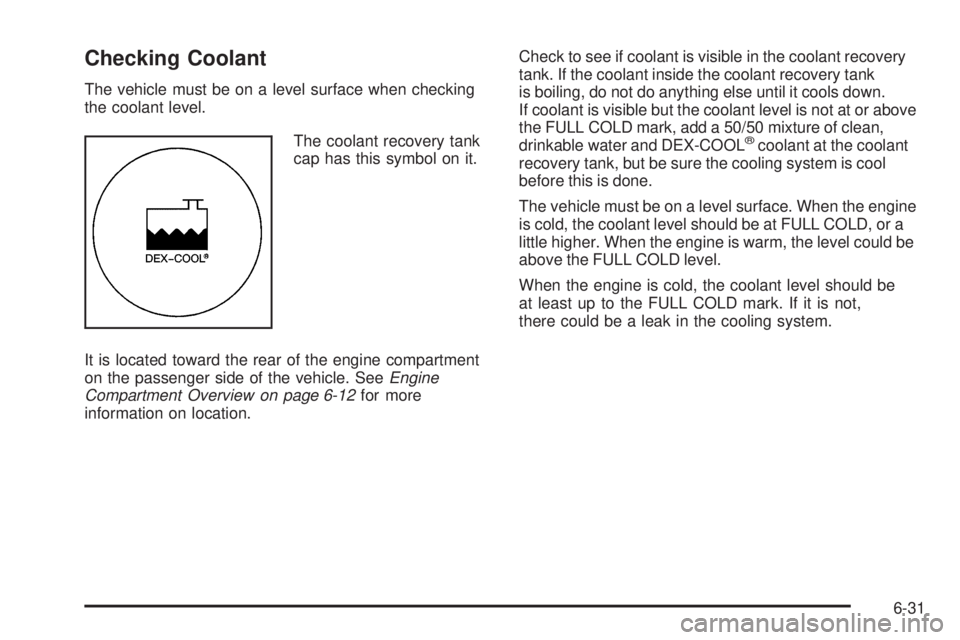
Checking Coolant
The vehicle must be on a level surface when checking
the coolant level.
The coolant recovery tank
cap has this symbol on it.
It is located toward the rear of the engine compartment
on the passenger side of the vehicle. SeeEngine
Compartment Overview on page 6-12for more
information on location.Check to see if coolant is visible in the coolant recovery
tank. If the coolant inside the coolant recovery tank
is boiling, do not do anything else until it cools down.
If coolant is visible but the coolant level is not at or above
the FULL COLD mark, add a 50/50 mixture of clean,
drinkable water and DEX-COOL
®coolant at the coolant
recovery tank, but be sure the cooling system is cool
before this is done.
The vehicle must be on a level surface. When the engine
is cold, the coolant level should be at FULL COLD, or a
little higher. When the engine is warm, the level could be
above the FULL COLD level.
When the engine is cold, the coolant level should be
at least up to the FULL COLD mark. If it is not,
there could be a leak in the cooling system.
6-31
Page 316 of 448
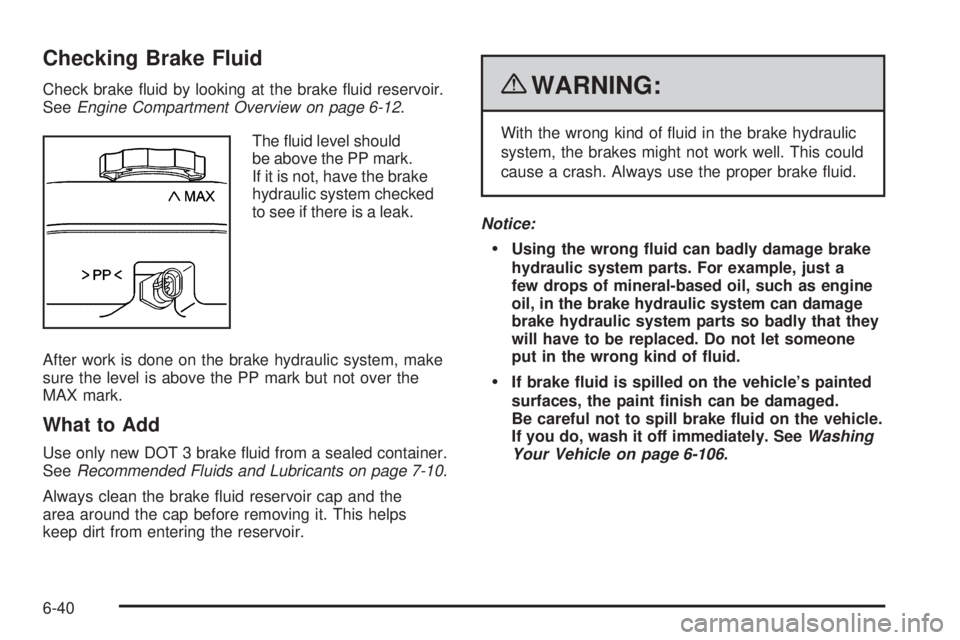
Checking Brake Fluid
Check brake fluid by looking at the brake fluid reservoir.
SeeEngine Compartment Overview on page 6-12.
The fluid level should
be above the PP mark.
If it is not, have the brake
hydraulic system checked
to see if there is a leak.
After work is done on the brake hydraulic system, make
sure the level is above the PP mark but not over the
MAX mark.
What to Add
Use only new DOT 3 brake fluid from a sealed container.
SeeRecommended Fluids and Lubricants on page 7-10.
Always clean the brake fluid reservoir cap and the
area around the cap before removing it. This helps
keep dirt from entering the reservoir.
{WARNING:
With the wrong kind of fluid in the brake hydraulic
system, the brakes might not work well. This could
cause a crash. Always use the proper brake fluid.
Notice:
Using the wrong uid can badly damage brake
hydraulic system parts. For example, just a
few drops of mineral-based oil, such as engine
oil, in the brake hydraulic system can damage
brake hydraulic system parts so badly that they
will have to be replaced. Do not let someone
put in the wrong kind of uid.
If brake uid is spilled on the vehicle’s painted
surfaces, the paint nish can be damaged.
Be careful not to spill brake uid on the vehicle.
If you do, wash it off immediately. SeeWashing
Your Vehicle on page 6-106.
6-40
Page 433 of 448

Bulb Replacement (cont.)
Halogen Bulbs............................................6-50
Headlamp Aiming........................................6-50
Headlamps.........................................6-50, 6-51
License Plate Lamps....................................6-54
Taillamps, Turn Signal, Stoplamps and
Back-up Lamps........................................6-53
Buying New Tires...........................................6-73
C
Calibration.....................................................3-37
California
Perchlorate Materials Requirements................. 6-4
Warning....................................................... 6-4
California Fuel.................................................. 6-6
Calling for Assistance........................................ 8-7
Canada........................................................... 8-6
Canadian Owners............................................... iii
Canadian Owners (Propriétaires Canadiens)........... iii
Capacities and Specifications..........................6-118
Carbon Monoxide
Engine Exhaust...........................................3-34
Tailgate........................................................ 3-8
Winter Driving.............................................5-29
Care of
Safety Belts..............................................6-105
CD Messages................................................4-55
CD, MP3 .......................................................4-56Cellular Phone Usage......................................4-62
Center Console Storage...................................3-40
Center High-Mounted Stoplamp (CHMSL)...........6-52
Certification/Tire Label.....................................5-38
Chains, Tire...................................................6-78
CHANGE OIL .................................................4-38
Charging System Light....................................4-24
Check
Engine Lamp..............................................4-28
Check Engine Light.........................................4-28
Checking Brake Fluid......................................6-40
Checking Coolant............................................6-31
Checking Engine Oil........................................6-15
Checking Things Under the Hood......................6-10
Chemical Paint Spotting.................................6-109
Child Restraints
Infants and Young Children...........................2-38
Lower Anchors and Tethers for Children..........2-46
Older Children.............................................2-35
Securing a Child Restraint in a
Rear Seat Position...................................2-58
Securing a Child Restraint in the
Center Front Seat Position........................2-60
Securing a Child Restraint in the
Right Front Seat Position
..........................2-60
Systems.....................................................2-42
Where to Put the Restraint...........................2-44
Chime Level Adjustment..................................4-63
Cigarette Lighter.............................................4-16
3
Page 438 of 448
Hill and Mountain Roads..................................5-28
Hitches..........................................................5-55
Hood
Checking Things Under................................6-10
Release.....................................................6-11
Horn ............................................................... 4-3
How OnStar Service Works..............................1-21
How to Add Automatic Transmission Fluid..........6-24
How to Add Coolant to the Radiator..................6-32
How to Add Fluid............................................6-26
How to Check........................................6-25, 6-65
How to Check and Add Fluid............................6-27
How to Check Automatic Transmission Fluid.......6-22
How to Check Lubricant..........................6-47, 6-49
How to Check Power Steering Fluid..................6-37
How to Inspect the Engine Air Cleaner/Filter.......6-20
How to Reset the Engine Oil Life System...........6-19
How to Wear Safety Belts Properly...................2-18
How to Add Coolant to the Recovery Tank.............6-32
Hydraulic Clutch.............................................6-26
Hydroplaning..................................................5-26I
If a Crash Occurs...........................................8-13
If No Steam is Coming from the Engine
Compartment..............................................6-36
If Steam is Coming from the Engine
Compartment..............................................6-35
If the Off Indicator is Lit for an Adult-Size
Occupant...................................................2-78
If the On Indicator is Lit for a Child Restraint......2-77
Ignition Positions.............................................3-17
Ignition Transmission Lock Check....................... 7-9
Infants and Young Children, Restraints...............2-38
Inflation - Tire Pressure...................................6-64
Instrument Panel
Brightness..................................................4-13
Cluster.......................................................4-19
Insuring Your Vehicle.......................................8-12
Interior Mirror.................................................1-11
Introduction...................................................... 7-2
8