2010 GMC CANYON engine
[x] Cancel search: enginePage 5 of 448

Vehicle Symbol Chart
Here are some additional symbols that may be found on
the vehicle and what they mean. For more information
on the symbol, refer to the index.
9:Airbag Readiness Light
#:Air Conditioning
!:Antilock Brake System (ABS)
g:Audio Steering Wheel Controls or OnStar®
$:Brake System Warning Light
":Charging System
I:Cruise Control
B:Engine Coolant Temperature
O:Exterior Lamps
#:Fog Lamps
.:Fuel Gage
+:Fuses
i:Headlamp High/Low-Beam Changer
j:LATCH System Child Restraints
*:Malfunction Indicator Lamp
::Oil Pressure
}:Power
/:Remote Vehicle Start
>:Safety Belt Reminders
7:Tire Pressure Monitor
F:Traction Control
M:Windshield Washer Fluid
v
Page 7 of 448

Instrument Panel..............................................1-2
Initial Drive Information....................................1-3
Remote Keyless Entry (RKE) System................1-4
Door Locks....................................................1-4
Tailgate........................................................1-5
Windows.......................................................1-6
Seat Adjustment.............................................1-7
Heated Seats.................................................1-9
Head Restraint Adjustment...............................1-9
Safety Belt...................................................1-10
Sensing System for Passenger Airbag.............1-10
Mirror Adjustment.........................................1-11
Steering Wheel Adjustment............................1-12
Interior Lighting............................................1-12
Exterior Lighting...........................................1-13
Windshield Wiper/Washer...............................1-14
Climate Controls...........................................1-14Vehicle Features.............................................1-15
Radio(s)......................................................1-15
Satellite Radio..............................................1-16
Driver Information Center (DIC).......................1-16
Cruise Control..............................................1-17
Power Outlets..............................................1-17
Performance and Maintenance.........................1-17
Traction Control System (TCS).......................1-17
StabiliTrak
®..................................................1-18
Tire Pressure Monitor....................................1-18
Engine Oil Life System..................................1-19
Driving for Better Fuel Economy.....................1-19
Roadside Assistance Program........................1-20
OnStar
®......................................................1-20
Section 1 In Brief
1-1
Page 25 of 448

Engine Oil Life System
The engine oil life system calculates engine oil life
based on vehicle use and displays a DIC message when
it is necessary to change the engine oil and filter.
Resetting the Oil Life System
1. Turn the ignition to ON/RUN, with the engine off.
2. Press and release the stem in the lower center
of the instrument cluster until the OIL LIFE
message is displayed.
3. Once the alternating OIL LIFE and RESET
messages appear, press and hold the stem
until several beeps sound. This confirms that the oil
life system has been reset.
4. Turn the key to LOCK/OFF.
SeeEngine Oil Life System on page 6-18.
Driving for Better Fuel Economy
Driving habits can affect fuel mileage. Here are some
driving tips to get the best fuel economy possible.
•Avoid fast starts and accelerate smoothly.
•Brake gradually and avoid abrupt stops.
•Avoid idling the engine for long periods of time.
•When road and weather conditions are appropriate,
use cruise control, if equipped.
•Always follow posted speed limits or drive more
slowly when conditions require.
•Keep vehicle tires properly inflated.
•Combine several trips into a single trip.
•Replace the vehicle’s tires with the same
TPC Spec number molded into the tire’s sidewall
near the size.
•Follow recommended scheduled maintenance.
1-19
Page 111 of 448
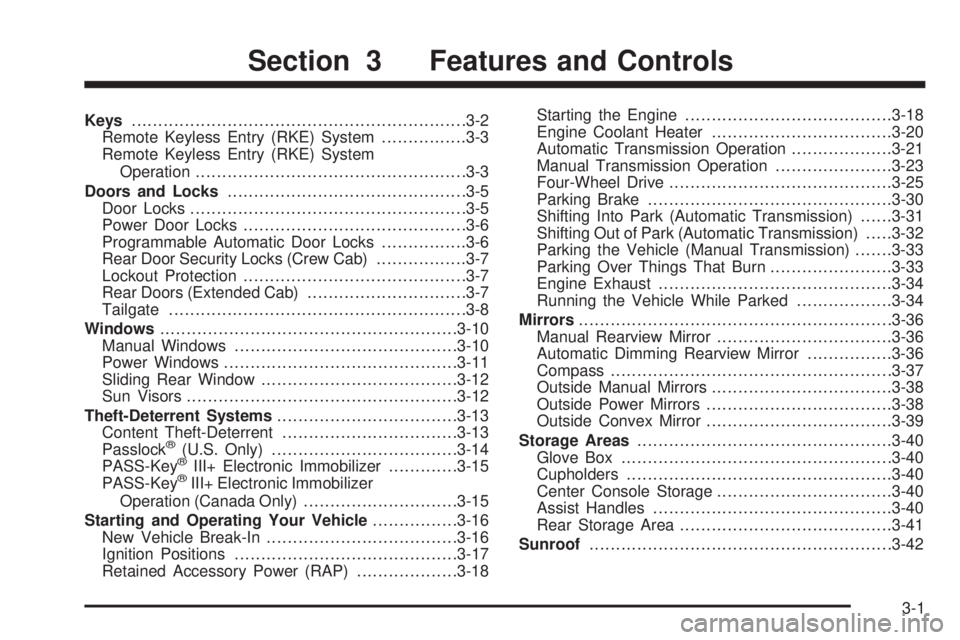
Keys...............................................................3-2
Remote Keyless Entry (RKE) System................3-3
Remote Keyless Entry (RKE) System
Operation...................................................3-3
Doors and Locks.............................................3-5
Door Locks....................................................3-5
Power Door Locks..........................................3-6
Programmable Automatic Door Locks................3-6
Rear Door Security Locks (Crew Cab).................3-7
Lockout Protection..........................................3-7
Rear Doors (Extended Cab)..............................3-7
Tailgate........................................................3-8
Windows........................................................3-10
Manual Windows..........................................3-10
Power Windows............................................3-11
Sliding Rear Window.....................................3-12
Sun Visors...................................................3-12
Theft-Deterrent Systems..................................3-13
Content Theft-Deterrent.................................3-13
Passlock
®(U.S. Only)...................................3-14
PASS-Key®III+ Electronic Immobilizer.............3-15
PASS-Key®III+ Electronic Immobilizer
Operation (Canada Only).............................3-15
Starting and Operating Your Vehicle................3-16
New Vehicle Break-In....................................3-16
Ignition Positions..........................................3-17
Retained Accessory Power (RAP)...................3-18Starting the Engine.......................................3-18
Engine Coolant Heater..................................3-20
Automatic Transmission Operation...................3-21
Manual Transmission Operation......................3-23
Four-Wheel Drive..........................................3-25
Parking Brake..............................................3-30
Shifting Into Park (Automatic Transmission)......3-31
Shifting Out of Park (Automatic Transmission).....3-32
Parking the Vehicle (Manual Transmission).......3-33
Parking Over Things That Burn.......................3-33
Engine Exhaust............................................3-34
Running the Vehicle While Parked..................3-34
Mirrors...........................................................3-36
Manual Rearview Mirror.................................3-36
Automatic Dimming Rearview Mirror................3-36
Compass.....................................................3-37
Outside Manual Mirrors..................................3-38
Outside Power Mirrors...................................3-38
Outside Convex Mirror...................................3-39
Storage Areas................................................3-40
Glove Box...................................................3-40
Cupholders..................................................3-40
Center Console Storage.................................3-40
Assist Handles.............................................3-40
Rear Storage Area........................................3-41
Sunroof.........................................................3-42
Section 3 Features and Controls
3-1
Page 123 of 448

Theft-Deterrent Systems
Vehicle theft is big business, especially in some cities.
This vehicle has theft-deterrent features, however,
they do not make it impossible to steal.
Content Theft-Deterrent
If your vehicle has
the Remote Keyless
Entry (RKE) system,
the vehicle has a content
theft-deterrent alarm
system.
To activate the content theft-deterrent system:
1. Close all the doors.
2. Lock the doors with the RKE transmitter.
The security light, located on the instrument panel
cluster, will flash.
If the lock button on the RKE transmitter is pressed, but
a door is open, the horn will chirp six times. Press
the lock button again, within three seconds, and the
doors will lock. Close the open door and the system will
be activated.If a locked door is not opened using the RKE transmitter,
or by OnStar
®, the pre-alarm will go off. If the engine
is not started or unlock not pressed within 10 seconds,
the front turn signal lamps will flash for two minutes,
and the horn will sound for two minutes, then will turn off
to save the battery power.
Remember, the theft-deterrent system will not activate if
you lock the doors with a key, the manual door lock,
or power door lock switch. The system can only
be activated using the RKE transmitter, or by OnStar
®.
See the OnStar Owner’s Guide for additional
information. You should also remember that you can
start your vehicle with the correct ignition key if the alarm
has been set off.
Here is how to avoid setting off the alarm by accident:
•If you do not want to activate the theft-deterrent
system, the vehicle should be locked with the
door key after the doors are closed.
•Always unlock a door with the RKE transmitter.
Unlocking a door any other way will set off the
alarm.
If you set off the alarm by accident, you can turn off the
alarm by pressing unlock on the RKE transmitter.
The alarm will not stop if you try to unlock a door any
other way.
3-13
Page 124 of 448

Testing the Alarm
To test the alarm:
1. From inside the vehicle, activate the system by
locking the doors with the RKE transmitter.
2. Unlock the door with the manual door lock and
open the door. This should set off the alarm.
3. To turn the alarm off, press the unlock button on
the RKE transmitter or start the engine.
If the alarm does not sound when it should but the lights
flash, check to see if the horn works. The horn fuse
may be blown. To replace the fuse, seeFuses and
Circuit Breakers on page 6-111.
If the alarm does not sound or the front turn
signal lamps do not flash, see your dealer/retailer
for service.
Passlock®(U.S. Only)
Passlock®is a passive theft-deterrent system that
enables fuel if the vehicle is started with a valid key.
If an incorrect key is used or the ignition lock cylinder is
tampered with, the fuel system is disabled and the
vehicle does not start.
The security light turns off approximately five seconds
after the engine is started. SeeSecurity Light on
page 4-32.
If the engine stalls and the security light flashes, wait
about 10 minutes until the light stops flashing before
trying to restart the engine. Release the key from
START as soon as the engine starts.
If the engine does not start after three tries, the vehicle
needs service.
If the engine is running and the security light comes on,
the engine restarts if you turn the engine off. However,
the Passlock
®system is not working properly and
must be serviced by your dealer/retailer. The vehicle is
not protected by Passlock
®at this time. See your
dealer/retailer for service.
In an emergency, call the Roadside Assistance Center.
SeeRoadside Assistance Program on page 8-7.
Do not leave the key or device that disarms or
deactivates the theft deterrent system in the vehicle.
3-14
Page 125 of 448

PASS-Key®III+ Electronic
Immobilizer
SeeRadio Frequency Statement on page 8-18for
information regarding Part 15 of the Federal
Communications Commission (FCC) Rules and
RSS-210/211 of Industry and Science Canada.
PASS-Key®III+ Electronic
Immobilizer Operation
(Canada Only)
This vehicle has a passive theft-deterrent system.
The system is automatically armed when the key is
removed from the ignition.
The system is automatically disarmed when the key is
turned to ON/RUN.
You do not have to manually arm or disarm the system.
The security light comes on if there is a problem with
arming or disarming the theft-deterrent system.
The key uses a transponder that matches an immobilizer
control unit in the vehicle. Only the correct key starts
the vehicle. If the key is ever damaged, the vehicle may
not start.When trying to start the vehicle, if the engine does not
start and the security light comes on, there may be
a problem with the theft-deterrent system. Turn the
ignition off and try again.
If the engine still does not start, and the key appears to
be undamaged, try another ignition key. Check the
fuse. SeeFuses and Circuit Breakers on page 6-111.
If the engine still does not start with the other key, the
vehicle needs service. If the vehicle does start, the
first key may be faulty. See your dealer/retailer who can
service the theft-deterrent system and have a new
key made.
It is possible for the theft-deterrent system decoder to
learn the transponder value of a new or replacement
key. Up to 10 keys can be programmed for the vehicle.
The following procedure is for programming additional
keys only.
Canadian Owners:If the keys are lost or damaged,
only a dealer/retailer can service the theft-deterrent
system to have new ones made. Two current driver’s
keys are required to program additional keys.
To program a new key:
1. Verify that the new key has PK3+ stamped on it.
2. Insert the current driver’s key in the ignition
and start the engine. If the engine does not start
see your dealer/retailer for service.
3-15
Page 126 of 448

3. After the engine has started, turn the key to
LOCK/OFF, and remove the key.
4. Insert the second current driver’s key in the ignition
and start the engine within ten seconds of removing
the previous key. If the engine does not start see
your dealer/retailer for service.
5. After the engine has started, turn the key to
LOCK/OFF, and remove the key. Insert the key to
be programmed and turn it to ON/RUN within
ten seconds of removing the previous key.
The security light turns off once the key has been
programmed.
6. Repeat the Steps 1 through 5 if additional keys are
to be programmed.
If the security light comes on and stays on while driving,
the engine will restart if you turn it off. However, the
theft-deterrent system is not working properly and must
be serviced by your dealer/retailer. The vehicle is
not protected by the theft-deterrent system at this time.
In an emergency, contact Roadside Assistance.
SeeRoadside Assistance Program on page 8-7.
Do not leave the key or device that disarms or
deactivates the theft deterrent system in the vehicle.Starting and Operating
Your Vehicle
New Vehicle Break-In
Notice:The vehicle does not need an elaborate
break-in. But it will perform better in the long run
if you follow these guidelines:
Keep your speed at 55 mph (88 km/h) or less for
the rst 500 miles (805 km).
Do not drive at any one constant speed, fast or
slow, for the rst 500 miles (805 km). Do not
make full-throttle starts. Avoid downshifting to
brake or slow the vehicle.
Avoid making hard stops for the rst 200 miles
(322 km) or so. During this time the new brake
linings are not yet broken in. Hard stops with
new linings can mean premature wear and
earlier replacement. Follow this breaking-in
guideline every time you get new brake linings.
Do not tow a trailer during break-in. SeeTowing
a Trailer on page 5-48for the trailer towing
capabilities of the vehicle and more information.
Following break-in, engine speed and load can
be gradually increased.
3-16