Page 12 of 57
WARNING:Hill descent mode does not provide hill hold at zero
mph (0 km/h). When stopped, the parking brake must be applied
and/or the vehicle must be placed in P (Park) or it may roll away.
Hill descent control requires a cooling down interval after a period of
sustained use. The amount of time that the feature can remain active
before cooling varies with conditions. The system will provide a warning
in the message center and a chime will sound when the system is about
to disengage for cooling. At this time, manually apply the brakes as
needed to maintain descent speed.
Enabling hill descent control and setting the descent speed
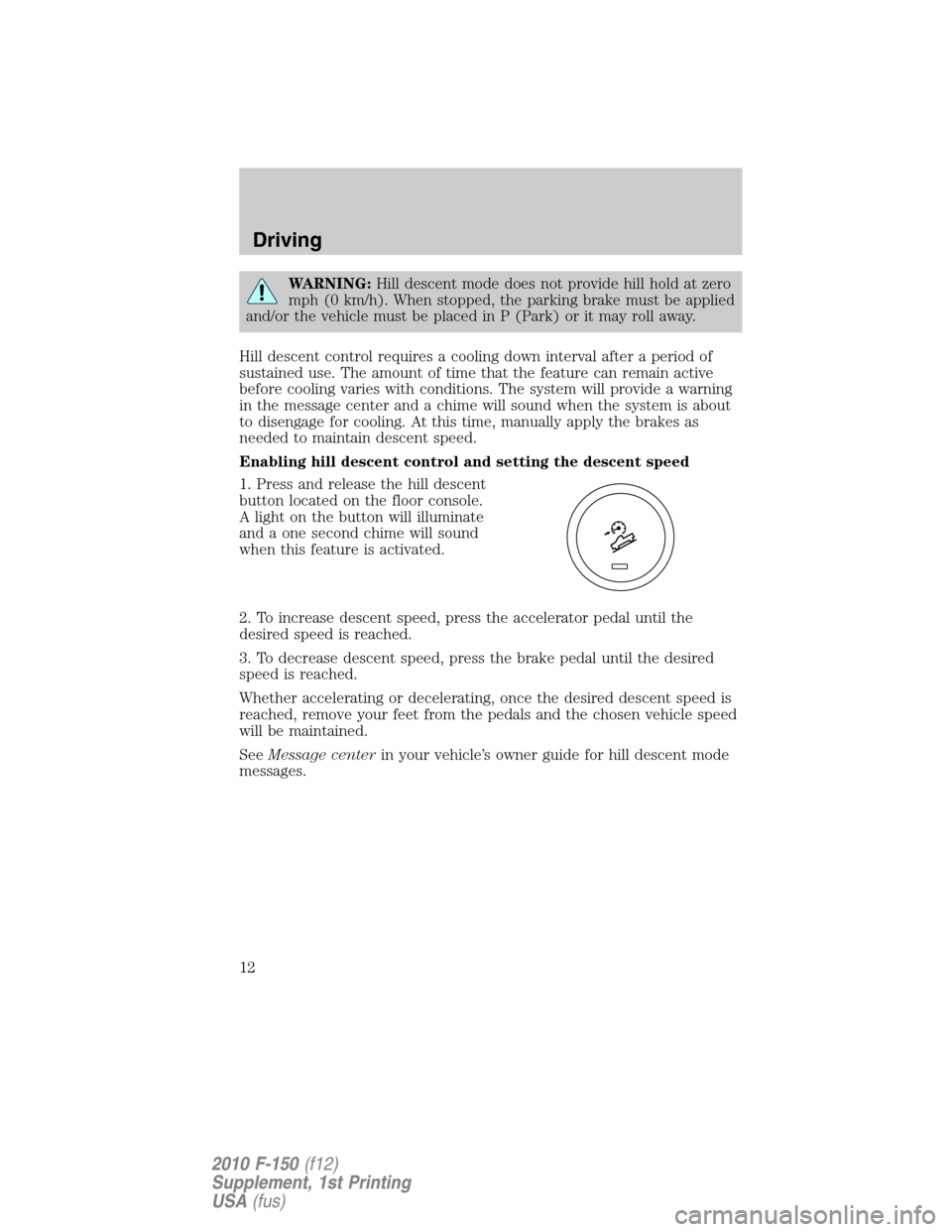
1. Press and release the hill descent
button located on the floor console.
A light on the button will illuminate
and a one second chime will sound
when this feature is activated.
2. To increase descent speed, press the accelerator pedal until the
desired speed is reached.
3. To decrease descent speed, press the brake pedal until the desired
speed is reached.
Whether accelerating or decelerating, once the desired descent speed is
reached, remove your feet from the pedals and the chosen vehicle speed
will be maintained.
SeeMessage centerin your vehicle’s owner guide for hill descent mode
messages.
Driving
12
2010 F-150(f12)
Supplement, 1st Printing
USA(fus)
Page 17 of 57
Hill climbing
•Always attempt to climb a steep hill along the fall line of the slope and
not diagonally.
•If the vehicle is unable to make it up the hill, DO NOT attempt to turn
back down the slope. Place the vehicle in low range and slowly back
down in reverse. Note that hill descent control is functional in reverse
and should be used in this situation.
WARNING:Extreme care should be used when steering the
vehicle in reverse down a slope so as not to cause the vehicle to
swerve out of control.
•
When descending a steep slope, select low gear and engage hill descent
control. Use the throttle and brake pedals to control your descent speed
as described earlier in this section using hill descent control.
Water wading
•Always determine the depth before attempting a water crossing.
•Proceed slowly and avoid splashing water any more than is necessary.
•
Be aware that obstacles and debris may be beneath the water’s surface.
•Keep the doors fully closed during the water crossing.
•Upon completion of the water crossing, slowly drive a short distance
and check the brakes for full effectiveness.
High speed off-roading
The off-road driving discussed thus far has focused on the type of events
typically encountered during slow speed off-road driving conditions. The
F-150 SVT Raptor provides excellent performance in a full size pick-up
truck during these slower speed conditions, but truly excels at higher
speed “baja style” off-road driving. High speed off-roading presents a
unique challenge, but extra care and caution should be taken before
engaging in this type of driving. If you plan on using the truck for severe,
high speed off-road use, the following is recommended:
•Equip your truck with the safety equipment used for the Stock-Full
Class as defined in the rule books for the Best in the Desert Racing
(www.bitd.com) and SCORE International Off Road Racing
(www.score-international.com).
•Use personal safety equipment including a SNELL SA certified helmet
and approved neck restraint device.
•Before venturing off-road in unfamiliar areas at high speeds, do a low
speed reconnaissance run (“prerun”) to become aware of any
obstacles that you will encounter.
Driving
17
2010 F-150(f12)
Supplement, 1st Printing
USA(fus)
Page 19 of 57

•While driving in desert conditions, the midpoint of the day is the most
difficult time to see many of the small ridges and dips due to�flat
shadows�from the sun being at its highest point. Extreme care should
be taken at these times to not inadvertently run into these obstacles.
•It is highly encouraged that you switch to off-road mode and perform
an�AdvanceTrac single press�to ensure improved off-road braking
performance under these conditions. Be sure to disengage the
�off-road mode�and switch back to�AdvanceTrac key-on mode�before
performing any street driving. Please see the Off-road mode section of
this supplement for more details.
After off-road driving
It is important to complete a full vehicle inspection after off-road driving.
Some items to check include:
•Ensure that tires are inflated to proper tire pressure as indicated on
the tire placard.
•Check the wheels and undercarriage for built up mud or debris which
can cause vehicle vibration.
•Ensure that the grille and radiator are clear of any obstructions that
may effect cooling.
•Ensure that the brakes are in proper working order and free of any
mud, stones etc., which can become trapped around the brake rotor,
backing plate and caliper.
•Check that the air filter is clean and dry.
•Inspect for torn or punctured boots on ball joints, half shafts, steering
gears.
•Inspect exhaust system for damage or looseness.
•Inspect undercarriage fasteners. If any are loose or damaged, tighten
or replace ensuring that the proper torque specification is used.
•Inspect the tires for any cuts in the tread or sidewall area. Also
inspect the sidewall for any bulge indicating damage to the tire.
•Inspect the wheels for dents, cracks, or other damage.
Driving
19
2010 F-150(f12)
Supplement, 1st Printing
USA(fus)
Page 38 of 57
BRAKES
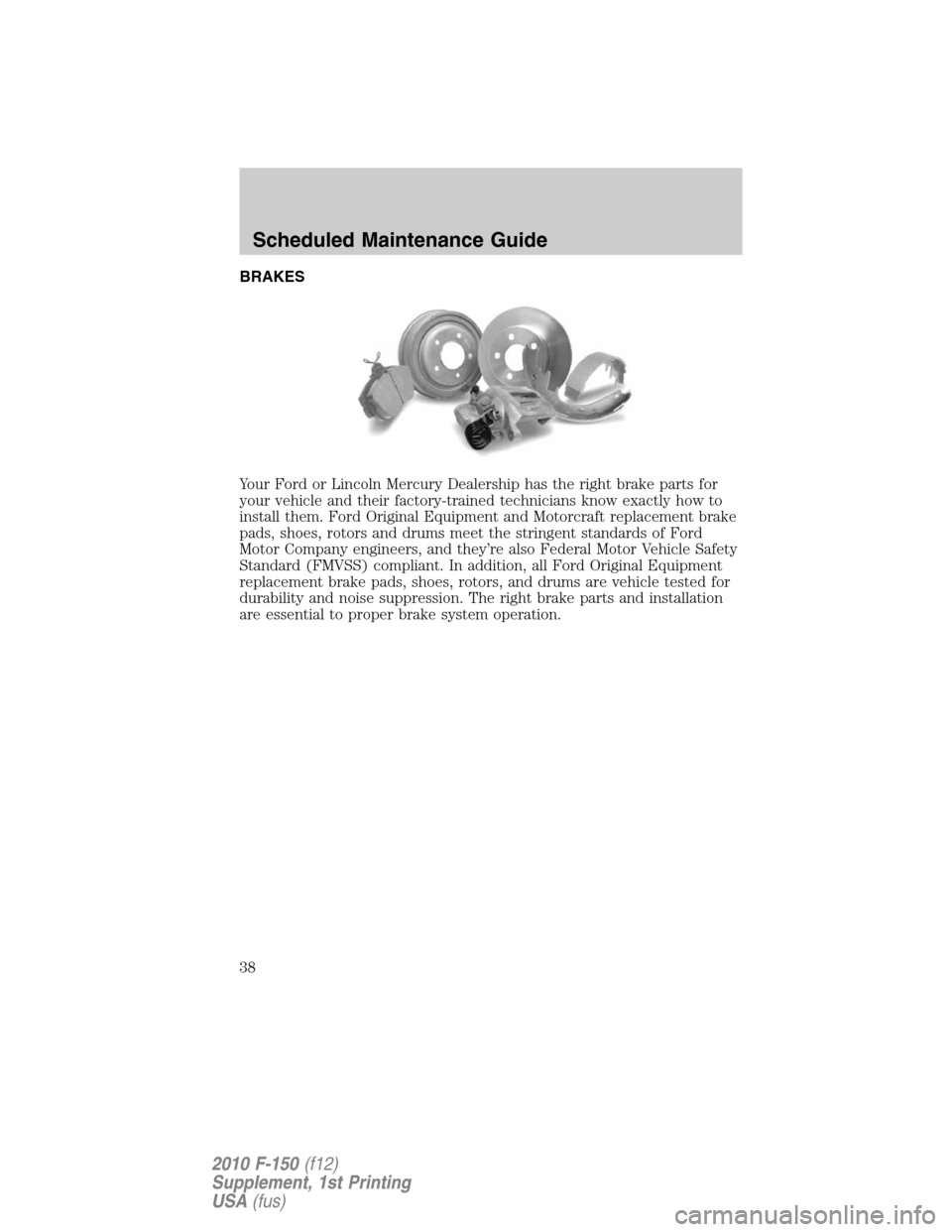
Your Ford or Lincoln Mercury Dealership has the right brake parts for
your vehicle and their factory-trained technicians know exactly how to
install them. Ford Original Equipment and Motorcraft replacement brake
pads, shoes, rotors and drums meet the stringent standards of Ford
Motor Company engineers, and they’re also Federal Motor Vehicle Safety
Standard (FMVSS) compliant. In addition, all Ford Original Equipment
replacement brake pads, shoes, rotors, and drums are vehicle tested for
durability and noise suppression. The right brake parts and installation
are essential to proper brake system operation.
Scheduled Maintenance Guide
38
2010 F-150(f12)
Supplement, 1st Printing
USA(fus)