Page 5 of 57
•Longer, cast aluminum lower control arms
•Longer, forged steel upper control arms
•Front coil springs and rear leaf springs
•Fox Racing 47mm piston internal bypass front shocks
•Fox Racing 47mm pistons, internal bypass, remote reservoir rear
shocks
•Micro-cellular urethane jounce bumpers (front and rear)
•Raptor navigation welcome screen
•17” cast aluminum wheels and 315/70-17 BFGoodrich�all-terrain tires
•Full size all-terrain spare tire
•Off-road specific calibrations for engine, transmission and
AdvanceTrac�traction control system
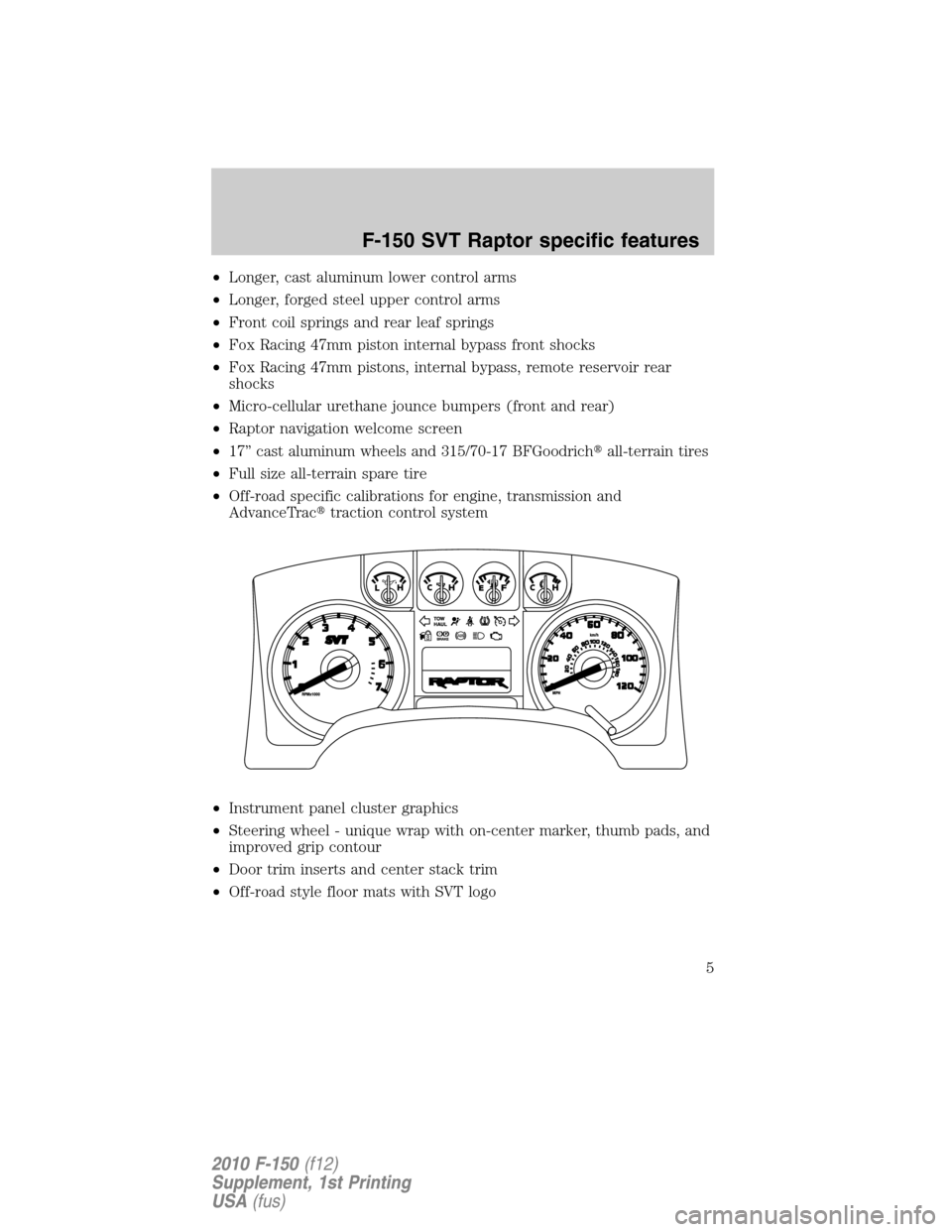
•Instrument panel cluster graphics
•Steering wheel - unique wrap with on-center marker, thumb pads, and
improved grip contour
•Door trim inserts and center stack trim
•Off-road style floor mats with SVT logo
F-150 SVT Raptor specific features
5
2010 F-150(f12)
Supplement, 1st Printing
USA(fus)
Page 6 of 57
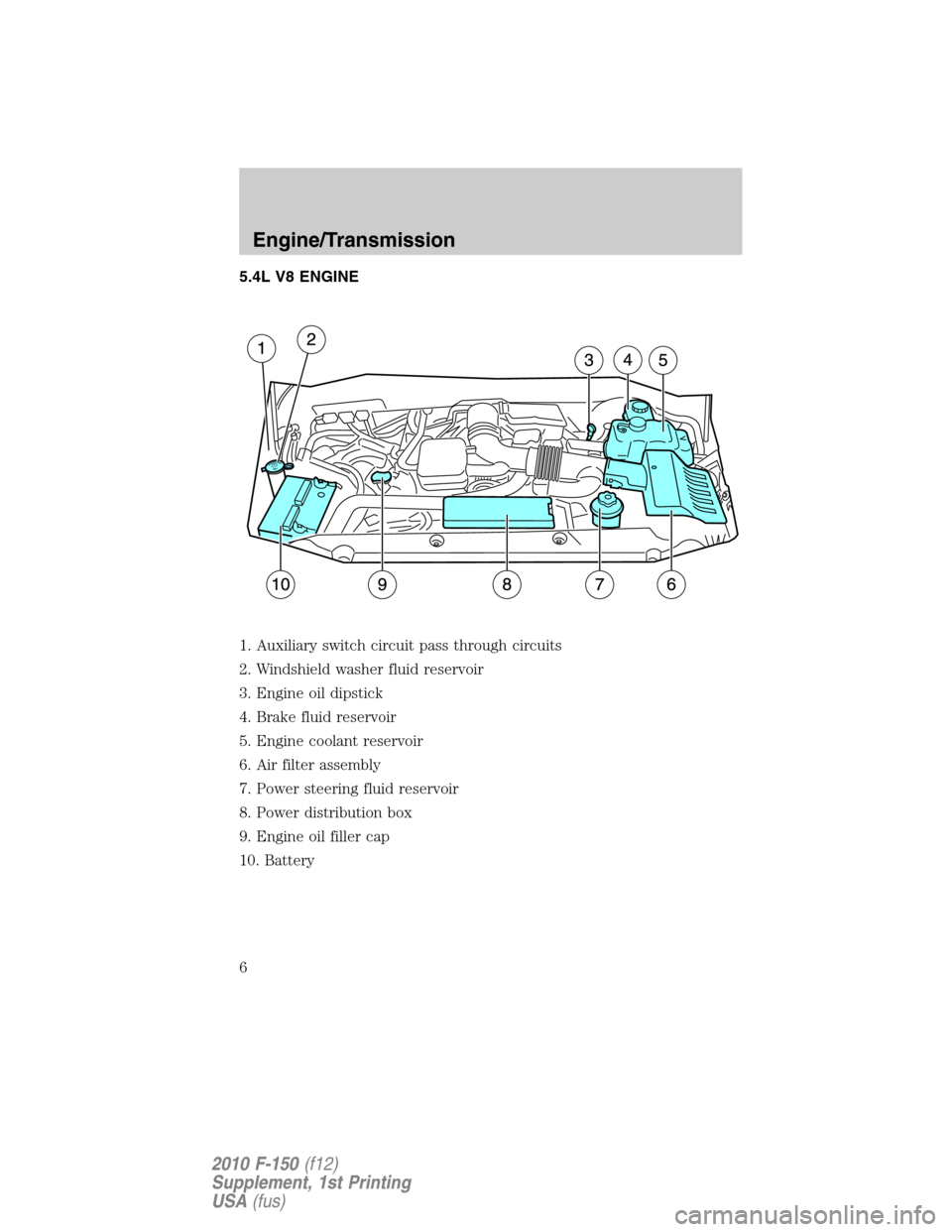
5.4L V8 ENGINE
1. Auxiliary switch circuit pass through circuits
2. Windshield washer fluid reservoir
3. Engine oil dipstick
4. Brake fluid reservoir
5. Engine coolant reservoir
6. Air filter assembly
7. Power steering fluid reservoir
8. Power distribution box
9. Engine oil filler cap
10. Battery
Engine/Transmission
6
2010 F-150(f12)
Supplement, 1st Printing
USA(fus)
Page 7 of 57
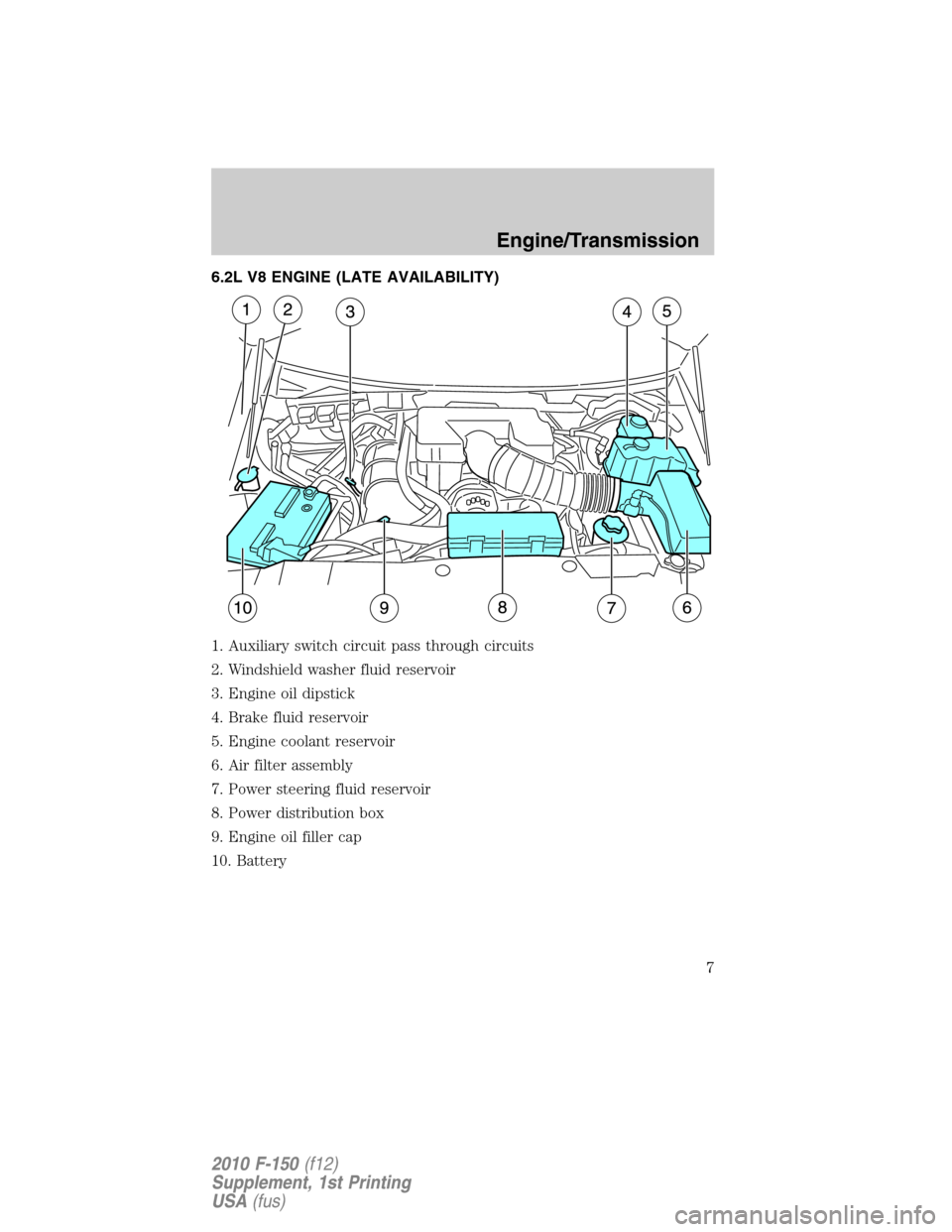
6.2L V8 ENGINE (LATE AVAILABILITY)
1. Auxiliary switch circuit pass through circuits
2. Windshield washer fluid reservoir
3. Engine oil dipstick
4. Brake fluid reservoir
5. Engine coolant reservoir
6. Air filter assembly
7. Power steering fluid reservoir
8. Power distribution box
9. Engine oil filler cap
10. Battery
Engine/Transmission
7
2010 F-150(f12)
Supplement, 1st Printing
USA(fus)
Page 8 of 57
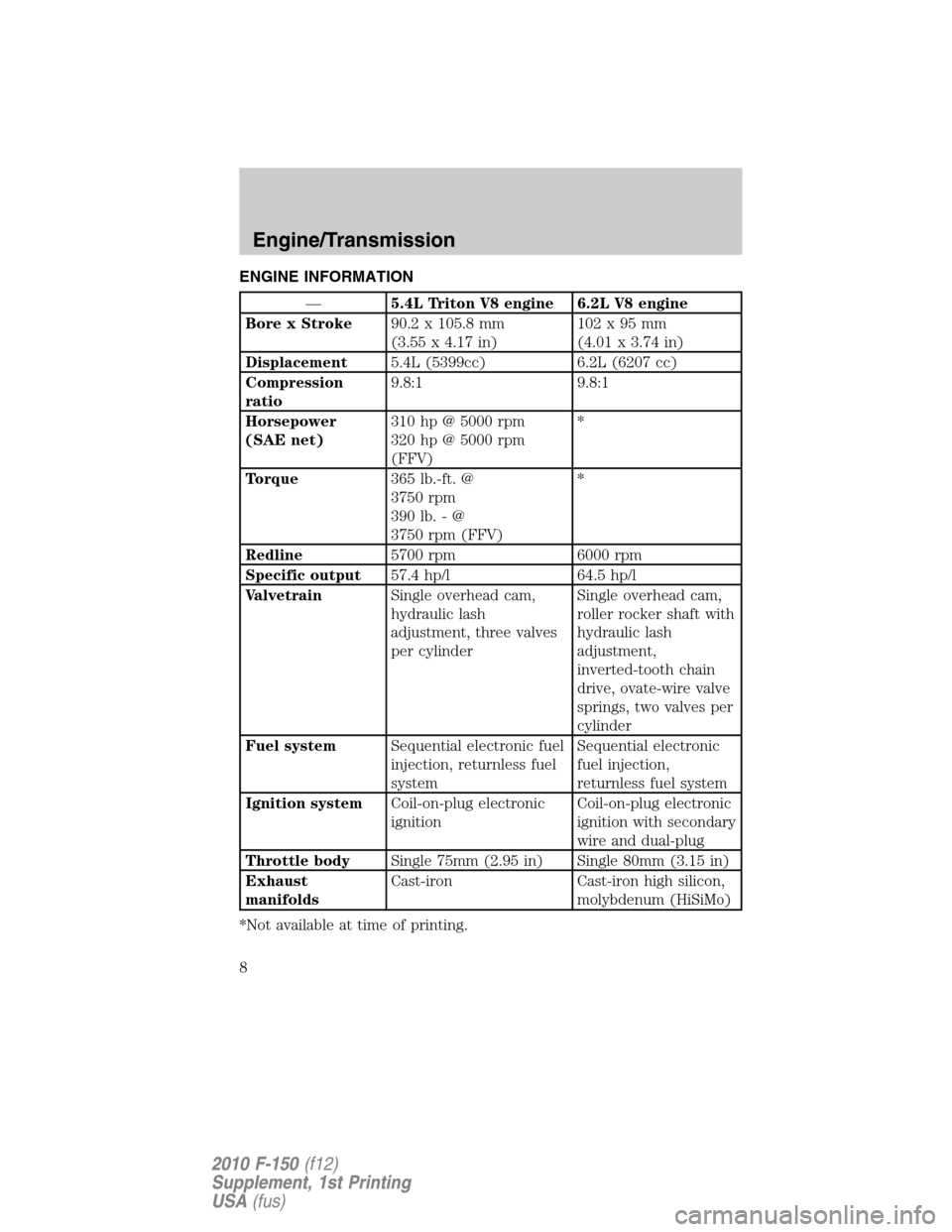
ENGINE INFORMATION
—5.4L Triton V8 engine 6.2L V8 engine
Bore x Stroke90.2 x 105.8 mm
(3.55 x 4.17 in)102x95mm
(4.01 x 3.74 in)
Displacement5.4L (5399cc) 6.2L (6207 cc)
Compression
ratio9.8:1 9.8:1
Horsepower
(SAE net)310 hp @ 5000 rpm
320 hp @ 5000 rpm
(FFV)*
Torque365 lb.-ft. @
3750 rpm
390 lb. - @
3750 rpm (FFV)*
Redline5700 rpm 6000 rpm
Specific output57.4 hp/l 64.5 hp/l
ValvetrainSingle overhead cam,
hydraulic lash
adjustment, three valves
per cylinderSingle overhead cam,
roller rocker shaft with
hydraulic lash
adjustment,
inverted-tooth chain
drive, ovate-wire valve
springs, two valves per
cylinder
Fuel systemSequential electronic fuel
injection, returnless fuel
systemSequential electronic
fuel injection,
returnless fuel system
Ignition systemCoil-on-plug electronic
ignitionCoil-on-plug electronic
ignition with secondary
wire and dual-plug
Throttle bodySingle 75mm (2.95 in) Single 80mm (3.15 in)
Exhaust
manifoldsCast-iron Cast-iron high silicon,
molybdenum (HiSiMo)
*Not available at time of printing.
Engine/Transmission
8
2010 F-150(f12)
Supplement, 1st Printing
USA(fus)
Page 22 of 57
MOTORCRAFT PART NUMBERS
Component 5.4L Triton V8 engine 6.2L V8 engine
Air filter element FA-1883 FA-1883
Battery BTX-59 or BTX-65-650
1BTX-59 or
BTX-65-6501
Oil filter FL-820S FL-820S
Spark plugs22
1
Heavy-duty battery, if equipped
2For spark plug replacement, see your authorized dealer. Refer to
scheduled maintenance informationfor the appropriate intervals for
changing the spark plugs.
Replace the spark plugs with ones that meet Ford material and
design specifications for your vehicle, such as Motorcraft or
equivalent replacement parts. The customer warranty may be
void for any damage to the engine if such spark plugs are not
used.
Maintenance
22
2010 F-150(f12)
Supplement, 1st Printing
USA(fus)
Page 23 of 57
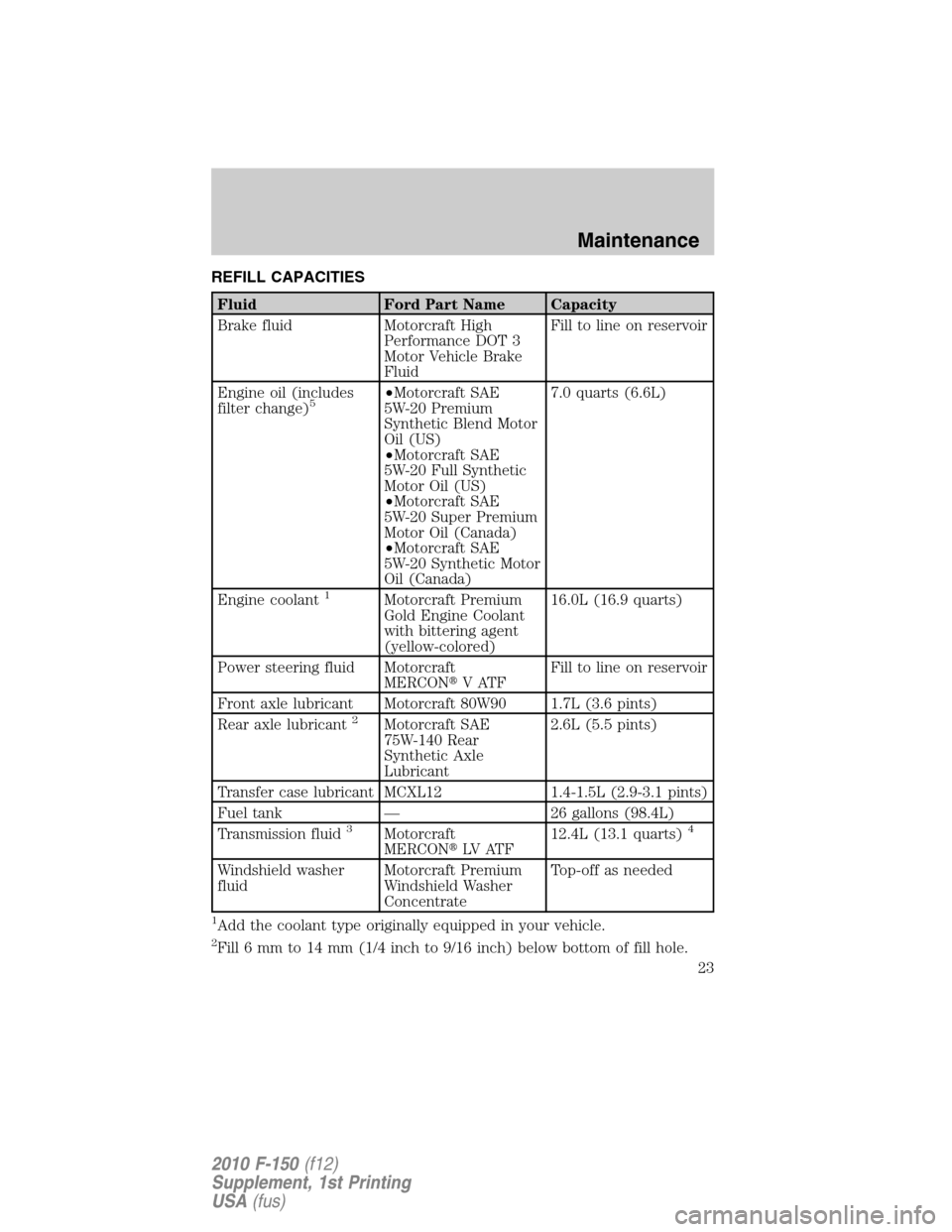
REFILL CAPACITIES
Fluid Ford Part Name Capacity
Brake fluid Motorcraft High
Performance DOT 3
Motor Vehicle Brake
FluidFill to line on reservoir
Engine oil (includes
filter change)
5•Motorcraft SAE
5W-20 Premium
Synthetic Blend Motor
Oil (US)
•Motorcraft SAE
5W-20 Full Synthetic
Motor Oil (US)
•Motorcraft SAE
5W-20 Super Premium
Motor Oil (Canada)
•Motorcraft SAE
5W-20 Synthetic Motor
Oil (Canada)7.0 quarts (6.6L)
Engine coolant
1Motorcraft Premium
Gold Engine Coolant
with bittering agent
(yellow-colored)16.0L (16.9 quarts)
Power steering fluid Motorcraft
MERCON�VATFFill to line on reservoir
Front axle lubricant Motorcraft 80W90 1.7L (3.6 pints)
Rear axle lubricant
2Motorcraft SAE
75W-140 Rear
Synthetic Axle
Lubricant2.6L (5.5 pints)
Transfer case lubricant MCXL12 1.4-1.5L (2.9-3.1 pints)
Fuel tank — 26 gallons (98.4L)
Transmission fluid
3Motorcraft
MERCON�LV AT F12.4L (13.1 quarts)4
Windshield washer
fluidMotorcraft Premium
Windshield Washer
ConcentrateTop-off as needed
1Add the coolant type originally equipped in your vehicle.
2Fill 6 mm to 14 mm (1/4 inch to 9/16 inch) below bottom of fill hole.
Maintenance
23
2010 F-150(f12)
Supplement, 1st Printing
USA(fus)
Page 24 of 57
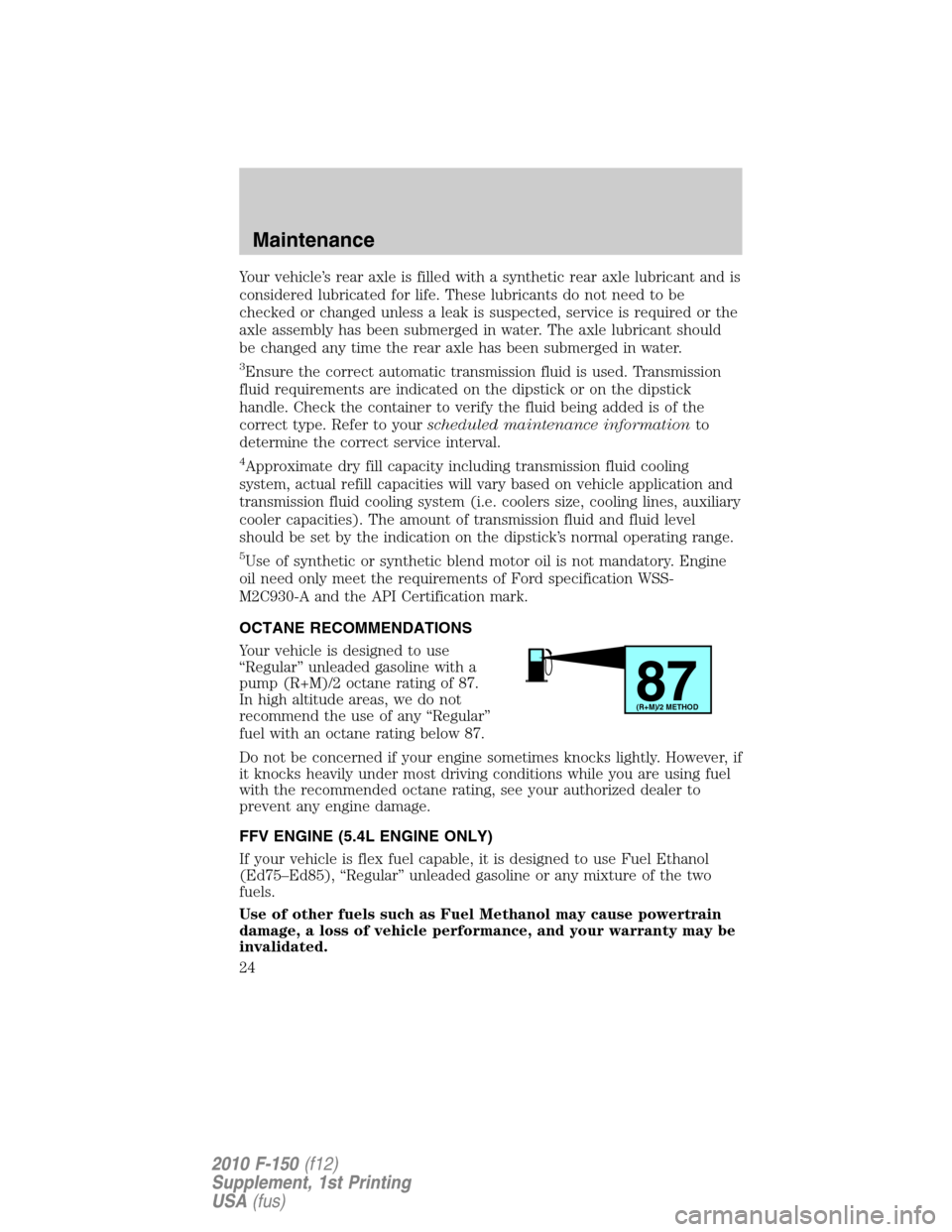
Your vehicle’s rear axle is filled with a synthetic rear axle lubricant and is
considered lubricated for life. These lubricants do not need to be
checked or changed unless a leak is suspected, service is required or the
axle assembly has been submerged in water. The axle lubricant should
be changed any time the rear axle has been submerged in water.
3Ensure the correct automatic transmission fluid is used. Transmission
fluid requirements are indicated on the dipstick or on the dipstick
handle. Check the container to verify the fluid being added is of the
correct type. Refer to yourscheduled maintenance informationto
determine the correct service interval.
4Approximate dry fill capacity including transmission fluid cooling
system, actual refill capacities will vary based on vehicle application and
transmission fluid cooling system (i.e. coolers size, cooling lines, auxiliary
cooler capacities). The amount of transmission fluid and fluid level
should be set by the indication on the dipstick’s normal operating range.
5Use of synthetic or synthetic blend motor oil is not mandatory. Engine
oil need only meet the requirements of Ford specification WSS-
M2C930-A and the API Certification mark.
OCTANE RECOMMENDATIONS
Your vehicle is designed to use
“Regular” unleaded gasoline with a
pump (R+M)/2 octane rating of 87.
In high altitude areas, we do not
recommend the use of any “Regular”
fuel with an octane rating below 87.
Do not be concerned if your engine sometimes knocks lightly. However, if
it knocks heavily under most driving conditions while you are using fuel
with the recommended octane rating, see your authorized dealer to
prevent any engine damage.
FFV ENGINE (5.4L ENGINE ONLY)
If your vehicle is flex fuel capable, it is designed to use Fuel Ethanol
(Ed75–Ed85), “Regular” unleaded gasoline or any mixture of the two
fuels.
Use of other fuels such as Fuel Methanol may cause powertrain
damage, a loss of vehicle performance, and your warranty may be
invalidated.
87(R+M)/2 METHOD
Maintenance
24
2010 F-150(f12)
Supplement, 1st Printing
USA(fus)
Page 32 of 57
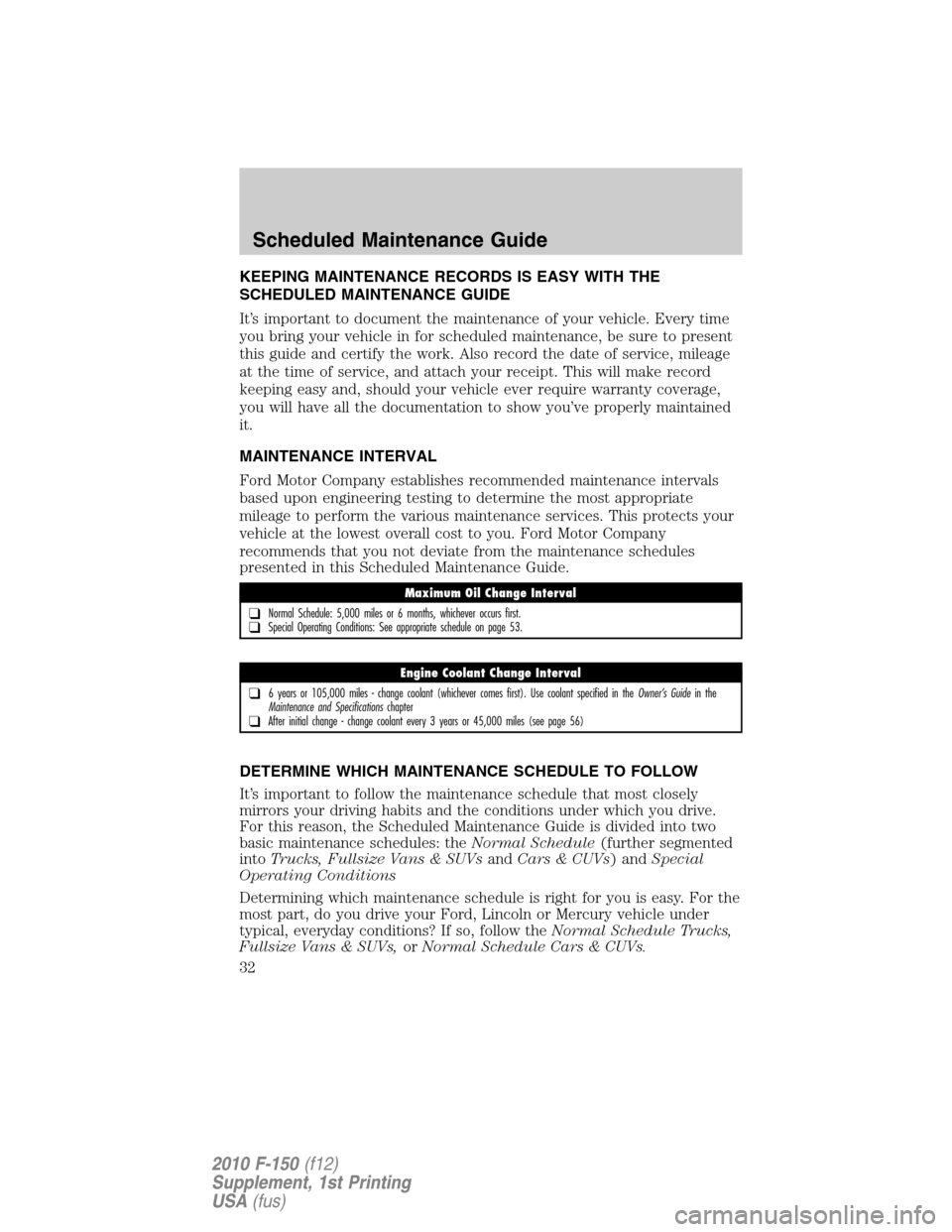
KEEPING MAINTENANCE RECORDS IS EASY WITH THE
SCHEDULED MAINTENANCE GUIDE
It’s important to document the maintenance of your vehicle. Every time
you bring your vehicle in for scheduled maintenance, be sure to present
this guide and certify the work. Also record the date of service, mileage
at the time of service, and attach your receipt. This will make record
keeping easy and, should your vehicle ever require warranty coverage,
you will have all the documentation to show you’ve properly maintained
it.
MAINTENANCE INTERVAL
Ford Motor Company establishes recommended maintenance intervals
based upon engineering testing to determine the most appropriate
mileage to perform the various maintenance services. This protects your
vehicle at the lowest overall cost to you. Ford Motor Company
recommends that you not deviate from the maintenance schedules
presented in this Scheduled Maintenance Guide.
DETERMINE WHICH MAINTENANCE SCHEDULE TO FOLLOW
It’s important to follow the maintenance schedule that most closely
mirrors your driving habits and the conditions under which you drive.
For this reason, the Scheduled Maintenance Guide is divided into two
basic maintenance schedules: theNormal Schedule(further segmented
intoTrucks, Fullsize Vans & SUVsandCars & CUVs) andSpecial
Operating Conditions
Determining which maintenance schedule is right for you is easy. For the
most part, do you drive your Ford, Lincoln or Mercury vehicle under
typical, everyday conditions? If so, follow theNormal Schedule Trucks,
Fullsize Vans & SUVs,orNormal Schedule Cars & CUVs.
Maximum Oil Change Interval
❑Normal Schedule: 5,000 miles or 6 months, whichever occurs first.❑Special Operating Conditions: See appropriate schedule on page 53.
Engine Coolant Change Interval
❑6 years or 105,000 miles - change coolant (whichever comes first). Use coolant specified in theOwner’s Guidein theMaintenance and Specificationschapter❑After initial change - change coolant every 3 years or 45,000 miles (see page 56)
Scheduled Maintenance Guide
32
2010 F-150(f12)
Supplement, 1st Printing
USA(fus)