Page 365 of 484
WARNING!
•Take care to avoid the radiator cooling fan when-
ever the hood is raised. It can start anytime the
ignition switch is on. You can be injured by
moving fan blades.
•Remove any metal jewelry such as watch bands or
bracelets that might make an inadvertent electrical
contact. You could be seriously injured.
•Batteries contain sulfuric acid that can burn your
skin or eyes and generate hydrogen gas which is
flammable and explosive. Keep open flames or
sparks away from the battery.
1. Set the parking brake, shift the automatic transmission
into PARK and turn the ignition to LOCK.
2. Turn off the heater, radio, and all unnecessary electri-
cal accessories. 3. If using another vehicle to jump-start the battery, park
the vehicle within the jumper cables reach, set the
parking brake and make sure the ignition is OFF.
WARNING!
Do not allow vehicles to touch each other as this
could establish a ground connection and personal
injury could result.
Jump-Starting Procedure
WARNING!
Failure to follow this procedure could result in per-
sonal injury or property damage due to battery ex-
plosion.
364 WHAT TO DO IN EMERGENCIES
Page 366 of 484
CAUTION!
Failure to follow these procedures could result in
damage to the charging system of the booster vehicle
or the discharged vehicle.
1. Connect the positive (+)end of the jumper cable to the
remote positive (+)post of the discharged vehicle.
2. Connect the opposite end of the positive (+)jumper
cable to the positive (+)post of the booster battery.
3. Connect the negative end (-)of the jumper cable to the
negative (-)post of the booster battery.
4. Connect the opposite end of the negative (-)jumper
cable to the remote negative (-)post of the vehicle with
the discharged battery.
WARNING!
Do not connect the cable to the negative post (-) of the
discharged battery. The resulting electrical spark
could cause the battery to explode and could result in
personal injury.
5. Start the engine in the vehicle that has the booster
battery, let the engine idle a few minutes, and then start
the engine in the vehicle with the discharged battery.
Once the engine is started, remove the jumper cables in
the reverse sequence:
6. Disconnect the negative (-)jumper cable from the
remote negative (-)post of the vehicle with the dis-
charged battery.
7. Disconnect the negative end (-)of the jumper cable
from the negative (-)post of the booster battery.
6
WHAT TO DO IN EMERGENCIES 365
Page 367 of 484
8. Disconnect the opposite end of the positive(+)jumper
cable from the positive (+)post of the booster battery.
9. Disconnect the positive (+)end of the jumper cable
from the remote positive (+)post of the discharged
vehicle.
If frequent jump-starting is required to start your vehicle
you should have the battery and charging system in-
spected at your authorized dealer.
CAUTION!
Accessories that can be plugged into the vehicle
power outlets draw power from the vehicle’s battery,
even when not in use (i.e., cellular phones, etc.).
Eventually, if plugged in long enough, the vehicle’s
battery will discharge sufficiently to degrade battery
life and/or prevent the engine from starting.
FREEING A STUCK VEHICLE
If your vehicle becomes stuck in mud, sand, or snow, it
can often be moved by a rocking motion. Turn your
steering wheel right and left to clear the area around the
front wheels. Then shift back and forth between RE-
VERSE and DRIVE. Using minimal accelerator pedal
pressure to maintain the rocking motion, without spin-
ning the wheels, is most effective.
NOTE: Turn off the Electronic Stability Program (ESP)
— if equipped, or Traction Control System (TCS) — if
equipped before rocking the vehicle. Refer to “Electronic
Brake Control” in “Starting and Operating” for further
information.
366 WHAT TO DO IN EMERGENCIES
Page 374 of 484
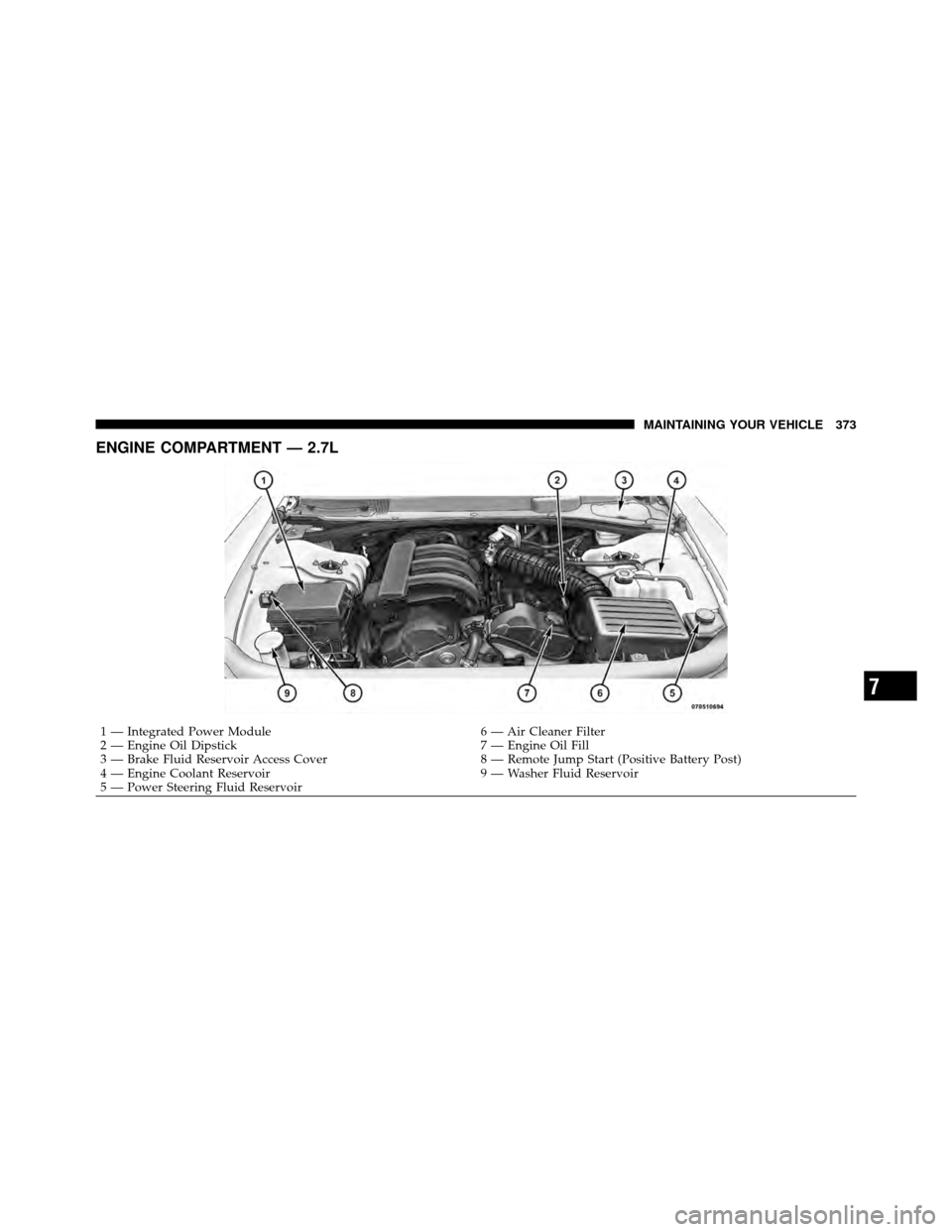
ENGINE COMPARTMENT — 2.7L
1 — Integrated Power Module6 — Air Cleaner Filter
2 — Engine Oil Dipstick 7 — Engine Oil Fill
3 — Brake Fluid Reservoir Access Cover 8 — Remote Jump Start (Positive Battery Post)
4 — Engine Coolant Reservoir 9 — Washer Fluid Reservoir
5 — Power Steering Fluid Reservoir
7
MAINTAINING YOUR VEHICLE 373
Page 375 of 484
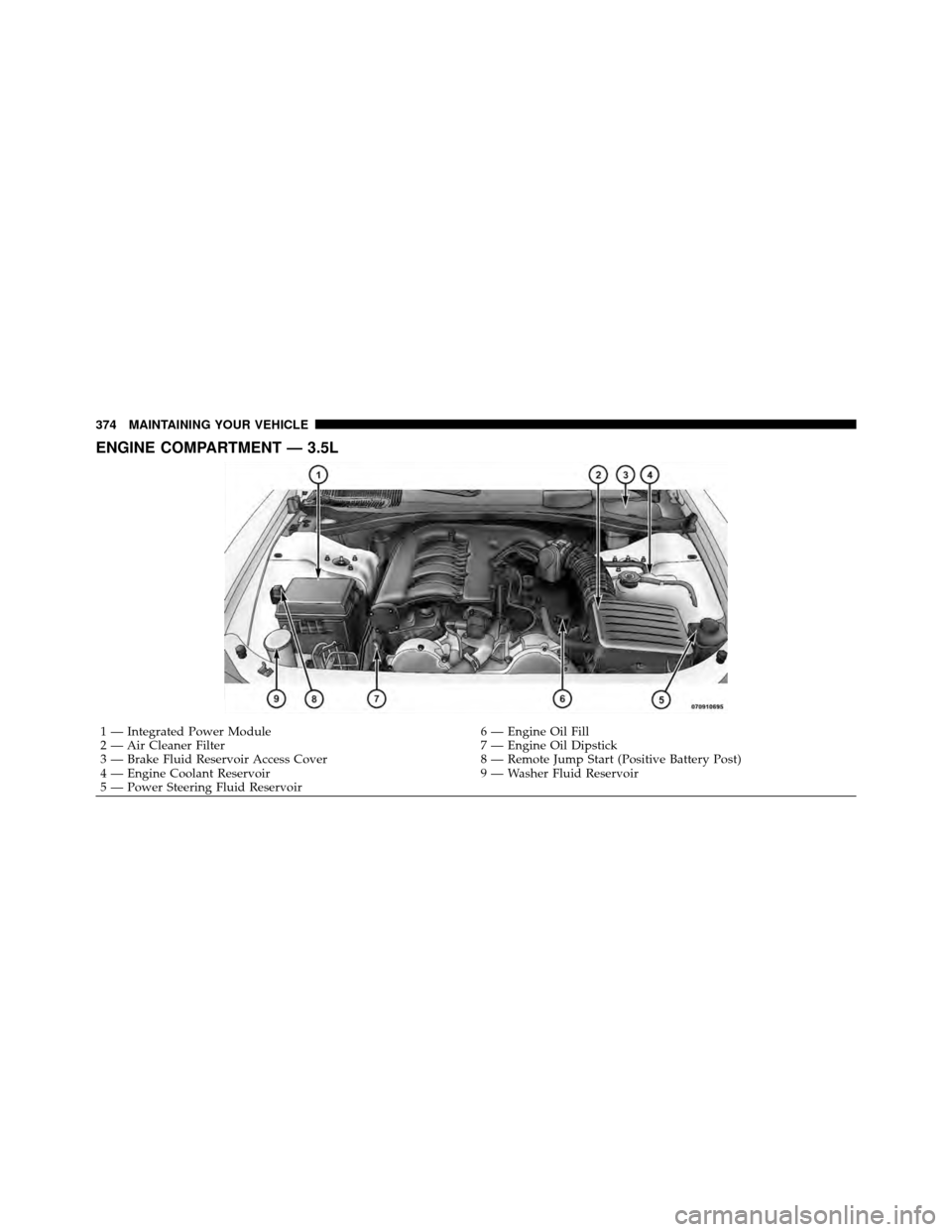
ENGINE COMPARTMENT — 3.5L
1 — Integrated Power Module6 — Engine Oil Fill
2 — Air Cleaner Filter 7 — Engine Oil Dipstick
3 — Brake Fluid Reservoir Access Cover 8 — Remote Jump Start (Positive Battery Post)
4 — Engine Coolant Reservoir 9 — Washer Fluid Reservoir
5 — Power Steering Fluid Reservoir
374 MAINTAINING YOUR VEHICLE
Page 376 of 484
ENGINE COMPARTMENT — 5.7L
1 — Integrated Power Module6 — Air Cleaner Filter
2 — Coolant Pressure Cap 7 — Engine Oil Fill
3 — Brake Fluid Reservoir Access Cover 8 — Engine Oil Dipstick
4 — Engine Coolant Reservoir 9 — Remote Jump Start (Positive Battery Post)
5 — Power Steering Fluid Reservoir 10 — Washer Fluid Reservoir
7
MAINTAINING YOUR VEHICLE 375
Page 385 of 484
Engine Air Cleaner Filter
Refer to “Maintenance Schedule” for further information.
WARNING!
The air induction system (air cleaner, hoses, etc.) can
provide a measure of protection in the case of engine
backfire. Do not remove the air induction system (air
cleaner, hoses, etc.) unless such removal is necessary
for repair or maintenance. Make sure that no one is
near the engine compartment before starting the
vehicle with the air induction system (air cleaner,
hoses, etc.) removed. Failure to do so can result in
serious personal injury.
Engine Air Cleaner Filter Selection
The quality of replacement engine air cleaner filters
varies considerably. Only high quality filters should be
used to assure most efficient service. MOPAR�engine air
cleaner filters are a high quality filter and are
recommended.
Maintenance-Free Battery
Your vehicle is equipped with a maintenance-free battery.
You will never have to add water, nor is periodic main-
tenance required.
NOTE: The battery is stored under an access cover in
the trunk. Remote battery terminals are located in the
engine compartment for jump starting. Refer to “Jump-
Starting Procedures” in “What To Do In Emergencies” for
further information.
384 MAINTAINING YOUR VEHICLE
Page 468 of 484
Jacking............................. 351
Jump Starting ......................... 362
Overheating .......................... 350
Towing ............................. 367
Emergency Trunk Release ................... 40
Emission Control System Maintenance ......377,432
Engine .......................... 373,374,375
Air Cleaner .......................... 384
Block Heater ......................... 265
Break-In Recommendations ................ 77
Checking Oil Level ..................... 380
Compartment ................... 373,374,375
Coolant (Antifreeze) ................. 394,428
Cooling ............................. 393
Exhaust Gas Caution .................. 78,330
Fails to Start .......................... 264
Flooded, Starting ...................... 264
Fuel Requirements ..................... 326
Jump Starting ......................... 362 Multi-Displacement
.................... 287
Oil ........................... 380,426,428
Oil Change Interval ...............180,189,381
Oil Filler Cap ......................... 382
Oil Filter ............................ 383
Oil Filter Disposal ..................... 383
Oil Selection ....................... 381,426
Oil Synthetic ......................... 383
Overheating .......................... 350
Temperature Gauge .................... 174
Engine Oil Viscosity ...................... 382
Enhanced Accident Response Feature .......... 62
Entry System, Illuminated .................. 19
Ethanol ............................... 327
Exhaust Gas Caution ................... 78,330
Exhaust System ....................... 78,391
Exterior Folding Mirrors ................... 89
Exterior Lighting ........................ 134
Exterior Lights .......................... 81
10
INDEX 467