Page 231 of 368

WARNING!
•Do not use a tire, wheel size or rating other than
that specified for your vehicle. Some combinations
of unapproved tires and wheels may change sus-
pension dimensions and performance characteris-
tics, resulting in changes to steering, handling, and
braking of your vehicle. This can cause unpredict-
able handling and stress to steering and suspen-
sion components. You could lose control and have
an accident resulting in serious injury or death.
Use only the tire and wheel sizes with load ratings
approved for your vehicle.
•Never use a tire with a smaller load index or
capacity, other than what was originally equipped
on your vehicle. Using a tire with a smaller load
index could result in tire overloading and failure.
You could lose control and have an accident.(Continued)
WARNING! (Continued)
•Failure to equip your vehicle with tires having
adequate speed capability can result in sudden tire
failure and loss of vehicle control.
CAUTION!
Replacing original tires with tires of a different size
may result in false speedometer and odometer read-
ings.
230 STARTING AND OPERATING
Page 232 of 368

TIRE CHAINS
Due to limited clearance, tire chains are not recom-
mended.
CAUTION!
Damage to the vehicle may result if tire chains are
used.
SNOW TIRES
Some areas of the country require the use of snow tires
during Winter. Standard tires are of the all-season type
and satisfy this requirement as indicated by the M+S
designation on the tire sidewall.
If you need snow tires, select tires equivalent in size and
type to the original equipment tires. Use snow tires only
in sets of four; failure to do so may adversely affect the
safety and handling of your vehicle.Snow tires generally have lower speed ratings than what
was originally equipped with your vehicle and should
not be operated at sustained speeds over 75 mph
(120 km/h).
TIRE ROTATION RECOMMENDATIONS
Tires on the front and rear axles of vehicles operate at
different loads and perform different steering, driving,
and braking functions. For these reasons, they wear at
unequal rates.
These effects can be reduced by timely rotation of tires.
The benefits of rotation are especially worthwhile with
aggressive tread designs such as those on all season type
tires. Rotation will increase tread life, help to maintain
mud, snow and wet traction levels, and contribute to a
smooth, quiet ride.
5
STARTING AND OPERATING 231
Page 249 of 368

Weight-Distributing Hitch
A weight-distributing hitch system works by applying
leverage through spring (load) bars. They are typically
used for heavier loads, to distribute trailer tongue weight
to the tow vehicle’s front axle and the trailer axle(s).
When used in accordance with the manufacturer’s direc-
tions, it provides for a more level ride, offering more
consistent steering and brake control thereby enhancing
towing safety. The addition of a friction/hydraulic sway
control also dampens sway caused by traffic and cross-
winds and contributes positively to tow vehicle and
trailer stability. Trailer sway control and a weight-
distributing (load equalizing) hitch are recommended for
heavier tongue weights (TW) and may be required de-
pending on Vehicle and Trailer configuration/loading to
comply with gross axle weight rating GAWR require-
ments.WARNING!
An improperly adjusted Weight-Distributing Hitch
system may reduce handling, stability, braking per-
formance, and could result in an accident.
Weight-Distributing Systems may not be compatible with
surge brake couplers. Consult with your hitch and trailer
manufacturer or a reputable recreational vehicle dealer
for additional information.
Trailer Hitch Classification
Your vehicle may be factory equipped for safe towing of
trailers weighing over 1,000 lbs (454 kg) with the optional
Trailer Tow Prep Package. See your authorized dealer
service center for package content.
248 STARTING AND OPERATING
Page 253 of 368

CAUTION!
•Do not tow a trailer at all during the first 500 miles
(805 km) the new vehicle is driven. The engine,
axle or other parts could be damaged.
•Then, during the first 500 miles (805 km) that a
trailer is towed, do not drive over 50 mph
(80 km/h) and do not make starts at full throttle.
This helps the engine and other parts of the
vehicle wear in at the heavier loads.
Perform the maintenance listed in the “Maintenance
Schedule.” When towing a trailer, never exceed the
GAWR, or GCWR ratings. Refer to “Maintenance Sched-
ule” for further information.
WARNING!
•Improper towing can lead to an injury accident.
•Make certain that the load is secured in the trailer
and will not shift during travel. When trailering
cargo that is not fully secured, dynamic load shifts
can occur that may be difficult for the driver to
control. You could lose control of your vehicle and
have an accident.
•When hauling cargo or towing a trailer, do not over-
load your vehicle or trailer. Overloading can cause a
loss of control, poor performance or damage to brakes,
axle, engine, transmission, steering, suspension, chas-
sis structure or tires.
•Safety chains must always be used between your
vehicle and trailer. Always connect the chains to the
252 STARTING AND OPERATING
Page 273 of 368

8. Disconnect the opposite end of the positive(+)jumper
cable from the positive (+)post of the booster battery.
9. Disconnect the positive (+)end of the jumper cable
from the positive (+)post of the discharged vehicle.
If frequent jump-starting is required to start your vehicle
you should have the battery and charging system in-
spected at your authorized dealer.
CAUTION!
Accessories that can be plugged into the vehicle
power outlets draw power from the vehicle’s battery,
even when not in use (i.e., cellular phones, etc.).
Eventually, if plugged in long enough, the vehicle’s
battery will discharge sufficiently to degrade battery
life and/or prevent the engine from starting.
FREEING A STUCK VEHICLE
NOTE: If your vehicle is equipped with Traction Con-
trol, turn the system OFF before attempting to “rock” the
vehicle.
If your vehicle becomes stuck in mud, sand or snow, it
can often be moved by a rocking motion. Turn your
steering wheel right and left to clear the area around the
front wheels. Then shift back-and-forth between RE-
VERSE and DRIVE (automatic transaxle) or REVERSE
and 1st gear (manual transaxle). Using, the least accel-
erator pedal pressure to maintain the rocking motion
without spinning the wheels is most effective.
272 WHAT TO DO IN EMERGENCIES
Page 274 of 368

WARNING!
Fast spinning tires can be dangerous. Forces gener-
ated by excessive wheel speeds may cause tire dam-
age or failure. A tire could explode and injure some-
one. Do not spin your vehicle’s wheels faster than
30 mph (48 km/h) when you are stuck. And do not let
anyone near a spinning wheel, no matter what the
speed.
CAUTION!
Racing the engine or spinning the wheels too fast
may lead to transaxle overheating and failure. It can
also damage the tires. Do not spin the wheels above
30 mph (48 km/h).
TOWING A DISABLED VEHICLE
Towing With The Key-In-Ignition
Four-Speed Automatic Transaxle
Your vehicle may be towed under the following condi-
tions: The steering column must be unlocked and the
shift lever must be in NEUTRAL, the distance to be
towed must not exceed 100 miles (160 km), and the
towing speed must not exceed 44 mph (72 km/h). If the
transaxle is not operative, or if the vehicle is to be towed
more than 100 miles (160 km), the vehicle must be towed
with the front wheels off the ground to avoid damage to
the transaxle.
Manual Transaxle
Your vehicle may be towed in a forward direction, with
all four wheels on the ground, and the shift lever in the
NEUTRAL position. If the transaxle is not operative, the
vehicle must be towed with the front wheels off the
ground.
6
WHAT TO DO IN EMERGENCIES 273
Page 275 of 368

All Transaxles
CAUTION!
If the vehicle being towed requires steering, the
ignition switch must be in the ACC position, not in
the LOCK position.
Do not attempt to use sling-type equipment when
towing. When securing the vehicle to a flatbed truck,
do not attach it to front or rear suspension compo-
nents. Damage to your vehicle may result from
improper towing.
If it is necessary to use the accessories while being towed
(wipers, defrosters, etc.), the key must be in the ON
position, not the ACC position. Make certain the trans-
axle remains in NEUTRAL.
Towing Without The Key-In-Ignition
Special care must be taken when the vehicle is towed
with the ignition in the LOCK position. A dolly should be
used under the front wheels if the rear wheels are raised.
Proper towing equipment is necessary to prevent dam-
age to the vehicle.
Towing Behind Another Vehicle (Flat Towing with
all four wheels on the ground)
If your vehicle is equipped with a manual transaxle, it
may be towed in a forward direction, at any legal
highway speed, for any distance, if the transaxle is in
NEUTRAL.
If the ignition key is not available, vehicles with auto-
matic transaxles can not be flat towed at any time.
274 WHAT TO DO IN EMERGENCIES
Page 278 of 368
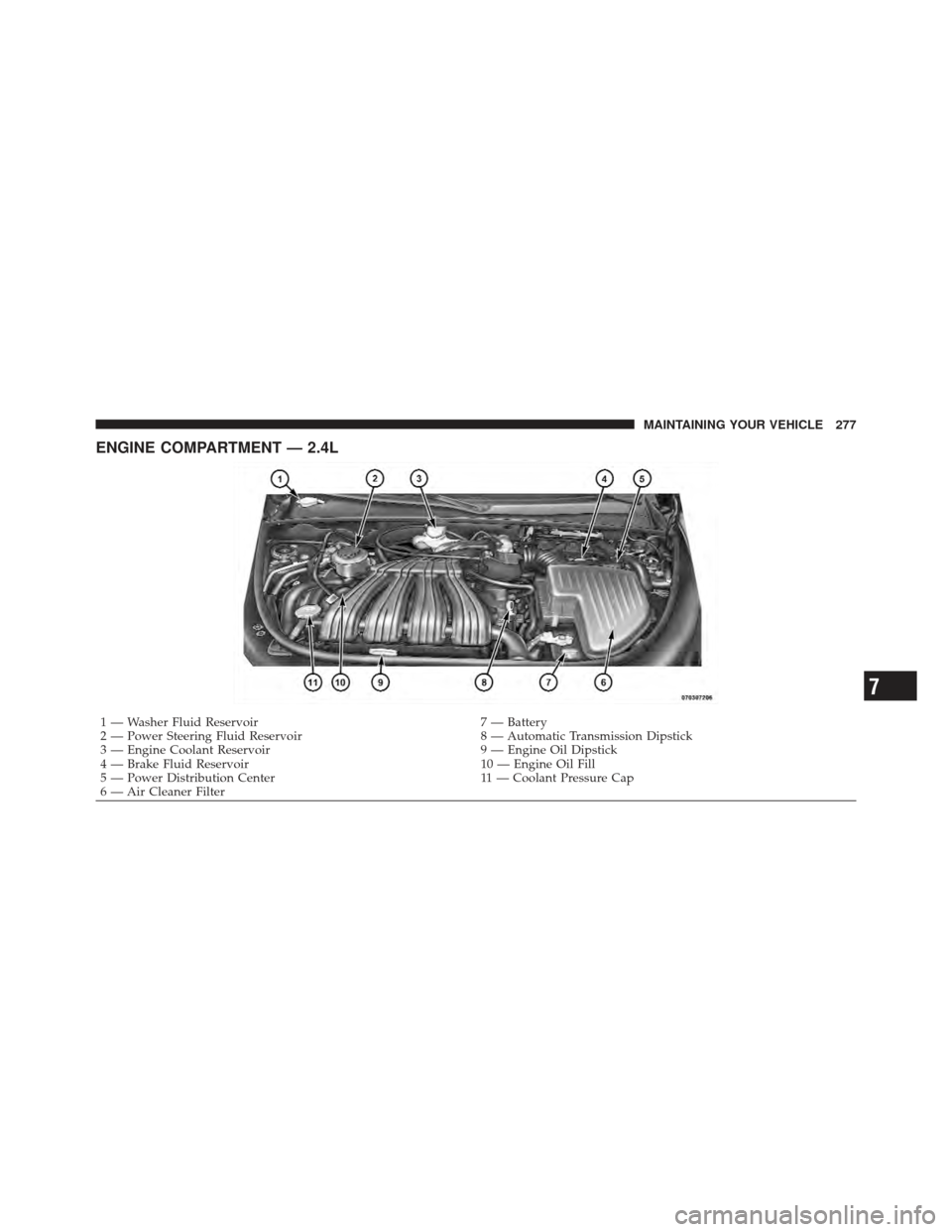
ENGINE COMPARTMENT — 2.4L
1 — Washer Fluid Reservoir7 — Battery
2 — Power Steering Fluid Reservoir 8 — Automatic Transmission Dipstick
3 — Engine Coolant Reservoir 9 — Engine Oil Dipstick
4 — Brake Fluid Reservoir 10 — Engine Oil Fill
5 — Power Distribution Center 11 — Coolant Pressure Cap
6 — Air Cleaner Filter
7
MAINTAINING YOUR VEHICLE 277