2010 CHEVROLET IMPALA tire pressure
[x] Cancel search: tire pressurePage 356 of 432
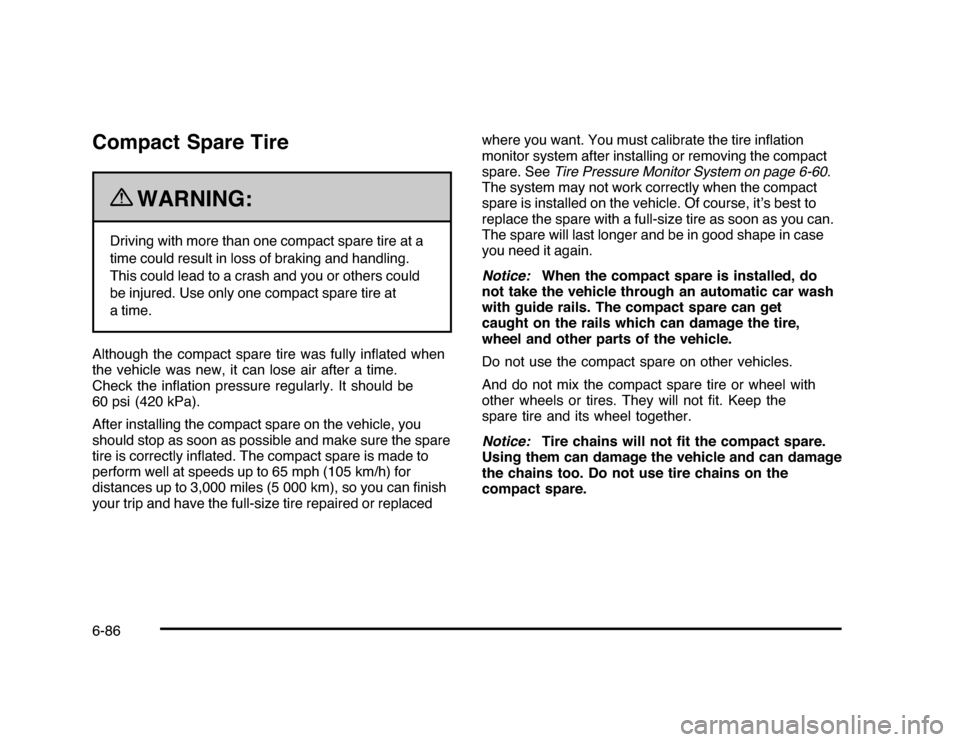
Compact Spare Tire
{
WARNING:
Driving with more than one compact spare tire at a
time could result in loss of braking and handling.
This could lead to a crash and you or others could
be injured. Use only one compact spare tire at
a time.
Although the compact spare tire was fully inflated when
the vehicle was new, it can lose air after a time.
Check the inflation pressure regularly. It should be
60 psi (420 kPa).
After installing the compact spare on the vehicle, you
should stop as soon as possible and make sure the spare
tire is correctly inflated. The compact spare is made to
perform well at speeds up to 65 mph (105 km/h) for
distances up to 3,000 miles (5 000 km), so you can finish
your trip and have the full-size tire repaired or replacedwhere you want. You must calibrate the tire inflation
monitor system after installing or removing the compact
spare. SeeTire Pressure Monitor System on page 6-60.
The system may not work correctly when the compact
spare is installed on the vehicle. Of course, it’s best to
replace the spare with a full-size tire as soon as you can.
The spare will last longer and be in good shape in case
you need it again.
Notice:When the compact spare is installed, do
not take the vehicle through an automatic car wash
with guide rails. The compact spare can get
caught on the rails which can damage the tire,
wheel and other parts of the vehicle.
Do not use the compact spare on other vehicles.
And do not mix the compact spare tire or wheel with
other wheels or tires. They will not fit. Keep the
spare tire and its wheel together.
Notice:Tire chains will not fit the compact spare.
Using them can damage the vehicle and can damage
the chains too. Do not use tire chains on the
compact spare.
6-86
Page 376 of 432

MaintenanceI•
Change engine oil and filter. SeeEngine Oil on
page 6-15.An Emission Control Service.
•
Engine coolant level check. SeeEngine Coolant on
page 6-25.
•
Windshield washer fluid level check. SeeWindshield
Washer Fluid on page 6-33.
•
Tire inflation check. SeeInflation - Tire Pressure on
page 6-59.
•
Tire wear inspection. SeeTire Inspection and
Rotation on page 6-65.
•
Rotate tires. SeeTire Inspection and Rotation on
page 6-65.
•
Fluids visual leak check (or every 12 months,
whichever occurs first). A leak in any system must
be repaired and the fluid level checked.
•
Engine air cleaner filter inspection (vehicles driven
in dusty conditions only). SeeEngine Air
Cleaner/Filter on page 6-19.
•
Brake system inspection (or every 12 months,
whichever occurs first).
MaintenanceII•
Perform all services described in MaintenanceI.
•
Steering and suspension inspection. Visual
inspection for damaged, loose, or missing parts or
signs of wear.
•
Engine cooling system inspection. Visual inspection
of hoses, pipes, fittings, and clamps and
replacement, if needed.
•
Windshield wiper blade inspection for wear,
cracking, or contamination and windshield and wiper
blade cleaning, if contaminated. SeeWindshield
and Wiper Blades on page 6-92. Worn or damaged
wiper blade replacement. SeeWindshield Wiper
Blade Replacement on page 6-49.
•
Body hinges and latches, key lock cylinders, folding
seat hardware, and rear compartment hinges
lubrication. SeeRecommended Fluids and
Lubricants on page 7-10. More frequent lubrication
may be required when vehicle is exposed to a
corrosive environment. Applying silicone grease on
weatherstrips with a clean cloth makes them last
longer, seal better, and not stick or squeak.
•
Restraint system component check. SeeChecking
the Restraint Systems on page 2-74.
7-4
Page 377 of 432

•
Automatic transmission fluid level check and adding
fluid, if needed. SeeAutomatic Transmission Fluid
on page 6-22.
•
Engine air cleaner filter inspection. SeeEngine Air
Cleaner/Filter on page 6-19.
•
Passenger compartment air filter replacement
(or every 12 months, whichever occurs first).
More frequent replacement may be required if
vehicle is driven regularly under dusty conditions.
Additional Required ServicesAt Each Fuel Stop
•
Engine oil level check. SeeEngine Oil on
page 6-15.
•
Engine coolant level check. SeeEngine Coolant on
page 6-25.
•
Windshield washer fluid level check. SeeWindshield
Washer Fluid on page 6-33.
Once a Month
•
Tire inflation check. SeeInflation - Tire Pressure on
page 6-59.
•
Tire wear inspection. SeeTire Inspection and
Rotation on page 6-65.
Once a Year
•
Starter switch check. SeeOwner Checks and
Services on page 7-8.
•
Parking brake and automatic transmission P (Park)
mechanism check. SeeOwner Checks and
Services on page 7-8.
•
Automatic transmission shiftlock control system
check. SeeOwner Checks and Services on
page 7-8.
•
Ignition transmission lock check. SeeOwner
Checks and Services on page 7-8.
•
Engine cooling system and pressure cap pressure
check. Radiator and air conditioning condenser
outside cleaning. SeeCooling System on
page 6-24.
•
Exhaust system and nearby heat shields inspection
for loose or damaged components.
•
Throttle system inspection for interference, binding
or for damaged or missing parts. Replace parts as
needed. Replace any components that have
high effort or excessive wear. Do not lubricate
accelerator or cruise control cables.
7-5
Page 379 of 432
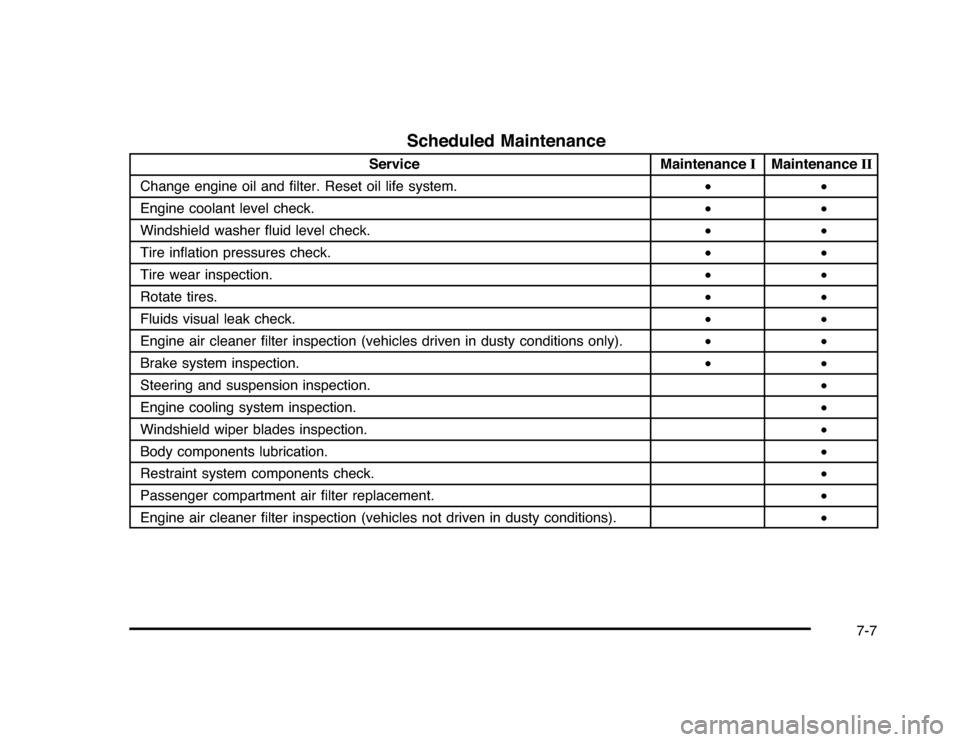
Scheduled Maintenance
Service MaintenanceIMaintenanceII
Change engine oil and filter. Reset oil life system.••
Engine coolant level check.••
Windshield washer fluid level check.••
Tire inflation pressures check.••
Tire wear inspection.••
Rotate tires.••
Fluids visual leak check.••
Engine air cleaner filter inspection (vehicles driven in dusty conditions only).••
Brake system inspection.••
Steering and suspension inspection.•
Engine cooling system inspection.•
Windshield wiper blades inspection.•
Body components lubrication.•
Restraint system components check.•
Passenger compartment air filter replacement.•
Engine air cleaner filter inspection (vehicles not driven in dusty conditions).•
7-7
Page 408 of 432
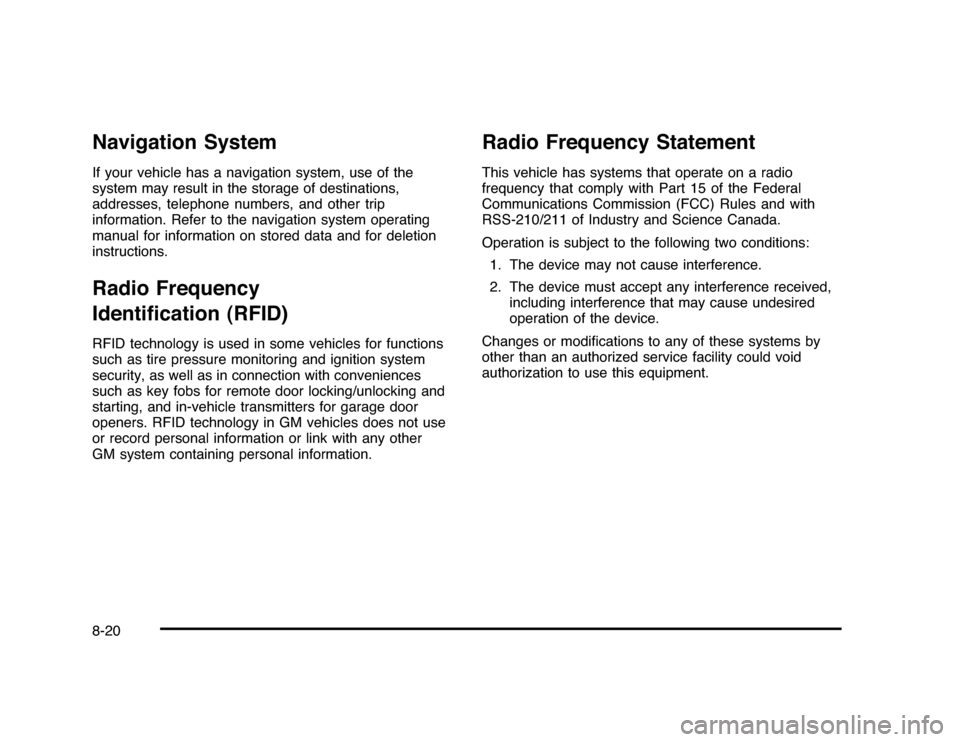
Navigation SystemIf your vehicle has a navigation system, use of the
system may result in the storage of destinations,
addresses, telephone numbers, and other trip
information. Refer to the navigation system operating
manual for information on stored data and for deletion
instructions.Radio Frequency
Identification (RFID)RFID technology is used in some vehicles for functions
such as tire pressure monitoring and ignition system
security, as well as in connection with conveniences
such as key fobs for remote door locking/unlocking and
starting, and in-vehicle transmitters for garage door
openers. RFID technology in GM vehicles does not use
or record personal information or link with any other
GM system containing personal information.
Radio Frequency StatementThis vehicle has systems that operate on a radio
frequency that comply with Part 15 of the Federal
Communications Commission (FCC) Rules and with
RSS-210/211 of Industry and Science Canada.
Operation is subject to the following two conditions:
1. The device may not cause interference.
2. The device must accept any interference received,
including interference that may cause undesired
operation of the device.
Changes or modifications to any of these systems by
other than an authorized service facility could void
authorization to use this equipment.
8-20
Page 415 of 432
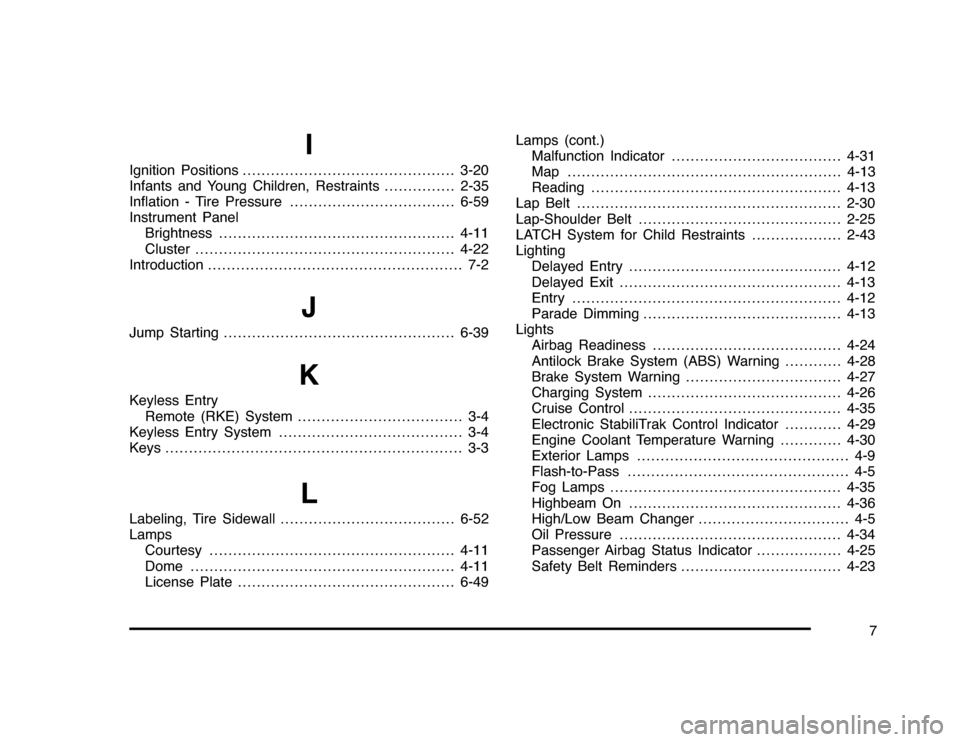
I
Ignition Positions.............................................3-20
Infants and Young Children, Restraints...............2-35
Inflation - Tire Pressure . . .................................6-59
Instrument Panel
Brightness..................................................4-11
Cluster . . .....................................................4-22
Introduction...................................................... 7-2
J
Jump Starting . . ...............................................6-39
K
Keyless Entry
Remote (RKE) System . .................................. 3-4
Keyless Entry System....................................... 3-4
Keys . . . . ........................................................... 3-3
L
Labeling, Tire Sidewall.....................................6-52
Lamps
Courtesy . . . . ................................................4-11
Dome . . . . . ...................................................4-11
License Plate..............................................6-49Lamps (cont.)
Malfunction Indicator....................................4-31
Map ..........................................................4-13
Reading.....................................................4-13
Lap Belt........................................................2-30
Lap-Shoulder Belt...........................................2-25
LATCH System for Child Restraints . . .................2-43
Lighting
Delayed Entry.............................................4-12
Delayed Exit...............................................4-13
Entry.........................................................4-12
Parade Dimming..........................................4-13
Lights
Airbag Readiness........................................4-24
Antilock Brake System (ABS) Warning . . . . . . . . . . . . 4-28
Brake System Warning . . . . .............................4-27
Charging System.........................................4-26
Cruise Control.............................................4-35
Electronic StabiliTrak Control Indicator . . . . . . . . . . . . 4-29
Engine Coolant Temperature Warning.............4-30
Exterior Lamps . . ........................................... 4-9
Flash-to-Pass............................................... 4-5
Fog Lamps.................................................4-35
Highbeam On.............................................4-36
High/Low Beam Changer................................ 4-5
Oil Pressure...............................................4-34
Passenger Airbag Status Indicator . . . ...............4-25
Safety Belt Reminders..................................4-23
7
Page 416 of 432
Lights (cont.)
Security .....................................................4-35
Tire Pressure . . ............................................4-31
Traction Control System (TCS) Warning..........4-28
Loading Your Vehicle.......................................5-20
Locks
Automatic Door Lock....................................3-10
Delayed Locking..........................................3-10
Door . . . ........................................................ 3-9
Lockout Protection.......................................3-12
Power Door . . . . ............................................3-10
Programmable Automatic Door Unlock............3-11
Rear Door Security Locks . . . . . ........................3-11
Loss of Control...............................................5-11
Lower Anchors and Tethers for Children . ............2-43
Lumbar
Manual Controls............................................ 2-5
M
Maintenance Schedule
Maintenance Record....................................7-13
Maintenance Replacement Parts....................7-11
Owner Checks and Services........................... 7-8
Recommended Fluids and Lubricants . ............7-10
Scheduled Maintenance................................. 7-3
Malfunction Indicator Lamp...............................4-31
Manual Lumbar Controls.................................... 2-5Manual Seats................................................... 2-4
Map Lamps....................................................4-13
Message
DIC Warnings and Messages........................4-44
Mirrors
Automatic Dimming Rearview........................3-33
Manual Rearview.........................................3-33
Outside Convex Mirror.................................3-34
Outside Heated Mirrors................................3-34
Outside Power Mirrors..................................3-34
MP3 .............................................................4-68
N
Navigation System, Privacy..............................8-20
Net, Convenience...........................................3-42
New Vehicle Break-In......................................3-19
O
Odometer......................................................4-23
Off-Road
Recovery....................................................5-11
Oil
Engine.......................................................6-15
Engine Oil Life System.................................6-18
Pressure Light.............................................4-34
8
Page 420 of 432

Split Folding Rear Seat....................................2-10
StabiliTrak Control Indicator Light, Electronic.......4-29
Start Vehicle, Remote....................................... 3-7
Starting the Engine.........................................3-21
Steering.......................................................... 5-9
Steering Wheel Controls, Audio.........................4-84
Steering Wheel, Tilt Wheel................................. 4-3
Storage Areas
Center Console...........................................3-42
Convenience Net.........................................3-42
Cupholders . . . . . . ...........................................3-42
Glove Box . . . . . . . . . . ........................................3-42
Rear . . . . . . . ...................................................3-42
Rear Seat Armrest.......................................3-42
Sunglasses Storage Compartment..................3-42
Stuck in Sand, Mud, Ice, or Snow.....................5-19
Sun Visors .....................................................3-16
Sunroof . . . . . ....................................................3-43
T
Tachometer ....................................................4-23
Taillamps
Turn Signal, Sidemarker, Stoplamps, and
Back-Up Lamps.......................................6-47
Text Telephone (TTY) Users............................... 8-6Theft-Deterrent Feature....................................4-84
Theft-Deterrent Systems...................................3-16
Content Theft-Deterrent................................3-17
PASS-Key
®
III+ Electronic Immobilizer............3-18
PASS-Key
®
III+ Electronic Immobilizer
Operation................................................3-18
Tilt Wheel........................................................ 4-3
Time, Setting..................................................4-58
Tires . . ...........................................................6-51
Aluminum Wheels, Cleaning..........................6-93
Buying New Tires........................................6-68
Chains.......................................................6-73
Changing a Flat Tire....................................6-75
Cleaning....................................................6-93
Compact Spare...........................................6-86
Different Size . . ............................................6-69
If a Tire Goes Flat.......................................6-74
Inflation - Tire Pressure................................6-59
Inspection and Rotation................................6-65
Installing the Spare Tire................................6-77
Pressure Light.............................................4-31
Pressure Monitor Operation ...........................6-62
Pressure Monitor System..............................6-60
Removing the Flat Tire.................................6-77
Removing the Spare Tire and Tools...............6-76
Sidewall Labeling.........................................6-52
12