Page 274 of 432
California Proposition 65 WarningMost motor vehicles, including this one, contain and/or
emit chemicals known to the State of California to
cause cancer and birth defects or other reproductive
harm. Engine exhaust, many parts and systems,
many fluids, and some component wear by-products
contain and/or emit these chemicals.California Perchlorate Materials
RequirementsCertain types of automotive applications, such as
airbag initiators, seat belt pretensioners, and lithium
batteries contained in remote keyless transmitters,
may contain perchlorate materials. Special handling
may be necessary. For additional information, see
www.dtsc.ca.gov/hazardouswaste/perchlorate.
Doing Your Own Service Work
{
WARNING:
You can be injured and the vehicle could be
damaged if you try to do service work on a vehicle
without knowing enough about it.
•
Be sure you have sufficient knowledge,
experience, the proper replacement parts,
and tools before attempting any vehicle
maintenance task.
•
Be sure to use the proper nuts, bolts, and
other fasteners. English and metric fasteners
can be easily confused. If the wrong fasteners
are used, parts can later break or fall off.
You could be hurt.
If doing some of your own service work, use the proper
service manual. It tells you much more about how to
service the vehicle than this manual can. To order
the proper service manual, seeService Publications
Ordering Information on page 8-17.
6-4
Page 275 of 432
This vehicle has an airbag system. Before attempting
to do your own service work, seeServicing Your
Airbag-Equipped Vehicle on page 2-72.
Keep a record with all parts receipts and list the
mileage and the date of any service work performed.
SeeMaintenance Record on page 7-13.Adding Equipment to the Outside of
the VehicleThings added to the outside of the vehicle can affect the
airflow around it. This can cause wind noise and can
affect fuel economy and windshield washer performance.
Check with your dealer/retailer before adding equipment
to the outside of the vehicle.FuelUse of the recommended fuel is an important part of the
proper maintenance of this vehicle. To help keep the
engine clean and maintain optimum vehicle performance,
we recommend the use of gasoline advertised as TOP
TIER Detergent Gasoline.
Look for the TOP TIER label on the fuel pump to ensure
gasoline meets enhanced detergency standards
developed by auto companies. A list of marketers
providing TOP TIER Detergent Gasoline can be found
at www.toptiergas.com.The 8th digit of the Vehicle Identification Number (VIN)
shows the code letter or number that identifies the
vehicle’s engine. The VIN is at the top left of the
instrument panel. SeeVehicle Identification Number
(VIN) on page 6-95.
If the vehicle has the 3.5L V6 engine (VIN Code K) or
the 3.9L V6 engine (VIN Code M), you can use
either unleaded gasoline or ethanol fuel containing up to
85% ethanol (E85). SeeFuel E85 (85% Ethanol) on
page 6-8. In all other engines, use only the unleaded
gasoline described underGasoline Octane on page 6-6.
6-5
Page 290 of 432
When to Inspect the Engine Air
Cleaner/FilterInspect the air cleaner/filter at the MaintenanceII
intervals and replace it at the first oil change after each
50,000 mile (80 000 km) interval. SeeScheduled
Maintenance on page 7-3for more information. If you
are driving in dusty/dirty conditions, inspect the filter
at each engine oil change.How to Inspect the Engine Air
Cleaner/FilterTo inspect the air cleaner/filter, remove the filter from
the vehicle and lightly shake the filter to release
loose dust and dirt. If the filter remains caked with dirt, a
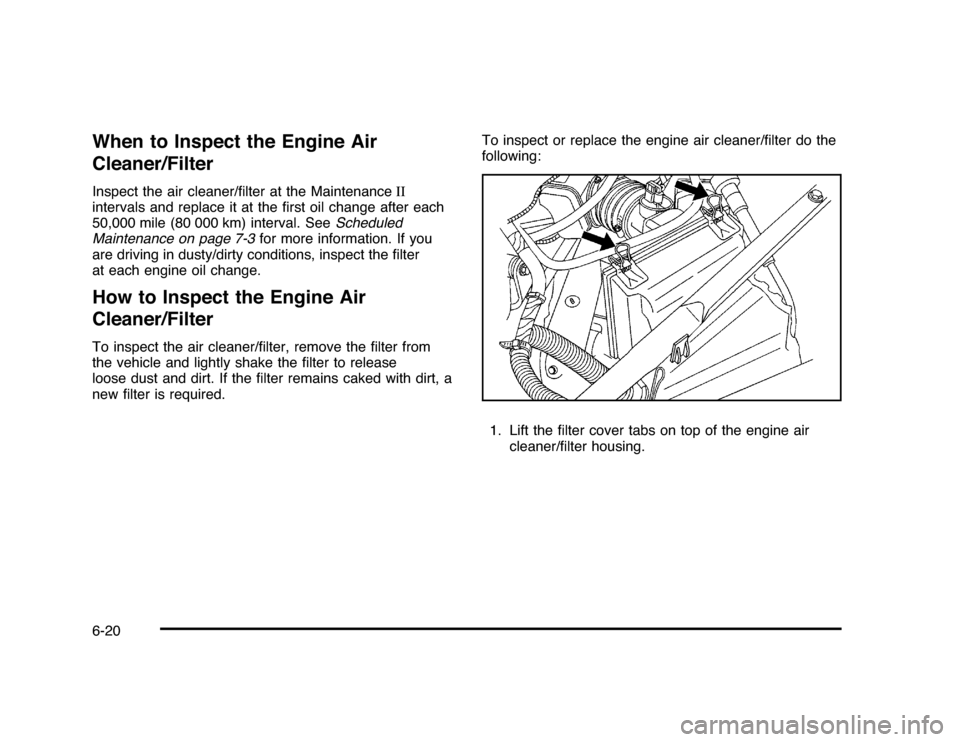
new filter is required.To inspect or replace the engine air cleaner/filter do the
following:
1. Lift the filter cover tabs on top of the engine air
cleaner/filter housing.6-20
Page 292 of 432

Automatic Transmission FluidWhen to Check and Change Automatic
Transmission FluidA good time to check your automatic transmission fluid
level is when the engine oil is changed.
Change the fluid and filter at the intervals listed in
Scheduled Maintenance on page 7-3, and be sure to
use the transmission fluid listed inRecommended Fluids
and Lubricants on page 7-10.How to Check Automatic Transmission
FluidBecause this operation can be a little difficult, you may
choose to have this done at the dealer/retailer service
department.
If you do it yourself, be sure to follow all the instructions
here, or you could get a false reading on the dipstick.Notice:Too much or too little fluid can damage
your transmission. Too much can mean that some
of the fluid could come out and fall on hot engine
parts or exhaust system parts, starting a fire.
Too little fluid could cause the transmission to
overheat. Be sure to get an accurate reading if you
check your transmission fluid.
Wait at least 30 minutes before checking the
transmission fluid level if you have been driving:
•
When outside temperatures are above 32°C (90°F).
•
At high speed for quite a while.
•
In heavy traffic — especially in hot weather.
•
While pulling a trailer.
To get the right reading, the fluid should be at normal
operating temperature, which is 82°C to 93°C
(180°F to 200°F).
Get the vehicle warmed up by driving about 24 km
(15 miles) when outside temperatures are above 10°C
(50°F). If it is colder than 10°C (50°F), you may have to
drive longer.
6-22
Page 294 of 432

How to Add FluidRefer to the Maintenance Schedule to determine what
kind of transmission fluid to use. SeeRecommended
Fluids and Lubricants on page 7-10.
If the fluid level is low, add only enough of the proper
fluid to bring the level into the cross-hatched area on the
dipstick.
1. Pull out the dipstick.
2. Using a long-neck funnel, add enough fluid at the
dipstick hole to bring it to the proper level.
It does not take much fluid, generally less than
one pint (0.5 L). Do not overfill.
Notice:Use of the incorrect automatic transmission
fluid may damage the vehicle, and the damages
may not be covered by the vehicle’s warranty.
Always use the automatic transmission fluid listed
inRecommended Fluids and Lubricants on
page 7-10.
3. After adding fluid, recheck the fluid level as
described under “How to Check Automatic
Transmission Fluid,” earlier in this section.
4. When the correct fluid level is obtained, push the
dipstick back in all the way.
Cooling SystemThe Cooling System allows the engine to maintain the
correct working temperature.
A. Coolant Recovery Tank
B. Pressure Cap
C. Electric Engine Cooling Fans3.5L V6 Engine shown, 3.9L Engine similar
6-24
Page 319 of 432
License Plate LampTo replace one of these bulbs:
1. Turn the lamp assembly counterclockwise and pull
the lamp assembly out of the connector.
2. Pull the old bulb from the lamp assembly, keeping
the bulb straight as you pull it out.
3. Install the new bulb.
4. Reverse Steps 1 through 3 to reinstall the license
plate lamp.Replacement Bulbs
Exterior Lamp Bulb Number
Back-Up 921
Front Parking/Turn Signal 3157NAK
License Plate Lamp 194
Headlamps
High-Beam H9
Low-Beam H11
Sidemarker 194
Stoplamp, Taillamp, and Turn
Signal3057
For replacement bulbs not listed here, contact your
dealer/retailer.
Windshield Wiper Blade
ReplacementWindshield wiper blades should be inspected for wear
or cracking. SeeScheduled Maintenance on page 7-3
for more information on wiper blade inspection.
Replacement blades come in different types and are
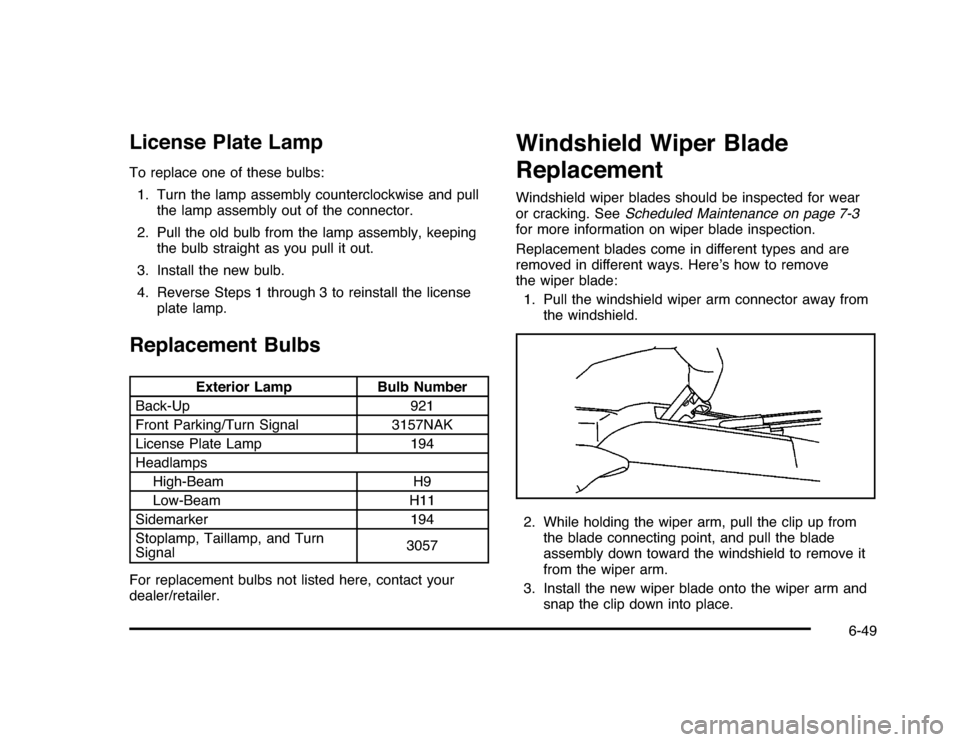
removed in different ways. Here’s how to remove
the wiper blade:
1. Pull the windshield wiper arm connector away from
the windshield.
2. While holding the wiper arm, pull the clip up from
the blade connecting point, and pull the blade
assembly down toward the windshield to remove it
from the wiper arm.
3. Install the new wiper blade onto the wiper arm and
snap the clip down into place.
6-49
Page 320 of 432
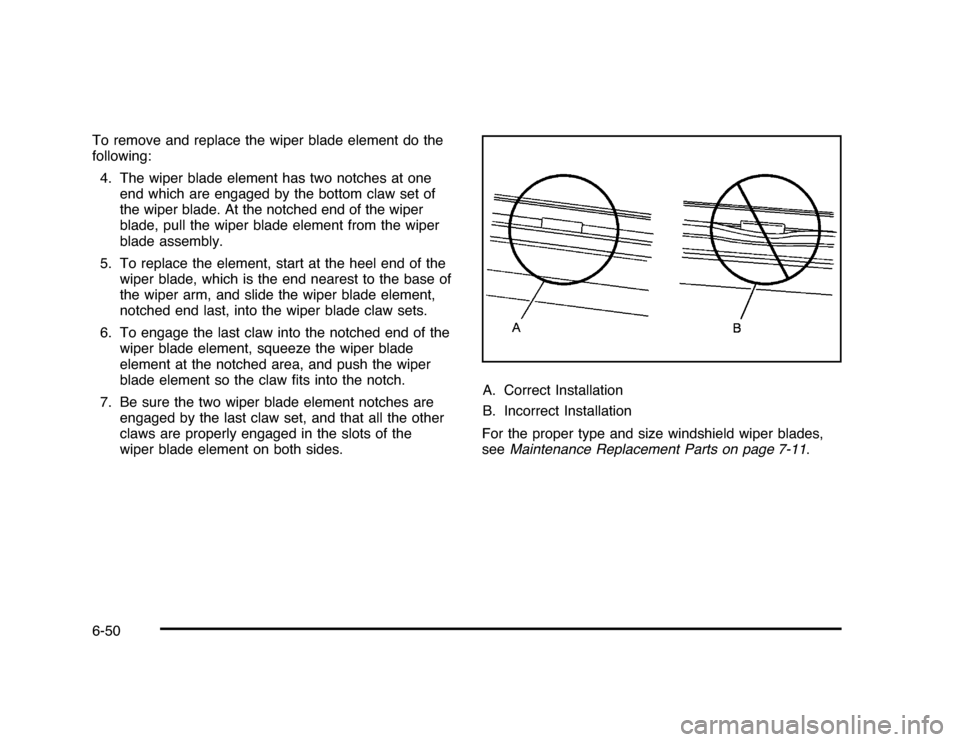
To remove and replace the wiper blade element do the
following:
4. The wiper blade element has two notches at one
end which are engaged by the bottom claw set of
the wiper blade. At the notched end of the wiper
blade, pull the wiper blade element from the wiper
blade assembly.
5. To replace the element, start at the heel end of the
wiper blade, which is the end nearest to the base of
the wiper arm, and slide the wiper blade element,
notched end last, into the wiper blade claw sets.
6. To engage the last claw into the notched end of the
wiper blade element, squeeze the wiper blade
element at the notched area, and push the wiper
blade element so the claw fits into the notch.
7. Be sure the two wiper blade element notches are
engaged by the last claw set, and that all the other
claws are properly engaged in the slots of the
wiper blade element on both sides.A. Correct Installation
B. Incorrect Installation
For the proper type and size windshield wiper blades,
seeMaintenance Replacement Parts on page 7-11.6-50
Page 331 of 432
Accordingly, when the low tire pressure telltale
illuminates, you should stop and check your tires as
soon as possible, and inflate them to the proper
pressure. Driving on a significantly under-inflated tire
causes the tire to overheat and can lead to tire failure.
Under-inflation also reduces fuel efficiency and tire
tread life, and may affect the vehicle’s handling
and stopping ability.
Please note that the TPMS is not a substitute for proper
tire maintenance, and it is the driver’s responsibility to
maintain correct tire pressure, even if under-inflation
has not reached the level to trigger illumination of
the TPMS low tire pressure telltale.
Your vehicle has also been equipped with a TPMS
malfunction indicator to indicate when the system is not
operating properly. The TPMS malfunction indicator is
combined with the low tire pressure telltale. When
the system detects a malfunction, the telltale will flash
for approximately one minute and then remain
continuously illuminated. This sequence will continue
upon subsequent vehicle start-ups as long as the
malfunction exists.When the malfunction indicator is illuminated, the
system may not be able to detect or signal low tire
pressure as intended. TPMS malfunctions may occur
for a variety of reasons, including the installation
of replacement or alternate tires or wheels on the vehicle
that prevent the TPMS from functioning properly.
Always check the TPMS malfunction telltale after
replacing one or more tires or wheels on your vehicle
to ensure that the replacement or alternate tires
and wheels allow the TPMS to continue to function
properly.
SeeTire Pressure Monitor Operation on page 6-62for
additional information.
Federal Communications Commission
(FCC) and Industry and Science CanadaSeeRadio Frequency Statement on page 8-20for
information regarding Part 15 of the Federal
Communications Commission (FCC) Rules and
RSS-210/211 of Industry and Science Canada.
6-61