Page 378 of 472
Tire Terminology and Definitions
Air Pressure:The amount of air inside the tire
pressing outward on each square inch of the tire.
Air pressure is expressed in pounds per square
inch (psi) or kilopascal (kPa).
Accessory Weight
:This means the combined
weight of optional accessories. Some examples of
optional accessories are, automatic transmission,
power steering, power brakes, power windows,
power seats, and air conditioning.
Aspect Ratio
:The relationship of a tire's height
to its width.
Belt
:A rubber coated layer of cords that is
located between the plies and the tread. Cords
may be made from steel or other reinforcing
materials.
Bead
:The tire bead contains steel wires wrapped
by steel cords that hold the tire onto the rim.
Bias Ply Tire
:A pneumatic tire in which the plies
are laid at alternate angles less than 90 degrees
to the centerline of the tread. Cold Tire Pressure
:The amount of air pressure
in a tire, measured in pounds per square inch (psi)
or kilopascals (kPa) before a tire has built up heat
from driving. See Inflation - Tire Pressure
on
page 6‑70
.
Curb Weight
:The weight of a motor vehicle with
standard and optional equipment including the
maximum capacity of fuel, oil, and coolant, but
without passengers and cargo.
DOT Markings
:A code molded into the sidewall
of a tire signifying that the tire is in compliance
with the U.S. Department of Transportation (DOT)
motor vehicle safety standards. The DOT code
includes the Tire Identification Number (TIN), an
alphanumeric designator which can also identify
the tire manufacturer, production plant, brand, and
date of production.
GVWR
:Gross Vehicle Weight Rating.
See Loading the Vehicle
on page 5‑28.
GAWR FRT
:Gross Axle Weight Rating for the
front axle. See Loading the Vehicle
on page 5‑28.
GAWR RR
:Gross Axle Weight Rating for the rear
axle. See Loading the Vehicle
on page 5‑28.
6-66
Page 401 of 472
If a Tire Goes Flat
It is unusual for a tire to blow out while you are driving,
especially if you maintain the tires properly. If air goes
out of a tire, it is much more likely to leak out slowly.
See Tires
on page 6‑62for additional information.
But if you should ever have a blowout, here are a few
tips about what to expect and what to do:
If a front tire fails, the flat tire creates a drag that pulls
the vehicle toward that side. Take your foot off the
accelerator pedal and grip the steering wheel firmly.
Steer to maintain lane position, and then gently brake
to a stop well out of the traffic lane.
A rear blowout, particularly on a curve, acts much like a
skid and may require the same correction you would
use in a skid. In any rear blowout remove your foot from
the accelerator pedal. Get the vehicle under control by
steering the way you want the vehicle to go. It may be
very bumpy and noisy, but you can still steer. Gently
brake to a stop, well off the road if possible.
The vehicle has no spare tire, no tire changing
equipment, and no place to store a tire. The vehicle, when new, had run-flat tires. This type of
tire can operate effectively with no air pressure, so you
will not need to stop on the side of the road to change
a flat tire. You can just keep on driving. The shorter
the distance you drive and the slower the speed, the
greater the chance that the run-flat tire will not have to
be replaced. Run-flat tires perform so well without any
air that a Tire Pressure Monitor System (TPMS) is used
to alert you if a tire has lost pressure. See
Run-Flat
Tires
on page 6‑69and Tire Pressure Monitor Systemon page 6‑72.
{WARNING:
Special tools and procedures are required to
service a run-flat tire. If these special tools and
procedures are not used you or others could
be injured and the vehicle could be damaged.
Always be sure the proper tools and procedures,
as described in the service manual, are used.
To order a service manual, see Service Publications
Ordering Information on page 8‑16.
6-89
Page 414 of 472
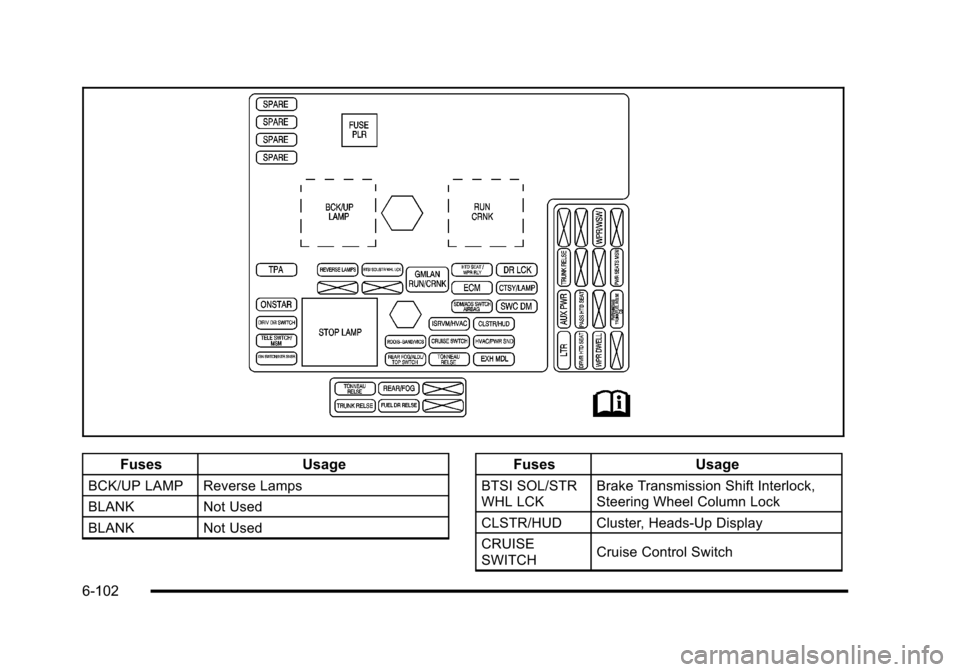
FusesUsage
BCK/UP LAMP Reverse Lamps
BLANKNot Used
BLANK Not Used
Fuses Usage
BTSI SOL/STR
WHL LCK Brake Transmission Shift Interlock,
Steering Wheel Column Lock
CLSTR/HUD Cluster, Heads‐Up Display
CRUISE
SWITCH Cruise Control Switch
6-102
Page 415 of 472
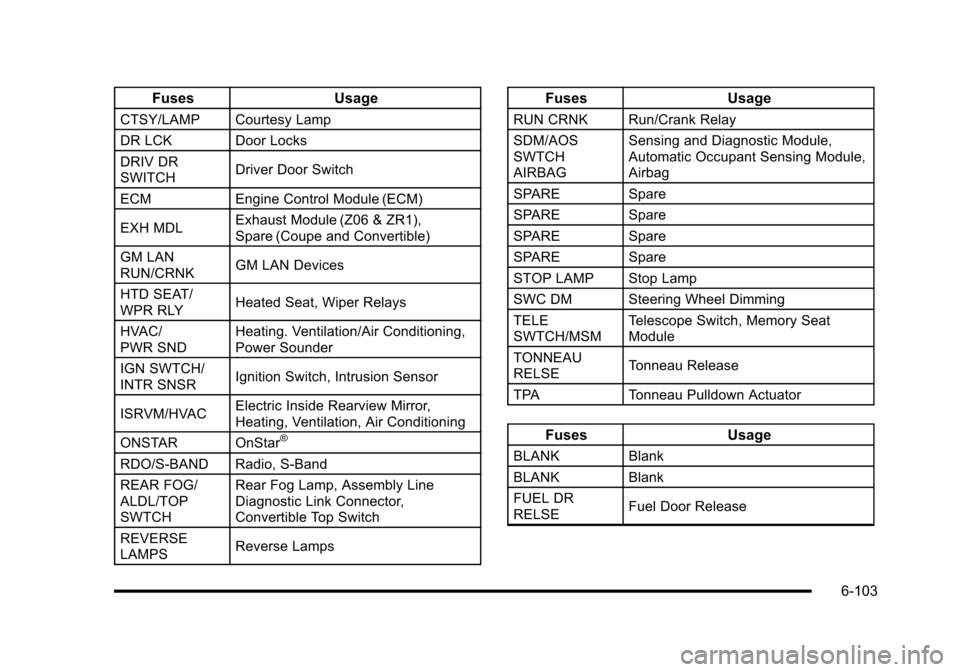
FusesUsage
CTSY/LAMP Courtesy Lamp
DR LCKDoor Locks
DRIV DR
SWITCH Driver Door Switch
ECM Engine Control Module (ECM)
EXH MDL Exhaust Module (Z06 & ZR1),
Spare (Coupe and Convertible)
GM LAN
RUN/CRNK GM LAN Devices
HTD SEAT/
WPR RLY Heated Seat, Wiper Relays
HVAC/
PWR SND Heating. Ventilation/Air Conditioning,
Power Sounder
IGN SWTCH/
INTR SNSR Ignition Switch, Intrusion Sensor
ISRVM/HVAC Electric Inside Rearview Mirror,
Heating, Ventilation, Air Conditioning
ONSTAR OnStar
®
RDO/S‐BAND Radio, S‐Band
REAR FOG/
ALDL/TOP
SWTCH Rear Fog Lamp, Assembly Line
Diagnostic Link Connector,
Convertible Top Switch
REVERSE
LAMPS Reverse Lamps
Fuses
Usage
RUN CRNK Run/Crank Relay
SDM/AOS
SWTCH
AIRBAG Sensing and Diagnostic Module,
Automatic Occupant Sensing Module,
Airbag
SPARE Spare
SPARE Spare
SPARE Spare
SPARE Spare
STOP LAMP Stop Lamp
SWC DM Steering Wheel Dimming
TELE
SWTCH/MSM Telescope Switch, Memory Seat
Module
TONNEAU
RELSE Tonneau Release
TPA Tonneau Pulldown Actuator
Fuses Usage
BLANKBlank
BLANK Blank
FUEL DR
RELSE Fuel Door Release
6-103
Page 426 of 472
.Tire wear inspection. SeeTire Inspection and
Rotation on page 6‑76.
.Fluids visual leak check (or every 12 months,
whichever occurs first). A leak in any system must
be repaired and the fluid level checked.
.Engine air cleaner filter inspection (vehicles
driven in dusty conditions only). See Engine Air
Cleaner/Filter on page 6‑27.
.Brake system inspection (or every 12 months,
whichever occurs first).
Maintenance II
.Perform all services described in Maintenance I.
.Steering and suspension inspection. Visual
inspection for damaged, loose, or missing parts
or signs of wear.
.Engine cooling system inspection. Visual
inspection of hoses, pipes, fittings, and clamps
and replacement, if needed.
.Windshield wiper blade inspection for wear,
cracking, or contamination and windshield and
wiper blade cleaning, if contaminated. See
Windshield and Wiper Blades
on page 6‑96.
Worn or damaged wiper blade replacement.
See Windshield Wiper Blade Replacement
on
page 6‑59.
.Body hinges and latches, key lock cylinders, any
folding seat hardware, and rear compartment,
hood, and console door hinges and latches
lubrication. See Recommended Fluids and
Lubricants
on page 7‑10. More frequent
lubrication may be required when vehicle is
exposed to a corrosive environment. Applying
silicone grease on weatherstrips with a clean cloth
makes them last longer, seal better, and not stick
or squeak.
.Restraint system component check. See Checking
the Restraint Systems on page 2‑60.
.Engine air cleaner filter inspection. See Engine Air
Cleaner/Filter on page 6‑27.
.Passenger compartment air filter replacement
(or every 12 months, whichever occurs first). More
frequent replacement may be required if vehicle is
driven regularly under dusty conditions.
Additional Required Services
At Each Fuel Stop
.Engine oil level check. See Engine Oilon
page 6‑19.
.Engine coolant level check. See Engine Coolanton page 6‑34.
.Windshield washer fluid level check. See
Windshield Washer Fluid on page 6‑42.
7-4
Page 429 of 472
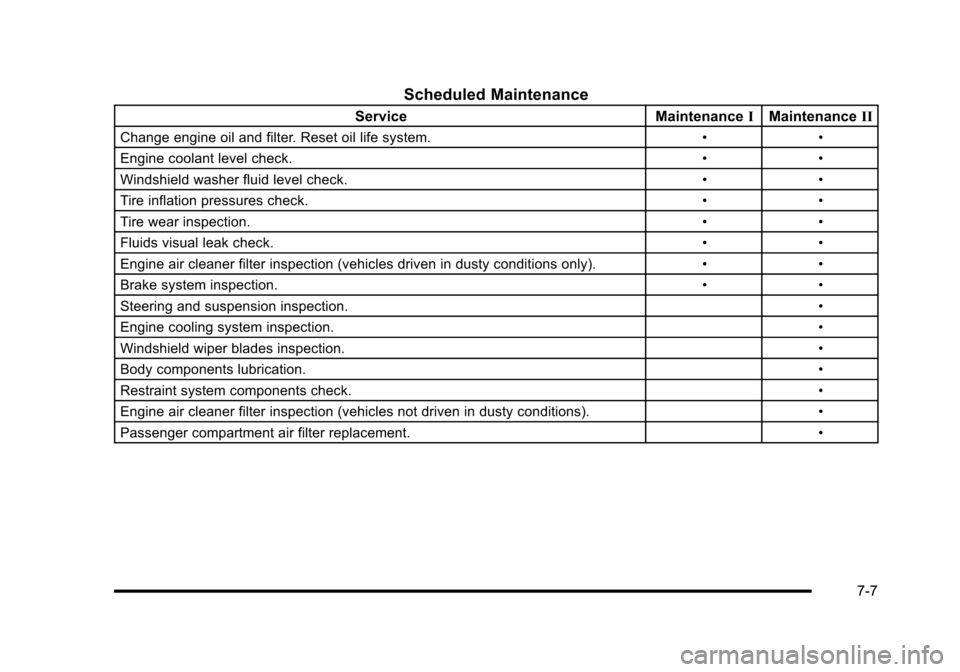
Scheduled Maintenance
ServiceMaintenanceIMaintenance II
Change engine oil and filter. Reset oil life system. ••
Engine coolant level check. ••
Windshield washer fluid level check. ••
Tire inflation pressures check. ••
Tire wear inspection. ••
Fluids visual leak check. ••
Engine air cleaner filter inspection (vehicles driven in dusty conditions only). ••
Brake system inspection. ••
Steering and suspension inspection. •
Engine cooling system inspection. •
Windshield wiper blades inspection. •
Body components lubrication. •
Restraint system components check. •
Engine air cleaner filter inspection (vehicles not driven in dusty conditions). •
Passenger compartment air filter replacement. •
7-7
Page 432 of 472
Recommended Fluids and
Lubricants
Fluids and lubricants identified below by name, part
number, or specification can be obtained from your
dealer/retailer. Usage Fluid/Lubricant
Engine Oil The engine requires a special engine
oil meeting GM Standard GM4718M.
Oils meeting this standard can be
identified as synthetic, and should
also be identified with the American
Petroleum Institute (API) Certified for
Gasoline Engines starburst symbol.
However, not all synthetic API oils
with the starburst symbol will meet
this GM standard. Look for and use
only an oil that meets GM Standard
GM4718M. For the proper viscosity,
see
Engine Oil on page 6‑19.
Engine Coolant 50/50 mixture of clean, drinkable
water and use only DEX-COOL
®
Coolant. See
Engine Coolanton
page 6‑34.
Usage Fluid/Lubricant
ZR1 Only:
Intercooler System 50/50 mixture of clean, drinkable
water and use only DEX-COOL®
Coolant. See
Engine Coolanton
page 6‑34.
Hydraulic Brake System DOT 3 Hydraulic Brake Fluid
(GM Part No. U.S. 88862806,
in Canada 88862807).
Windshield Washer Optikleen
®Washer Solvent.
Hydraulic Clutch System Hydraulic Clutch Fluid. Use only
GM Part No. U.S. 88958860,
in Canada 88901244,
Super DOT-4 brake fluid.
Power Steering System GM Power Steering Fluid
(GM Part No. U.S. 89021184,
in Canada 89021186).
Chassis
Lubrication
(Rear Toe‐Link
Outer Ends with
ZO6, ZR1,
or Z51 Option) Chassis Lubricant
(GM Part No. U.S. 12377985, in
Canada 88901242) or lubricant
meeting requirements of NLGI #2,
Category LB or GC-LB.
7-10
Page 454 of 472
Reporting Safety Defects to the
Canadian Government
If you live in Canada, and you believe that your
vehicle has a safety defect, notify Transport Canada
immediately, in addition to notifying General Motors of
Canada Limited. Call them at 1-800-333-0510 or
write to: Transport Canada
Road Safety Branch
2780 Sheffield Road
Ottawa, Ontario K1B 3V9
Reporting Safety Defects to General
Motors
In addition to notifying NHTSA (or Transport Canada) in
a situation like this, please notify General Motors.
Call 1-800-222-1020, or write: Chevrolet Motor Division
Chevrolet Customer Assistance Center
P.O. Box 33170
Detroit, MI 48232-5170 In Canada, call 1-800-263-3777 (English) or
1-800-263-7854 (French), or write:
General Motors of Canada Limited
Customer Communication Centre, CA1-163-005
1908 Colonel Sam Drive
Oshawa, Ontario L1H 8P7
Service Publications Ordering
Information
Service Manuals
Service Manuals have the diagnosis and repair
information on engines, transmission, axle suspension,
brakes, electrical, steering, body, etc.
Service Bulletins
Service Bulletins give additional technical service
information needed to knowledgeably service
General Motors cars and trucks. Each bulletin contains
instructions to assist in the diagnosis and service of
your vehicle.
8-16