2010 CHEVROLET CORVETTE oil
[x] Cancel search: oilPage 403 of 472
Do not clean the vehicle using:
.A knife or any other sharp object to remove a soil
from any interior surface.
.A stiff brush. It can cause damage to the vehicle's
interior surfaces.
.Heavy pressure or aggressive rubbing with a
cleaning cloth. Use of heavy pressure can damage
the interior and does not improve the effectiveness
of soil removal.
.Laundry detergents or dishwashing soaps with
degreasers can leave residue that streaks and
attracts dirt. For liquid cleaners, about 20 drops
per gallon (3.78 L) of water is a good guide.
Use only mild, neutral-pH soaps.
.Too much cleaner that saturates the upholstery.
.Organic solvents such as naptha, alcohol, etc. that
can damage the vehicle's interior.
Fabric/Carpet
Use a vacuum cleaner with a soft brush attachment
frequently to remove dust and loose dirt. A canister
vacuum with a beater bar in the nozzle may only be
used on floor carpet and carpeted floor mats. For any
soil, always try to remove it first with plain water or club
soda. Before cleaning, gently remove as much of the
soil as possible using one of the following techniques:
.For liquids: gently blot the remaining soil with a
paper towel. Allow the soil to absorb into the paper
towel until no more can be removed.
.For solid dry soils: remove as much as possible
and then vacuum.
6-91
Page 404 of 472
To clean: 1. Saturate a lint-free, clean white cloth with water or club soda.
2. Wring the cloth to remove excess moisture.
3. Start on the outside edge of the soil and gently rub toward the center. Continue cleaning, using a clean
area of the cloth each time it becomes soiled.
4. Continue to gently rub the soiled area until the cleaning cloth remains clean.
5. If the soil is not completely removed, use a mild soap solution and repeat the cleaning process that
was used with plain water.
If any of the soil remains, a commercial fabric cleaner
or spot lifter may be necessary. When a commercial
upholstery cleaner or spot lifter is to be used, test a
small hidden area for colorfastness first. If the locally
cleaned area gives any impression that a ring formation
may result, clean the entire surface.
After the cleaning process has been completed, a paper
towel can be used to blot excess moisture from the
fabric or carpet.Coated Moldings
These moldings are around the hatch opening in the
rear area.
.When lightly soiled, wipe with a sponge or soft
lint-free cloth dampened with water.
.When heavily soiled, use warm soapy water.
Leather
A soft cloth dampened with water can be used to
remove dust. If a more thorough cleaning is necessary,
a soft cloth dampened with a mild soap solution can
be used. Allow the leather to dry naturally. Do not use
heat to dry. Never use steam to clean leather. Never
use spot lifters or spot removers on leather. Many
commercial leather cleaners and coatings that are
sold to preserve and protect leather may permanently
change the appearance and feel of the leather and are
not recommended. Do not use silicone or wax-based
products, or those containing organic solvents to clean
the vehicle's interior because they can alter the
appearance by increasing the gloss in a non-uniform
manner. Never use shoe polish on leather.
6-92
Page 407 of 472

Finish Care
Occasional waxing or mild polishing of the vehicle by
hand may be necessary to remove residue from the
paint finish. Approved cleaning products can be
obtained from your dealer/retailer.
If the vehicle has a basecoat/clearcoat paint finish, the
clearcoat gives more depth and gloss to the colored
basecoat. Always use waxes and polishes that are
non-abrasive and made for a basecoat/clearcoat paint
finish.
Notice: Machine compounding or aggressive
polishing on a basecoat/clearcoat paint finish
may damage it. Use only non-abrasive waxes and
polishes that are made for a basecoat/clearcoat
paint finish on the vehicle.
Foreign materials such as calcium chloride and other
salts, ice melting agents, road oil and tar, tree sap,
bird droppings, chemicals from industrial chimneys,
etc., can damage the vehicle's finish if they remain
on painted surfaces. Wash the vehicle as soon as
possible. If necessary, use non-abrasive cleaners
that are marked safe for painted surfaces to remove
foreign matter.
Exterior painted surfaces are subject to aging, weather
and chemical fallout that can take their toll over a period
of years. To help keep the paint finish looking new, keep
the vehicle garaged or covered whenever possible.
Protecting Exterior Bright Metal Parts
Bright metal parts should be cleaned regularly to keep
their luster. Washing with water is all that is usually
needed. However, chrome polish may be used on
chrome or stainless steel trim, if necessary.
Use special care with aluminum trim. To avoid
damaging protective trim, never use auto or chrome
polish, steam or caustic soap to clean aluminum.
A coating of wax, rubbed to high polish, is
recommended for all bright metal parts.
ZR1 Carbon Fiber Panels
Carbon fiber panels can be washed and waxed like any
other panels.
Use a clear or black pigmented wax on the inner hood
carbon fiber panel.
ZR1 Hood Window
The hood window on the ZR1 can be cleaned in the
same manner as the headlamp lenses. See Cleaning
Exterior Lamps/Lenses
on page 6‑94for more
information.
6-95
Page 420 of 472
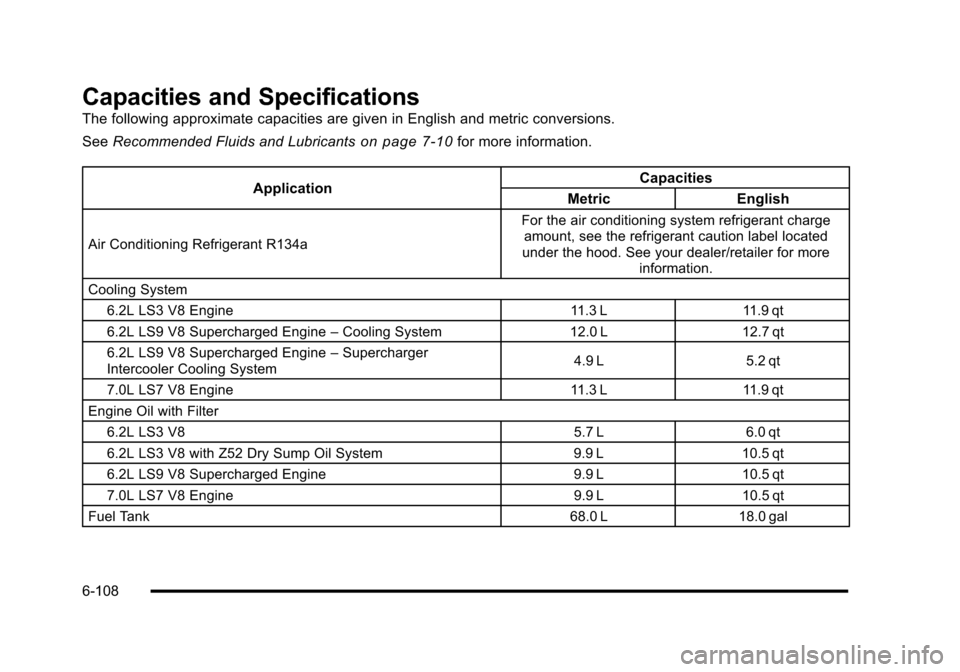
Capacities and Specifications
The following approximate capacities are given in English and metric conversions.
See Recommended Fluids and Lubricants
on page 7‑10for more information.
Application Capacities
Metric English
Air Conditioning Refrigerant R134a For the air conditioning system refrigerant charge
amount, see the refrigerant caution label located
under the hood. See your dealer/retailer for more information.
Cooling System
6.2L LS3 V8 Engine 11.3 L11.9 qt
6.2L LS9 V8 Supercharged Engine –Cooling System 12.0 L12.7 qt
6.2L LS9 V8 Supercharged Engine –Supercharger
Intercooler Cooling System 4.9 L
5.2 qt
7.0L LS7 V8 Engine 11.3 L11.9 qt
Engine Oil with Filter 6.2L LS3 V8 5.7 L6.0 qt
6.2L LS3 V8 with Z52 Dry Sump Oil System 9.9 L10.5 qt
6.2L LS9 V8 Supercharged Engine 9.9 L10.5 qt
7.0L LS7 V8 Engine 9.9 L10.5 qt
Fuel Tank 68.0 L18.0 gal
6-108
Page 425 of 472
Scheduled Maintenance
When the Change Engine Oil Message
Displays
Change engine oil and filter. See Engine Oilon
page 6‑19. An Emission Control Service.
When the Change Engine Oil message displays,
service is required for the vehicle as soon as possible,
within the next 1 000 km/600 miles. If driving under the
best conditions, the engine oil life system might not
indicate the need for vehicle service for more than a
year. The engine oil and filter must be changed at least
once a year and the oil life system must be reset. Your
dealer/retailer has trained service technicians who will
perform this work and reset the system. If the engine
oil life system is reset accidentally, service the vehicle
within 5 000 km/3,000 miles since the last service.
Reset the oil life system whenever the oil is changed.
See Engine Oil Life System on page 6‑25. When the Change Engine Oil message displays,
certain services, checks, and inspections are
required. The services described for Maintenance
I
should be performed at every engine oil change.
The services described for Maintenance IIshould
be performed when:.Maintenance Iwas performed the last time the
engine oil was changed.
.It has been 10 months or more since the Change
Engine Oil message has displayed or since the last
service.
Maintenance I
.Change engine oil and filter. See Engine Oilon
page 6‑19. An Emission Control Service.
.Engine coolant level check. See Engine Coolanton page 6‑34.
.Windshield washer fluid level check. See
Windshield Washer Fluid on page 6‑42.
.Tire inflation check. See Inflation - Tire Pressureon page 6‑70.
7-3
Page 426 of 472
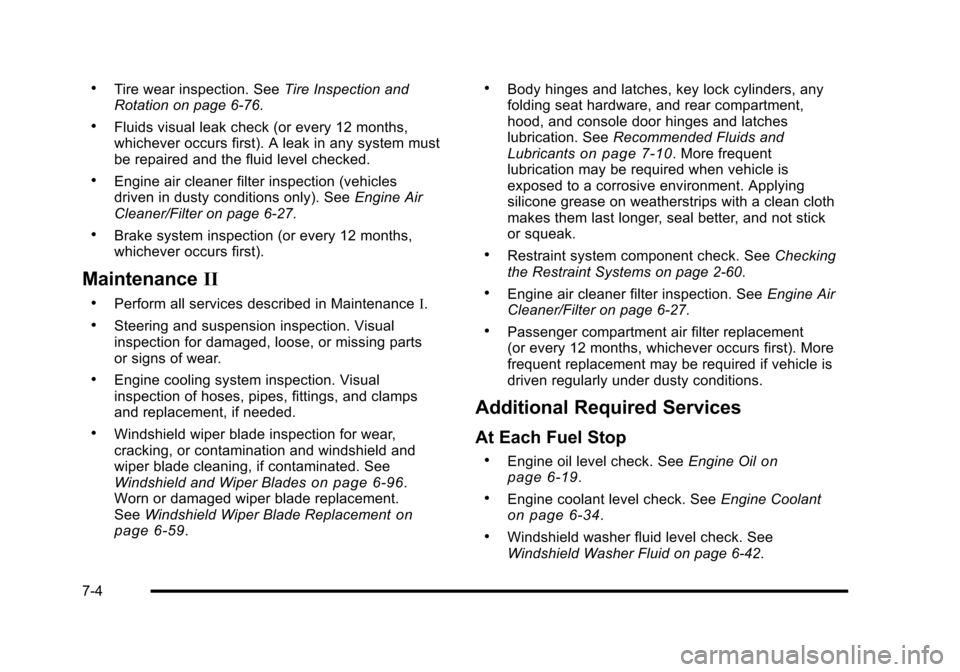
.Tire wear inspection. SeeTire Inspection and
Rotation on page 6‑76.
.Fluids visual leak check (or every 12 months,
whichever occurs first). A leak in any system must
be repaired and the fluid level checked.
.Engine air cleaner filter inspection (vehicles
driven in dusty conditions only). See Engine Air
Cleaner/Filter on page 6‑27.
.Brake system inspection (or every 12 months,
whichever occurs first).
Maintenance II
.Perform all services described in Maintenance I.
.Steering and suspension inspection. Visual
inspection for damaged, loose, or missing parts
or signs of wear.
.Engine cooling system inspection. Visual
inspection of hoses, pipes, fittings, and clamps
and replacement, if needed.
.Windshield wiper blade inspection for wear,
cracking, or contamination and windshield and
wiper blade cleaning, if contaminated. See
Windshield and Wiper Blades
on page 6‑96.
Worn or damaged wiper blade replacement.
See Windshield Wiper Blade Replacement
on
page 6‑59.
.Body hinges and latches, key lock cylinders, any
folding seat hardware, and rear compartment,
hood, and console door hinges and latches
lubrication. See Recommended Fluids and
Lubricants
on page 7‑10. More frequent
lubrication may be required when vehicle is
exposed to a corrosive environment. Applying
silicone grease on weatherstrips with a clean cloth
makes them last longer, seal better, and not stick
or squeak.
.Restraint system component check. See Checking
the Restraint Systems on page 2‑60.
.Engine air cleaner filter inspection. See Engine Air
Cleaner/Filter on page 6‑27.
.Passenger compartment air filter replacement
(or every 12 months, whichever occurs first). More
frequent replacement may be required if vehicle is
driven regularly under dusty conditions.
Additional Required Services
At Each Fuel Stop
.Engine oil level check. See Engine Oilon
page 6‑19.
.Engine coolant level check. See Engine Coolanton page 6‑34.
.Windshield washer fluid level check. See
Windshield Washer Fluid on page 6‑42.
7-4
Page 427 of 472
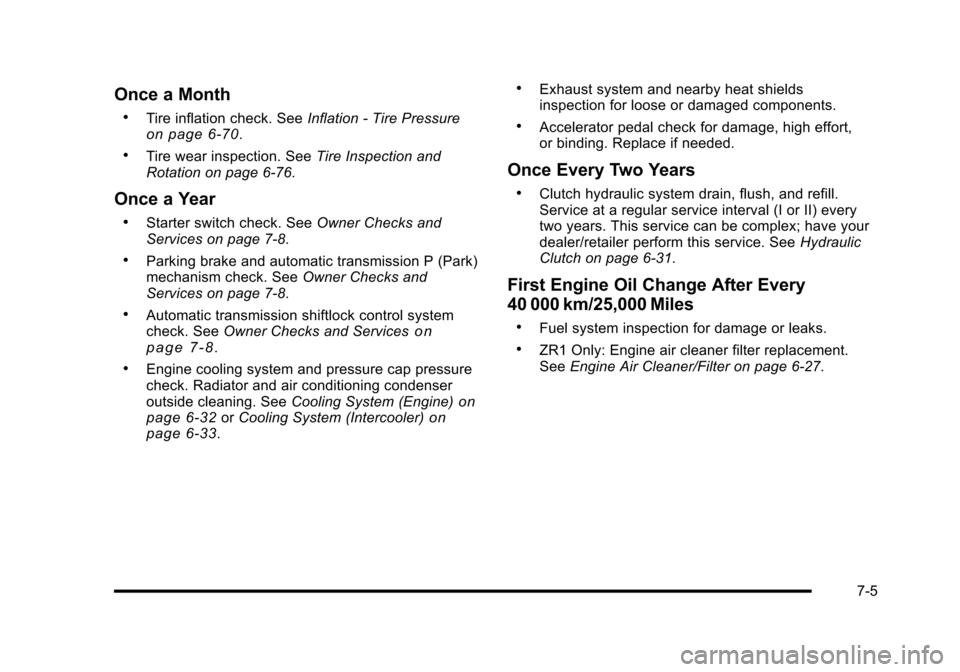
Once a Month
.Tire inflation check. SeeInflation - Tire Pressureon page 6‑70.
.Tire wear inspection. See Tire Inspection and
Rotation on page 6‑76.
Once a Year
.Starter switch check. See Owner Checks and
Services on page 7‑8.
.Parking brake and automatic transmission P (Park)
mechanism check. See Owner Checks and
Services on page 7‑8.
.Automatic transmission shiftlock control system
check. See Owner Checks and Serviceson
page 7‑8.
.Engine cooling system and pressure cap pressure
check. Radiator and air conditioning condenser
outside cleaning. See Cooling System (Engine)
on
page 6‑32or Cooling System (Intercooler)on
page 6‑33.
.Exhaust system and nearby heat shields
inspection for loose or damaged components.
.Accelerator pedal check for damage, high effort,
or binding. Replace if needed.
Once Every Two Years
.Clutch hydraulic system drain, flush, and refill.
Service at a regular service interval (I or II) every
two years. This service can be complex; have your
dealer/retailer perform this service. See Hydraulic
Clutch on page 6‑31.
First Engine Oil Change After Every
40 000 km/25,000 Miles
.Fuel system inspection for damage or leaks.
.ZR1 Only: Engine air cleaner filter replacement.
See Engine Air Cleaner/Filter on page 6‑27.
7-5
Page 428 of 472
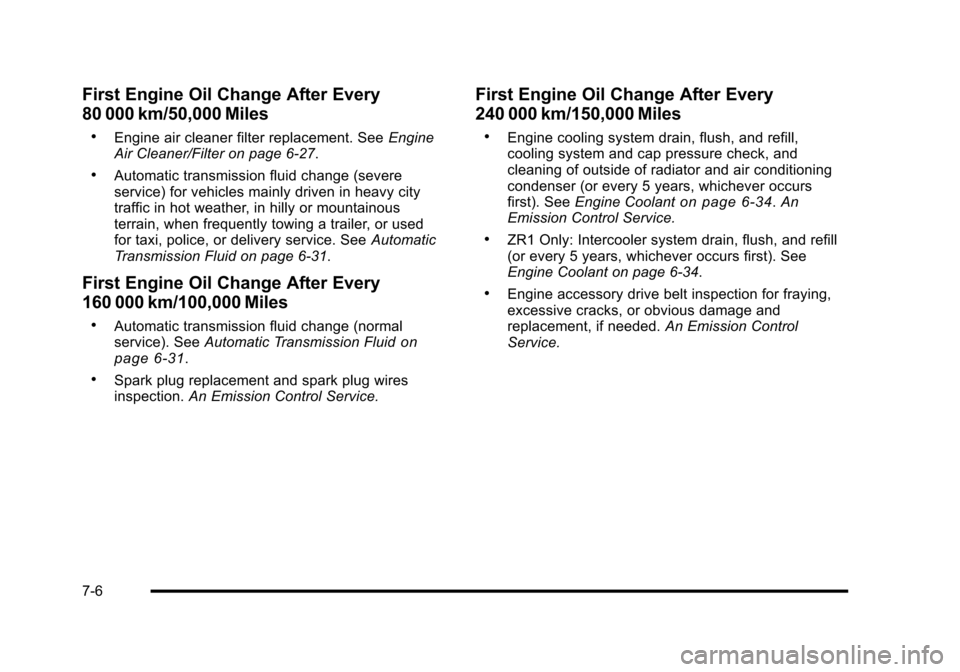
First Engine Oil Change After Every
80 000 km/50,000 Miles
.Engine air cleaner filter replacement. See Engine
Air Cleaner/Filter on page 6‑27.
.Automatic transmission fluid change (severe
service) for vehicles mainly driven in heavy city
traffic in hot weather, in hilly or mountainous
terrain, when frequently towing a trailer, or used
for taxi, police, or delivery service. See Automatic
Transmission Fluid on page 6‑31.
First Engine Oil Change After Every
160 000 km/100,000 Miles
.Automatic transmission fluid change (normal
service). See Automatic Transmission Fluidon
page 6‑31.
.Spark plug replacement and spark plug wires
inspection. An Emission Control Service.
First Engine Oil Change After Every
240 000 km/150,000 Miles
.Engine cooling system drain, flush, and refill,
cooling system and cap pressure check, and
cleaning of outside of radiator and air conditioning
condenser (or every 5 years, whichever occurs
first). See Engine Coolant
on page 6‑34.An
Emission Control Service.
.ZR1 Only: Intercooler system drain, flush, and refill
(or every 5 years, whichever occurs first). See
Engine Coolant on page 6‑34.
.Engine accessory drive belt inspection for fraying,
excessive cracks, or obvious damage and
replacement, if needed. An Emission Control
Service.
7-6