Page 38 of 472

Heated Seats
On vehicles with heated seats, the buttons are located
on the center console.
The ignition must be on for this feature to work.
L: Press to turn the seat on at the high setting.
Press again to turn it to the low setting
9: Press to turn the system off.
Memory Seat, Mirrors and Steering
Wheel
On vehicles with the memory package, the controls are
located on the driver's door.
1 : Saves the seating position for driver 1.
2 : Saves the seating position for driver 2.
B:Recalls the easy exit position. The numbers on the back of the keyless access
transmitters correspond to the numbers on the
memory buttons.
To save seating positions in the memory:
1. Adjust the driver's seat, both outside mirrors, and the telescopic steering column to a comfortable
driving position.
2. Press and hold button 1 until two beeps let you know that the position has been stored in the
memory.
A second seating, mirror, and telescopic steering
column position can be set by repeating the above
steps and pressing button 2.
2-4
Page 40 of 472
Reclining Seatbacks
{WARNING:
You can lose control of the vehicle if you try to
adjust a manual driver's seat while the vehicle is
moving. The sudden movement could startle and
confuse you, or make you push a pedal when you
do not want to. Adjust the driver's seat only when
the vehicle is not moving.
{WARNING:
If either seatback is not locked, it could move
forward in a sudden stop or crash. That could
cause injury to the person sitting there. Always
push and pull on the seatbacks to be sure they
are locked.
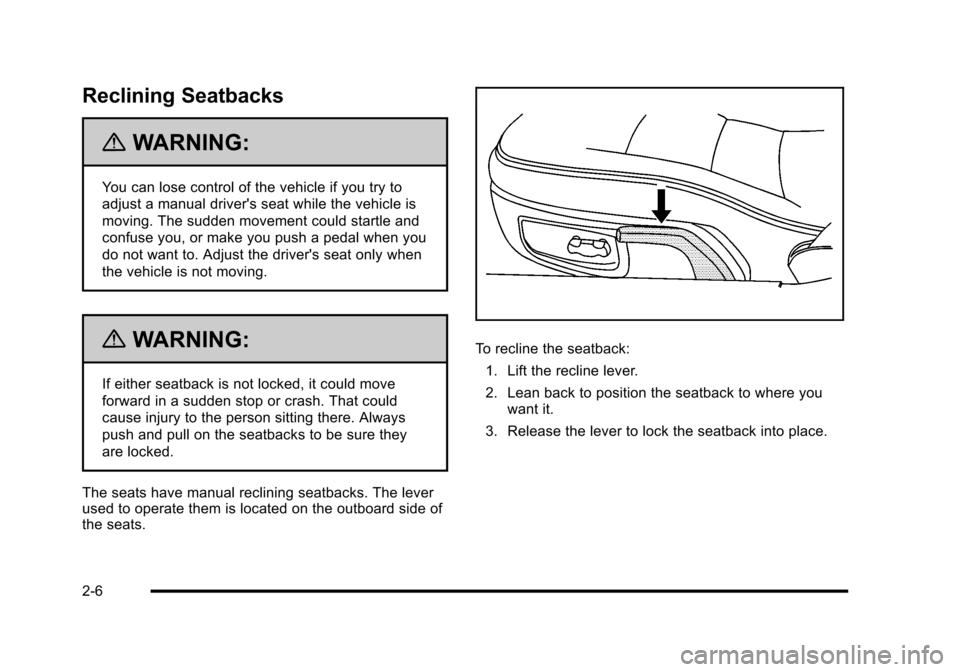
The seats have manual reclining seatbacks. The lever
used to operate them is located on the outboard side of
the seats.
To recline the seatback: 1. Lift the recline lever.
2. Lean back to position the seatback to where you want it.
3. Release the lever to lock the seatback into place.
2-6
Page 43 of 472
Safety Belts
Safety Belts: They Are for Everyone
This section of the manual describes how to use safety
belts properly. It also describes some things not to do
with safety belts.
{WARNING:
Do not let anyone ride where a safety belt cannot
be worn properly. In a crash, if you or your
passenger(s) are not wearing safety belts, the
injuries can be much worse. You can hit things
inside the vehicle harder or be ejected from the
vehicle. You and your passenger(s) can be
seriously injured or killed. In the same crash, you
might not be, if you are buckled up. Always fasten
your safety belt, and check that your passenger(s)
are restrained properly too.
{WARNING:
It is extremely dangerous to ride in a cargo area,
inside or outside of a vehicle. In a collision,
people riding in these areas are more likely to
be seriously injured or killed. Do not allow people
to ride in any area of your vehicle that is not
equipped with seats and safety belts. Be sure
everyone in your vehicle is in a seat and using a
safety belt properly.
This vehicle has indicators as a reminder to buckle the
safety belts. See Safety Belt Reminders
on page 4‑32for additional information.
2-9
Page 57 of 472
Lap-Shoulder Belt
All seating positions in the vehicle have a
lap-shoulder belt.
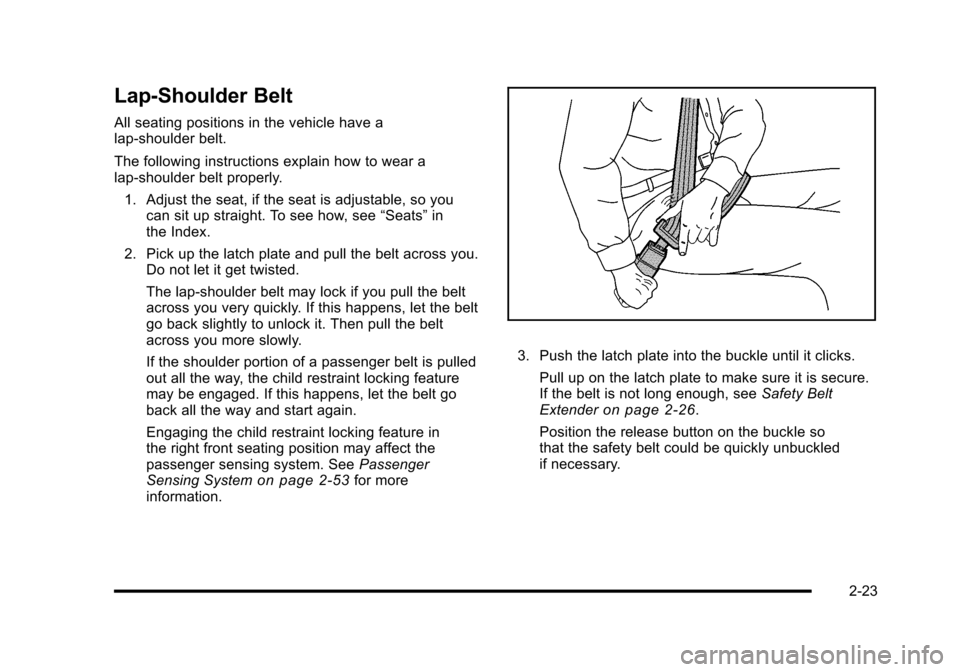
The following instructions explain how to wear a
lap-shoulder belt properly. 1. Adjust the seat, if the seat is adjustable, so you can sit up straight. To see how, see “Seats”in
the Index.
2. Pick up the latch plate and pull the belt across you. Do not let it get twisted.
The lap-shoulder belt may lock if you pull the belt
across you very quickly. If this happens, let the belt
go back slightly to unlock it. Then pull the belt
across you more slowly.
If the shoulder portion of a passenger belt is pulled
out all the way, the child restraint locking feature
may be engaged. If this happens, let the belt go
back all the way and start again.
Engaging the child restraint locking feature in
the right front seating position may affect the
passenger sensing system. See Passenger
Sensing System
on page 2‑53for more
information.
3. Push the latch plate into the buckle until it clicks.
Pull up on the latch plate to make sure it is secure.
If the belt is not long enough, see Safety Belt
Extender
on page 2‑26.
Position the release button on the buckle so
that the safety belt could be quickly unbuckled
if necessary.
2-23
Page 60 of 472
Safety Belt Extender
If the vehicle's safety belt will fasten around you,
you should use it.
But if a safety belt is not long enough, your dealer/
retailer will order you an extender. When you go in to
order it, take the heaviest coat you will wear, so the
extender will be long enough for you. To help avoid
personal injury, do not let someone else use it, and use
it only for the seat it is made to fit. The extender has
been designed for adults. Never use it for securing child
seats. To wear it, attach it to the regular safety belt.
For more information, see the instruction sheet that
comes with the extender.
Child Restraints
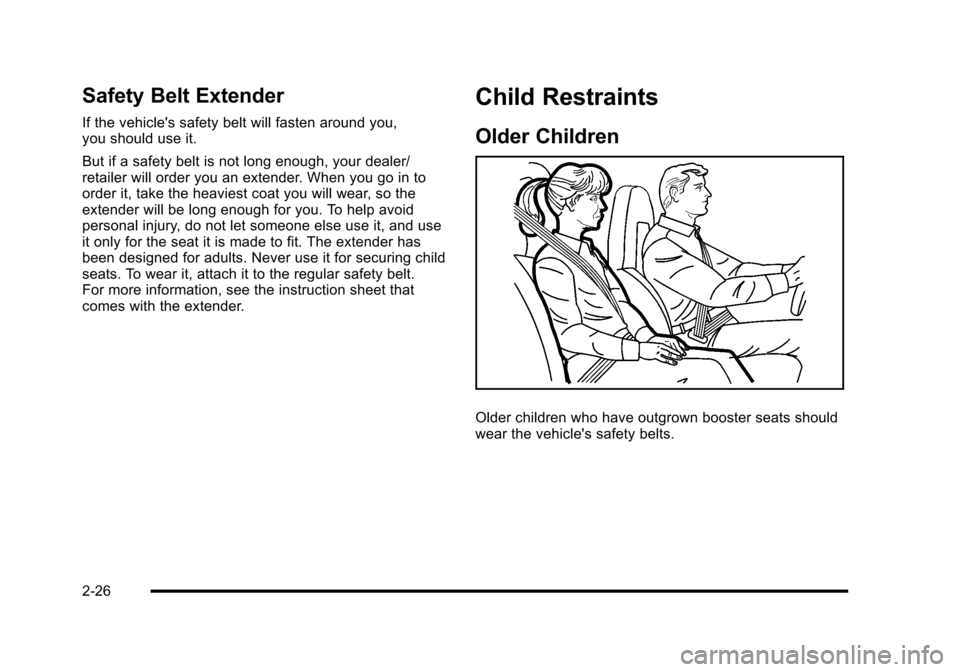
Older Children
Older children who have outgrown booster seats should
wear the vehicle's safety belts.
2-26
Page 68 of 472
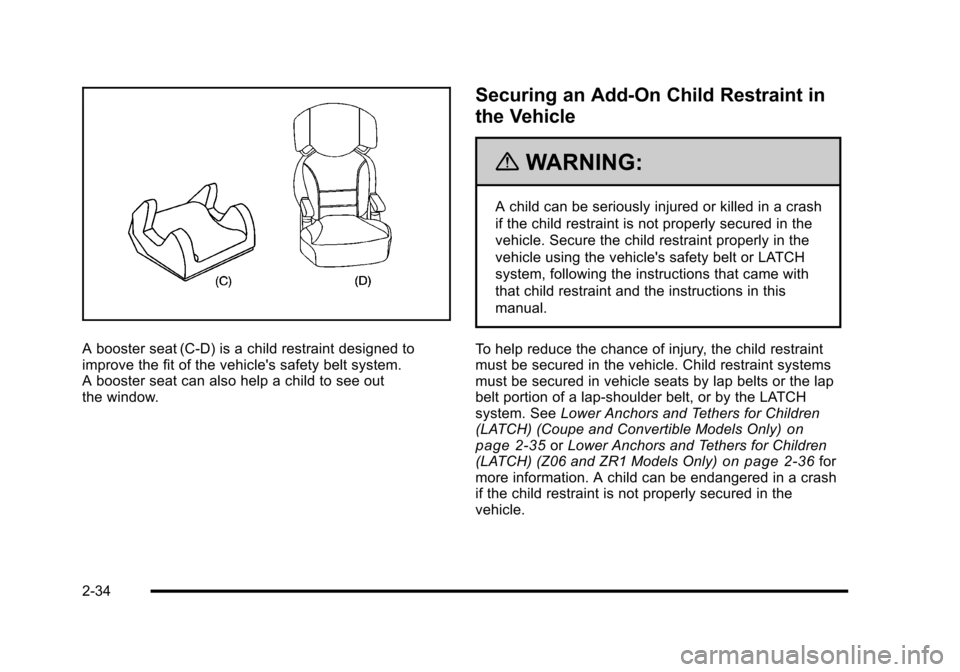
A booster seat (C-D) is a child restraint designed to
improve the fit of the vehicle's safety belt system.
A booster seat can also help a child to see out
the window.
Securing an Add-On Child Restraint in
the Vehicle
{WARNING:
A child can be seriously injured or killed in a crash
if the child restraint is not properly secured in the
vehicle. Secure the child restraint properly in the
vehicle using the vehicle's safety belt or LATCH
system, following the instructions that came with
that child restraint and the instructions in this
manual.
To help reduce the chance of injury, the child restraint
must be secured in the vehicle. Child restraint systems
must be secured in vehicle seats by lap belts or the lap
belt portion of a lap-shoulder belt, or by the LATCH
system. See Lower Anchors and Tethers for Children
(LATCH) (Coupe and Convertible Models Only)
on
page 2‑35or Lower Anchors and Tethers for Children
(LATCH) (Z06 and ZR1 Models Only)on page 2‑36for
more information. A child can be endangered in a crash
if the child restraint is not properly secured in the
vehicle.
2-34
Page 93 of 472
Adding Equipment to Your
Airbag-Equipped Vehicle
Q: Is there anything I might add to or change about the vehicle that could keep the airbags from
working properly?
A: Yes. If you add things that change your vehicle's
frame, bumper system, height, front end or side
sheet metal, they may keep the airbag system from
working properly. Changing or moving any parts of
the front seats, safety belts, the airbag sensing and
diagnostic module, steering wheel, instrument panel,
the inside review mirror, front sensors, or airbag
wiring can affect the operation of the airbag system.
In addition, the vehicle has a passenger sensing
system for the right front passenger position, which
includes sensors that are part of the passenger seat.
The passenger sensing system may not operate
properly if the original seat trim is replaced with
non-GM covers, upholstery or trim, or with
GM covers, upholstery or trim designed for a
different vehicle. Any object, such as an aftermarket
seat heater or a comfort enhancing pad or device,
installed under or on top of the seat fabric, could also interfere with the operation of the passenger
sensing system. This could either prevent proper
deployment of the passenger airbag(s) or prevent
the passenger sensing system from properly turning
off the passenger airbag(s). See
Passenger Sensing
System
on page 2‑53.
If you have any questions about this, you should
contact Customer Assistance before you modify
your vehicle. The phone numbers and addresses
for Customer Assistance are in Step Two of the
Customer Satisfaction Procedure in this manual.
See Customer Satisfaction Procedure on page 8‑2.
Q: Because I have a disability, I have to get my vehicle modified. How can I find out whether this
will affect my airbag system?
A: If you have questions, call Customer Assistance.
The phone numbers and addresses for Customer
Assistance are in Step Two of the Customer
Satisfaction Procedure in this manual. See
Customer Satisfaction Procedure on page 8‑2.
Your dealer/retailer and the service manual have
information about the location of the airbag sensors,
sensing and diagnostic module and airbag wiring.
2-59
Page 195 of 472
The rear window defogger turns off about 10 minutes
after the button is pressed when traveling less than
48 km/h (30 mph). If turned on again, the defogger
only runs for about five minutes before turning off.
The defogger can also be turned off by turning off
the engine.
The vehicle has heated outside rearview mirrors.
The mirrors will heat to help clear fog or frost from the
surface of the mirrors when the rear window defogger
button is pressed.
For vehicles with a power convertible top, the rear
window defogger and heated mirrors are automatically
disabled when the power convertible top is moving
or down.
Notice: Do not use anything sharp on the inside of
the rear window. If you do, you could cut or damage
the warming grid, and the repairs would not be
covered by the vehicle warranty. Do not attach a
temporary vehicle license, tape, a decal or anything
similar to the defogger grid.Outlet Adjustment
Use the tab located on the air outlets to change the
direction of the airflow.
Operation Tips
.Clear away any ice, snow or leaves from the air
inlets at the base of the windshield that may block
the flow of air into your vehicle.
.Use of non-GM approved hood deflectors may
adversely affect the performance of the system.
.Keep the area around the base of the instrument
panel console and air path under the seats clear of
objects to help circulate the air inside of your
vehicle more effectively.
4-27