Page 369 of 472
If the low-beam headlamp needs to be replaced, see
your dealer/retailer. See High Intensity Discharge (HID)
Lighting
on page 6‑56for more information.
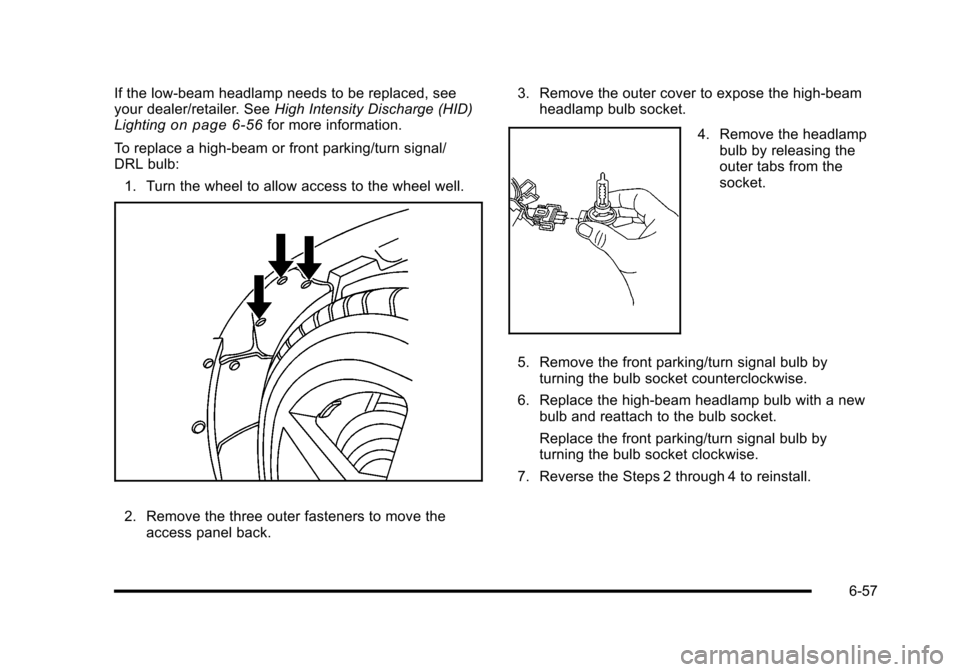
To replace a high-beam or front parking/turn signal/
DRL bulb: 1. Turn the wheel to allow access to the wheel well.
2. Remove the three outer fasteners to move the access panel back. 3. Remove the outer cover to expose the high-beam
headlamp bulb socket.
4. Remove the headlamp
bulb by releasing the
outer tabs from the
socket.
5. Remove the front parking/turn signal bulb by turning the bulb socket counterclockwise.
6. Replace the high-beam headlamp bulb with a new bulb and reattach to the bulb socket.
Replace the front parking/turn signal bulb by
turning the bulb socket clockwise.
7. Reverse the Steps 2 through 4 to reinstall.
6-57
Page 370 of 472
Taillamps, Turn Signal, and
Stoplamps
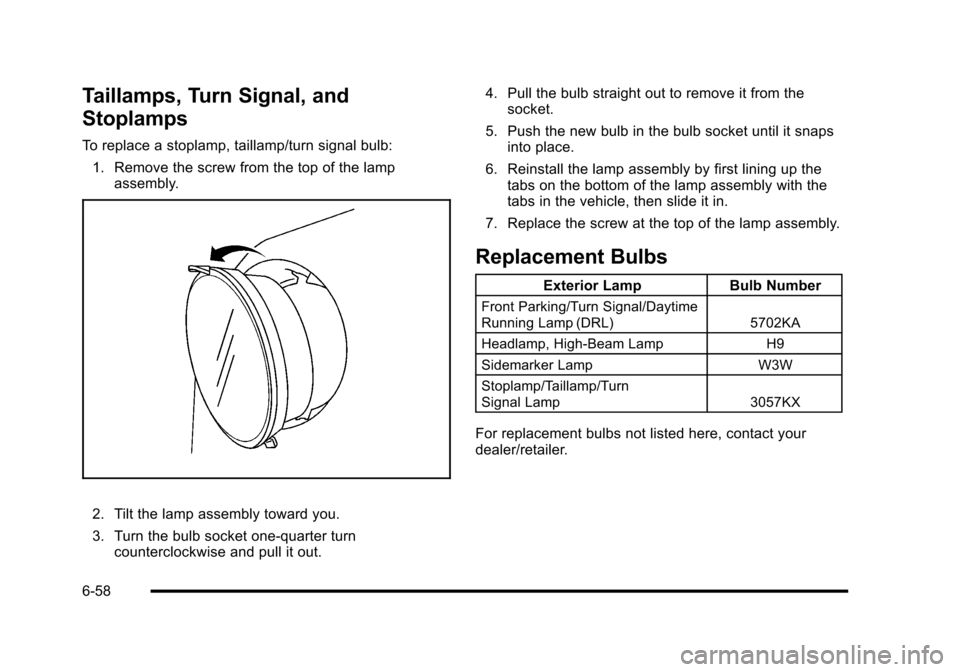
To replace a stoplamp, taillamp/turn signal bulb: 1. Remove the screw from the top of the lamp assembly.
2. Tilt the lamp assembly toward you.
3. Turn the bulb socket one-quarter turn counterclockwise and pull it out. 4. Pull the bulb straight out to remove it from the
socket.
5. Push the new bulb in the bulb socket until it snaps into place.
6. Reinstall the lamp assembly by first lining up the tabs on the bottom of the lamp assembly with the
tabs in the vehicle, then slide it in.
7. Replace the screw at the top of the lamp assembly.
Replacement Bulbs
Exterior Lamp Bulb Number
Front Parking/Turn Signal/Daytime
Running Lamp (DRL) 5702KA
Headlamp, High‐Beam Lamp H9
Sidemarker Lamp W3W
Stoplamp/Taillamp/Turn
Signal Lamp 3057KX
For replacement bulbs not listed here, contact your
dealer/retailer.
6-58
Page 372 of 472
A. Blade Assembly
B. Arm Assembly
C. Locking Tab D. Blade Pivot
E. Hook Slot
F. Arm Hook 3. Press down on the blade assembly pivot locking
tab (C). Pull down on the blade assembly (A) to
release it from the wiper arm hook (F).
4. Remove the insert from the blade assembly (A). The insert has two notches at one end that are
locked by the bottom claws of the blade assembly.
At the notch end, pull the insert from the blade
assembly.
6-60
Page 373 of 472
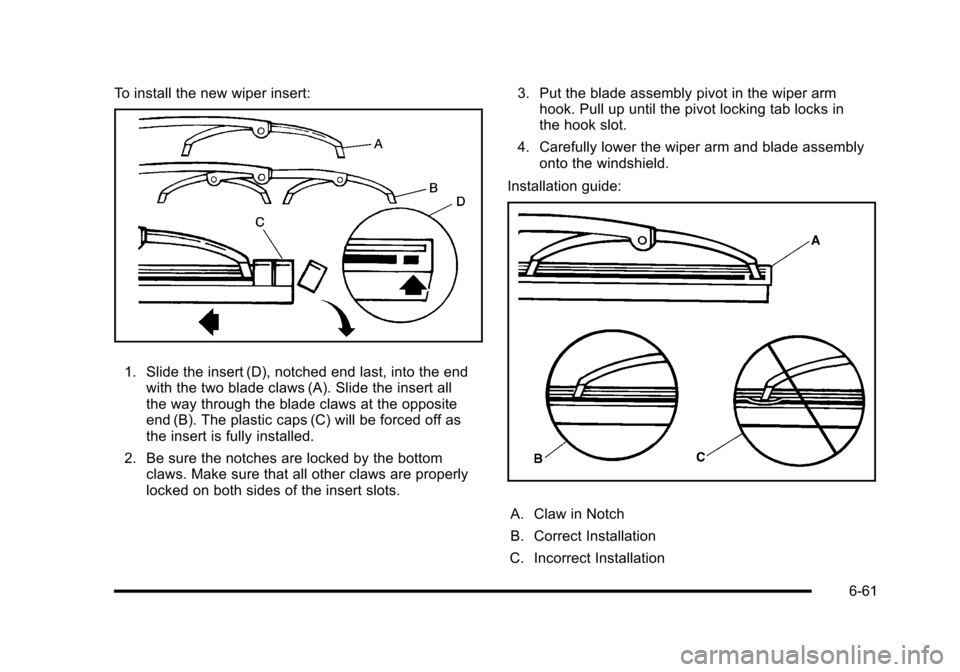
To install the new wiper insert:
1. Slide the insert (D), notched end last, into the end with the two blade claws (A). Slide the insert all
the way through the blade claws at the opposite
end (B). The plastic caps (C) will be forced off as
the insert is fully installed.
2. Be sure the notches are locked by the bottom claws. Make sure that all other claws are properly
locked on both sides of the insert slots. 3. Put the blade assembly pivot in the wiper arm
hook. Pull up until the pivot locking tab locks in
the hook slot.
4. Carefully lower the wiper arm and blade assembly onto the windshield.
Installation guide:
A. Claw in Notch
B. Correct Installation
C. Incorrect Installation
6-61
Page 391 of 472
Different Size Tires and Wheels
If you add wheels or tires that are a different size than
your original equipment wheels and tires, this may
affect the way your vehicle performs, including its
braking, ride and handling characteristics, stability,
and resistance to rollover . Additionally, if your vehicle
has electronic systems such as, antilock brakes,
traction control, and electronic stability control, the
performance of these systems can be affected.
{WARNING:
If you add different sized wheels, your vehicle
may not provide an acceptable level of
performance and safety if tires not recommended
for those wheels are selected. You may increase
the chance that you will crash and suffer serious
injury. Only use GM specific wheel and tire
systems developed for your vehicle, and have
them properly installed by a GM certified
technician.
See Buying New Tires
on page 6‑77andAccessories
and Modificationson page 6‑3for additional
information.
Uniform Tire Quality Grading
Quality grades can be found where applicable
on the tire sidewall between tread shoulder and
maximum section width. For example:
Treadwear 200 Traction AA
Temperature A
The following information relates to the system
developed by the United States National
Highway Traffic Safety Administration (NHTSA),
which grades tires by treadwear, traction, and
temperature performance. This applies only to
vehicles sold in the United States. The grades
are molded on the sidewalls of most passenger
car tires. The Uniform Tire Quality Grading
(UTQG) system does not apply to deep tread,
winter-type snow tires, space-saver, or temporary
use spare tires, tires with nominal rim diameters
of 10 to 12 inches (25 to 30 cm), or to some
limited-production tires.
6-79
Page 396 of 472
Tire Chains
{WARNING:
Do not use tire chains. There is not enough
clearance. Tire chains used on a vehicle without
the proper amount of clearance can cause
damage to the brakes, suspension, or other
vehicle parts. The area damaged by the tire
chains could cause you to lose control of the
vehicle and you or others may be injured in a
crash. Use another type of traction device only
if its manufacturer recommends it for use on
the vehicle and tire size combination and
road conditions. Follow that manufacturer's
instructions. To help avoid damage to the vehicle,
drive slowly, re‐adjust or remove the device if
it is contacting the vehicle, and do not spin the
wheels. If you do find traction devices that will fit,
install them on the rear tires.
Lifting the Vehicle
{WARNING:
Lifting a vehicle can cause an injury. The vehicle
can slip off the jack and roll over you or other
people. You and they could be badly injured.
Find a level place to lift your vehicle. To help
prevent the vehicle from moving: 1. Set the parking brake firmly.
2. Put an automatic transmission shift lever in P (Park), or shift a manual transmission to
1 (First) or R (Reverse).
3. Turn off the engine.
To be even more certain the vehicle won't move,
you can put blocks in front of and behind the
wheels.
6-84
Page 397 of 472
{WARNING:
Getting under a vehicle when it is jacked up is
dangerous. If the vehicle slips off the jack, you
could be badly injured or killed. Never get under a
vehicle when it is supported only by a jack.
{WARNING:
Raising the vehicle with the jack improperly
positioned can damage the vehicle or the vehicle
may fall and cause your or others injury.
If you ever use a jack to lift your vehicle, follow the
instructions that came with the jack, and be sure to use
the correct lifting points to avoid damaging your vehicle. Notice:
Lifting your vehicle improperly can damage
your vehicle and result in costly repairs not covered
by your warranty. To lift your vehicle properly,
follow the advice in this part.
To help prevent vehicle damage:
.Be sure to place a block or pad between the
jack and the vehicle.
.Make sure the jack you are using spans at
least two crossmember ribs.
.Lift only in the areas shown in the following
pictures.
For additional information, see your dealer/retailer
and the Chevrolet Corvette service manual.
6-85
Page 398 of 472
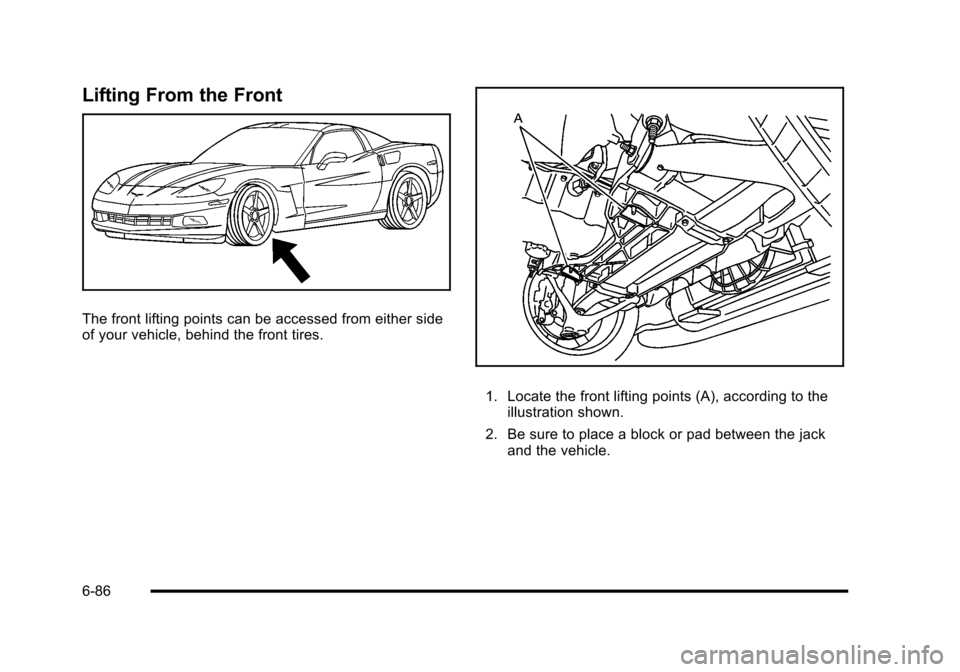
Lifting From the Front
The front lifting points can be accessed from either side
of your vehicle, behind the front tires.
1. Locate the front lifting points (A), according to the illustration shown.
2. Be sure to place a block or pad between the jack and the vehicle.
6-86