Page 427 of 616
If you put things inside your vehicle—like
suitcases, tools, packages, or anything
else—they will go as fast as the vehicle goes.
If you have to stop or turn quickly, or if there is a
crash, they will keep going.
{WARNING:
Things you put inside your vehicle can strike
and injure people in a sudden stop or turn,
or in a crash.
.Put things in the cargo area of your
vehicle. Try to spread the weight evenly.
.Never stack heavier things, like
suitcases, inside the vehicle so that some
of them are above the tops of the seats.
.Do not leave an unsecured child restraint
in your vehicle.
.When you carry something inside the
vehicle, secure it whenever you can.
.Do not leave a seat folded down unless
you need to.
There is also important loading information for
off-road driving in this manual. See“Loading Your
Vehicle for Off-Road Driving”underOff-Road
Drivingon page 6!13.
Add-On Equipment
When you carry removable items, you may need
to put a limit on how many people you can carry
inside your vehicle. Be sure to weigh your vehicle
before you buy and install the new equipment.
Notice :Overloading the vehicle may cause
damage. Repairs would not be covered by the
vehicle warranty. Do not overload the vehicle.
Remember not to exceed the Gross Axle Weight
Rating (GAWR) of the front or rear axle.
Automatic Level Control
The automatic level control rear suspension
comes as a part of the Road Sensing Suspension.
SeeRoad Sensing Suspensionon page 6!9.
This type of level control is fully automatic and will
provide a better leveled riding position as well as
better handling under a variety of passenger and
loading conditions. An air compressor connected
to the rear shocks will raise or lower the rear of
the vehicle to maintain proper vehicle height.
6-37
Page 431 of 616
Two-wheel-drive vehicles should not be towed withthe rear wheels on the ground. Two-wheel-drivetransmissions have no provisions for internal lubricationwhile being towed.
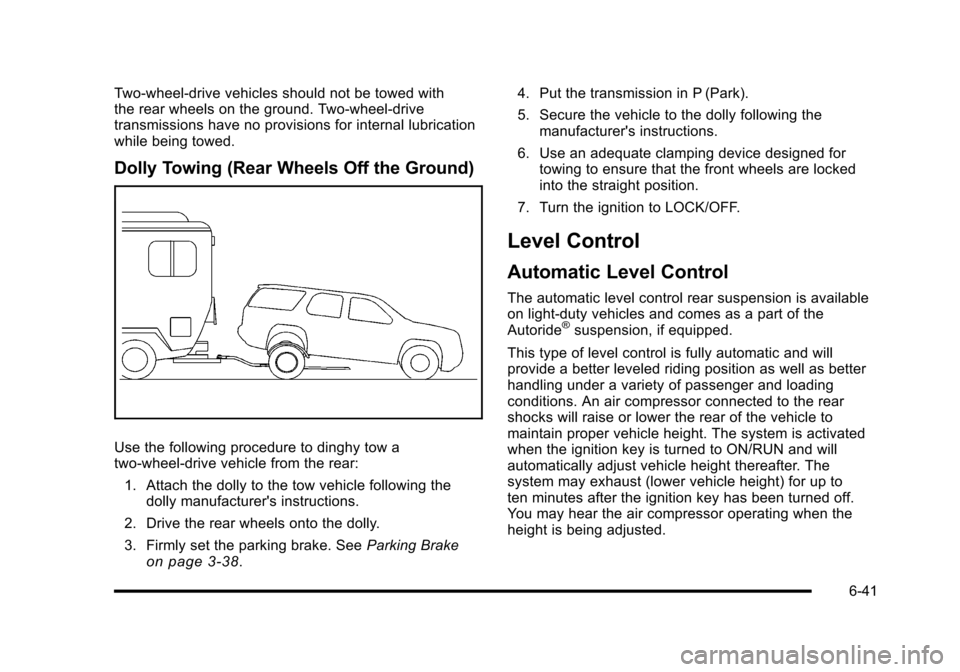
Dolly Towing (Rear Wheels Off the Ground)
Use the following procedure to dinghy tow atwo-wheel-drive vehicle from the rear:
1. Attach the dolly to the tow vehicle following thedolly manufacturer's instructions.
2. Drive the rear wheels onto the dolly.
3. Firmly set the parking brake. SeeParking Brakeon page 3!38.
4. Put the transmission in P (Park).
5. Secure the vehicle to the dolly following themanufacturer's instructions.
6. Use an adequate clamping device designed fortowing to ensure that the front wheels are lockedinto the straight position.
7. Turn the ignition to LOCK/OFF.
Level Control
Automatic Level Control
The automatic level control rear suspension is availableon light!duty vehicles and comes as a part of theAutoride®suspension, if equipped.
This type of level control is fully automatic and willprovide a better leveled riding position as well as betterhandling under a variety of passenger and loadingconditions. An air compressor connected to the rearshocks will raise or lower the rear of the vehicle tomaintain proper vehicle height. The system is activatedwhen the ignition key is turned to ON/RUN and willautomatically adjust vehicle height thereafter. Thesystem may exhaust (lower vehicle height) for up toten minutes after the ignition key has been turned off.You may hear the air compressor operating when theheight is being adjusted.
6-41
Page 434 of 616

Weight of the Trailer
How heavy can a trailer safely be?
It depends on how the rig is used. Speed, altitude, roadgrades, outside temperature and how much the vehicleis used to pull a trailer are all important. It can dependon any special equipment on the vehicle, and theamount of tongue weight the vehicle can carry. See“Weight of the Trailer Tongue”later in this section formore information.
Trailer weight rating (TWR) is calculated assuming thetow vehicle has only the driver but all required traileringequipment. Weight of additional optional equipment,passengers and cargo in the tow vehicle must besubtracted from the trailer weight rating.
Use the following chart to determine how much thevehicle can weigh, based upon the vehicle modeland options.
VehicleAxle Ratio Maximum Trailer WeightGCWR*
Escalade 2WD 6.2L V83.428,300 lbs (3 765 kg)14,000 lbs (6 350 kg)
Escalade AWD 6.2L V83.428,100 lbs (3 674 kg)14,000 lbs (6 350 kg)
Escalade ESV 2WD 6.2L V83.427,600 lbs (3 447 kg)14,000 lbs (6 350 kg)
Escalade ESV AWD 6.2L V83.427,800 lbs (3 538 kg)14,000 lbs (6 350 kg)
*The Gross Combination Weight Rating (GCWR) is the total allowable weight of the completely loaded vehicle andtrailer including any passengers, cargo, equipment and conversions. The GCWR for the vehicle should not beexceeded.
Ask your dealer/retailer for trailering information oradvice, or write us at our Customer Assistance Offices.SeeCustomer Assistance Officeso n p a g e 9!6formore information.
6-44
Page 441 of 616

During the trip, check occasionally to be sure that theload is secure and the lamps and any trailer brakesstill work.
Following Distance
Stay at least twice as far behind the vehicle ahead asyou would when driving the vehicle without a trailer.This can help to avoid heavy braking and sudden turns.
Passing
More passing distance is needed when towing a trailer.The combination will not accelerate as quickly and islonger so it is necessary to go much farther beyond thepassed vehicle before returning to the lane.
Backing Up
Hold the bottom of the steering wheel with one hand.Then, to move the trailer to the left, move that hand tothe left. To move the trailer to the right, move your handto the right. Always back up slowly and, if possible,have someone guide you.
Making Turns
Notice:Making very sharp turns while traileringcould cause the trailer to come in contact with thevehicle. The vehicle could be damaged. Avoidmaking very sharp turns while trailering.
When turning with a trailer, make wider turns thannormal. Do this so the trailer will not strike softshoulders, curbs, road signs, trees or other objects.Avoid jerky or sudden maneuvers. Signal wellin advance.
If the trailer turn signal bulbs burn out, the arrowson the instrument panel will still flash for turns. It isimportant to check occasionally to be sure the trailerbulbs are still working.
6-51
Page 480 of 616

4. With the coolant surge tank pressure cap off, startthe engine and let it run until you can feel theupper radiator hose getting hot. Watch out for theengine cooling fan.
By this time, the coolant level inside the coolantsurge tank may be lower. If the level is lower, addmore of the proper mixture to the coolant surgetank until the level reaches the FULL COLD mark.
5. Replace the pressure cap. Be sure the pressurecap is hand-tight and fully seated.
6. Verify coolant level after engine is shut off and thecoolant is cold. If necessary, repeat coolant fillprocedure Steps 1 through 6.
Notice:If the pressure cap is not tightly installed,coolant loss and possible engine damage mayoccur. Be sure the cap is properly and tightlysecured.
Engine Overheating
The vehicle has several indicators to warn of engineoverheating.
There is a coolant temperature gage on your vehicle'sinstrument panel. SeeEngine Coolant TemperatureGage on page 4!35.
In addition, ENGINE OVERHEATED STOP ENGINE,ENGINE OVERHEATED IDLE ENGINE, and a ENGINEPOWER IS REDUCED message comes on in the DriverInformation Center (DIC) on the instrument panel. SeeDIC Warnings and Messages on page 4!48.
You may decide not to lift the hood when this warningappears, but instead get service help right away. SeeRoadside Service on page 9!8.
7-34
Page 518 of 616

Any time you notice unusual wear, rotate your
tires as soon as possible and check wheel
alignment. Also check for damaged tires or
wheels. SeeWhen It Is Time for New Tireson
page 7!73andWheel Replacementon page 7!77.
When rotating your vehicle's tires, always use the
correct rotation pattern shown here.
Do not include the spare tire in the tire rotation.
After the tires have been rotated, adjust the front
and rear inflation pressures as shown on the Tire
and Loading Information label. SeeInflation - Tire
Pressureon page 7!65andLoading the Vehicleon
page 6!32.
Reset the Tire Pressure Monitor System. SeeTire
Pressure Monitor Operationon page 7!68.
Make certain that all wheel nuts are properly
tightened. See“Wheel Nut Torque”under
Capacities and Specificationson page 7!115.
{WARNING:
Rust or dirt on a wheel, or on the parts to
which it is fastened, can make wheel nuts
become loose after time. The wheel could
come off and cause an accident. When you
change a wheel, remove any rust or dirt from
places where the wheel attaches to the
vehicle. In an emergency, you can use a
cloth or a paper towel to do this; but be
sure to use a scraper or wire brush later,
if needed, to get all the rust or dirt off.
SeeChanging a Flat Tireon page 7!80.
Make sure the spare tire is stored securely.
Push, pull, and then try to rotate or turn the tire.
If it moves, tighten the cable. SeeStoring a Flat
or Spare Tire and Toolson page 7!94.
7-72
Page 538 of 616
4. Repeat this procedure at least two times. If thespare tire lowers to the ground, continue withStep 5 ofRemoving the Spare Tire and Toolsonpage 7!81.
5. If the spare does not lower, turn the wrenchcounterclockwise until approximately 6 inches(15 cm) of cable is exposed.
6. Stand the wheel blocks on their shortest ends,with the backs facing each other.
7. Place the bottom edgeof the jack (A) on thewheel blocks (B),separating them so thatthe jack is balancedsecurely.
8. Attach the jack handle, extension, and wheelwrench to the jack and place it (with the wheelblocks) under the vehicle toward the front of therear bumper.
7-92
Page 542 of 616
4. Insert the open end ofthe extension (J)through the hole in therear bumper (I) (hoistshaft access hole).
5. Raise the tire part way upward. Make sure theretainer is fully seated across the underside of thewheel and centered in the wheel opening.
6. Raise the tire fully against the underside of thevehicle by turning the wheel wrench clockwise untilyou hear two clicks or feel it skip twice. You cannotovertighten the cable.
7. Make sure the tire is stored securely. Push,pull (A), and then try to turn (B) the tire. If the tiremoves, use the wheel wrench to tighten the cable.
8. Reinstall the spare tire lock.
9. Reinstall the hoist shaft access cover.
10. Reinstall the hitch cover.
7-96

