2010 CADILLAC ESCALADE warning
[x] Cancel search: warningPage 107 of 616

Here are the most important things to know about theairbag system:
{WARNING:
You can be severely injured or killed in a crash if
you are not wearing your safety belt—even if you
have airbags. Airbags are designed to work with
safety belts, but do not replace them. Also,
airbags are not designed to deploy in every crash.
In some crashes safety belts are your only
restraint. SeeWhen Should an Airbag Inflate?on
page 2!80.
Wearing your safety belt during a crash helps
reduce your chance of hitting things inside the
vehicle or being ejected from it. Airbags are
“supplemental restraints”to the safety belts.
Everyone in your vehicle should wear a safety belt
properly—whether or not there is an airbag for
that person.
{WARNING:
Airbags inflate with great force, faster than the
blink of an eye. Anyone who is up against, or very
close to, any airbag when it inflates can be
seriously injured or killed. Do not sit unnecessarily
close to the airbag, as you would be if you were
sitting on the edge of your seat or leaning forward.
Safety belts help keep you in position before and
during a crash. Always wear your safety belt,
even with airbags. The driver should sit as far
back as possible while still maintaining control of
the vehicle.
Occupants should not lean on or sleep against the
door or side windows in seating positions with
seat-mounted side impact airbags and/or roof-rail
airbags.
2-75
Page 108 of 616
{WARNING:
Children who are up against, or very close to, any
airbag when it inflates can be seriously injured or
killed. Airbags plus lap-shoulder belts offer
protection for adults and older children, but not for
young children and infants. Neither the vehicle's
safety belt system nor its airbag system is
designed for them. Young children and infants
need the protection that a child restraint system
can provide. Always secure children properly in
your vehicle. To read how, seeOlder Childrenon
page 2!49orInfants and Young Childrenon
page 2!52.
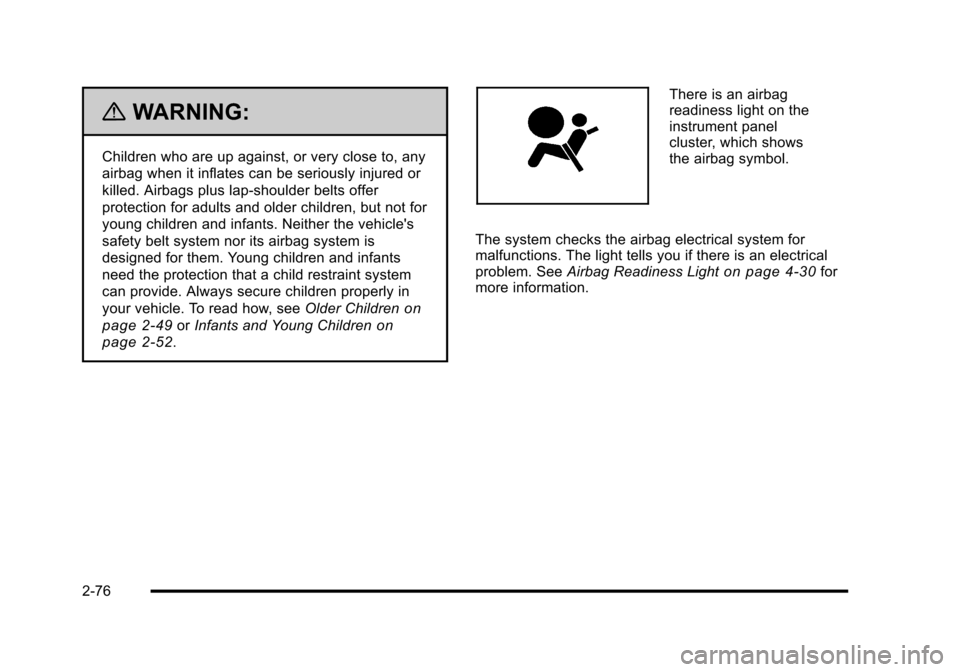
There is an airbagreadiness light on theinstrument panelcluster, which showsthe airbag symbol.
The system checks the airbag electrical system formalfunctions. The light tells you if there is an electricalproblem. SeeAirbag Readiness Lighton page 4!30formore information.
2-76
Page 111 of 616

Driver Side shown, Passenger Side similar
If the vehicle has a third row passenger seat, theroof-rail airbags are located in the ceiling above the rearwindows for the outboard passenger positions in thethird row.
{WARNING:
If something is between an occupant and an
airbag, the airbag might not inflate properly or it
might force the object into that person causing
severe injury or even death. The path of an
inflating airbag must be kept clear. Do not put
anything between an occupant and an airbag, and
do not attach or put anything on the steering
wheel hub or on or near any other airbag
covering.
Do not use seat accessories that block the
inflation path of a seat-mounted side impact
airbag.
Never secure anything to the roof of a vehicle with
roof-rail airbags by routing a rope or tie down
through any door or window opening. If you do,
the path of an inflating roof-rail airbag will be
blocked.
2-79
Page 114 of 616

Rollover capable roof-rail airbags are designed to helpcontain the head and chest of occupants in theoutboard seating positions in the first, second, and thirdrows, if equipped with a third row seat. The rollovercapable roof-rail airbags are designed to help reducethe risk of full or partial ejection in rollover events,although no system can prevent all such ejections.
But airbags would not help in many types of collisions,primarily because the occupant's motion is not towardthose airbags. SeeWhen Should an Airbag Inflate?onpage 2!80for more information.
Airbags should never be regarded as anything morethan a supplement to safety belts.
What Will You See After an Airbag
Inflates?
After the frontal airbags and seat-mounted side impactairbags inflate, they quickly deflate, so quickly thatsome people may not even realize an airbag inflated.Roof-rail airbags may still be at least partially inflated forsome time after they deploy. Some components of theairbag module may be hot for several minutes. Forlocation of the airbag modules, seeWhat Makes anAirbag Inflate? on page 2!81.
The parts of the airbag that come into contact with youmay be warm, but not too hot to touch. There may besome smoke and dust coming from the vents in thedeflated airbags. Airbag inflation does not prevent thedriver from seeing out of the windshield or being able tosteer the vehicle, nor does it prevent people fromleaving the vehicle.
{WARNING:
When an airbag inflates, there may be dust in the
air. This dust could cause breathing problems for
people with a history of asthma or other breathing
trouble. To avoid this, everyone in the vehicle
should get out as soon as it is safe to do so.
If you have breathing problems but cannot get out
of the vehicle after an airbag inflates, then get
fresh air by opening a window or a door. If you
experience breathing problems following an airbag
deployment, you should seek medical attention.
The vehicle has a feature that may automatically unlockthe doors, turn on the interior lamps and hazard warningflashers, and shut off the fuel system after the airbagsinflate. You can lock the doors, turn off the interiorlamps and hazard warning flashers by using thecontrols for those features.
2-82
Page 115 of 616

{WARNING:
A crash severe enough to inflate the airbags may
have also damaged important functions in the
vehicle, such as the fuel system, brake and
steering systems, etc. Even if the vehicle appears
to be drivable after a moderate crash, there may
be concealed damage that could make it difficult
to safely operate the vehicle.
Use caution if you should attempt to restart the
engine after a crash has occurred.
In many crashes severe enough to inflate the airbag,windshields are broken by vehicle deformation.Additional windshield breakage may also occur fromthe right front passenger airbag.
.Airbags are designed to inflate only once. After anairbag inflates, you will need some new parts forthe airbag system. If you do not get them, theairbag system will not be there to help protect youin another crash. A new system will include airbagmodules and possibly other parts. The servicemanual for your vehicle covers the need to replaceother parts.
.The vehicle has a crash sensing and diagnosticmodule which records information after a crash.SeeVehicle Data Recording and Privacyonpage 9!18andEvent Data Recordersonpage 9!19.
.Let only qualified technicians work on the airbagsystems. Improper service can mean that anairbag system will not work properly. See yourdealer/retailer for service.
2-83
Page 117 of 616

{WARNING:
A child in a rear-facing child restraint can be
seriously injured or killed if the right front
passenger airbag inflates. This is because the
back of the rear-facing child restraint would be
very close to the inflating airbag. A child in a
forward-facing child restraint can be seriously
injured or killed if the right front passenger airbag
inflates and the passenger seat is in a forward
position.
Even if the passenger sensing system has turned
off the right front passenger frontal airbag, no
system is fail-safe. No one can guarantee that an
airbag will not deploy under some unusual
circumstance, even though the airbag is
turned off.
Secure rear-facing child restraints in a rear seat,
even if the airbag is off. If you secure a
forward-facing child restraint in the right front seat,
always move the front passenger seat as far back
as it will go. It is better to secure the child restraint
in a rear seat.
The passenger sensing system is designed to turn offthe right front passenger frontal airbag if:
.The right front passenger seat is unoccupied.
.The system determines an infant is present in achild restraint.
.A right front passenger takes his/her weight off ofthe seat for a period of time.
.Or, if there is a critical problem with the airbagsystem or the passenger sensing system.
When the passenger sensing system has turned off theright front passenger frontal airbag, the off indicator willlight and stay lit to remind you that the airbag is off. SeePassenger Airbag Status Indicator on page 4!31.
The passenger sensing system is designed to turn on(may inflate) the right front passenger frontal airbaganytime the system senses that a person of adult size issitting properly in the right front passenger seat.
When the passenger sensing system has allowed theairbag to be enabled, the on indicator will light and staylit to remind you that the airbag is active.
2-85
Page 118 of 616

For some children, including children in child restraints,and for very small adults, the passenger sensingsystem may or may not turn off the right front passengerfrontal airbag, depending upon the person's seatingposture and body build. Everyone in your vehicle whohas outgrown child restraints should wear a safety beltproperly—whether or not there is an airbag forthat person.
{WARNING:
If the airbag readiness light ever comes on and
stays on, it means that something may be wrong
with the airbag system. To help avoid injury to
yourself or others, have the vehicle serviced right
away. SeeAirbag Readiness Lighton page 4!30
for more information, including important safety
information.
If the On Indicator is Lit for a Child
Restraint
If a child restraint has been installed and the onindicator is lit:
1. Turn the vehicle off.
2. Remove the child restraint from the vehicle.
3. Remove any additional items from the seat such asblankets, cushions, seat covers, seat heaters,or seat massagers.
4. Reinstall the child restraint following the directionsprovided by the child restraint manufacturer andrefer toSecuring a Child Restraint in the RightFront Seat Position on page 2!71.
5. If, after reinstalling the child restraint and restartingthe vehicle, the on indicator is still lit, turn thevehicle off. Then slightly recline the vehicleseatback and adjust the seat cushion, if adjustable,to make sure that the vehicle seatback is notpushing the child restraint into the seat cushion.
Also make sure the child restraint is not trappedunder the vehicle head restraint. If this happens,adjust the head restraint. SeeHead Restraintsonp a g e 2!2.
6. Restart the vehicle.
The passenger sensing system may or may notturn off the airbag for a child in a child restraintdepending upon the child’s seating posture andbody build. It is better to secure the child restraintin a rear seat.
2-86
Page 120 of 616

Additional Factors Affecting System
Operation
Safety belts help keep the passenger in position on theseat during vehicle maneuvers and braking, which helpsthe passenger sensing system maintain the passengerairbag status. See“Safety Belts”and“Child Restraints”in the Index for additional information about theimportance of proper restraint use.
If the shoulder portion of the belt is pulled out all theway, the child restraint locking feature will be engaged.This may unintentionally cause the passenger sensingsystem to turn the airbag off for some adult sizeoccupants. If this happens, let the belt go back all theway and start again.
A thick layer of additional material, such as a blanket orcushion, or aftermarket equipment such as seat covers,seat heaters, and seat massagers can affect how wellthe passenger sensing system operates. We
recommend that you not use seat covers or otheraftermarket equipment except when approved byGM for your specific vehicle. SeeAdding Equipment toYour Airbag-Equipped Vehicleon page 2!89for moreinformation about modifications that can affect how thesystem operates.
The on indicator may be lit if an object, such as abriefcase, handbag, grocery bag, laptop or otherelectronic device, is put on an unoccupied seat.If this is not desired remove the object from the seat.
{WARNING:
Stowing of articles under the passenger seat or
between the passenger seat cushion and
seatback may interfere with the proper operation
of the passenger sensing system.
2-88