Page 68 of 616
Q: What is wrong with this?
A:The shoulder belt is worn under the arm. It shouldbe worn over the shoulder at all times.
{WARNING:
You can be seriously injured if you wear the
shoulder belt under your arm. In a crash, your
body would move too far forward, which would
increase the chance of head and neck injury.
Also, the belt would apply too much force to the
ribs, which are not as strong as shoulder bones.
You could also severely injure internal organs like
your liver or spleen. The shoulder belt should go
over the shoulder and across the chest.
2-36
Page 69 of 616
Q: What is wrong with this?
A:The belt is behind the body.
{WARNING:
You can be seriously injured by not wearing the
lap-shoulder belt properly. In a crash, you would
not be restrained by the shoulder belt. Your body
could move too far forward increasing the chance
of head and neck injury. You might also slide
under the lap belt. The belt force would then be
applied right on the abdomen. That could cause
serious or fatal injuries. The shoulder belt should
go over the shoulder and across the chest.
2-37
Page 70 of 616
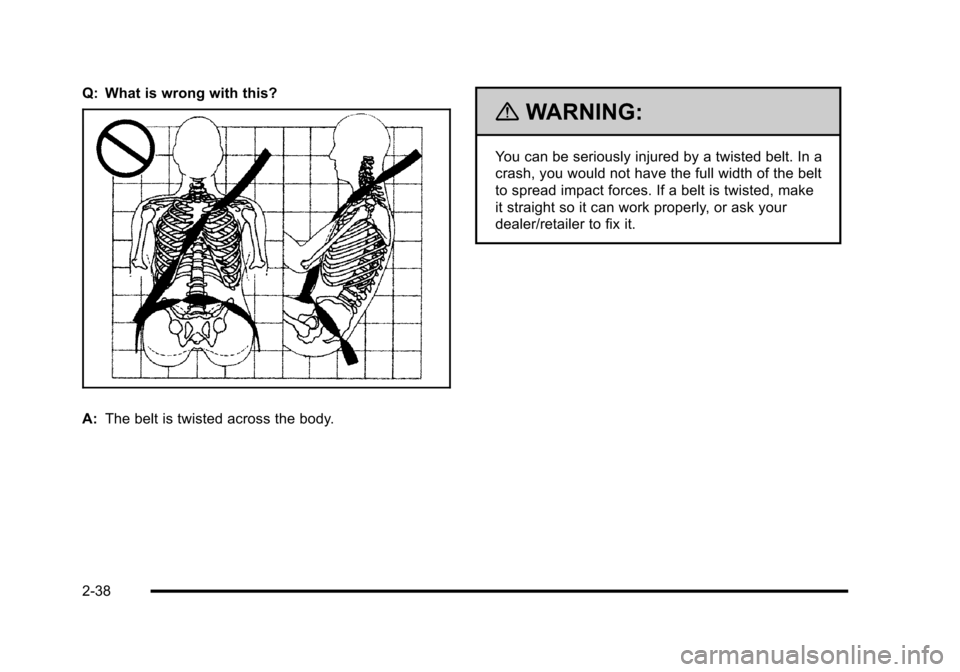
Q: What is wrong with this?
A:The belt is twisted across the body.
{WARNING:
You can be seriously injured by a twisted belt. In a
crash, you would not have the full width of the belt
to spread impact forces. If a belt is twisted, make
it straight so it can work properly, or ask your
dealer/retailer to fix it.
2-38
Page 71 of 616
Lap-Shoulder Belt
All seating positions in the vehicle have a lap-shoulderbelt except for the center front passenger position,if equipped, which has a lap belt. SeeLap Beltonpage 2!47for more information.
The lap!shoulder belts for the first and second rowseating positions are equipped with free!falling latchplates. If the vehicle has a third row, the lap!shoulderbelts have either free!falling or cinching latch plates.
Use the following pictures to determine the latchplate style:
Free-Falling Latch Plate
Cinching Latch Plate
The following instructions explain how to wear alap-shoulder belt properly.
1. Adjust the seat, if the seat is adjustable, so youcan sit up straight. To see how, see“Seats”inthe Index.
2. Pick up the latch plate and pull the belt across you.Do not let it get twisted.
The lap-shoulder belt may lock if you pull the beltacross you very quickly. If this happens, let the beltgo back slightly to unlock it. Then pull the beltacross you more slowly.
2-39
Page 72 of 616
If the shoulder portion of a passenger belt with afree!falling latch plate is pulled out all the way, thechild restraint locking feature may be engaged.If this happens, let the belt go back all the wayand start again.
Engaging the child restraint locking featurein the right front seating position may affect thepassenger sensing system, if equipped. SeePassenger Sensing Systemon page 2!84formore information.
If the belt stops before it reaches the buckle, forlap!shoulder belts with cinching latch plates, tilt thelatch plate and keep pulling the safety belt until itcan be buckled.
2-40
Page 73 of 616
3. Push the latch plate into the buckle until it clicks.If you find that the latch plate will not go fully intothe buckle, see if you are using the correct buckle.
Pull up on the latch plate to make sure it is secure.If the belt is not long enough, seeSafety BeltExtenderon page 2!48.
Position the release button on the buckle so thatthe safety belt could be quickly unbuckled ifnecessary.
4. If equipped with a shoulder belt height adjuster,move it to the height that is right for you. See“Shoulder Belt Height Adjustment”later in thissection for instructions on use and important safetyinformation.
5. To make the lap part tight, pull up on theshoulder belt.
It may be necessary to pull stitching on the safetybelt through the latch plate to fully tighten the lapbelt on smaller occupants.
2-41
Page 74 of 616
To unlatch the belt, push the button on the buckle.The belt should return to its stowed position.
Before a door is closed, be sure the safety belt is out ofthe way. If a door is slammed against a safety belt,damage can occur to both the belt and the vehicle.
Shoulder Belt Height Adjuster
The vehicle has a shoulder belt height adjuster for thedriver and right front passenger positions.
Adjust the height so that the shoulder portion of the beltis centered on the shoulder. The belt should be awayfrom the face and neck, but not falling off the shoulder.Improper shoulder belt height adjustment could reducethe effectiveness of the safety belt in a crash.
Squeeze the buttons (A)on the sides of the heightadjuster and move theheight adjuster to thedesired position.
2-42
Page 75 of 616

The adjuster can be moved up just by pushing up onthe shoulder belt guide.
After the adjuster is set to the desired position, try tomove it down without squeezing the buttons to makesure it has locked into position.
Safety Belt Pretensioners
This vehicle has safety belt pretensioners forfront outboard occupants. Although the safety beltpretensioners cannot be seen, they are part of thesafety belt assembly. They can help tighten the safetybelts during the early stages of a moderate to severefrontal, near frontal, or rear crash if the thresholdconditions for pretensioner activation are met.And, if the vehicle has side impact airbags, safety beltpretensioners can help tighten the safety belts in a sidecrash or a rollover event.
Pretensioners work only once. If the pretensionersactivate in a crash, they will need to be replaced, andprobably other new parts for the vehicle's safety beltsystem. SeeReplacing Restraint System Parts After aCrash on page 2!92.
Rear Safety Belt Comfort Guides
This vehicle may have rear shoulder belt comfortguides. If not, they are available through yourdealer/retailer. The guides may provide added safetybelt comfort for older children who have outgrownbooster seats and for some adults. When installed andproperly adjusted, the comfort guide positions the beltaway from the neck and head.
2-43