Page 460 of 620

Black plate (12,1)Cadillac Escalade/Escalade ESV Owner Manual - 2010
To open the fuel door, push the rearward center edge in
and release and it will open.
To remove the fuel cap, turn it slowly counterclockwise.
The fuel cap has a spring in it; if the cap is released too
soon, it will spring back to the right.
While refueling, hang the tethered fuel cap from the
hook on the fuel door. { WARNING: Fuel can spray out on you if you open the fuel cap
too quickly. If you spill fuel and then something
ignites it, you could be badly burned. This spray
can happen if the tank is nearly full, and is more
likely in hot weather. Open the fuel cap slowly and
wait for any hiss noise to stop. Then unscrew the
cap all the way.
Be careful not to spill fuel. Do not top off or overfill the
tank and wait a few seconds after you have finished
pumping before removing the nozzle. Clean fuel from
painted surfaces as soon as possible. See Washing
Your Vehicle on page 7 ‑ 103 .
When replacing the fuel cap, insert the tether in its hole
before tightening the cap. Turn the fuel cap clockwise
until it clicks. It will require more effort to turn the fuel
cap on the last turn as you tighten it. Make sure the cap
is fully installed. The diagnostic system can determine if
the fuel cap has been left off or improperly installed.
This would allow fuel to evaporate into the atmosphere.
See Malfunction Indicator Lamp on page 4 ‑ 36 .
7-12
Page 465 of 620

Black plate (17,1)Cadillac Escalade/Escalade ESV Owner Manual - 2010
A. Engine Air Cleaner/Filter on page 7 ‑ 22 .
B. Coolant Surge Tank and Pressure Cap. See
Cooling System on page 7 ‑ 27 .
C. Remote Positive (+) Terminal. See Jump Starting
on page 7 ‑ 44 .
D. Battery on page 7 ‑ 43 .
E. Engine Oil Fill Cap. See “ When to Add Engine Oil ”
under Engine Oil on page 7 ‑ 17 .
F. Automatic Transmission Dipstick (Out of View).
See “ Checking the Fluid Level ” under Automatic
Transmission Fluid on page 7 ‑ 24 .
G. Remote Negative ( − ) Terminal (GND) (Out of
View). See Jump Starting on page 7 ‑ 44 .
H. Engine Oil Dipstick (Out of View). See “ Checking
Engine Oil ” under Engine Oil on page 7 ‑ 17 .
I. Engine Cooling Fan (Out of View). See Cooling
System on page 7 ‑ 27 .
J. Power Steering Fluid Reservoir (Out of View). See
Power Steering Fluid on page 7 ‑ 38 .
K. Brake Master Cylinder Reservoir. See “ Brake
Fluid ” under Brakes on page 7 ‑ 40 . L. Underhood Fuse Block on page 7 ‑ 113 .
M. Windshield Washer Fluid Reservoir. See “ Adding
Washer Fluid ” under Windshield Washer Fluid
on
page 7 ‑ 39 .
Engine Oil Checking Engine Oil It is a good idea to check the engine oil level at each
fuel fill. In order to get an accurate reading, the oil must
be warm and the vehicle must be on level ground.
The engine oil dipstick handle is a yellow loop. See
Engine Compartment Overview on page 7 ‑ 16 for the
location of the engine oil dipstick.
1. Turn off the engine and give the oil several minutes
to drain back into the oil pan. If this is not done, the
oil dipstick might not show the actual level.
2. Pull out the dipstick and clean it with a paper towel
or cloth, then push it back in all the way. Remove it
again, keeping the tip down, and check the level.
7-17
Page 474 of 620

Black plate (26,1)Cadillac Escalade/Escalade ESV Owner Manual - 2010
5. If the fluid level is below the COLD check band,
add only enough fluid as necessary to bring the
level into the COLD band. It does not take much
fluid, generally less than one pint (0.5L). Do not
overfill.
6. Perform a hot check at the first opportunity after
the transmission reaches a normal operating
temperature between 160°F to 200°F (71°C
to 93°C).
7. If the fluid level is in the acceptable range, push
the dipstick back in all the way, then flip the handle
down to lock the dipstick in place. Hot Check Procedure Use this procedure to check the transmission fluid level
when the transmission fluid temperature is between
160°F and 200°F (71°C and 93°C).
The hot check is the most accurate method to check the
fluid level. The hot check should be performed at the
first opportunity in order to verify the cold check. The
fluid level rises as fluid temperature increases, so it is
important to ensure the transmission temperature is
within range.
1. Locate the
transmission dipstick at
the rear of the engine
compartment, on the
passenger side of the
vehicle.
See Engine Compartment Overview
on page 7 ‑ 16
for more information.
2. Flip the handle up and then pull out the dipstick
and wipe it with a clean rag or paper towel.
3. Install the dipstick by pushing it back in all the way,
wait three seconds, and then pull it back out again.
7-26
Page 475 of 620

Black plate (27,1)Cadillac Escalade/Escalade ESV Owner Manual - 2010
4. Check both sides of the dipstick and read the lower
level. Repeat the check procedure to verify the
reading.
5. Safe operating level is within the HOT cross hatch
band on the dipstick. If the fluid level is not within
the HOT band, and the transmission temperature
is between 160°F and 200°F (71°C and 93°C), add
or drain fluid as necessary to bring the level into
the HOT band. If the fluid level is low, add only
enough fluid to bring the level into the HOT band.
It does not take much fluid, generally less than one
pint (0.5L). Do not overfill.
6. If the fluid level is in the acceptable range, push
the dipstick back in all the way, then flip the handle
down to lock the dipstick in place. Consistency of Readings Always check the fluid level at least twice using the
procedures described. Consistency (repeatable
readings) is important to maintaining proper fluid level.
If fluid is added, it may take 15 minutes or longer to
obtain an accurate reading because of residual fluid
draining down the dipstick tube. If inconsistent readings
persist, check the transmission breather to be sure it is
clean and not clogged. If readings are still inconsistent,
contact your dealer.
Cooling System The cooling system allows the engine to maintain the
correct working temperature.
7-27
Page 481 of 620
Black plate (33,1)Cadillac Escalade/Escalade ESV Owner Manual - 2010
If no coolant is visible in the surge tank, add coolant as
follows:
1. You can remove the
coolant surge tank
pressure cap when
the cooling system,
including the coolant
surge tank pressure
cap and upper radiator
hose, is no longer hot.
Turn the pressure cap slowly counterclockwise
about one full turn. If you hear a hiss, wait for
that to stop. A hiss means there is still some
pressure left.
2. Keep turning the pressure cap slowly and
remove it. 3. Fill the coolant surge tank with the proper mixture
to the FULL COLD mark.
7-33
Page 501 of 620
Black plate (53,1)Cadillac Escalade/Escalade ESV Owner Manual - 2010
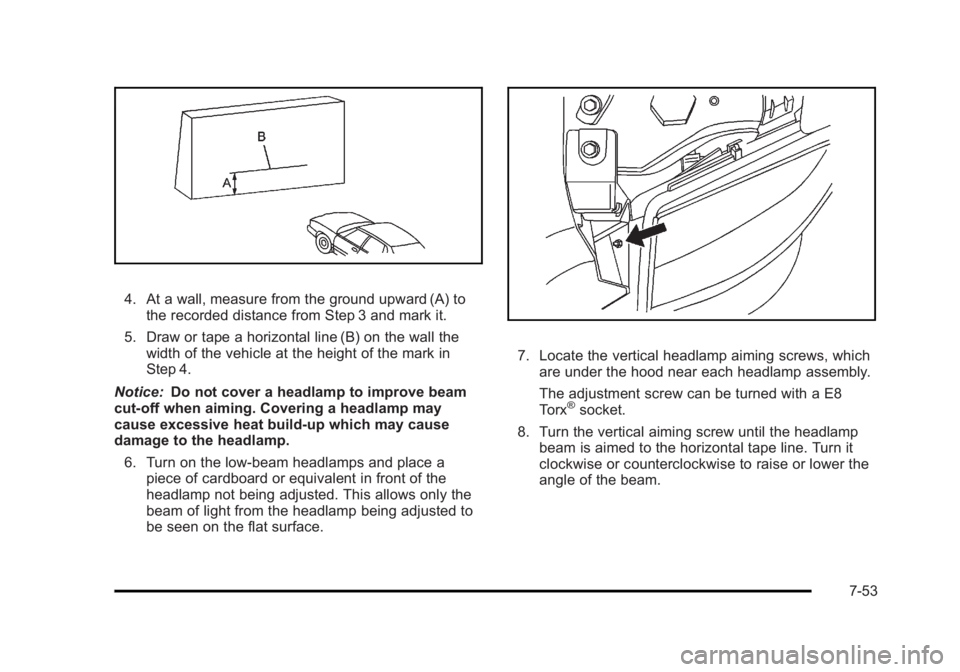
4. At a wall, measure from the ground upward (A) to
the recorded distance from Step 3 and mark it.
5. Draw or tape a horizontal line (B) on the wall the
width of the vehicle at the height of the mark in
Step 4.
Notice: Do not cover a headlamp to improve beam
cut-off when aiming. Covering a headlamp may
cause excessive heat build-up which may cause
damage to the headlamp.
6. Turn on the low-beam headlamps and place a
piece of cardboard or equivalent in front of the
headlamp not being adjusted. This allows only the
beam of light from the headlamp being adjusted to
be seen on the flat surface. 7. Locate the vertical headlamp aiming screws, which
are under the hood near each headlamp assembly.
The adjustment screw can be turned with a E8
Torx ®
socket.
8. Turn the vertical aiming screw until the headlamp
beam is aimed to the horizontal tape line. Turn it
clockwise or counterclockwise to raise or lower the
angle of the beam.
7-53
Page 503 of 620
Black plate (55,1)Cadillac Escalade/Escalade ESV Owner Manual - 2010
LED Lighting The vehicle may have LED headlamps.
For replacement of the LED lighting assembly
contact your dealer.
Back-Up Lamps To replace this bulb:
1. Open the liftgate.
See Power Liftgate
on
page 3 ‑ 14 for more
information. 2. Remove the two
screws from the
taillamp assembly.
3. Pull the taillamp assembly rearward until you
disengage the inner pins on the taillamp assembly
from the vehicle.
4. Press the release tab, if the bulb socket has one,
and turn the socket counterclockwise to remove it
from the taillamp assembly.
5. Pull the old bulb straight out from the socket.
6. Press a new bulb into the socket, insert the socket
into the taillamp assembly and turn the socket
clockwise into the taillamp assembly until it clicks.
7-55
Page 504 of 620
Black plate (56,1)Cadillac Escalade/Escalade ESV Owner Manual - 2010
7. Reinstall the taillamp assembly. When reinstalling,
make sure to line up the pins on the taillamp
assembly with the vehicle. If you do not line up the
pins correctly, you will not be able install the
taillamp assembly properly.
If you need to replace the taillamp, stoplamp, or turn
signal, you will need to see your dealer for service.
License Plate Lamp
1. Remove the two screws holding each of the
license plate lamps to the molding that is part of
the liftgate. 2. Twist and pull the license plate lamp forward
through the molding opening.
3. Turn the bulb socket counterclockwise and pull the
bulb straight out of the socket.
4. Install the new bulb.
5. Reverse Steps 1 through 3 to reinstall the license
plate lamp.
Replacement Bulbs Exterior Lamp Bulb Number
Back-up Lamp 7440
License Plate Lamp W5W
For replacement bulbs not listed here, contact your
dealer.
7-56


