2010 AUDI S6 key
[x] Cancel search: keyPage 279 of 368

___________________________________________ C..:...._ h:....:e :....:c:..:. k.::..: i..:.. n .:..:g:!:....:: a....:. n..:.. d~ f:....:. i.:..ll :.:.i:....:n :.:g !....- _,n
Closing the engine hood
- Pull the hood down until the pressure from the struts is
reduced.
- Let the hood
drop down and latch in place. Do not try to
push it shut;
it may fail to engage=:> &.
& WARNING
A hood that is not completely latched could fly up and block your
view while driving.
• When you close the engine hood, check it to make sure the
safety catch has properly engaged. The hood should be flush with
the surrounding vehicle body parts.
• If you notice while driving that the hood is not secured prop
erly, stop at once and close it. •
Working in the engine compartment
Be especially careful whenever you work in the engine
compartment.
Whenever you must perform any work in the engine compartment,
for example checking and filling different fluids, there is a risk of injury, burns and accidents. To prevent personal injury always
observe the following WARNINGS. The engine compartment of any
vehicle is a hazardous area=>& .
& WARNING
To help avoid injury, before you check anything under the hood:
• Turn off the engine.
• Remove the ignition key.
• Apply the parking brake.
Safety first
& WARNING (continued)
• Move selector lever to "P" (Park).
• Always let the engine cool down. Hot components will burn
skin on contact.
• To reduce the risk of being burned, never open the hood if you
see or hear steam or coolant escaping from the engine compart
ment. Wait until no steam or coolant can be seen or heard before
carefully opening the hood.
• Keep children away from the engine compartment.
• Never spill fluids on hot engine components. They can cause a
fire. • Never touch the radiator fan. The auxiliary electric fan is
temperature controlled and can switch on suddenly.
• Never open the coolant reservoir cap when the engine is still
warm. The coolant system is pressurized and hot coolant could
spray out.
• Protect your face, hands and arm from steam or hot engine
coolant by placing a thick rag over the cap when you open the
coolant reservoir.
• If work on the fuel system or the electrical system is necessary:
- Always disconnect the battery.
- Never smoke or work near heaters or open flames. Fluids in
the engine compartment could start a fire.
- Keep an approved fire extinguisher immediately available.
• To avoid electrical shock and personal injury while the engine is
running or being started, never touch:
-Ignition cables
- Other components of the high voltage electronic ignition
system.
• If you must perform a check or repair with the engine running:
- First, fully apply the parking brake, move selector lever to
"P" (Park). .,
Vehicle care Technical data
Page 290 of 368

-L~C~ h~ e~c ~k :..!_i ~ n ~g ~ a~n ~d~ f~il ~l~in ~ g[_ ________________________________________ _
0 Note
Brake fluid will damage the paint of your vehicle.
the special tools required and the necessary expertise, we recom
mend that you have the brake fluid changed by your authorized Audi
dealer. •
Battery
General information
Under normal operating condit ions, the battery in your Aud i does not
need any maintenance. With
high outside temperatures or long daily
drives we recommend that you have the electrolyte level checked by
a service facility. The electrolyte level should also be checked each
time the battery is charged~
page 290.
Have the battery checked when you take your vehicle in for service.
You are well advised to replace a battery that is older than 5 years.
With certain types of a irbag deployment, the battery is disconnected
from the vehicle electrical system for safety reasons=>
& in "Repair,
care and disposal of the airbags" on
page 209.
Disconnecting the battery terminals
Some vehicle functions (power window regulators, for example) are
lost if the battery terminals are disconnected. These functions have
to be relearned after the battery terminals are connected aga in. To
prevent this, the battery should only be disconnected from the
vehicle electrical system when absolutely necessary for repairs.
Vehicles not driven for long periods
If you do not drive your veh icle over a period of severa l days or weeks,
electrical components are gradually cut back or switched off. This
reduces energy consumption and maintains starting capability over a
longer period~
page 247.
Take into consideration that when you unlock your vehicle, some
convenience functions, such as the master key remote function or
power seat adjustment, may not be available. The convenience func
tions will be available again when you turn on the ign ition and start
the engine.
Winter operation
During the winter months, battery capacity tends to decrease as
temperatures drop. This is because more power is also consumed
while starting, and the headlights, rear window defogger, etc., are used more often .
Avoid unnecessary power consumpt ion, particu larly in city traffic or
when traveling only short distances. Let your authorized Audi dealer
check the capacity of the vehicle battery before w inter sets in
=> page 290. A well charged battery will not only prevent starting
problems when the weather is cold, but will also last longe r.
(I] Tips
If your veh icle is left standing for several weeks at extreme ly low
temperatures, the vehicle battery should be removed and stored
where it will not freeze. This will prevent it from being damaged and
having to be replaced.•
Page 327 of 368
Fuses and bulbs -_______________ __.PfWII
Fuses and bulbs
Fuses
Replacing a fuse
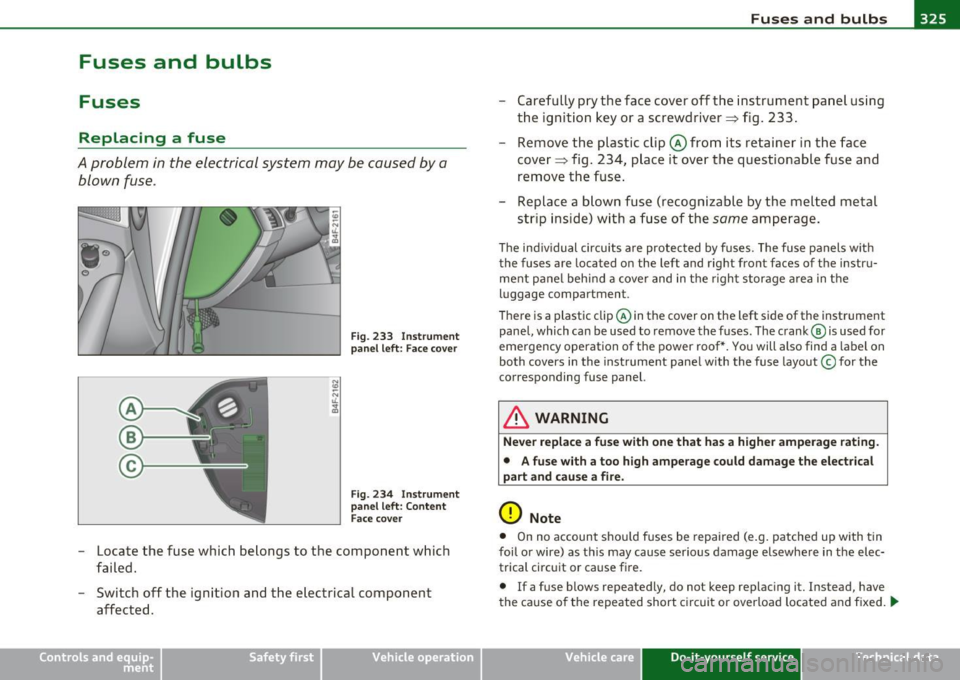
A problem in the electrical system may be caused by a
blown fuse.
Fig. 233 Instrument
panel left: Face cover
Fig. 234 Instrument
panel left: Content
Face cover
-Locate the fuse which belongs to the component which
failed.
- Switch off the ignition and the electrical component
affected.
Vehicle OP-eration
- Carefully pry the face cover off the instrument panel using
the ignition key or a screwdriver::::::, fig. 233.
- Remove the plastic clip @from its retainer in the face
cover==> fig. 234, place it over the questionable fuse and
remove the fuse.
- Replace a blown fuse (recognizable by the melted metal
strip inside) with a fuse of the
same amperage.
The individual circuits are protected by fuses. The fuse panels with
the fuses are located on the left and right front faces of the instru
ment panel behind a cover and in the right storage area in the
luggage compartment.
Ther e is a plastic clip@ in the cover on the left side of the instrument
panel, which can be used to remove the fuses. The crank @ is used for
eme rgency operation of the power roof*. You will also find a label on
both covers in the instrument panel with the fuse layout © for the
corresponding fuse panel.
& WARNING
Never replace a fuse with one that has a higher amperage rating.
• A fuse with a too high amperage could damage the electrical
part and cause a fire.
0 Note
• On no account should fuses be repaired (e.g. patched up with tin
foil or wire) as this may cause serious damage elsewhere in the elec
trical circuit or cause fire.
• If a fuse blows repeatedly, do not keep replacing it. Instead, have
the cause of the repeated short circuit or overload located and fixed.
ti>
Vehicle care Do-it-yourself service iTechnical data
Page 329 of 368

______________________________________________ F _u_s _e_ s_ a_ n_ d _ b _u_l_b _ s _ ___.9I
No. Equipment
29 Not used
30 Not used
31 Back-up
light switch, transmission, engine com-
ponents
Intelligent power module driver (footwell light
32 and front headlights, horn, wiper system, elec-
trically adjustable steering wheel)
-
33 Intelligent power module dr
iver
(lights left-side)
34 Intelligent power module driver
(lights right-side)
35 Not used
36 Headlight
washer system
37 Electronic Stabilization Program (ESP)
38 Wiper system
39 Door control module
left-side
Horn
41 Heater fan
42 Control module electronic ignition lock/electri-
cally adjustable steering wheel
43 Rear
windshie ld wiper (Avant)
44 Power window opener (left-side)
Amps
15
30
25
25
30
25
30 15
25
40
30
15
-
-
35 •
Vehicle OP-eration
Fuse Location, Instrument Panel right
Fig. 236 Fuse panel
l ayou t
Some of the equipment items listed are optional or only available on
certain model configurations.
Note that the following table is accurate at the time of going to
press and is subject to change. In the event of discrepancies, the
label on the inside of the cover always takes precedence.
The power seats are protected by circuit breakers , which automati
cally reset afte r a few seconds after the overload has been remedied.
No. Equipment Amps
Fuse holder (black)
1 Control module Convenience
key
15
2 Cigarette lighter front 20
3 Tire pressure monitoring system
5
4 Electrical outlet front (center console)
20
-
5 Intelligent power module passenger
15
(glove box lock)
6 Door control module right-s ide
15
Sunroof 20
A/C controls 10
Vehicle care Do-it-yourself service iTechnical data
Page 340 of 368
___ G_ e_n_ e_r _a _ l_ in_ f_o _r_ m_ a_ t_io _ n _______________________________________________ _
General information
Explanation of technical data
Some of the technical data listed in this manual requires
further explanation.
The technical data for your vehicle is listed in the charts starting on
~ page 341 . This sect ion prov ides genera l information, notes and
restrictions which app ly to this data .•
Veh icle identification
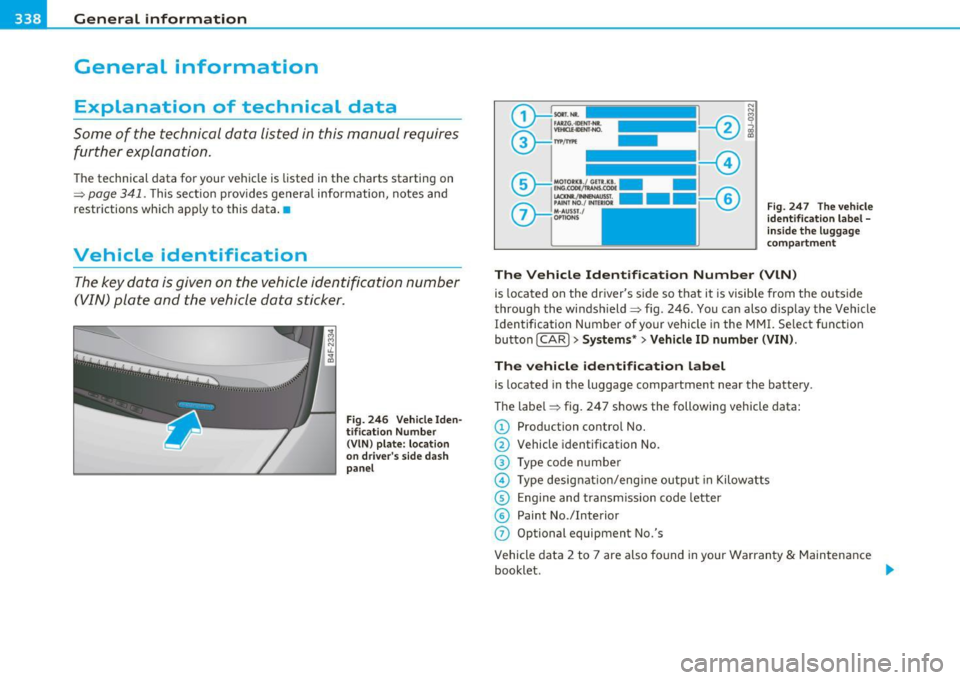
The key data is given on the vehicle identification number
(VIN) plate and the vehicle data sticker.
F ig. 2 46 V ehicle I den
t ifi ca tion Nu mbe r
(V IN ) plate: locat io n
o n d river's s id e d ash
p an el Fi
g. 2 47 The vehi cle
i d enti ficati on l abel -
in side the l ugga ge
co mpa rtme nt
The Vehicle Id ent ifi cat ion Number (VlN )
is located on the driver's s ide so that it is visible from the outside
through the windshield~ fig. 246. You can also d isp lay the Vehicle
Identification Number of your vehicle in the MMI. Se lect funct ion
button [CAR]>
S yst em s*> Vehicle ID number (VIN ).
The vehicle identifica tion lab el
is located in the luggage compartment near the battery .
The label~ fig. 247 shows the following vehicle data:
© Production control No.
@ Vehicle identification No.
® Type code n umber
@ Type designat io n/eng ine output in Kilow atts
© Engine and transmission code letter
© Paint No./Interior
(j) Optional equipment No.'s
Vehicle data 2 to 7 are also found in your Warranty
& Maintenance
booklet . .,,
Page 348 of 368
___ C_ o_n_ s _ u_m_ e_ r_ I_ n_ f_o _r_ m_ a_ t_io _ n _____________________________________________ _
& WARNING (conti nu ed )
• The engine compartment of any motor veh icle is a potentially
hazardous area . Never reach into th e area around or touch the
radiator fa n. It is temperature controlled and can switch on
s uddenly -even when the engine is off and the ignition key has
been remo ved. The radiator fan switches on autom atically when
the coolant rea ches a certain temperature and will continue to run
until the coolant tempe rature drops.
• Always remove the ignition key before anyone gets under the
vehicle.
• Always support your vehicle with safety stands if it i s neces sary
to work unde rne ath the vehicle. The jac k supplied with the vehicle
is not adequate for thi s purpose and could collap se cau sing
serious personal injury.
• If you must work underneath the vehicle w ith the wheels on
the ground , always ma ke sure the vehicle is on level ground , th at
the whe els are alway s securely blocked and that the engine cannot
be started .
• Always make sure the transmi ssion selector l ever (automatic
tran smission) is in "P" (Park position ) and the par k brake is firmly
applied.
W For the sake of the environment
• Changing the engine settings will adversely affect e miss io n levels.
Th is is detrimenta l to the environment and increases fuel consump
ti on.
• Always observe enviro nmental regulations when disposing of old
eng ine o il, use d brake fl uid, dirt y engine coo lant, s pent ba tt er ies or
worn out t ires.
• Undep loyed a irbag modules and pretens ioners migh t be classified
as Perchlorate Mater ia l -spec ial handling may apply, see
www.dts c.ca .g ov/h azar douswas te/pe rchlo ra te . When the veh icle or
parts of the rest raint system including a irbag modu les sa fety belts
w ith pretens ioners are sc rapped, all applicable laws and regulat io ns must be observed
. Your authorized Aud i dealer is familiar with these
re qui remen ts and we recomme nd that you have your dealer perfo rm
this serv ice for you .•
Additional accessories,
modifications and parts
replacement
Additional accessories and parts
replacement
A lway s con sul t an autho rized Audi dealer before
purchasi ng a ccess ories.
Your vehicle incorporates the latest safety design feat ures ens uring a
hig h stand ard of active and passive s afe ty.
T hi s safety co uld be compromised by no n-app roved changes to the
vehicle. Fo r this reason, if parts have to be replace d, p lease observe
the following points when installing addit ional accessories :
Approved Audi accessories and genuine Aud i parts are available from
a u thor ized Aud i deal ers.
T hese dea lers a lso have the necessary fac ilities, tools and tra ined
speci alists to inst all the parts and ac cessor ies p ro p er ly.
& WARNING
Using the wrong spar e parts or u sing non-approved ac ce ss ories
can cause damage to the vehicle and serious personal injury .
• Use only acces sories expressly approved by Audi and genuine
Audi spare parts
• The se parts and acces sorie s have been specially designed to be
used on your vehicle . _,.
Page 349 of 368
_____________________________________________ C_o_ n_s _u_ m __ e_r _ I_ n_ f_o _r_ m_ a_ t_ i _o_ n __ __
& WARNING (co ntinued )
• Never install acces sorie s such a s telephone cradle s or beve rage
holder s on airbag covers or within the airbag deployment zones .
Doing so will inc rease the risk of injury if airbags are triggered in
an accident!
• Before you che ck anything in the engine compartment , always
read and heed all WARNINGS~
page 269.
0 Note
• If items o ther than genui ne Aud i spare pa rts, add-on equ ipment
and accessory items are used or if repair work is not performed
acco rding to specified me thods , this can res ult in seve re damage to
yo ur vehicle's engine and body (such as corros ion) and adversely
affe ct your vehicle's w arran ty.
• If emergency repairs must be performe d elsewhere, have the
vehicle exam ined by an authori zed A udi de alersh ip as soon a s
possible.
• Th e manufacturer ca nnot be held liab le for damage w hich occ urs
due to fai lure to comply with these stipulat ions. •
Technical Modifications
Our guid elines must be complied with when technical
modificati ons are made .
Always cons ult an a uth orized Audi dealer before starting wo rk o n any
mod ificat ions.
Th is w ill help ensure that veh icle function, perfo rmance and safety
a re no t imp aired ~& .
Attempting to work on e lectron ic compone nts and the software used
wit h them can cause malf unctio ns. Beca use o f the way electronic
compone nts are interco nnected w ith each o ther, suc h ma lfunct ions
can also have an a dverse affect on other systems that are not directly
Safety first
involved . Th is means that you risk bot h a substantial reduction in the
operation al safety o f yo ur veh icle and an incre ase d wear o f vehicle
parts~ &.
Authorized Audi dea lers will perform this work in a professiona l and
co mpe ten t manner o r, in special cases, refe r yo u to a p rofessional
company that specializes in s uch mod ifications.
& WARNING
Improper repairs and modifications can change the way vehicle
sy stems work and cause damage to the veh icl e and serious
personal injury .
0 Note
If emergency repai rs must be perfo rmed elsewhere, have the vehicle
ex amined by an auth o riz ed Audi dealers hip as soo n as poss ible. •
Declaration of Compliance,
Telecommunications and Electronic Systems
Ra dio Frequency Dev ices a nd Radioco mmunicati on
Eq uip m en t U ser Manual N otic e .
The man ufact urer is not responsible for any radio or TV interfere nce
caused by unauthorized modifications to this equipment .
Devices
The fo llow ing dev ices e ach c omply w it h F CC P art 15.19, FCC Part
1 5 .21 a nd RSS-Ge n Issue 1:
• Adaptive Cr uise Control
• Convenie nce key
• Audi s ide a ss ist
Do-it,yourself service Technical data
Page 350 of 368
___ C_ o_n_ s _ u_m_ e_ r_ I_ n_ f_o _r_ m_ a_ t_io _ n _____________________________________________ _
• Cell phone package
• Electronic immobilizer
• Homelink ® universal remote control
• Remote control key
FCC Part 15.19
This device complies with part 15 of the FCC Rules. Operation is
subject to the following two conditions:
(1) This device may not cause harmful interference, and
(2) this device must accept any interference received, including inter
ference that may cause undesired operation.
FCC Part 15.21
CAUTION :
Changes or modifications not expressly approved by the party
respons ible for compliance could void the user's authority to operate
the equipment ,
RSS-Gen Issue 1
Operation is subject to the following two conditions:
(1) this device may not cause interference, and
(2) this device must accept any interference, including interference
that may cause undesired operation of the device. •