2010 AUDI S6 key
[x] Cancel search: keyPage 167 of 368

Park assist IIJII _________________________________ _____;.....:;_;_.:..:,____;;_ ____ _
0 Note
In the MMI display, the d irect ion of t ravel of the vehicle rear is rep re
sented depend ing on the steering wheel angle. The vehicle front
swi ngs ou t mo re t han t he ve hicle re ar. M ain tain ple nty of dist ance
from an obstacle so t hat your outs ide mirror or a corner of your
vehicle d oes no t collide with any o bstacles - dange r of accide nt!
[ i ) Tips
Th e left or right or ientat ion lines and s urfaces will be displ aye d,
depending on the tu rn signal being used. •
App lies to veh icles : with park ing syst em (rear, wit h rea r view cam era)
Adjusting the display and warning tones
Th e display and warning tones can be adjusted in the
MM I.
-Select: Funct ion button !CA R]> Systems *> Parking
system .
Display
• Off -when the parking system is switche d off, only audible sig na ls
are given.
• On -when t he pa rking system is swi tched on, the pic ture from the
rear view camera is displayed.
Warning tones (Canada models)
• Rear volume -rear sensor vo lume
• Rear frequency -rear sensor frequency
• In-car entertainment fader -w hen the p ark in g sys tem is switche d
on, t he volume of the active audio source is lowered.
Th e newly adj uste d value is briefly hear d from the signal generator .
Th e set tings are automat ically stored and assigned to the master key
with remote control.
Controls and equip
ment Safety first
& WARNING
•
Canada models: always make sure that the volume and
frequency of the chimes is adjusted so that you can easily hear the
acoustic distance signal even if the radio is playing, the air-condi
tioner blower is on High or there is a high level of outside noise.
• Check the settings whenever someone else has driven the
vehicle before you.
[I] Tips
• Cana da mo dels: the warning tones can a lso be adjusted directly
from t he rear -view came ra image* . Simply press the
!Settings)
control button.
• Cha nged settings are activated w hen parking assist is switched on
again. •
Appli es to ve hicle s: wit h pa rk ing system (rea r, wi th r ear vie w c amer a)
Error messages
If a wa rni ng tone* is aud ible for abo ut five seconds w he n you t urn on
the ignition , the re is a ma lfunction in the system. Have the prob lem
co rrected by yo ur aut ho rized Audi dea ler.
Keep the sensors in the rear b umper clean and free from ice so that
t he a cousti c p ark assis t* sys tem c an fun ction pro perly .•
Vehicle care Technical data
Page 172 of 368

ffl..__H_ o_m_ e_ L_ i _n_ k_ ® _______________________________________________ _
Applies to veh icles : w ith Homelin k® un iversa l remote control
Programming the Homel ink ® transmitter
The transmitter is programmed in two phases . For rolling
code transmitters, a third phase is also necessary .
illUl~~ . l
~-1 II I Ill
Fig. 163 Over head
conso le: Homelink ®
keypad
Fig. 164 F ront
bumper, passenger
s ide: loc ation of trans
mitter unit
Phase 1: progr amming th e overhead k eypad
1. Make sure your vehicle is within operating range of the
remote controlled garage door opener .
2. Set the parking brake~
& in "General information " on
page 169.
3. Turn the ignition on . Do not start the engine! 4
. Press and hold the two outside Homelink ® buttons
(D
and (@)for approximately 20 seconds until indicator l ight
@ ~ fig. 163 begins to flash . Then release both buttons .
Do not hold the buttons for longer than 30 seconds .
- This procedure only needs to be performed
on ce . It erases
the factory-set default codes and does not have to be repeated to program additional remote controls .
5. Press and hold the Homelink ® button
(D , @ or@ until
the indicator light © starts flashing
slowly . Release the
button .
-The system will now rema in in programming mode for 5
minutes.
Co to the front of the vehicle and proceed with
phase
2 .
Phase 2:
programming the bumper mounted tr ansmit
ter
6 . Hold the original r emote control at a distance between 0-
6 in. (0 -15 cm) from the bumper below the appropriate
headlight for your vehicle~ fig . 164 (use the shortest
distance possible) .
7 . Aim the remote control just below the
pa ss e nger sid e
headlight .
8. Press and hold the activation button on the remote control.
- May be d ifferent in Canada . If so, press and re-press
(cycle) the activation button on your remote control every
two seconds. .-,,
Page 173 of 368
HomeLink® -_______________ __.
9. The emergency flashers will flash three times (after about
15-60 seconds) when the programming is successful.
Release the button on the remote control.
-To program more devices, repeat steps 4 to 9.
10. Press and hold the trained Homelink ® button and
observe the indicator light©~
page 170, fig. 163.
- If the indicator light is solid/continuous, programming is
complete and your device should activate when you press
and release the trained Homelink ® button.
- If the indicator light blinks rapidly for 2 seconds and is then a solid/continuous light, proceed with phase 3 to program a rolling code device.
Phase 3: rolling code programming
- A second person on a ladder who can safely reach the
garage door opener motor is recommended.
11 . Locate the "learn" button on the garage door opener
motor (refer to the operating instructions for the opener,
as the location of this button may vary by manufacturer) .
12. Press and release the learn button on the garage door
opener motor.
-Note: once the button is pressed, there are 30 seconds in
which to initiate the next step.
13. On the Homelink® keypad inside the vehicle, firmly press
and hold the Homelink® button previously programmed
in phases 1 and 2 for two seconds and release. Repeat this
sequence
twice .
Contro ls a nd e quip
m en t Vehicle
OP-eration
-Some vehicles may require the press/hold/release
sequence up to three times to complete the training
process.
- Homelink ® should now activate your rolling code
equipped device.
If the 5 minute time limit is exceeded, the emergency flashers will
flash one time
to indicate that the process has been terminated. In
this case, repeat steps 4 through 9.
If the emergency flashers do not flash three times (after about 15 -
60 seconds), programming was not successful. In this case, repeat
steps 4 through 9.
Remote control units for garage door openers in Canada are set to
stop transmitt ing radio frequency signals after two seconds. This
time may not be sufficient for the Home link® system to learn the
radio frequency signal. Perform all other steps as described above.•
Applies to veh icles: with Hom elin k® un iversa l rem ote cont rol
Operating the Homelink ® transmitter
The HomeLink ® transmitter works in the same manner as
the original hand held remote control that came with the
system.
~ ;;;;;~~~~ ~=;==~~~ ;;;;:;;;~,~!:
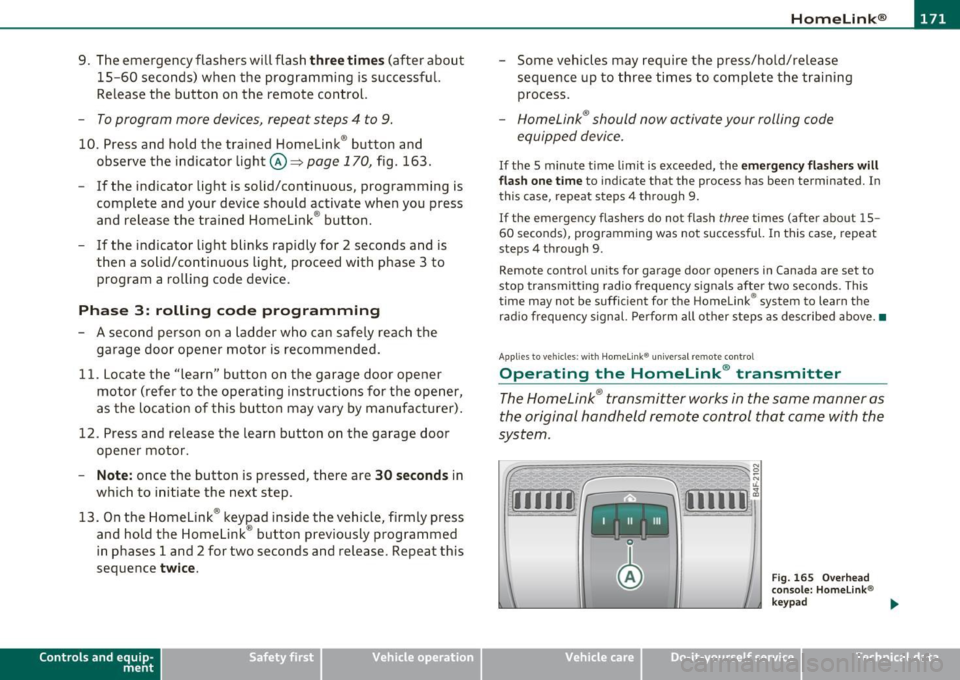
{I I I I I~ i 111111 1,A
Fig. 1 65 Overhead
conso le: Homelink®
keypad
Vehicle care Do-it-yourselt service iTechnical data
Page 174 of 368
-HomeLin k® •m ___________________ _
-Press th e ap pro priate programmed button G) , @ or@
to activate the desired remote control function ::::>
& in
"Genera l informat io n" on
page 169. •
Applies to ve hicles : w ith Hom eli nk® univer sa l rem ote c ont rol
Reprogramming a single button
A Homelink ® button can be reprogrammed individually
without affecting the other button allocations.
Programming the ov erh ead keypad
- Press the appropriate Homelink ® button until the indi-
cator light begins flashing slowly .
Programming the bumper mounted transmit
ter
1. Hold the original remote control at a distance between 0 -
5 in . (0-13 cm) from the bumper below the appropriate
headlight for your vehicle (use the shortest distance
possible).
2. Aim the remote control just below the
pas senger side
headlight .
3 . Press and hold the ac tivation button on the remote
control.
4 . The emergency flashers will flash
three times (after about
15 -60 seconds) when the programm ing is successful.
N ow release the b utton on the remote control.
- If the device utilizes a rolling code , please follow phase 3
of =>
page 170 , "Programming the Homelink ® trans
mitter" for rolling code programming.
This pr ocedur e will caus e th e ex is ting pr ogramming on th e
Homelink ® button to be era sed !•
Ap plies to veh icles: w ith Ho meli nk® un ive rsa l rem ote c ont rol
Erasing the programming of the
Homelink ® tr ansmitter
When you erase the programming, the programming on
all three of the transmitter channels with be lost!
- Perform steps 1 to 4 as described on::::> page 170, "Phase
1 : programming the overhead keypad".
When completed , the Homel ink ® system will be in the programm ing
mode and is then ready to learn the codes for remote controlled
devices .
[I) Tips
• Programmed buttons cannot be erased individually.
• For security reasons you are advised to erase the programming of
the Homelink ® system before you sell your veh icle .•
Page 191 of 368
& WARNING (continued)
• Never let any person ride with their feet on the instrument
panel or sticking out the window or on the seat.
• Never remove a safety belt while the vehicle is moving. Doing
so will increase your risk of being injured or killed.
• Never wear belts twisted.
• Never wear belts over rigid or breakable objects in or on your
clothing, such as eye glasses, pens, keys, etc., as these may cause
injury.
• Never allow safety belts to become damaged by being caught
in door or seat hardware.
• Do not wear the shoulder part of the belt under your arm or
otherwise out of position .
• Several layers of heavy clothing may interfere with correct
positioning of belts and reduce the overall effectiveness of the
system.
• Always keep belt buckles free of anything that may prevent the
buckle from latching securely.
• Never use comfort clips or devices that create slack in the
shoulder belt. However, special clips may be required for the
proper use of some child restraint systems.
• Torn or frayed safety belts can tear, and damaged belt hard
ware can break in an accident. Inspect belts regularly. If webbing, bindings, buckles, or retractors are damaged, have belts replaced
by an authorized Audi dealer or qualified workshop.
• Safety belts that have been worn and loaded in an accident
must be replaced with the correct replacement safety belt by an
authorized Audi dealer. Replacement may be necessary even if
damage cannot be clearly seen. Anchorages that were loaded
must also be inspected.
• Never remove, modify, disassemble, or try to repair the safety
belts yourself.
Safety first Vehicle OP-eration
Safety belts
& WARNING (continued)
• Always keep the belts clean. Dirty belts may not work properly
and can impair the function of the inertia reel=>
page 269,
"Safety belts". •
Safety belts
Fastening safety belts
Seat first -everybody buckle up!
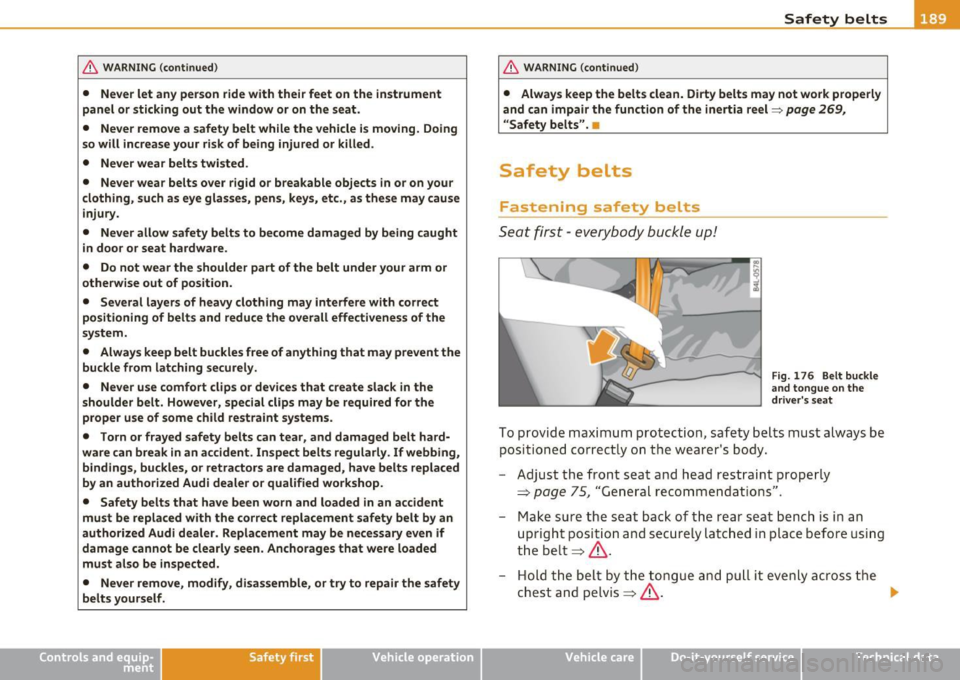
Fig. 176 Belt buckle
and tongue on the
driver's seat
To provide maximum protection , safety belts must always be
positioned correctly on the wearer's body.
- Adjust the front seat and head restraint properly
=>
page 75 , "General recommendations" .
- Make sure the seat back of the rear seat bench is in an
upright position and securely latched in place before using
the belt =>& .
- Hold the belt by the tongue and pull it evenly across the
chest and pelvis=>& . _,.
Vehicle care Do-it-yourselt service iTechnical data
Page 192 of 368
___ S_a_ f_ e_ t__, y,,__ b_ e _ lt_ s _______________________________________________ _
-Ins ert t he tongue into the correct buckle of your seat unti l
you hear it latch secure ly=> fig. 176 .
- Pull on t he be lt to make sure t hat it is secure ly latched in
the buck le.
Automatic safety belt retractors
Every safety be lt is equipped with an automatic be lt retractor on the
shoulder bel t. This fea ture locks the be lt whe n the belt is pulled out
fast, during hard braking and in an acc ident. The belt may also lock
w hen you dr ive up or dow n a s teep hill or throug h a sharp curve.
During norma l dr iving the belt lets you move freely.
Safety belt pretensioners
The safety bel ts are equipped w ith a belt pretensioner that helps to
t ighten the s afety be lt and remove sla ck when the pre tensioner is
act ivated. The function of the pretensioner is monitored by a warn ing
light =>
page 14.
Switchable locking featu re
Eve ry sa fe ty be lt exc ep t the one on the driver sea t is e quipped wi th a
switchable locking feature that
must be used when the safety belt is
used to attach a child safety seat. Be s ure to read t he import ant info r
mation about this feature=>
page 227.
& WARNING
Improperly positio ned safety belts can cause serious injury in a n
accident =>
page 190, "Safety belt po sition ".
• Safety belts offer optimum p rote ction onl y when the seat back
i s upright and belts are properly positioned on the body .
• Always make sure th at the rear seat backre st to which the
center rear safety b elt is attached i s securely latched whenever the
rear center safety belt is being used. If the ba ckrest is not securely
latch ed, the passenger will move forward with the ba ckrest during
sudden br aking, in a s udden maneu ve r and e speci ally in a crash.
& WARNING (contin u ed )
• Never atta ch the safety belt to the buckle fo r another seat.
Attaching the b elt to the w rong buckle will reduce safety belt
effecti veness and can cause serious personal injury.
• A pass enger who is not properly restr ained can be seriou sly
injured by the safety belt it self when it move s from the stronger
parts of th e body into critical areas like the abdomen.
• Alway s lock the convertible locking retractor when y ou are
securing a child safety seat in the vehicle=>
page 229. •
Safety belt position
Correct belt posi tion is the key to get ting maximum
protection from safety belts .
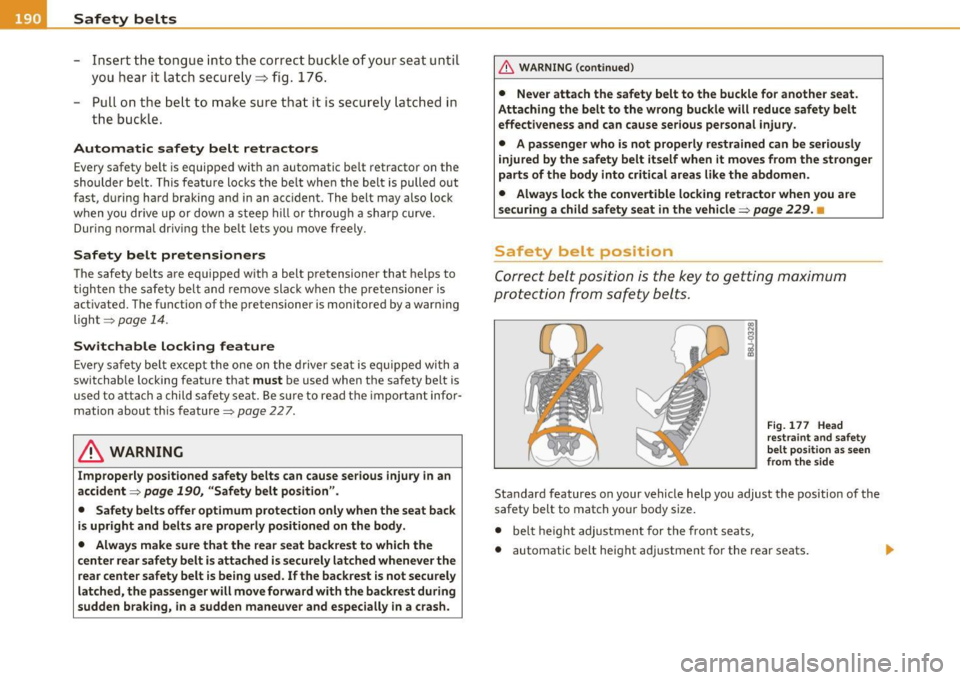
Fig. 17 7 Hea d
re stra int an d safe ty
belt posi tio n as se en
fro m the s ide
Standard features on your vehicle help you adjust the position of the
safety belt to match your body size.
• belt height adj ustment for the fro nt seats,
• automatic belt height adjustment for the rear seats .
Page 250 of 368

Intelligent technology
'-------------------------------------------------
It is in precisely these situations that you will notice energy manage
ment actively regulating the distribution of energy.
Vehicle stands for an extended period
If you do not drive your vehicle over a period of several days or weeks,
electrical components are gradually cut back or switched off. This
red uces energy consumption and maintains starting capability over a
longer period.
Take into consideration that when you unlock your vehicle, some
convenience functions, such as the remote key or power seat adjust
ment, may not be avai lab le. The convenience functions wi ll be ava il
able again when you turn on the ignition and start the engine.
With the engine turned off
If you listen to the radio, for example, with the engine turned off o r
use other MMI functions, the battery is being discharged.
If starting capability is jeopard ized due to energy consumption, the
following warning appears in the MMI display:
Please start engine, otherwise system will switch off in
3 minutes .
The warning indicates that the system will be turned off automati
cally after 3 minutes. If you wis h to continue using the funct ions, you
have to start the engine.
With the engine running
Although electrica l energy is generated when the vehicle is being
dr iven, the battery can become discharged. This happens mostly
when little energy is being generated and a great deal consumed and
the battery's state of charge is not optimal.
To bring the energy balance back into equilibrium, consumers which
req uire especially large amounts of energy are temporarily cut back
or switched off . H eating systems in particular require a great deal of
energy. If you notice, for example, that the heated seats* or the
heated rear window are not heating, they have been temporarily cut
back or switched off. These systems will be ava ilable again as soon as
the energy ba lance has been restored. You will also
notice that engine idle speed has been increased
slightly. This is normal and not a cause for concern. By increasing
engine idle speed the addit ional energy required is generated and the
battery is charged. •
Driver notification in the instrument
cluster display
If battery powe r drops into the range where it can limit the ability of
the engine to start, this is shown in the instrument cluster display
w ith the following driver message:
1 Low battery charge: battery will be charged while driving
This notification reminds you that the starting capability of the
eng ine may be limited. As soon as you start driving again, the battery
will be recharged and the notification will go out.
Driver notification appears and goes out again
If this driver notification appears after the ignition is turned on or
wh ile driving and it goes out again after a while, the battery has been
adequately recharged.
Driver notification appears and does not go out
again
If this dr iver not ificat ion appears after the ign it ion is turned on or
whi le driving and does not go out again, the battery's state of charge
is not in the optimal range. Starting ability is restricted . Have the
battery checked as soon as possible at a dealership.
Page 272 of 368
-~_C_ le_ a_n_ i_ n_ g=- a_ n_d___. p_ ro_ t_e _c_ t_ i_o _n ___________________________________________ _
in. WARNING
Be aware: The engine compartment of any motor vehicle is a
potentially hazardous area.
• Before working in the engine compartment, be sure to read the information =>
page 269.
• Before reaching into the front plenum panel, always remove
the ignition key. Otherwise, the windshield wiper system could
unintentionally be switched on, possibly causing personal injury
from the moving wiper linkage.
• Never reach into the area around or touch the radiator fan. The
auxiliary fan is temperature controlled and can switch on suddenly
- even when the ignition is off.
• Do not wash, wax or dry the engine with the engine running.
Moving or hot parts could injure you.
• Do not clean the underside of the chassis, fenders, wheel
covers, or other hard to reach parts without protecting your hands
and arms. You may cut yourself on sharp-edged metal parts.
• Always read and heed all WARNINGS and other information
=:> page 258. •